

What is the Moth–Flame Optimization Algorithm?
The Moth–Flame Optimization Algorithm (MFO) is a nature-inspired metaheuristic optimization technique that simulates the navigation behavior of moths flying around artificial lights. In nature, moths maintain a fixed angle with respect to moonlight to travel long distances in straight lines. However, when moths encounter artificial light sources, this strategy results in spiral trajectories, causing them to converge toward the light source. In computational terms, moths represent candidate solutions, and flames represent the best solutions found so far. The algorithm iteratively updates moth positions around flames using a logarithmic spiral function, allowing the population to explore the search space efficiently while gradually exploiting high-quality solutions. MFO is widely used to solve continuous, nonlinear, multimodal, and high-dimensional optimization problems, especially where classical gradient-based methods struggle due to local optima, discontinuities, or non-differentiable objective functions.
Introduction to the Moth–Flame Optimization
Optimization is a fundamental task in engineering, data science, artificial intelligence, and operations research. Traditional deterministic optimization methods often fail when dealing with complex, nonlinear, or high-dimensional problems. To overcome these limitations, researchers have turned to metaheuristic algorithms, which rely on stochastic processes and natural inspirations. The Moth–Flame Optimization Algorithm was introduced as part of a broader family of swarm intelligence and evolutionary computation techniques, alongside algorithms such as Genetic Algorithms, Particle Swarm Optimization, Ant Colony Optimization, and Grey Wolf Optimization.
What makes MFO distinctive is its explicit modeling of exploitation and exploration using the moth–flame mechanism. Instead of moving randomly or following velocity-based updates, moths move along spiral paths toward flames, ensuring:
- Smooth convergence
- Reduced risk of premature stagnation
- Balanced global and local search behavior
MFO has gained popularity due to its simple mathematical structure, few control parameters, and competitive performance on benchmark optimization problems.
Detailed Explanation of the Moth–Flame Optimization Algorithm
This section presents the mathematical formulation and algorithmic steps of MFO in detail.
Problem Definition
Consider an optimization problem defined as:

Subject to:

Where:
- d is the dimensionality of the problem
- xx is a candidate solution
- f(x) is the objective (fitness) function
Initialization of Moths
Let the number of moths be N. Each moth represents a candidate solution initialized randomly within the search bounds:

Where:
- Mi,j is the position of the i-th moth in the j-th dimension
- rand()∈[0,1]
Fitness Evaluation
The fitness of each moth is calculated using the objective function:
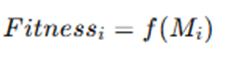
These fitness values determine the quality of each solution.
Flame Initialization
Flames are defined as the best solutions found so far. Initially:

- Flames are obtained by sorting moths based on fitness
- The best moths are copied as flames
Let:
Where F1 represents the best solution.
Adaptive Reduction of Flames
To balance exploration and exploitation, the number of flames decreases over iterations:

Where:
- t is the current iteration
- T is the maximum number of iterations
This mechanism allows diverse exploration in early stages and focused exploitation near convergence.
Position Update Using Logarithmic Spiral
The core movement equation of MFO is:

Where:

(distance between moth and flame)
- b is a constant defining spiral tightness (commonly b=1)
- l∈[−1,1] is a random number
- Fj is the corresponding flame
This spiral movement ensures smooth convergence while maintaining randomness.
Boundary Handling
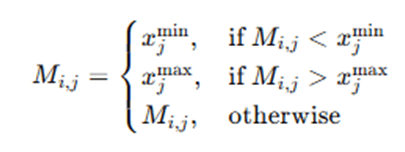
After updating positions, moths that exceed boundaries are corrected:
Termination Criteria
The algorithm stops when:
- Maximum number of iterations is reached, or
- Convergence criteria are satisfied
The best flame is reported as the optimal solution.
The Moth–Flame Optimization Algorithm begins by randomly initializing a population of moths within the defined search space. Each moth corresponds to a potential solution of the optimization problem. Once initialized, the fitness of each moth is evaluated using the objective function, which determines how good each solution is relative to the problem goal. After fitness evaluation, moths are sorted, and the best-performing moths are designated as flames. Flames act as reference points that guide the movement of moths. Unlike many optimization algorithms where agents follow a global best or velocity vector, moths in MFO move toward flames using a logarithmic spiral path, mimicking real moth navigation behavior. As iterations progress, the number of flames is gradually reduced. In the early stages, many flames exist, encouraging exploration across the search space. In later stages, fewer flames remain, forcing moths to concentrate around the best solutions found so far. This adaptive mechanism helps prevent premature convergence while ensuring steady improvement.
At each iteration, moth positions are updated using the spiral equation, where the distance between a moth and its flame determines the radius of the spiral. Randomness in the spiral angle ensures diversity, while attraction to flames promotes convergence. Boundary constraints are enforced to maintain feasibility. The algorithm continues until termination, finally returning the best flame as the optimal or near-optimal solution.
Example: How the Moth–Flame Optimization Algorithm Works
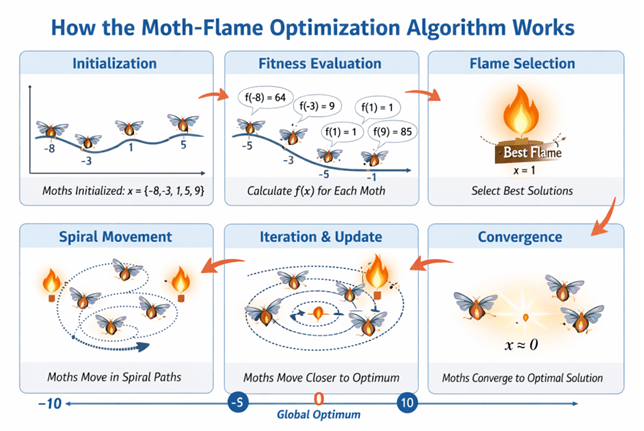
Problem Definition
To clearly understand the working of the Moth–Flame Optimization (MFO) Algorithm, consider a simple single-variable minimization problem defined as:

The objective is to find the value of x that minimizes the function. The global minimum of this function occurs at x=0, where the function value is zero.
Initialization of Moths
In the first step, a population of moths (candidate solutions) is initialized randomly within the search space. Assume that five moths are generated with the following positions:
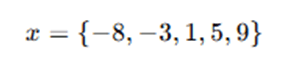
Each moth represents a possible solution to the optimization problem.
Fitness Evaluation
Next, the fitness of each moth is evaluated using the objective function f(x)=x2. The computed fitness values are:
- f(−8)=64
- f(−3)=9
- f(1)=1
- f(5)=25
- f(9)=81
Lower fitness values indicate better solutions since this is a minimization problem.
Flame Selection
After fitness evaluation, moths are sorted in ascending order based on their fitness values. The best-performing moths are selected as flames, which act as guiding reference points.
In this case:
- The moth at x=1 becomes the best flame, as it has the minimum fitness value.
- Other top-performing moths may also be considered flames depending on the iteration stage.
Spiral Movement Toward Flames
Each moth updates its position by moving toward its assigned flame using a logarithmic spiral function. Instead of moving in a straight line, moths follow spiral trajectories around the flame, which introduces both exploration and exploitation.
This spiral motion allows moths that are far from the optimum to explore broadly, while moths closer to the flame refine their positions more precisely.
Iterative Position Update
As iterations continue:
- The number of flames gradually decreases
- Moths increasingly focus on the best solutions
- The spiral paths become tighter
With every iteration, moth positions move closer to the global optimum at:
x=0
Convergence Behavior
After several iterations, the moths cluster near the optimal solution. Their positions converge toward values very close to zero, and the algorithm stabilizes.
This convergence occurs without using gradient information, demonstrating the strength of MFO in handling optimization problems where derivatives may be unavailable or unreliable.
Key Insight from the Example
This example clearly illustrates how the Moth–Flame Optimization Algorithm:
- Starts with randomly distributed solutions
- Uses fitness-based flame selection
- Applies spiral motion to guide search agents
- Gradually converges toward the global optimum
The example highlights MFO’s effectiveness in guiding solutions toward optimality using biologically inspired movement rather than traditional gradient-based techniques.
Advantages and Disadvantages of the Moth–Flame Optimization Algorithm
Advantages
- Simple Mathematical Formulation : The Moth–Flame Optimization Algorithm is based on a clear and intuitive mathematical model inspired by the natural navigation behavior of moths. Its core mechanism relies on logarithmic spiral equations, making the algorithm easy to understand, implement, and adapt for different optimization problems.
- Few Control Parameters: MFO requires only a limited number of parameters, such as population size and maximum iterations. The absence of complex tuning parameters reduces implementation complexity and makes the algorithm more user-friendly compared to many other metaheuristic approaches.
- Strong Balance Between Exploration and Exploitation: One of the major strengths of MFO is its ability to balance global exploration and local exploitation. The adaptive reduction in the number of flames allows broad search in early iterations while focusing on promising regions as the algorithm progresses.
- Effective for Nonlinear and Multimodal Problems: MFO performs particularly well on nonlinear and multimodal optimization problems where multiple local optima exist. The spiral movement mechanism helps moths escape local minima and improves the likelihood of locating near-global optimal solutions.
- Suitable for High-Dimensional Optimization: Due to its population-based structure and efficient search dynamics, the Moth–Flame Optimization Algorithm is capable of handling high-dimensional optimization problems commonly found in engineering design, machine learning, and scientific computing.
Disadvantages
- Slower Convergence for Some Unimodal Problems: For simple unimodal optimization problems, MFO may converge more slowly than gradient-based or deterministic optimization methods, as it relies on stochastic movements rather than direct gradient information.
- Performance Depends on Population Size: The effectiveness of MFO is sensitive to the number of moths used. A small population may lead to poor exploration, while a large population increases computational cost without guaranteeing proportional performance improvement.
- Risk of Stagnation if Diversity Is Lost: If moth positions become too similar during iterations, the algorithm may suffer from stagnation and reduced search diversity. This can limit its ability to explore new regions of the solution space.
- Computationally Expensive for Very Large Populations: For large-scale problems requiring a high number of moths and iterations, MFO can become computationally expensive, especially when evaluating complex objective functions.
Applications of the Moth–Flame Optimization Algorithm
- Engineering Design Optimization: The Moth–Flame Optimization Algorithm is widely used in engineering design problems that involve complex constraints and nonlinear objective functions. It is applied to optimize structural parameters, mechanical components, and electrical system designs, where traditional optimization methods often struggle due to multiple local optima and high-dimensional search spaces.
- Feature Selection in Machine Learning: In machine learning, MFO is employed for feature selection to identify the most relevant features from large datasets. By minimizing redundancy and maximizing classification or prediction accuracy, MFO helps improve model performance while reducing computational complexity.
- Neural Network Training: MFO is effectively used to optimize neural network parameters such as weights, biases, and learning rates. Its gradient-free search capability makes it suitable for training neural networks where error surfaces are highly nonlinear and contain many local minima.
- Image Segmentation and Processing: In image processing applications, the Moth–Flame Optimization Algorithm is applied to tasks such as image segmentation, edge detection, thresholding, and feature extraction. Its strong exploration ability helps in accurately identifying optimal segmentation boundaries and processing parameters.
- Power System Optimization: MFO has been applied extensively in power system engineering for solving problems such as economic load dispatch, optimal power flow, unit commitment, and voltage control. Its robustness and flexibility enable effective handling of complex constraints and dynamic system behavior.
- Scheduling and Resource Allocation: The algorithm is used in scheduling and resource allocation problems, including job scheduling, cloud computing resource management, and task allocation. MFO efficiently balances competing objectives such as minimizing completion time, cost, or energy consumption.
- Control System Parameter Tuning: MFO is utilized to tune control system parameters, such as PID controller gains, to enhance system stability and performance. Its ability to search globally makes it suitable for optimizing control parameters in nonlinear and time-varying systems.
- Internet of Things (IoT) Optimization Problems: In IoT environments, MFO supports optimization tasks such as sensor placement, energy-efficient routing, data aggregation, and network lifetime maximization. The algorithm’s scalability and adaptability make it well-suited for large, distributed IoT systems.
Conclusion
The Moth–Flame Optimization (MFO) Algorithm stands out as a powerful, flexible, and intuitively designed metaheuristic inspired by the natural navigation behavior of moths around light sources. By modeling candidate solutions as moths and elite solutions as flames, the algorithm introduces a unique spiral-based search mechanism that enables smooth and controlled movement toward optimal regions of the search space. One of the key strengths of MFO lies in its adaptive balance between exploration and exploitation. In the early stages, multiple flames encourage wide exploration, allowing the algorithm to investigate diverse regions and reduce the likelihood of getting trapped in poor local optima. As the algorithm progresses, the gradual reduction in the number of flames promotes focused exploitation, ensuring convergence toward high-quality solutions.MFO’s simple mathematical structure and limited number of control parameters make it easy to implement and suitable for a wide range of optimization problems. It has demonstrated competitive performance in solving nonlinear, multimodal, and high-dimensional problems across engineering, machine learning, image processing, power systems, and IoT applications. However, like most metaheuristic algorithms, MFO is not without limitations. Its convergence speed may be slower for simple unimodal problems, and performance can be sensitive to population size and parameter settings. Nevertheless, these challenges can be effectively addressed through proper parameter tuning, hybridization with other algorithms, or problem-specific adaptations. Overall, the Moth–Flame Optimization Algorithm is a valuable and versatile optimization tool, particularly well-suited for complex real-world problems where traditional optimization techniques fail or become inefficient.
Frequently Asked Questions (FAQs)
Is Moth–Flame Optimization suitable for discrete problems?
MFO is primarily designed for continuous optimization problems. However, it can be adapted for discrete or combinatorial problems using suitable encoding schemes, discretization techniques, or mapping strategies that convert continuous positions into discrete solutions.
How does MFO avoid local optima?
MFO avoids premature convergence through its logarithmic spiral movement and the presence of multiple flames. These mechanisms encourage continuous exploration of the search space while still guiding solutions toward promising regions, reducing the risk of being trapped in local optima.
What parameters control MFO performance?
The main parameters influencing MFO performance include:
- Population size (number of moths)
- Maximum number of iterations
- Spiral constant b, which controls the shape and tightness of the spiral trajectory
Proper tuning of these parameters is essential for achieving optimal performance.
How does MFO compare with PSO or GA?
Compared to Particle Swarm Optimization (PSO) and Genetic Algorithms (GA), MFO typically requires fewer control parameters and offers smoother convergence behavior. However, its effectiveness depends on the nature of the optimization problem, and no single algorithm is universally superior for all cases.
Can MFO be hybridized with other algorithms?
Yes, MFO can be effectively hybridized with other optimization techniques such as PSO, GA, differential evolution, or local search methods. Hybrid MFO approaches often improve convergence speed, solution accuracy, and robustness for complex optimization problems.