
ANN Algorithm
A computational model called an artificial neural network (ANN) is modeled after the composition and operations of the human brain. It is a crucial part of deep learning methods and a subset of machine learning. ANNs may accomplish tasks like classification, regression, grouping, and decision-making because they are made up of layers of interconnected nodes, or neurons, that process and learn patterns from input. How ANN Works?
- The network receives input data.
- The input is run through activation functions after being multiplied by weights.
- The last layer is where the output is produced.
- After calculating the mistake, backpropagation modifies weights to reduce it.
- Until the model achieves the ideal level of accuracy, the procedure is repeated.
Real-World Examples of ANN:
- Image Recognition: Facial recognition in smartphones.
- Natural Language Processing: Chatbots and virtual assistants.
- Medical Diagnosis: Detecting diseases using medical imaging.
- Finance: Predicting stock market trends.
Types of Neural Networks
- Feedforward Neural Network (FNN): Basic ANN where data flows in one direction.
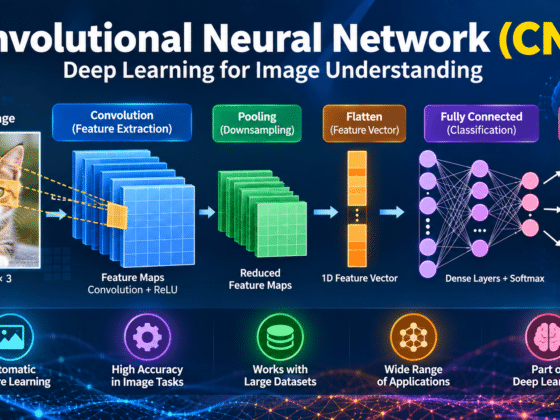
- Convolutional Neural Network (CNN): Used for image processing and computer vision.
- Recurrent Neural Network (RNN): Used for sequential data like speech and text.
- Deep Neural Networks (DNN): Multiple hidden layers for deep learning tasks.
Introduction to ANN Algorithm
A class of machine learning techniques known as artificial neural networks (ANN) is based on the architecture and operations of the human brain. An essential part of deep learning and artificial intelligence (AI), artificial neural networks (ANNs) allow computers to recognize patterns in data and make decisions without explicit programming.
A.Inspiration from Biological Neurons
ANN simulates how the human brain functions, where:
- Biological neurons that transfer signals make up the brain.
- Artificial neurons, sometimes referred to as perceptrons, are what make up an ANN.
- After processing input, each neuron transmits its output to the subsequent layer of neurons.
B.Structure of an Artificial Neural Network
A typical ANN consists of three main layers:
- Input Layer:
- Receives raw data (e.g., images, text, numbers).
- Each neuron in this layer represents a feature of the input data.
- Hidden Layers:
- Intermediate layers that transform inputs into meaningful patterns.
- The depth (number of hidden layers) determines the complexity of the ANN.
- More hidden layers = Deep Neural Networks (DNNs).
- Output Layer:
- Provides the final result, such as classification (e.g., dog or cat in image recognition).
C.Working Mechanism of ANN
- Forward Propagation:
- Input data is passed through layers, and the output is generated.
- Each neuron applies a weight to the input and processes it using an activation function.
- Error Calculation (Loss Function):
- The difference between predicted and actual output is calculated.
- Common loss functions:
- Mean Squared Error (MSE) for regression problems.
- Cross-Entropy Loss for classification problems.
- Backpropagation & Weight Adjustment:
- The error is propagated backward to update neuron weights.
- Uses optimization techniques like Gradient Descent to minimize the error.
- Training & Optimization:
- The process is repeated over multiple epochs until the ANN learns optimal patterns.
- Techniques like dropout and batch normalization improve performance.
A key component of contemporary AI, artificial neural networks propel developments in fields such as image recognition, natural language processing, and medical diagnosis. ANN is becoming more effective and available for a range of real-world applications with ongoing research and technology advancements.
Detailed : Artificial Neural Networks (ANN) Algorithm
Artificial Neural Networks (ANN) interpret data, identify patterns, and generate predictions by using interconnected nodes (neurons) stacked in layers. A thorough explanation of ANN operation, including the required formulas, is provided below.
Step 1: Data Preprocessing
Before feeding data into the ANN, it must be cleaned and transformed to improve performance.
Key Preprocessing Steps:
- Normalization & Standardization: Scaling input values to a uniform range (e.g., [0,1] or [-1,1])
- Feature Selection: Selecting relevant features to reduce dimensionality
- Handling Missing Values: Filling or removing missing data
- Splitting Data: Dividing data into training, validation, and test sets
Step 2: Initializing Weights and Biases
Each neuron has an associated weight (W) and bias (b), which determine how inputs influence outputs. Weights are randomly initialized using techniques like:
- Xavier Initialization
- He Initialization
where n is the number of input features.
Step 3: Forward Propagation
The input data is passed through the network layer by layer. Each neuron performs the following computation:
Neuron Activation Formula:

where:
- Z = weighted sum of inputs
- X = input data
- W = weight matrix
- b = bias
- f(Z) = activation function
Common Activation Functions:
- Sigmoid Function (Used for binary classification)

- ReLU (Rectified Linear Unit) (Used in hidden layers)

- Softmax Function (Used for multi-class classification)

The output from each layer is used as the input for the next layer, until the final output layer.
Step 4: Loss Calculation (Error Computation)
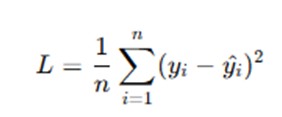
The loss function quantifies the difference between the predicted and actual values.
Common Loss Functions:
- Mean Squared Error (MSE) (for regression problems)
- Binary Cross-Entropy (for binary classification)

- Categorical Cross-Entropy (for multi-class classification)

where:
- y = actual output
- y^ = predicted output
Step 5: Backpropagation Algorithm (Gradient Descent Optimization)
Backpropagation adjusts weights and biases to minimize the error using gradient descent.
Weight Update Formula (Gradient Descent):

where:
- η = learning rate (controls step size for weight updates)
-
= derivative of loss with respect to weight
Steps in Backpropagation:
- Compute gradient of loss function with respect to weights.
- Apply chain rule to propagate errors backward.
- Adjust weights and biases to reduce error.
- Repeat until convergence (error is minimized).
Optimization Techniques:
- Stochastic Gradient Descent (SGD): Updates weights after each sample.
- Adam Optimizer: Adaptive learning rate, combines momentum and RMSProp.
Step 6: Model Training & Optimization
Key Hyperparameters:
- Learning Rate (η): Determines how much weights are updated.
- Number of Epochs: Number of times the model sees the data.
- Batch Size: Number of samples processed before updating weights.
Regularization Techniques (To Prevent Overfitting):
- L1/L2 Regularization: Adds penalty term to loss function.
- Dropout: Randomly removes neurons during training.
- Batch Normalization: Normalizes activations for stable training.
Step 7: Model Evaluation
After training, the model is evaluated on unseen data using performance metrics.
Common Evaluation Metrics:
- Classification: Accuracy, Precision, Recall, F1-Score
- Regression: RMSE (Root Mean Squared Error), R² Score
Confusion Matrix Example (for classification):
| Actual \ Predicted | Positive | Negative |
| Positive | TP | FN |
| Negative | FP | TN |
where:
- TP = True Positive
- FN = False Negative
- FP = False Positive
- TN = True Negative
Step 8: Deployment of ANN Model
Once trained and optimized, the model can be deployed for real-world applications.
- On Cloud Services (AWS, Google Cloud, Azure)
- On Mobile/Embedded Devices (TensorFlow Lite, ONNX)
Summary of ANN Workflow
1 Input Data → 2 Forward Propagation → 3 Loss Calculation → 4 Backpropagation → 5 Weight Update → 6 Training → 7 Evaluation → 8 Deployment
Advantages and Limitations of ANN Algorithm
Artificial Neural Networks (ANN) have transformed artificial intelligence and machine learning by empowering systems to identify patterns, make judgments, and resolve challenging issues. They do, however, have benefits and drawbacks.
Advantages of ANN
- Ability to Learn Complex Patterns : Complex and non-linear correlations between input and output data can be learned by ANN. It does not necessitate the definition of explicit rules, in contrast to conventional algorithms.
- Adaptability and Self-Learning: As it gains knowledge from fresh data, ANN gets better over time. It uses gradient descent and backpropagation to automatically modify weights.
- High Accuracy for Large Datasets: ability to do tasks like speech processing, picture identification, and medical diagnosis with a high degree of precision. performs admirably in situations where rule-based programming is ineffective.
- Handles Unstructured Data: capable to handle information from a variety of sources, including audio, video, text, and images. Ideal for uses such as computer vision and natural language processing (NLP).
- Parallel Processing Capability: For quicker training, ANN calculations can be split among cloud-based systems and GPUs. allows for real-time processing in financial trading, robotics, and driverless cars.
- Fault Tolerance and Robustness: Because of distributed learning, an ANN can still work well even if part of its neurons fail. beneficial for vital applications such as security systems and medical imaging.
- Feature Extraction and Representation Learning: Important features can be automatically learned from raw data using ANN, in contrast to typical ML models that need manual feature engineering. Deep learning models, such as CNNs and RNNs, are very good at recognizing patterns.
- Scalability and Versatility: ANNs may be learned on distributed computing and scaled to big datasets. performs well in a variety of fields, including cybersecurity, e-commerce, healthcare, and banking.
Limitations of ANN
- Requires Large Amounts of Data: For ANNs to generalize effectively, large datasets are required. Overfitting, or memorizing training data rather than general patterns, can result from small datasets.
- Computationally Expensive: Deep neural network training demands a lot of processing power (GPUs, TPUs). Billions of parameters require a lot of energy and processing time.
- Difficult to Interpret (“Black Box” Nature): Because ANN is opaque, it is challenging to comprehend the decision-making process. In sectors where decisions need to be justified, such as healthcare and finance, explainability is a crucial concern.
- Prone to Overfitting : Poor generalization on unseen data might result from an ANN that becomes overly sensitive to training data. need methods to reduce overfitting, such as data augmentation, regularization (L1/L2), and dropout.
- Requires Careful Hyperparameter Tuning: The learning rate, number of layers, activation functions, and optimizers all have a significant impact on the model’s performance. It takes a lot of trial-and-error and experimenting to find the ideal architecture.
- Slow Training Time: It may take hours, days, or even weeks to train massive neural networks. Training time is further increased via hyperparameter tuning and optimization (such as grid search or Bayesian optimization).
| Aspect | Advantages | Limitations |
| Learning Capability | Learns complex patterns | Needs large datasets |
| Adaptability | Self-learning and adaptive | Requires careful tuning |
| Data Handling | Works with unstructured data | Sensitive to noise & small data |
| Computational Power | Parallel processing on GPUs | High energy consumption |
| Generalization | Can generalize to unseen data | Prone to overfitting |
| Interpretability | Automatic feature extraction | Black-box nature |
| Scalability | Scalable across domains | Requires powerful hardware |
ANN is a potent algorithm that has revolutionized deep learning and artificial intelligence applications. To get the best results, though, it needs a lot of processing power, big datasets, and careful tuning. Despite the difficulties posed by its black-box nature and high training cost, interpretability and efficiency are being improved by ongoing developments in AI research.
Applications of ANN Algorithm
Artificial Neural Networks (ANNs) have revolutionized various industries by enabling machines to process vast amounts of data, recognize complex patterns, and make intelligent decisions. Their applications span across multiple domains, enhancing automation, security, healthcare, finance, and many more.
- In image processing and computer vision, ANNs play a crucial role in facial recognition for authentication, object detection for autonomous vehicles and security systems, and medical image analysis for detecting diseases such as cancer and fractures in X-rays and MRIs. Optical Character Recognition (OCR) further leverages ANN for converting scanned documents into editable text. Models like Convolutional Neural Networks (CNNs), including ResNet, VGG, and YOLO, are widely employed for these tasks.
- In the field of Natural Language Processing (NLP) and chatbots, ANN-based models enable speech recognition in virtual assistants like Alexa, Google Assistant, and Siri. They power machine translation tools such as Google Translate, sentiment analysis for social media monitoring and stock market predictions, and AI-driven chatbots for customer support. Transformers like GPT and BERT enhance search engines and chatbot responses by understanding human language more effectively.
- The healthcare and medical domain greatly benefits from ANN in disease prediction, diagnosis, and personalized medicine. AI models analyze Electronic Health Records (EHR) to identify patient risk factors and assist in robotic surgeries for improved precision. Systems like IBM Watson Health and DeepMind’s AI outperform human doctors in diagnosing diseases such as cancer and eye disorders.
- In financial services and stock market prediction, ANN is instrumental in detecting fraudulent transactions, predicting market trends, assessing loan risks, and optimizing algorithmic trading. Financial institutions, including JPMorgan Chase, use AI-driven fraud detection, while hedge funds utilize Long Short-Term Memory (LSTM) networks for stock price forecasting.
- ANNs are also integral to autonomous vehicles and robotics, where they enhance self-driving car functionalities like object detection, lane tracking, and traffic prediction. AI-powered drones use ANN for navigation and obstacle avoidance, while industrial automation relies on AI-powered robots for performing complex manufacturing tasks. Companies such as Tesla and Waymo employ deep learning models for autonomous driving, whereas Boston Dynamics utilizes ANN for real-time robotic navigation.
- In cybersecurity and fraud detection, ANNs bolster intrusion detection systems, detect malware and phishing attacks, and power biometric authentication methods like fingerprint and iris recognition. AI-driven anomaly detection also strengthens data encryption and security, with solutions like Google’s reCAPTCHA distinguishing between humans and bots.
- The e-commerce industry extensively leverages ANN for personalized product recommendations, dynamic pricing adjustments, AI chatbots for customer service, and detecting fake reviews. Platforms like Amazon, Netflix, and YouTube implement AI-powered recommendation engines, while Google Ads utilizes ANN for optimized ad targeting.
- Another crucial application of ANN lies in weather forecasting and disaster prediction, where AI predicts temperature fluctuations, rainfall, hurricanes, and seismic activity for earthquake and tsunami warnings. NASA and IBM’s Deep Thunder AI use ANN to model climate changes and space weather patterns.
- In smart agriculture and crop monitoring, ANN assists in identifying plant diseases, optimizing precision farming techniques, and monitoring soil quality using AI-powered drones. Companies like John Deere incorporate AI-driven tractors for automated farming, while TensorFlow AI aids in crop health analysis through satellite imagery.
- Lastly, ANN fuels gaming and AI-powered creativity, enhancing non-player character (NPC) behavior, AI-generated art, and music production. Virtual reality (VR) applications utilize ANN for creating immersive environments, while models like DeepMind’s AlphaGo and AI-generated art tools such as DALL·E and Midjourney showcase the creative potential of deep learning.
- Looking ahead, the future of ANN will be shaped by advancements in Quantum Computing, Edge AI, and 6G networks, leading to breakthroughs in brain-computer interfaces (BCI), AI-powered drug discovery, and Artificial General Intelligence (AGI) for human-like reasoning. These innovations will further expand the scope of ANN applications, making them indispensable across industries.
| Industry | Application Examples |
| Computer Vision | Face recognition, medical imaging, object detection |
| NLP & Chatbots | Voice assistants, machine translation, sentiment analysis |
| Healthcare | Disease diagnosis, robotic surgery, EHR analysis |
| Finance | Fraud detection, stock prediction, algorithmic trading |
| Autonomous Systems | Self-driving cars, industrial robotics, drones |
| Cybersecurity | Malware detection, biometric authentication, data encryption |
| E-Commerce | Personalized recommendations, dynamic pricing, AI chatbots |
| Weather & Disaster | Climate modeling, earthquake and tsunami prediction |
| Agriculture | Smart farming, crop disease detection, AI-powered irrigation |
| Gaming & Creativity | AI-generated art, NPC behavior, deepfake technology |
Conclusion
Machines can now learn from data, identify patterns, and make wise judgments thanks to Artificial Neural Networks (ANN), which have revolutionized the field of artificial intelligence. A powerful tool for resolving complicated issues in a variety of fields, artificial neural networks (ANNs) are inspired by the human brain and process information through layers of interconnected neurons. ANN is a sophisticated and adaptable technology that finds extensive application in a variety of industries, including cybersecurity, computer vision, natural language processing, healthcare, and finance. Self-learning, which enables it to get better with training, adjust to new data, and increase prediction accuracy over time, is one of its main advantages.Advanced ANN architectures including Convolutional Neural Networks (CNNs), Recurrent Neural Networks (RNNs), and Transformers have propelled the deep learning revolution, paving the way for ground-breaking technologies like facial recognition, self-driving cars, and AI-powered medical diagnosis. But there are also a lot of difficulties with ANN. To get the best results, it needs a lot of processing power, big datasets, and careful tuning. Furthermore, its “black-box” nature poses questions regarding interpretability and the moral use of AI, especially in crucial fields like finance and healthcare.
Notwithstanding these obstacles, ANN appears to have a bright future. With ongoing improvements in AI algorithms and hardware, including GPUs and TPUs, ANN will get faster, more effective, and easier to understand. Artificial general intelligence (AGI), robotics, and quantum AI will all advance as a result of these advancements. Artificial neural networks (ANNs) have already changed sectors and will continue to influence AI in the future. Neural networks will grow in strength, interpretability, and accessibility as AI research advances, opening up new avenues for advancement in science, technology, and society.
Frequently Asked Questions (FAQs)
A. What is an Artificial Neural Network (ANN)?
Answer: An Artificial Neural Network (ANN) is a machine learning algorithm inspired by the structure and functioning of the human brain. It consists of interconnected neurons (nodes) arranged in layers that process data and make decisions. ANN is widely used in image recognition, natural language processing, and predictive analytics.
B. What are the key components of an ANN?
Answer: The main components of an ANN include:
- Neurons (Nodes): Processing units that receive input, apply weights, and pass output.
- Layers:
- Input Layer: Receives raw data.
- Hidden Layers: Processes data and extracts patterns.
- Output Layer: Produces the final result.
- Weights & Biases: Adjust values to optimize learning.
- Activation Function: Decides neuron activation (e.g., ReLU, Sigmoid, Softmax).
- Loss Function: Measures the difference between predicted and actual outputs.
- Optimizer: Adjusts weights to minimize the error (e.g., Gradient Descent, Adam).
C. What are the different types of Artificial Neural Networks?
Answer: Some common types of ANN include:
- Feedforward Neural Networks (FNN): Data flows in one direction, commonly used for simple tasks.
- Convolutional Neural Networks (CNN): Designed for image processing and computer vision.
- Recurrent Neural Networks (RNN): Used for sequential data like speech recognition and time series forecasting.
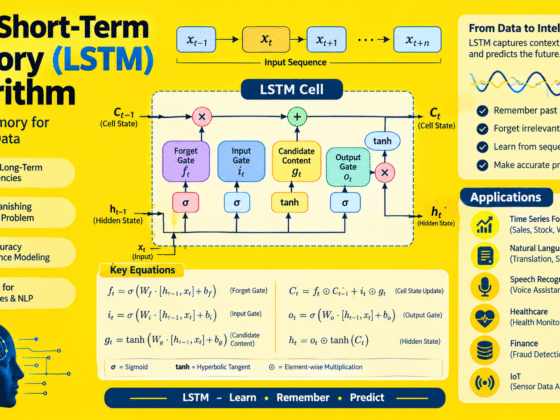
- Long Short-Term Memory (LSTM): A type of RNN specialized for long-term dependencies.
- Deep Neural Networks (DNN): Multiple hidden layers for complex learning tasks.
- Generative Adversarial Networks (GANs): Used for generating realistic images, videos, and deepfakes.
What are the advantages and disadvantages of ANN?
Answer:
Advantages:
- Learns complex patterns automatically.
- Works well with large datasets and unstructured data (images, text, audio).
- Adaptable to different domains like healthcare, finance, and robotics.
- High accuracy in tasks like image recognition and speech processing.
Disadvantages:
- Requires a large amount of training data.
- Computationally expensive and requires powerful hardware (GPUs/TPUs).
- Difficult to interpret (black-box nature).
- Prone to overfitting if not properly regularized.
E. How does ANN learn from data?
Answer: ANN learns through a process called Supervised Learning, which involves:
- Forward Propagation: Input data is passed through the layers to generate an output.
- Loss Calculation: The error between predicted and actual output is measured using a loss function.
- Backpropagation: The error is propagated backward to adjust weights using Gradient Descent.
- Weight Update: The weights are updated to minimize error and improve accuracy.
- Iteration: Steps 1-4 are repeated over multiple epochs until the model converges.
G. What is the difference between ANN and Deep Learning?
Answer:
- ANN (Artificial Neural Networks): Refers to all neural network-based models, including simple ones with one or two hidden layers.
- Deep Learning: A subset of ANN with multiple hidden layers (Deep Neural Networks), allowing for more complex feature extraction and learning.
Example: Deep Learning models like CNNs and RNNs are specialized versions of ANN used in tasks like image recognition and language modeling.
H. How is ANN used in real-world applications?
Answer: ANN is widely used in:
- Computer Vision: Facial recognition, object detection, medical imaging.
- Natural Language Processing (NLP): Chatbots, translation, speech recognition.
- Healthcare: Disease prediction, drug discovery, robotic surgery.
- Finance: Fraud detection, stock market prediction, credit risk assessment.
- Autonomous Vehicles: Self-driving cars, drones, robotics.
I. What are the main challenges in training an ANN?
Answer: Some common challenges include:
- Overfitting: The model memorizes training data but performs poorly on new data.
- Vanishing & Exploding Gradients: Deep networks struggle with backpropagation in early layers.
- Hyperparameter Tuning: Choosing the right learning rate, batch size, and activation functions requires experimentation.
- Computational Cost: Training deep networks requires high computational power (GPUs).
J. How can overfitting be prevented in ANN?
Answer: Techniques to prevent overfitting include:
- Dropout: Randomly disabling neurons during training.
- L1/L2 Regularization: Adds a penalty to large weights.
- Data Augmentation: Expanding the dataset by applying transformations (e.g., rotating images).
- Early Stopping: Stops training when validation loss stops decreasing.
K. What tools and frameworks are used for ANN implementation?
Answer: Popular deep learning frameworks include:
- TensorFlow (Google)
- PyTorch (Facebook)
- Keras (High-level API for TensorFlow)
- Scikit-learn (For simple ANN models)
- Theano, CNTK, MXNet (Older frameworks)