Because deep learning can learn from and make predictions based on large volumes of data, it has become a game-changing technology that has allowed for substantial breakthroughs in a variety of industries. The foundations of deep learning are examined in this article, along with its main ideas, essential elements, and several architecture styles. It explores the complexities of deep learning model training, going over key strategies for resolving issues including interpretability of the model, computing costs, and data needs. The paper also discusses deployment-related practical challenges as well as the moral implications of deep learning applications. The article seeks to provide readers a firm grasp of deep learning and its revolutionary effects on industry and technology by offering a thorough summary of these subjects.
Introduction
In recent years, deep learning has emerged as one of the most fascinating and significant fields within machine learning (ML) and artificial intelligence (AI). By utilizing extensive datasets and intricate neural network topologies, it allows robots to replicate human-like learning patterns. Deep learning is transforming industries all around the world, from enabling self-driving cars to powering voice assistants like Siri and Alexa.
In its most basic form, deep learning is a kind of machine learning that models intricate patterns in data using multi-layered neural networks. Deep learning automates this process by learning directly from the data, whereas typical machine learning algorithms need feature engineering and domain expertise to extract valuable information from raw data. This makes it especially useful for tasks like playing games, recognizing images, and processing natural language.
The fundamental ideas of deep learning will be covered in this essay, along with its definition, operation, and reasons for becoming such a potent AI tool. This guide will give you the fundamental knowledge you need to begin deep learning, regardless of whether you’re new to the area or want to learn more.
What Is Deep Learning?
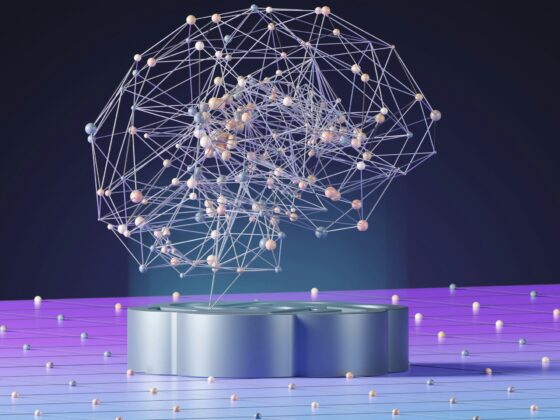
A subfield of machine learning called “deep learning” focuses on algorithms that are modeled after the composition and operation of neural networks found in the brain. Fundamentally, deep learning builds hierarchical models in which each layer of the model pulls more abstract elements from the input data, enabling machines to learn from vast volumes of data.
Define: Deep neural networks, which are made up of several layers of interconnected nodes (neurons), are what define deep learning. These networks are capable of automatically recognizing patterns and characteristics in unprocessed data, including text, audio, and images. Deep learning models learn the optimal features directly from the data, which is especially helpful for complicated tasks, in contrast to typical machine learning methods that rely on manual feature engineering.
Neural Networks: The Foundation of Deep Learning
Artificial neural networks (ANNs), which imitate the structure of the human brain, are at the core of deep learning. After processing inputs using mathematical operations, each neuron sends the results to other neurons in layers below. During training, the network “learns” by modifying the weights and biases connected to these neurons.
Difference between Machine Learning and Deep Learning
The primary distinction between traditional machine learning and deep learning lies in how they approach problem-solving:
- Machine Learning: Usually necessitates the human extraction of data attributes. Algorithms such as random forests, support vector machines, and decision trees are then fed these features.
- Deep Learning: This technique is ideal for applications like picture recognition, audio processing, and complicated data modeling because it automatically extracts patterns and features from data by running it through several layers of neurons.
Why Is It Called “Deep”?
The number of layers in the neural network is referred to as “deep” in deep learning. Deep learning models can have dozens, hundreds, or even thousands of layers, whereas standard neural networks may only have one or two layers (shallow networks). Different levels of abstraction are learned by each layer, with deeper layers capturing more intricate aspects.
Key Advantages of Deep Learning
- Automated Feature Extraction: The model learns to extract features from raw data, eliminating the need for human feature engineering.
- Scalability: As datasets expand, deep learning models can efficiently manage ever-increasing volumes of data.
- State-of-the-Art Performance: Deep learning models frequently outperform conventional machine learning techniques for applications like speech recognition, picture classification, and natural language processing.
Deep learning has become widely used in a variety of areas, including healthcare, banking, autonomous vehicles, and entertainment, because to its capacity to process large volumes of unstructured data with little operator involvement.
Key Components of Deep Learning
In order for neural networks to learn from data, modify their internal parameters, and provide predictions, deep learning depends on a number of crucial elements. Gaining an understanding of these essential components is essential to understanding deep learning models.
A. Neurons and Perceptrons
- Neuron: Based on the biological neuron found in the human brain, a neuron is the fundamental building block of a neural network. After processing input, it produces an output.
- Perceptron: Developed by Frank Rosenblatt in 1958, this is the most basic type of neuron. In order to generate an output, a perceptron takes several inputs, weights them, adds them up, and then runs the result through an activation function.
B. Layers in Neural Networks
Deep learning models are structured in layers that define how the input data is transformed into the final output:
- Input Layer: The initial layer that sends raw input data, like text or images, to the subsequent layer.
- Hidden Layers: The input data is processed by these intermediary layers. Each hidden layer in a deep learning network can extract ever more complicated features from the data.
- Output Layer: The last layer generates the output, which might be a forecast (like the stock price) or a classification label (like “cat” or “dog”).
C. Activation Functions
By adding non-linearity to the model, activation functions enable neural networks to recognize intricate patterns. Typical activation functions consist of:
- Sigmoid: Produces values in the range of 0 and 1. utilized in problems involving binary categorization.
- ReLU (Rectified Linear Unit): The most widely used hidden layer activation function. It is computationally efficient since it outputs zero for negative inputs and the input itself for positive values.
- Softmax: Converts raw output scores into probabilities, typically used in multi-class classification tasks.
D. Forward Propagation
The process by which input data moves from the input layer to the output layer within a neural network is known as forward propagation. The information is multiplied by weights, added together, and then run through an activation function at every neuron in the hidden and output layers. Predictions are produced by this procedure using the network’s current parameters.
F. Backpropagation and Gradient Descent
Deep learning models learn by adjusting the weights of neurons to minimize the error in predictions. This process involves:
- Backpropagation: Following a network prediction, backpropagation compares the expected and actual outputs to determine the error. Then, layer by layer, the error spreads backward through the network.
- Gradient Descent: The loss function, or the discrepancy between the expected and actual output, is minimized using this optimization technique. By determining the gradient (or slope) of the loss function, it modifies the network’s weights and shifts them in the direction that minimizes error.
G. Loss Function
The loss function quantifies the difference between the predicted output and the actual target values. It serves as the guide for optimizing the model. Some common loss functions include:
- Mean Squared Error (MSE): Used for regression tasks.
- Cross-Entropy Loss: Commonly used for classification tasks.
H. Weights and Biases
- Weights: Parameters that are learned during training. They determine the strength of the connection between neurons in different layers. Larger weights imply a stronger connection.
- Biases: Extra parameters are applied to neurons in order to change the activation function and increase the adaptability of the model.
I. Learning Rate
One important hyperparameter that regulates how much the weights are changed during training is the learning rate. While a lower learning rate may lead to slow convergence, a greater learning rate enables faster learning but may overshoot the ideal values.
J. Epochs and Batches
- Epoch: During the learning process, a single pass across the whole training dataset.
- Batch: The data is frequently divided into smaller groups known as batches during training. Each batch is processed by the model before the weights are updated. Using batches lowers memory utilization and stabilizes the learning process.
K. Dropout and Regularization
To prevent overfitting, deep learning models often use regularization techniques:
- Dropout: Randomly “drops out” a percentage of neurons during training to prevent the network from relying too heavily on specific neurons.
- L2 Regularization: Adds a penalty term to the loss function to constrain the size of the weights, encouraging the model to find simpler solutions.
The foundation for mastering deep learning is laid by comprehending these essential elements: neurons, layers, activation functions, forward and backpropagation, and optimization strategies. Together, these elements enable deep learning models to generate predictions, learn from data, and continuously become better through training.
Types of Deep Learning Architectures
Numerous neural network topologies, each tailored for particular tasks and data kinds, are included in the field of deep learning. Because of their differences in input processing and data learning, these architectures can be used for a variety of tasks, including time-series analysis, picture recognition, and natural language processing. Some of the most well-known varieties of deep learning architectures are as follows:
A. Feedforward Neural Networks (FNNs)
- A Multi-Layer Perceptron (MLP) is the most basic type of neural network. Information flows in a single path in FNNs, from the input layer to the output layer via hidden layers, without going back.
- Structure: An input layer, one or more hidden layers, and an output layer make up this system.
- Applications: Used for simple regression and classification tasks, including classifying emails as spam or not, or forecasting market values.
B. Convolutional Neural Networks (CNNs)
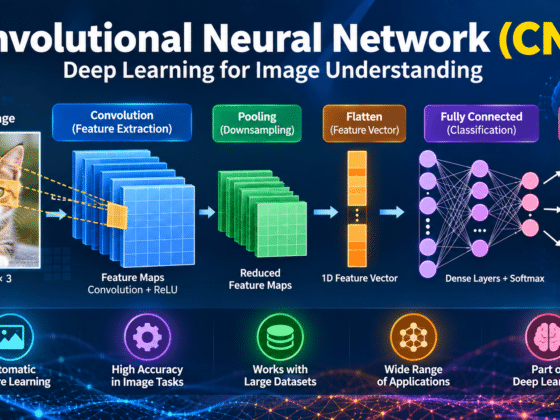
- By automatically capturing spatial hierarchies of features, CNNs are specialized for processing structured grid data, especially images.
- Structure: They are made up of several layers, such as fully connected layers, pooling layers for downsampling, and convolutional layers that apply filters to the input.
- Key Feature: By identifying local patterns in tiny areas of an image, convolutional layers maintain the spatial relationships between pixels.
- Applications: Widely used in facial recognition, video analysis, medical image diagnostics, and image categorization (e.g., detecting items in images).
C. Recurrent Neural Networks (RNNs)
- By using network loops to retain recollection of prior inputs, RNNs are made to handle sequential data, including time series and plain language.
- Structure: RNNs include links that loop back, allowing information to remain, in contrast to feedforward networks. In addition to the current data point, each neuron receives information from its own prior output.
- Key Variants:
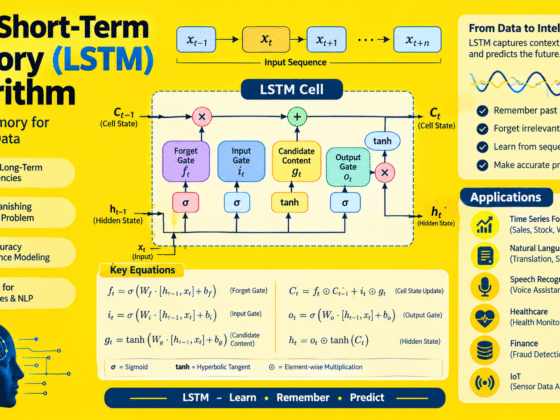
- Long Short-Term Memory (LSTM): A special kind of RNN that overcomes the vanishing gradient problem by maintaining long-term memory.
- Gated Recurrent Units (GRU): A simplified version of LSTM, requiring fewer parameters and offering similar performance.
- Applications: Used in tasks like language translation, speech recognition, time-series prediction, and sentiment analysis.
D. Autoencoders
- Autoencoders are unsupervised learning models that compress data into representations with fewer dimensions and then use those representations to recreate the original data.
- Structure: They are divided into two primary sections:
- Encoder: Condenses the input data into a lower-dimensional, compressed format.
- Decoder: recovers the compressed input data and reconstructs it.
- Applications: frequently employed in anomaly detection, data denoising, dimensionality reduction, and synthetic data generation.
E. Generative Adversarial Networks (GANs)
- Two neural networks make up GANs: the Generator, which creates fresh data, and the Discriminator, which analyzes the data. While the Discriminator seeks to discern between created and genuine data, the Generator attempts to produce data that closely resembles the real data.
- Structure:
- Generator: Produces new, synthetic data (e.g., images) from random noise.
- Discriminator: Evaluates the data and classifies it as real (from the dataset) or fake (generated).
- Applications: Used in generating realistic images, video, music, and even deepfake technology. GANs are also applied in creative fields like art and game design.
F. Recursive Neural Networks
- Recursive neural networks perform well with hierarchical data because they apply the same set of weights recursively to structured inputs like trees.
- Structure: These networks parse phrases in natural language processing (NLP) by using recursion to process input that comes in hierarchical structures.
- Uses: Frequently applied to tasks such as machine translation, semantic analysis, and sentence parsing.
G. Deep Belief Networks (DBNs)
- Multiple layers of hidden units make up DBNs, which are probabilistic generative models. Layer after layer, they are pre-trained, and supervised learning is used to refine them.
- Structure: Usually, they are made up of several stacked Restricted Boltzmann Machines (RBMs).
- Uses: For problems involving unsupervised learning, image recognition, and feature extraction.
H. Transformer Networks
- Transformers are a deep learning architecture primarily used for processing sequences of data, particularly in natural language processing tasks. They rely on an attention mechanism that allows them to focus on different parts of a sequence more efficiently than RNNs or LSTMs.
- Structure: They have an encoder-decoder structure, but they can be parallelized because they don’t require sequential processing like RNNs do.
- Applications: Often utilized in natural language processing (NLP) activities such as text generation, summarization, and machine translation (e.g., models like GPT, BERT, and T5).
Every deep learning architecture is made to manage particular kinds of jobs and data. Knowing these architectures enables you to select the best model for the task at hand, from CNNs that excel at image-related tasks to RNNs that grasp sequential data. Deep learning keeps developing as a result of continuous breakthroughs like GANs and Transformers that push the envelope and provide answers to progressively challenging issues in a variety of domains.
Applications of Deep Learning
By offering creative answers to challenging issues that were previously unresolvable with conventional machine learning techniques, deep learning has completely transformed a variety of industries. Its widespread use has changed how tasks are carried out and sped up technological breakthroughs due to its capacity to process vast volumes of unstructured data. The following are a few of the most significant uses of deep learning:
A. Computer Vision
Deep learning has significantly improved the accuracy and capabilities of computer vision systems, allowing machines to “see” and interpret visual information.
- Image Classification: Convolutional Neural Networks (CNNs), a type of deep learning model, are used to classify objects in photographs, making it possible to do tasks like identifying products, automobiles, or animals.
- Object Detection: Often utilized in surveillance systems and autonomous driving (identifying cars and pedestrians), algorithms are able to identify and locate several items inside a single image or video frame.
- Facial Recognition: Security systems, social media, and smartphone unlocking can all benefit from the real-time facial recognition capabilities of sophisticated deep learning models.
- Medical Imaging: Deep learning helps healthcare professionals analyze medical imaging, such as CT, MRI, and X-rays, to find anomalies like tumors, fractures, or heart issues.
B. Natural Language Processing (NLP)
Natural Language Processing has been greatly enhanced by deep learning models, allowing computers to understand, generate, and interact with human language.
- Language Translation: Deep learning is used by transformer models, such as Google Translate, to translate text across languages automatically and accurately.
- Sentiment Analysis: Text can be analyzed by deep learning models to identify the sentiment (positive, negative, or neutral) underlying articles, social media posts, and customer reviews.
- Chatbots and Virtual Assistants: Deep learning is used by programs like Siri, Google Assistant, and Amazon Alexa to comprehend user inquiries and deliver precise, context-aware answers.
- Text Generation: Applications such as content creation, writing support, and even creative writing can employ models like GPT (Generative Pre-trained Transformer) to produce text that appears human.
C. Autonomous Vehicles
Deep learning is at the heart of autonomous driving technology, enabling vehicles to make real-time decisions by analyzing data from cameras, radar, and LIDAR sensors.
- Object Detection and Tracking: To ensure safe navigation, CNNs and Recurrent Neural Networks (RNNs) are employed to identify and follow objects including cars, pedestrians, and traffic signals.
- Path Planning: Vehicles can design the best routes while avoiding obstructions and following traffic laws with the use of deep reinforcement learning models.
- Driver Assistance Systems: Deep learning is used to analyze the environment in real time for features like adaptive cruise control, lane-keeping assistance, and automated braking.
D. Healthcare
Deep learning has made a major impact in healthcare by improving diagnostics, treatment planning, and even drug discovery.
- Disease Diagnosis: Deep learning models can accurately detect diseases by analyzing imaging, test findings, and medical records. For instance, identifying cancer from tissue samples or identifying diabetic retinopathy from eye scans.
- Personalized Medicine: Deep learning algorithms can suggest individualized treatment regimens based on a patient’s medical background, genetic makeup, and way of life by evaluating patient data.
- Drug Discovery: By forecasting how chemicals will interact with biological targets, deep learning models speed up the process of finding novel medications, saving pharmaceutical research time and money.
E. Speech Recognition
Deep learning has significantly improved speech recognition technologies, enabling computers and devices to understand spoken language more accurately.
- Voice Assistants: Deep learning is used by programs like Google Assistant, Amazon’s Alexa, and Apple’s Siri to process and understand voice requests.
- Transcription Services: Deep learning is used by speech-to-text programs like Google Speech-to-Text and Otter.ai to accurately translate spoken words into written text.
- Real-Time Translation: Voice translation software converts spoken words between languages in real-time using deep learning models.
F. Robotics
In robotics, deep learning enables machines to learn and adapt to complex environments and tasks, enhancing both industrial and service robots.
- Robotic Process Automation (RPA): Deep learning enables robots to do repetitive activities, like assembling components, sorting products, and detecting flaws in manufacturing and assembly lines.
- Autonomous Robots: Deep learning enables robots to sense their environment and move freely in changing conditions, which makes them practical for jobs like search and rescue operations, drone navigation, and warehouse automation.
- Human-Robot Interaction: Social robots employ deep learning to identify and react to human speech, gestures, and emotions, facilitating more organic and effective interactions in healthcare and customer service environments.
G. Financial Services
Deep learning is widely used in the financial sector to analyze data, detect fraud, and optimize decision-making processes.
- Fraud Detection: By examining trends in credit card transactions, insurance claims, or stock trading activity, deep learning algorithms are able to identify fraudulent transactions.
- Algorithmic Trading: AI-driven trading platforms employ deep learning to examine past market data, spot patterns, and decide whether to purchase or sell stocks.
- Credit Scoring: Deep learning algorithms can provide more accurate and equitable credit scores than conventional techniques by examining a variety of aspects from an individual’s financial history.
H. Entertainment and Media
The entertainment industry uses deep learning to enhance user experiences by providing personalized recommendations and generating content.
- Recommendation Systems: Deep learning is used by platforms such as Netflix, YouTube, and Spotify to examine user activity and make tailored content recommendations based on user preferences.
- material Generation: Realistic visuals, audio, and even video material may be produced by deep learning models, especially Generative Adversarial Networks (GANs), which have uses in advertising, gaming, and movies.
- Deepfake Technology: GANs are used to produce incredibly lifelike fake images and videos. This technology has contentious uses but also has potential for usage in content production and spectacular effects.
I. Agriculture
Deep learning is transforming agriculture by improving crop monitoring, pest detection, and precision farming.
- Crop Disease Detection: By using deep learning models to examine plant photos, farmers may identify illnesses early and take preventative measures before they spread.
- Precision farming: By optimizing water use, fertilizer application, and harvesting schedules, AI-powered systems evaluate data from sensors and drones, lowering waste and raising yields.
- Yield Prediction: By using historical data, weather trends, and soil conditions, deep learning models can forecast crop yields, assisting farmers in making better decisions.
J. Security and Surveillance
Deep learning enhances security by providing smarter surveillance systems and real-time threat detection.
- Video Surveillance: Systems driven by deep learning can watch video streams to spot questionable activities or recognize people in crowded areas.
- Cybersecurity: AI models examine network traffic to identify possible malware infections, phishing attempts, and cyberattacks, enabling proactive responses from enterprises.
- Biometric Security: Deep learning enhances the precision of access control in secure settings by enabling biometric recognition systems like fingerprint and facial recognition.
Across a wide range of sectors, including healthcare, banking, agriculture, and entertainment, deep learning has proven its capacity to resolve challenging issues. Deep learning’s applications will grow as it develops further, opening up new possibilities in fields like personalized technologies, autonomous systems, and human-computer interaction. With cleverer, more effective solutions, this expanding influence is improving daily living and influencing the direction of industries.
Conclusion
Because deep learning allows machines to learn from large quantities of data and make highly accurate conclusions, it has emerged as a disruptive technology that has the potential to completely transform a number of industries. Its importance and versatility are demonstrated by its applications, which range from natural language processing and computer vision to autonomous cars and healthcare. Deep learning does, however, confront a number of important obstacles in spite of its achievements. These include significant computing resources, the requirement for sizable and high-quality datasets, and problems with overfitting and model interpretability. For deep learning technology to be used responsibly and fairly, issues with biases, ethical ramifications, and security flaws must also be addressed. Overcoming these obstacles will require constant research and development as the field develops. The future of deep learning will be driven by improvements in data processing techniques, ethical considerations, and model efficiency, interpretability, and generalization. By tackling these issues, we can fully utilize deep learning to develop novel solutions and improve many facets of our lives, all the while making sure that these technologies are applied sensibly and fairly.
Frequently Asked Questions (FAQs)
Q1. What is deep learning, and how is it different from machine learning?
Answer: Artificial neural networks with multiple layers—hence the term “deep”—are trained to learn from data and generate predictions as part of the machine learning sector. Deep learning focuses on models with numerous layers, including deep neural networks, convolutional neural networks (CNNs), and recurrent neural networks (RNNs), whereas machine learning includes a wide variety of techniques that may learn from data. When dealing with vast volumes of unstructured data, such as text, audio, and photos, deep learning models do very well.
Q2. What are some common applications of deep learning?
Answer: Deep learning has a wide range of applications, including:
- Computer Vision: Image classification, object detection, facial recognition.
- Natural Language Processing (NLP): Language translation, sentiment analysis, chatbots.
- Autonomous Vehicles: Object detection, path planning, driver assistance systems.
- Healthcare: Disease diagnosis, personalized medicine, medical imaging analysis.
- Speech Recognition: Voice assistants, transcription services, real-time translation.
Q3. What kind of hardware is required for deep learning?
Answer: Training deep learning models typically requires powerful hardware to handle the large computational demands. Commonly used hardware includes:
- Graphics Processing Units (GPUs): GPUs are essential for accelerating the training of deep learning models due to their parallel processing capabilities.
- Tensor Processing Units (TPUs): TPUs are specialized hardware developed by Google to accelerate deep learning tasks and are used in cloud-based services.
- High-Performance CPUs: While less common for training large models, CPUs are still used for smaller models and inference tasks.
Q4. How can I overcome the challenge of insufficient data for training deep learning models?
Answer: If you have limited data, consider the following strategies:
- Data Augmentation: Generate additional training samples by applying transformations like rotations, flips, and cropping to existing data.
- Transfer Learning: Use pre-trained models on similar tasks and fine-tune them on your specific data.
- Synthetic Data: Generate synthetic data using simulation tools or data generation techniques.
- Crowdsourcing: Collect more data by leveraging crowdsourcing platforms to label or gather additional samples.
Q5. What are the common methods for preventing overfitting in deep learning models?
Answer: To prevent overfitting, you can use several techniques:
- Regularization: Techniques like L2 regularization (weight decay) add a penalty to the loss function for large weights, discouraging overfitting.
- Dropout: Randomly drop neurons during training to prevent the model from becoming too reliant on specific neurons.
- Early Stopping: Monitor the model’s performance on a validation set and stop training when performance starts to degrade.
- Data Augmentation: Increase the diversity of training data through augmentation techniques to improve generalization.
Q6. How do I choose the right architecture for my deep learning model?
Answer: Choosing the right architecture depends on the specific task and data characteristics. Here are some guidelines:
- For Image Tasks: Use Convolutional Neural Networks (CNNs) which are effective at capturing spatial hierarchies in images.
- For Sequential Data: Use Recurrent Neural Networks (RNNs) or Long Short-Term Memory (LSTM) networks for tasks involving sequences, such as time series or text.
- For Complex Patterns: Consider Transformer architectures for tasks involving large-scale sequence data or contexts, such as language modeling or translation.
- For General Tasks: Explore pre-trained models and transfer learning approaches to leverage existing architectures that have been validated on similar tasks.
Q7. What are some key considerations for deploying deep learning models in production?
Answer: When deploying deep learning models, consider the following:
- Model Performance: Ensure the model meets the desired performance metrics on real-world data.
- Scalability: Ensure the infrastructure can handle the load, including both computational resources and data throughput.
- Latency: Optimize the model for low latency if real-time predictions are required.
- Monitoring and Maintenance: Continuously monitor the model’s performance and update it as needed to adapt to changes in data or requirements.
- Security and Privacy: Implement measures to protect sensitive data and ensure the model is secure against potential attacks.