Introduction
Database design sits at the heart of every scalable, reliable, and high-performing application. Whether you’re building a learning management system, a SaaS platform, or a data-heavy research portal, the structure of your database directly influences performance, maintainability, and scalability.
Two fundamental concepts dominate database design discussions: normalization and denormalization. Traditionally, normalization has been taught as the “correct” way to design databases—ensuring minimal redundancy and maximum consistency. However, in modern systems where performance and speed often outweigh theoretical purity, denormalization plays an equally important role.
What is Normalization?
Normalization is the process of organizing data in a database to reduce redundancy and improve data integrity. It involves dividing large tables into smaller, related tables and defining relationships between them using keys.
The main goals of normalization are:
- Eliminate duplicate data
- Ensure logical data storage
- Maintain consistency across the database
- Simplify updates and maintenance
Normal Forms Overview
Normalization is structured into several levels called normal forms:
First Normal Form (1NF)
- Ensures atomic values (no repeating groups or arrays)
- Each column contains a single value
Second Normal Form (2NF)
- Removes partial dependency
- All non-key attributes depend on the entire primary key
Third Normal Form (3NF)
- Eliminates transitive dependencies
- Non-key attributes depend only on the primary key
Boyce-Codd Normal Form (BCNF)
- A stricter version of 3NF
- Ensures every determinant is a candidate key
Example of Normalization
Consider an unnormalized table:
| OrderID | CustomerName | CustomerCity | Product | Price |
| 1 | Ravi | Chennai | Laptop | 50000 |
| 2 | Ravi | Chennai | Mouse | 500 |
Problems:
- Redundant customer data
- Risk of inconsistency
Normalized Structure:
Customers Table
| CustomerID | Name | City |
| 1 | Ravi | Chennai |
Orders Table
| OrderID | CustomerID |
| 1 | 1 |
| 2 | 1 |
Products Table
| ProductID | Name | Price |
OrderItems Table
| OrderID | ProductID |
This structure eliminates redundancy and improves consistency.
Advantages of Normalization
- Data Integrity: Changes are made in one place, reducing inconsistencies.
- Reduced Redundancy: No duplicate data means efficient storage.
- Easier Maintenance: Updates, inserts, and deletes are simpler and safer.
- Better Data Modeling: Reflects real-world relationships more accurately.
Disadvantages of Normalization
Despite its advantages, normalization has some downsides:
- Complex Queries: Requires multiple JOIN operations.
- Performance Overhead: JOINs can slow down read-heavy applications.
- More Tables: Increased complexity in schema design.
What is Denormalization?
Denormalization is the process of intentionally introducing redundancy into a database to improve read performance. Instead of splitting data across multiple tables, denormalization combines them to reduce the need for JOIN operations.
Example of Denormalization
Instead of multiple tables, you might store:
| OrderID | CustomerName | City | Product | Price |
| 1 | Ravi | Chennai | Laptop | 50000 |
This eliminates JOINs but introduces redundancy.
Advantages of Denormalization
- Improved Read Performance: Fewer JOINs = faster queries.
- Simplified Queries: Single-table queries are easier and faster.
- Better for Analytics: Ideal for reporting and dashboards.
- Reduced Query Complexity: Developers can write simpler queries.
Disadvantages of Denormalization
- Data Redundancy: Duplicate data increases storage usage.
- Update Anomalies: Updating the same data in multiple places can lead to inconsistencies.
- Maintenance Complexity: Harder to manage large datasets with duplication.
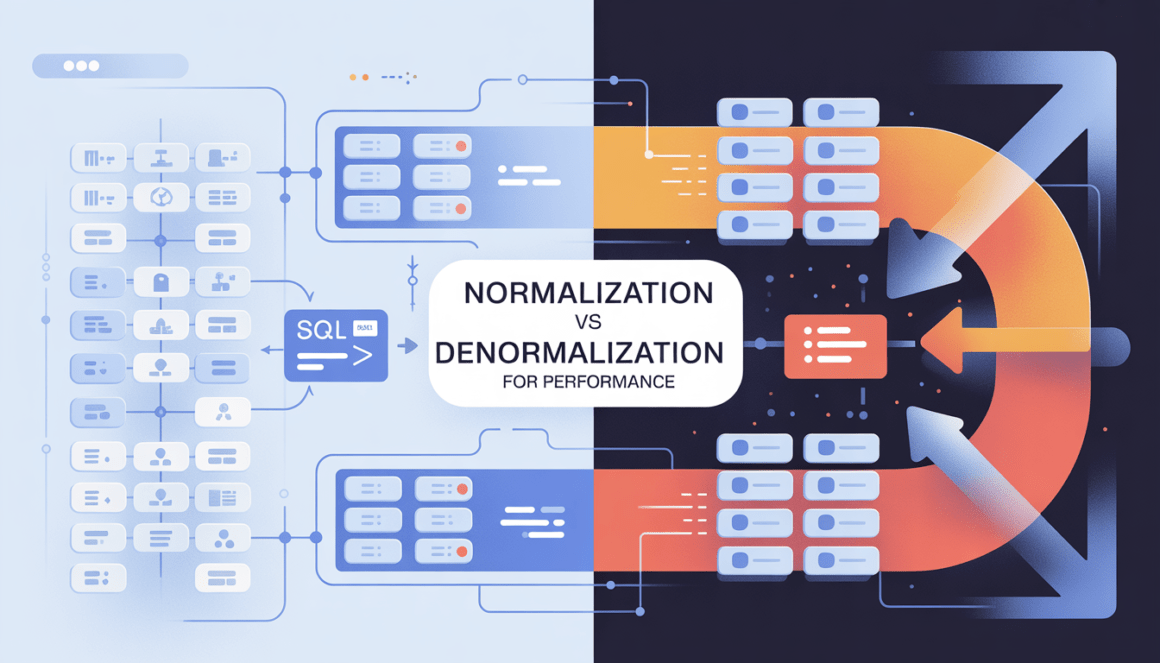
Normalization vs Denormalization: Key Differences
| Feature | Normalization | Denormalization |
| Data Redundancy | Minimal | High |
| Performance | Slower reads | Faster reads |
| Complexity | Higher (more tables) | Lower (fewer tables) |
| Data Integrity | Strong | Weaker |
| Use Case | OLTP systems | OLAP systems |
When to Use Normalization
Normalization is ideal in the following scenarios:
- Transactional Systems (OLTP): Applications like: Banking systems , E-commerce order processing , CRM systems . These require high data integrity.
- Frequent Updates: If data changes often, normalization ensures consistency.
- Limited Storage: Avoiding redundancy saves space.
- Strict Data Relationships: When maintaining relationships is critical.
When to Use Denormalization
Denormalization is suitable for:
- Read-Heavy Applications: Examples: Analytics dashboards , Reporting systems and Search systems
- Performance-Critical Systems: When speed matters more than storage.
- Large-Scale Data Warehousing: Data warehouses often use denormalized schemas.
- Caching Scenarios: Precomputed data for faster access.
Real-World Example: E-Commerce System
Normalized Design:
- Users table
- Orders table
- Products table
- OrderItems table
Problem:
Fetching order history requires multiple JOINs.
Denormalized Approach:
Store:
- Customer name
- Product name
- Price snapshot
in a single order table.
Benefit:
- Faster order history retrieval
- Reduced query complexity
The Hybrid Approach: Best of Both Worlds
Modern systems rarely choose one approach exclusively. Instead, they use a hybrid model.
Strategy:
- Normalize core transactional data
- Denormalize for reporting and performance
Example:
- Normalized database for operations
- Denormalized replicas for analytics
Techniques for Denormalization
- Adding Redundant Columns: Store frequently accessed data in multiple tables.
- Precomputed Tables: Store aggregated data (e.g., total sales).
- Materialized Views: Pre-built query results for faster access.
- Caching: Use tools like Redis to store computed results.
Performance Considerations
JOIN Cost: Multiple JOINs increase CPU and memory usage.
Indexing: Indexes can improve normalized database performance.
Query Patterns: Understand how your application queries data.
Common Mistakes
- Over-Normalization: Too many tables can hurt performance.
- Premature Denormalization: Don’t optimize before identifying bottlenecks.
- Ignoring Use Case: Design should match application needs.
How to Decide: Practical Guidelines
Ask These Questions:
- Is your system read-heavy or write-heavy?
- How critical is data consistency?
- What are your performance requirements?
- Can you afford data redundancy?
Decision Framework
| Scenario | Approach |
| Banking system | Normalization |
| Analytics dashboard | Denormalization |
| E-commerce checkout | Normalization |
| Product catalog browsing | Denormalization |
Modern Trends
- NoSQL Databases: Often favor denormalization.
- Microservices: Each service may use different strategies.
- Cloud Databases: Scalability reduces need for strict normalization.
Case Study: Learning Management System
In an LMS:
Normalized:
- Users
- Courses
- Enrollments
Denormalized:
- Course dashboards
- Student progress reports
Result:
- Efficient operations + fast reporting
Best Practices
- Start normalized
- Measure performance
- Optimize with denormalization
- Use indexing wisely
- Monitor query performance
Conclusion
Normalization and denormalization are not opposing strategies—they are complementary tools. Normalization ensures your data remains clean, consistent, and maintainable. Denormalization ensures your system performs efficiently under real-world workloads. The key is knowing when to follow the rules and when to break them. In modern application development, strict normalization alone is rarely enough. Likewise, excessive denormalization can create chaos.
The smartest approach is a balanced one:
- Normalize where integrity matters
- Denormalize where performance matters
Ultimately, database design is not about rigid rules—it’s about making informed decisions based on your application’s needs.