
What is Max-Min Scheduling Algorithm?
The Max-Min Scheduling Algorithm is a task scheduling technique primarily used in distributed computing environments such as cloud computing, grid computing, and parallel processing systems. Its main goal is to efficiently allocate tasks (also called jobs or processes) to available resources (such as processors or virtual machines) in a way that optimizes execution time and improves system performance. In this algorithm, tasks are first evaluated based on their expected completion times across available resources. Unlike the Min-Min algorithm, which prioritizes smaller tasks, the Max-Min algorithm selects the task with the maximum execution time and assigns it to the resource that can complete it the earliest. This approach ensures that larger tasks do not suffer from starvation and are executed earlier in the schedule. The Max-Min strategy is particularly useful in scenarios where balancing workload and minimizing overall completion time (makespan) is critical. By handling longer tasks first, it prevents delays that could occur if large tasks are postponed until the end.
Introduction of Max-Min Scheduling
In modern computing systems, especially in cloud environments, efficient resource utilization is essential. Tasks submitted by users vary significantly in size and complexity. Some tasks may require minimal computation, while others may demand extensive processing time. Traditional scheduling algorithms often struggle to handle this diversity effectively. For example, if smaller tasks are always prioritized, larger tasks may experience delays, leading to inefficiencies and increased total execution time.
The Max-Min Scheduling Algorithm addresses this issue by adopting a different strategy:
- It calculates the expected completion time for each task on every available resource.
- It identifies the task with the maximum minimum completion time.
- It assigns that task to the resource where it can be completed the fastest.
This ensures that long-running tasks are handled early, reducing the chances of bottlenecks later in the execution process.
Max-Min is widely used in:
- Cloud computing systems
- Distributed systems
- High-performance computing (HPC)
- Workflow scheduling environments
Its simplicity and effectiveness make it a popular choice for task scheduling problems.
Detailed Max-Min Scheduling Algorithm
The Max-Min Scheduling Algorithm follows a structured process. Below is a detailed explanation of each step along with the relevant formulas.
Step 1: Define Task Set and Resource Set
Let:
- T = {T₁, T₂, T₃, …, Tn} be the set of tasks
- R = {R₁, R₂, R₃, …, Rm} be the set of resources
Step 2: Compute Expected Execution Time (EET)
The execution time of each task on each resource is calculated as:
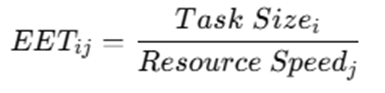
Where:
- EETij = execution time of task i on resource j
Step 3: Compute Completion Time (CT)
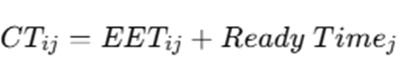
Where:
- Ready Timej = time when resource j becomes available
Step 4: Find Minimum Completion Time for Each Task
For each task Ti:

Step 5: Select Task with Maximum Minimum Completion Time

Step 6: Assign Task to Corresponding Resource
Assign task Tk to the resource where its completion time is minimum.
Step 7: Update Resource Ready Time

Step 8: Remove Task from Task Set
Remove Tk from the list and repeat until all tasks are scheduled.
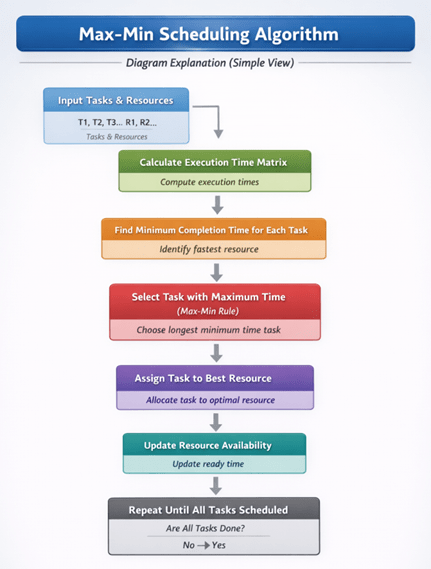
The Max-Min Scheduling Algorithm begins by identifying all the tasks that need to be executed and the available computing resources. Each task may have different computational requirements, and each resource may have different processing capabilities. The algorithm first calculates the expected execution time for every task-resource pair. This is typically done by dividing the size of the task by the processing speed of the resource. Once the execution times are computed, the algorithm determines the completion time for each task on each resource. This includes both the execution time and the current workload of the resource (i.e., its ready time). At this stage, the algorithm identifies the minimum completion time for each task, meaning it finds the fastest possible resource for executing each task.
After this, the algorithm focuses on selecting the task that has the maximum among these minimum completion times. In simple terms, it chooses the task that would take the longest to complete even under the best possible conditions. This ensures that long-running tasks are not delayed unnecessarily. Once the task is selected, it is assigned to the resource that provides the minimum completion time for that task. The resource’s ready time is then updated to reflect the new workload. The scheduled task is removed from the list, and the process repeats for the remaining tasks. This iterative process continues until all tasks have been assigned to resources. By prioritizing longer tasks, the Max-Min algorithm ensures better load balancing and reduces the overall makespan of the system.
Example of How Max-Min Scheduling Algorithm Works
Let’s consider:
Tasks:
- T1 = 10 units
- T2 = 20 units
- T3 = 5 units
Resources:
- R1 speed = 2 units/sec
- R2 speed = 1 unit/sec
Step 1: Calculate Execution Time
| Task | R1 | R2 |
| T1 | 5 | 10 |
| T2 | 10 | 20 |
| T3 | 2.5 | 5 |
Step 2: Minimum Completion Time
- T1 → 5
- T2 → 10
- T3 → 2.5
Step 3: Select Maximum (Max-Min)
- T2 has maximum (10)
Step 4: Assign T2 → R1
Update R1 ready time = 10
Repeat process for remaining tasks.
Diagram Representation
Advantages and Disadvantages of Max-Min Scheduling Algorithm
Advantages
- Prevents Starvation of Large Tasks: The Max-Min Scheduling Algorithm ensures that tasks with longer execution times are given priority. By selecting the task with the maximum minimum completion time, it prevents large tasks from being postponed indefinitely. This avoids starvation and ensures that all tasks, especially computationally intensive ones, are completed within a reasonable timeframe.
- Improved Load Balancing: The algorithm distributes tasks across available resources based on their completion times, which helps in balancing the workload effectively. Instead of overloading a single resource, it intelligently assigns tasks to the most suitable resource, improving overall system efficiency and avoiding bottlenecks.
- Reduced Makespan: By executing longer tasks earlier, the algorithm minimizes the total completion time (makespan) of all tasks. If large tasks are delayed, they can extend the total execution time significantly. Max-Min addresses this by scheduling them first, leading to better time optimization.
- Suitable for Heterogeneous Systems: In environments where resources have different processing capabilities (e.g., cloud or grid computing), the Max-Min algorithm performs well. It considers the execution time of tasks on each resource, ensuring that tasks are assigned to the most appropriate resource based on performance.
- Simple Implementation: The algorithm is relatively easy to understand and implement. Its step-by-step approach—calculating execution time, selecting tasks, and assigning resources—makes it practical for real-world applications without requiring complex logic or heavy customization.
Disadvantages
- Delay for Small Tasks: Since the algorithm prioritizes tasks with longer execution times, smaller tasks may experience delays. This can increase their waiting time and negatively impact response time, especially in systems where quick task completion is important.
- Not Always Optimal: Although Max-Min improves scheduling efficiency in many cases, it does not guarantee the optimal solution. Depending on the task distribution and system conditions, other algorithms might produce better results in terms of makespan or resource utilization.
- High Computation Overhead: The algorithm requires repeated calculation of execution and completion times for all task-resource pairs in each iteration. This can lead to increased computational overhead, especially in large-scale systems with many tasks and resources.
- Poor Performance in Uniform Task Environments: hen all tasks are similar in size and execution requirements, the advantage of prioritizing larger tasks becomes insignificant. In such cases, Max-Min may not perform better than simpler scheduling algorithms.
- Static Nature: Max-Min is generally considered a static scheduling algorithm, meaning it does not adapt well to dynamic changes such as new task arrivals or fluctuating resource availability. This limits its effectiveness in real-time or highly dynamic environments.
Applications of Max-Min Scheduling Algorithm
The Max-Min Scheduling Algorithm is widely applied across multiple computing environments because of its ability to efficiently manage tasks with varying execution times. Its strategy of prioritizing larger tasks makes it particularly useful in systems where workload diversity and performance optimization are critical.
- Cloud Computing: In cloud computing environments, the Max-Min algorithm is used to allocate tasks to virtual machines (VMs) in an efficient manner. Since cloud systems handle a mix of small and large tasks from multiple users, this algorithm ensures that long-running tasks are executed early, preventing delays and improving overall system throughput. It also helps in optimizing resource utilization by assigning tasks to the most suitable VM based on execution time, leading to cost efficiency and better performance.
- Grid Computing: Grid computing involves connecting multiple distributed systems to solve large-scale computational problems. The Max-Min algorithm plays a key role in distributing tasks across these systems. By prioritizing tasks with higher execution times, it ensures that complex computations are handled early, reducing the total execution time. This is especially useful in scientific research, weather forecasting, and large data analysis projects.
- Distributed Systems: In distributed systems, tasks are executed across multiple interconnected nodes. The Max-Min algorithm helps in scheduling these tasks efficiently by considering the processing capabilities of each node. It ensures balanced workload distribution and minimizes delays caused by uneven task allocation. This leads to improved system performance, reduced latency, and better utilization of resources.
- Workflow Scheduling: Many real-world applications involve workflows where tasks have dependencies and must be executed in a specific order. The Max-Min algorithm is used in such scenarios to schedule tasks based on their execution time while respecting dependencies. It is widely used in scientific workflows, business process management, and data pipelines, where efficient scheduling is essential for timely completion.
- Data Centers: In data centers, thousands of tasks are processed simultaneously across multiple servers. The Max-Min algorithm helps in assigning tasks to servers in a way that avoids overloading any single machine. By prioritizing larger tasks, it reduces the risk of bottlenecks and ensures smoother operation. This improves system performance, reduces latency, and enhances the overall efficiency of data center operations.
- High-Performance Computing (HPC): High-Performance Computing environments deal with complex simulations and large-scale computations, such as climate modeling, molecular simulations, and engineering analysis. The Max-Min algorithm is used to schedule these intensive tasks across powerful computing resources. By executing longer tasks earlier, it helps in reducing total computation time and improving system efficiency.
- Internet of Things (IoT): In IoT systems, tasks are distributed across edge devices and cloud platforms. The Max-Min algorithm assists in scheduling these tasks efficiently by considering device capabilities and execution time requirements. It ensures that resource-intensive tasks are handled appropriately, improving response time and system reliability. This is particularly important in applications like smart cities, healthcare monitoring, and industrial automation.
Conclusion
The Max-Min Scheduling Algorithm stands out as an effective and widely adopted approach for task scheduling in modern computing environments such as cloud computing, distributed systems, and high-performance computing platforms. Its core strategy—prioritizing tasks with the longest execution time—addresses one of the major challenges in scheduling: preventing large tasks from being delayed or starved. By ensuring that these resource-intensive tasks are handled early, the algorithm contributes to a more balanced and efficient execution process. One of the key strengths of the Max-Min algorithm is its ability to improve overall system performance by reducing the total completion time, also known as makespan. In environments where tasks vary significantly in size and complexity, this approach helps avoid bottlenecks that can occur when large tasks are postponed. Additionally, its capability to distribute workloads intelligently across heterogeneous resources makes it particularly suitable for real-world systems where computing resources differ in speed and capacity.
Despite its advantages, the algorithm is not without limitations. Smaller tasks may experience delays due to the prioritization of larger ones, which can impact response time in certain applications. Furthermore, the need to repeatedly calculate execution and completion times can introduce computational overhead, especially in large-scale systems. Its static nature also limits its adaptability in dynamic environments where tasks and resource availability change frequently. However, in many practical scenarios, the benefits of the Max-Min Scheduling Algorithm outweigh these drawbacks. Its simplicity, ease of implementation, and effectiveness in handling diverse workloads make it a reliable choice for researchers, system designers, and engineers. It serves as a foundational scheduling technique that can also be combined with other algorithms or enhanced with dynamic features to improve performance further.
As computing technologies continue to evolve—with increasing demand for scalability, efficiency, and real-time processing—scheduling algorithms like Max-Min will remain essential. They play a crucial role in optimizing resource utilization, improving system throughput, and ensuring timely execution of tasks in complex and large-scale computing environments.
Frequently Asked Questions (FAQs)
What is the main goal of the Max-Min Scheduling Algorithm?
The main goal is to minimize overall execution time by prioritizing tasks with the longest completion time and assigning them efficiently to resources.
How is Max-Min different from Min-Min?
Max-Min selects the task with the maximum completion time, while Min-Min selects the task with the minimum completion time first.
Where is Max-Min Scheduling commonly used?
It is widely used in cloud computing, grid computing, distributed systems, and high-performance computing environments.
Does Max-Min guarantee optimal scheduling?
No, it does not always guarantee the optimal solution, but it provides a near-optimal and efficient scheduling strategy.
What is the biggest drawback of Max-Min Scheduling?
The main drawback is that smaller tasks may experience delays due to prioritization of larger tasks.