What is the Round Robin Load Balancing Algorithm?
The Round Robin Load Balancing Algorithm is one of the simplest and most widely used scheduling and load distribution techniques in computer systems, networking, cloud computing, and distributed environments. It works on the principle of equal and cyclic distribution of incoming requests across a group of servers, processes, or resources.
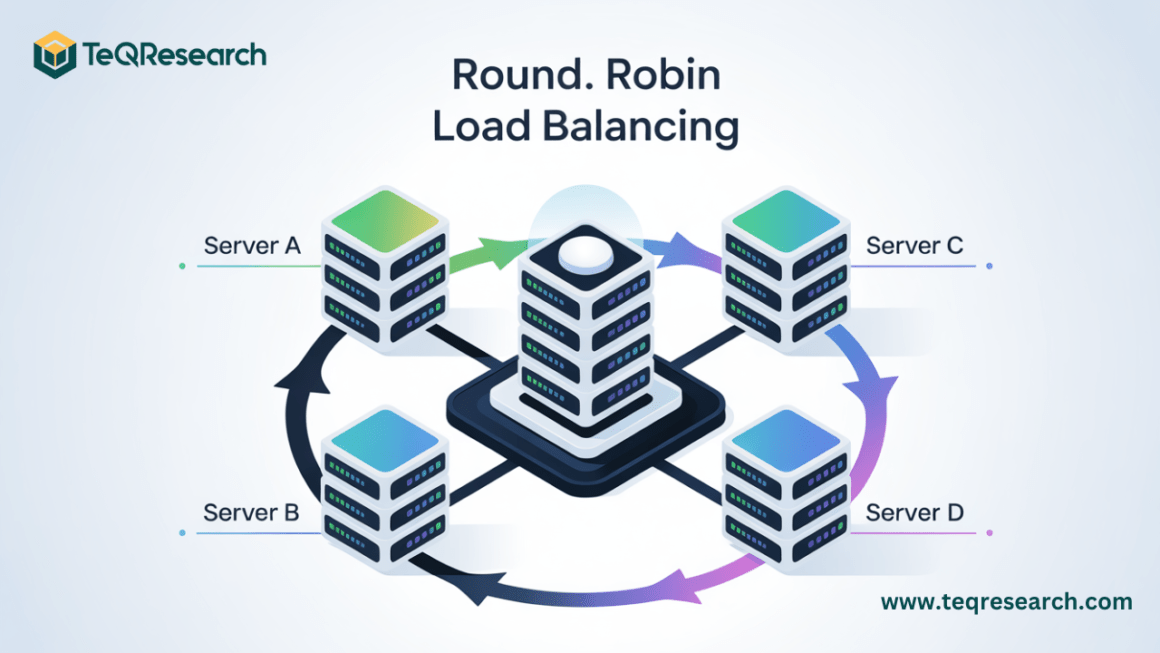
In a Round Robin approach, each server or resource is assigned requests in a fixed, circular order. Once the algorithm assigns a request to the last server in the list, it returns to the first server and continues the cycle. This ensures that all servers receive approximately the same number of requests over time, assuming the requests are similar in size and processing requirements.
Round Robin load balancing is commonly used in:
- Web server clusters
- CPU process scheduling
- Network traffic management
- Cloud and microservices architectures
- DNS-based load balancing systems
Because of its simplicity, fairness, and low overhead, Round Robin remains a popular choice, especially in environments where tasks are relatively uniform.
Introduction to the Round Robin Load Balancing
As modern computing systems grow in scale and complexity, efficiently distributing workload across multiple resources has become critical. Load balancing algorithms are designed to prevent any single server from becoming a bottleneck while others remain underutilized. Among the various load balancing strategies, Round Robin is often considered the baseline or foundational algorithm.
The Round Robin load balancing algorithm does not require complex calculations, historical data, or real-time performance monitoring. Instead, it relies on a predefined ordering of servers and distributes incoming requests sequentially. This makes it easy to implement, predictable in behavior, and computationally inexpensive. Historically, the concept of Round Robin originated in CPU scheduling algorithms in operating systems, where time slices are allocated to processes in a circular order. Over time, this concept was adapted to networking and distributed systems to manage traffic and resource utilization. While Round Robin may not always provide optimal performance in heterogeneous environments (where servers have different capacities), it continues to be a preferred choice for homogeneous systems and lightweight load balancing scenarios.
Detailed Explanation of the Round Robin Load Balancing
The Round Robin load balancing algorithm maintains:
- A list of servers or resources
- A pointer (or index) that tracks the next server to receive a request
Each new incoming request is assigned to the server currently pointed to. After assignment, the pointer moves to the next server in the list. When the pointer reaches the end, it loops back to the beginning.
Let:
- S={S1,S2,S3,…,Sn} be the set of servers
- R={R1,R2,R3,…,Rm} be the incoming requests
- i be the current server index
The server selected for request Rk is:
Server(Rk)=S(k mod n)
Where:
- n is the total number of servers
- k is the request number (starting from 0 or 1 depending on implementation)
This modulo operation ensures that once the last server is reached, the algorithm cycles back to the first server.
Algorithm Steps
- Initialize a list of available servers.
- Set a pointer to the first server.
- Receive an incoming request.
- Assign the request to the server indicated by the pointer.
- Move the pointer to the next server in the list.
- If the pointer exceeds the list size, reset it to the first server.
- Repeat the process for every incoming request.
The Round Robin load balancing algorithm begins by defining a fixed sequence of servers that are available to handle incoming requests. This sequence remains constant unless servers are added or removed. A pointer is then initialized to reference the first server in this sequence. When the first client request arrives, the algorithm assigns it to the server currently referenced by the pointer, ensuring a deterministic and fair selection.
After the request is assigned, the pointer is incremented to reference the next server in the sequence. This movement of the pointer is crucial, as it guarantees that the next incoming request will be handled by a different server. The algorithm does not evaluate the server’s current load, response time, or capacity at this stage; it strictly follows the predefined order.
As additional requests arrive, each is assigned to the next server in turn. When the pointer reaches the end of the server list, it wraps around to the beginning, forming a continuous cycle. This circular behavior ensures that all servers participate equally in handling requests over time.
The simplicity of this step-by-step process makes Round Robin extremely efficient in environments where tasks are uniform. However, because the algorithm does not adapt dynamically to changing server conditions, it assumes that all servers have similar processing capabilities and that requests require roughly equal computational effort.
Example: How the Round Robin Load Balancing Algorithm Works
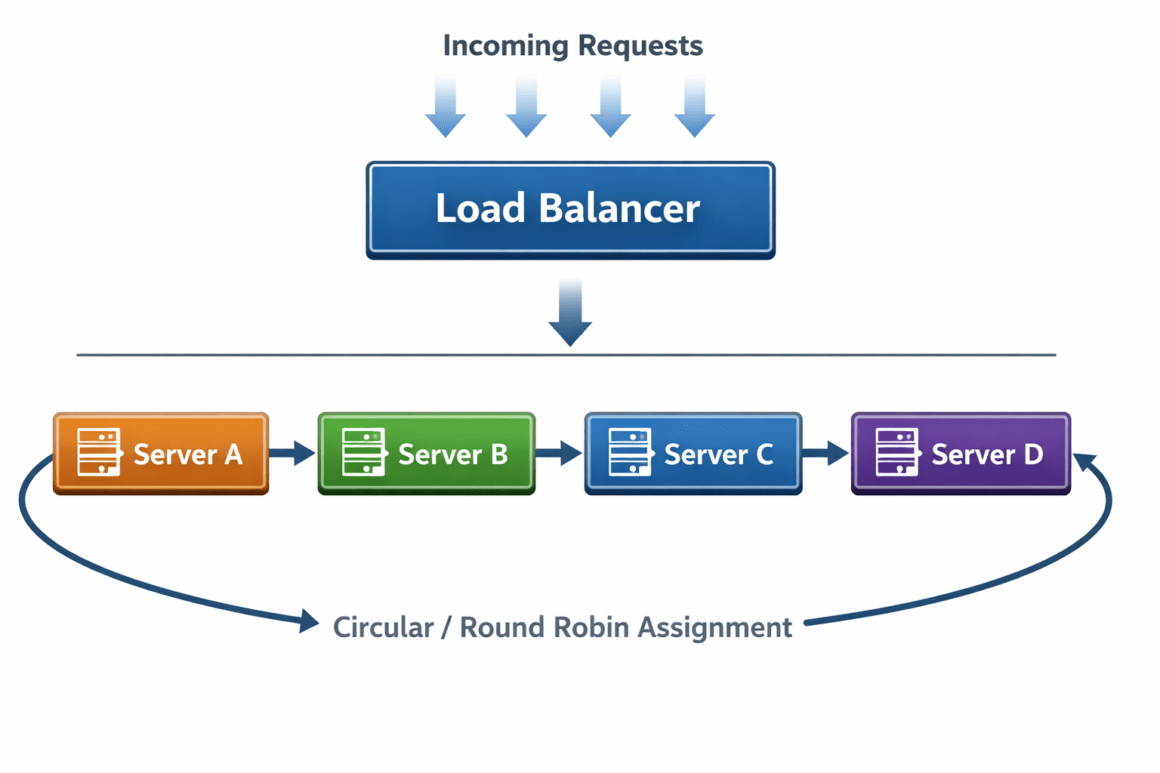
To understand the working of the Round Robin Load Balancing Algorithm, consider a simple web-based system consisting of four identical web servers deployed behind a load balancer. These servers are labeled as Server A, Server B, Server C, and Server D. Each server has the same processing capacity, memory, and network bandwidth, making the environment homogeneous, which is ideal for Round Robin scheduling.
Now assume that eight client requests arrive at the system sequentially. These requests are denoted as R1, R2, R3, R4, R5, R6, R7, and R8. The load balancer’s role is to distribute these incoming requests across the available servers in a fair and orderly manner using the Round Robin algorithm.
The servers are arranged in a fixed circular order:
Server A → Server B → Server C → Server D → Server A (repeat).
The load balancer maintains a pointer that tracks the next server to which a request should be assigned.
As each request arrives, the load balancer assigns it to the next server in the sequence without considering server load or response time. The distribution of requests occurs as follows:
| Request | Assigned Server |
| R1 | Server A |
| R2 | Server B |
| R3 | Server C |
| R4 | Server D |
| R5 | Server A |
| R6 | Server B |
| R7 | Server C |
| R8 | Server D |
The first request, R1, is assigned to Server A, as the pointer initially references the first server in the list. After assignment, the pointer moves to Server B, which handles R2. This process continues sequentially until R4 is assigned to Server D. Once the pointer reaches the last server, it loops back to Server A, allowing R5 to be assigned to Server A again. This cyclic pattern continues for all incoming requests.
As a result, each server receives exactly two requests, ensuring uniform workload distribution. This demonstrates the fairness property of the Round Robin algorithm, where no server is favored over others and all participate equally in handling client traffic.
The fairness achieved in this example is a direct consequence of the cyclic assignment mechanism inherent to the Round Robin algorithm. Since there are four servers and eight requests, the total workload is evenly divisible, allowing each server to process the same number of requests. This predictable and balanced distribution helps prevent server starvation and underutilization in systems where workloads are similar.
However, it is important to note that this fairness assumes all requests require approximately the same processing time. If some requests were significantly heavier than others, the perceived load on servers could differ despite equal request counts. Nonetheless, for uniform workloads, this example clearly illustrates why Round Robin is widely used in web servers, cloud services, and distributed applications.
Advantages and Disadvantages
The Round Robin Load Balancing Algorithm is widely adopted due to its simplicity and fairness. However, like any algorithm, it has both strengths and limitations. Understanding these advantages and disadvantages is essential when selecting an appropriate load balancing strategy for a given system.
Advantages
- Simplicity: One of the most significant advantages of the Round Robin algorithm is its simplicity. The algorithm is straightforward to implement and easy to understand, making it an excellent choice for beginners and system designers alike. It does not require complex logic, historical data, or advanced mathematical computations, which reduces development and maintenance effort.
- Fairness: Round Robin ensures fair distribution of requests by assigning them sequentially to each server in a cyclic manner. Over time, all servers receive an equal number of requests, preventing starvation and ensuring that no single server is overused while others remain idle. This fairness is particularly beneficial in environments with uniform workloads.
- Low Overhead: The algorithm operates with minimal computational overhead because it does not continuously monitor server metrics such as CPU utilization, memory consumption, or response time. As a result, Round Robin consumes fewer system resources and can handle a large number of requests efficiently, especially in high-throughput systems.
- Predictable Behavior: Another important advantage is the deterministic nature of the Round Robin algorithm. Since request assignment follows a predefined sequence, system behavior is predictable. This predictability simplifies debugging, testing, and performance analysis, as administrators can easily anticipate how requests will be distributed across servers.
- Suitable for Homogeneous Systems: Round Robin performs exceptionally well in homogeneous environments where all servers have similar hardware configurations and processing capabilities. In such systems, equal distribution of requests naturally leads to balanced resource utilization and stable system performance.
Disadvantages
Despite its benefits, the Round Robin algorithm has certain limitations that may affect its suitability in more complex or dynamic environments.
- Ignores Server Load: A major drawback of Round Robin is that it does not consider the current load or performance status of servers. Even if a server is heavily loaded or experiencing delays, it will continue to receive new requests. This can result in performance degradation and increased response times.
- Not Ideal for Heterogeneous Environments: In environments where servers have different processing capacities, Round Robin may lead to inefficient load distribution. Since all servers receive the same number of requests regardless of their capability, weaker servers can become overloaded while more powerful servers remain underutilized.
- No Fault Awareness: Basic Round Robin does not automatically detect server failures or downtime. If a server becomes unavailable, the load balancer may continue sending requests to it unless additional health-check mechanisms are implemented. This can result in failed requests and reduced system reliability.
- Poor Performance with Unequal Requests: When incoming requests vary significantly in size or computational complexity, Round Robin may cause load imbalance. Some servers may end up processing resource-intensive requests while others handle lighter ones, leading to uneven performance despite equal request distribution.
Applications of the Round Robin Load Balancing
The Round Robin Load Balancing Algorithm is widely adopted across various computing domains due to its simplicity, fairness, and low operational overhead. It is particularly effective in environments where resources have similar capabilities and workloads are relatively uniform. This section discusses the major application areas where Round Robin load balancing is commonly used.
- Web Server Clusters: One of the most common applications of the Round Robin algorithm is in web server clusters. In such environments, multiple backend servers host the same web application or website, and a load balancer distributes incoming HTTP or HTTPS requests among them. Using Round Robin, each incoming client request is forwarded to the next available web server in a cyclic order. This ensures that all servers participate equally in handling traffic, improving system availability and throughput. By preventing any single server from becoming overloaded, Round Robin helps maintain consistent response times and enhances the overall user experience, especially for static or moderately dynamic web content.
- Operating Systems and CPU Scheduling: In operating systems, the Round Robin algorithm is widely used for CPU scheduling, particularly in time-sharing systems. Each process is assigned a fixed time quantum during which it can execute on the CPU. After the time slice expires, the CPU is allocated to the next process in the ready queue. This cyclic allocation ensures fairness by allowing all processes to receive CPU time, preventing starvation and promoting responsiveness. Round Robin CPU scheduling is especially suitable for interactive systems, where quick response time is more important than throughput.
- Cloud Computing Environments : In cloud computing, Round Robin load balancing is commonly used to distribute tasks across virtual machines (VMs), containers, or microservices instances. Cloud platforms often deploy multiple identical instances of a service to handle large volumes of requests. Round Robin enables even distribution of workloads across these instances, improving resource utilization and fault tolerance. In microservices architectures, it helps ensure that no single service instance becomes a bottleneck, thereby supporting scalability and reliability in cloud-based applications.
- Network Load Balancing: Round Robin is also applied in network load balancing, where routers and switches distribute traffic across multiple network links or paths. By cycling through available routes, the algorithm ensures balanced usage of network resources. This approach helps reduce congestion, improve bandwidth utilization, and increase network reliability. In software-defined networking (SDN) and modern network infrastructures, Round Robin is often used as a simple and effective method for traffic distribution when network paths have similar capacities.
- DNS Load Balancing (Round Robin DNS): Another important application of the Round Robin algorithm is in DNS load balancing, commonly known as Round Robin DNS. In this technique, a single domain name is associated with multiple IP addresses corresponding to different servers. When a DNS query is made, the DNS server rotates the order of IP addresses in its response, effectively distributing client traffic across multiple servers. This method improves availability and redundancy, ensuring that if one server becomes unavailable, others can continue serving requests. Although it lacks real-time load awareness, Round Robin DNS remains a cost-effective and widely used load balancing solution.
Across web systems, operating systems, cloud platforms, networks, and DNS services, the Round Robin Load Balancing Algorithm serves as a foundational strategy for fair and efficient resource allocation. While more advanced algorithms may be required for highly dynamic or heterogeneous environments, Round Robin continues to be a reliable and widely implemented solution in both academic and real-world systems.
Conclusion
The Round Robin Load Balancing Algorithm continues to be a fundamental and widely adopted technique in the fields of distributed systems, networking, and cloud computing. Its enduring relevance is primarily due to its simplicity, fairness, and low computational overhead, which make it easy to implement and maintain. By distributing requests in a cyclic and deterministic manner, Round Robin ensures that all available servers or resources participate equally in handling workload, thereby preventing starvation and underutilization. This algorithm is particularly effective in homogeneous environments, where servers possess similar processing power, memory, and network capabilities, and where incoming requests are relatively uniform in nature. In such scenarios, Round Robin provides predictable performance and balanced resource utilization without the need for complex monitoring mechanisms or real-time decision-making. However, Round Robin is not without limitations. Its inability to account for server load, processing capacity, or request complexity makes it less suitable for heterogeneous or highly dynamic systems. To overcome these shortcomings, several enhanced variants—such as Weighted Round Robin, Dynamic Round Robin, and Health-Aware Round Robin—have been developed. These adaptations introduce intelligence into the scheduling process while retaining the core cyclic principle. For students, researchers, and industry professionals, understanding the Round Robin algorithm is essential, as it forms the conceptual foundation for more advanced load balancing strategies used in modern cloud infrastructures, microservices architectures, and large-scale distributed computing systems. Mastery of this algorithm not only aids in system design but also provides valuable insight into the evolution of resource management techniques in contemporary computing.
Frequently Asked Questions (FAQs)
Q1. What is the main principle behind the Round Robin load balancing algorithm?
The primary principle of the Round Robin load balancing algorithm is the cyclic and equal distribution of requests. Incoming requests are assigned to servers in a fixed sequential order, and once the last server is reached, the algorithm cycles back to the first server. This ensures fairness and prevents any single server from being overburdened.
Q2. Is Round Robin suitable for cloud environments?
Yes, Round Robin is suitable for homogeneous cloud environments, where virtual machines or containers have similar configurations and processing capabilities. However, in heterogeneous cloud systems, where resource capacities differ, weighted or dynamic variants of Round Robin are preferred to achieve better performance and efficiency.
Q3. Does Round Robin consider server performance?
No, the basic Round Robin algorithm does not consider server performance metrics such as CPU utilization, memory usage, network latency, or response time. It assigns requests purely based on order, which can lead to inefficiencies if servers are unevenly loaded.
Q4. What is the difference between Round Robin and Weighted Round Robin?
In Round Robin, all servers receive an equal number of requests regardless of their capacity. In contrast, Weighted Round Robin assigns a higher proportion of requests to servers with greater processing power or resources, enabling better load distribution in heterogeneous environments.
Q5. Where is Round Robin commonly used?
Round Robin is commonly used in web server load balancing, CPU scheduling in operating systems, DNS load balancing, cloud platforms, microservices architectures, and network routing systems, where fairness and simplicity are key requirements.