
What is Dragonfly Algorithm
The Dragonfly Algorithm (DA) is a nature-inspired metaheuristic optimization algorithm that mimics the static and dynamic swarming behaviors of dragonflies in nature. Dragonflies are fascinating insects known for their complex social interactions, especially during hunting (static swarming) and migration (dynamic swarming). These behaviors demonstrate intelligent collective movement, which can be mathematically modeled to solve complex optimization problems.
In optimization, the Dragonfly Algorithm is used to find optimal or near-optimal solutions by balancing two essential aspects of search:
- Exploration (searching new areas of the solution space)
- Exploitation (refining solutions in promising regions)
DA is particularly effective for continuous, discrete, and multi-objective optimization problems, making it suitable for engineering design, machine learning, data clustering, routing, and control systems.
Introduction of Dragonfly Algorithm
Metaheuristic algorithms have become crucial in solving real-world problems where classical optimization techniques fail due to non-linearity, high dimensionality, or uncertainty. Algorithms such as Genetic Algorithms (GA), Particle Swarm Optimization (PSO), Ant Colony Optimization (ACO), and Firefly Algorithm have gained popularity by drawing inspiration from natural phenomena.
The Dragonfly Algorithm, introduced by Mirjalili in 2016, belongs to the swarm intelligence family. Unlike PSO, which relies mainly on velocity updates, DA models five key social behaviors observed in dragonfly swarms:
- Separation
- Alignment
- Cohesion
- Attraction towards food
- Distraction away from enemies
By mathematically simulating these behaviors, DA creates a flexible optimization framework capable of escaping local optima while converging efficiently toward global solutions.
Detailed Dragonfly Algorithm
The Dragonfly Algorithm models the movement of each dragonfly (candidate solution) in the search space using position and step vectors. Let us examine each behavioral component and its corresponding formula.
Separation (Avoiding Crowding)
Separation represents the tendency of dragonflies to avoid overcrowding by maintaining a minimum distance from neighboring individuals.
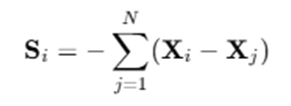
Where:
- Xi is the position of the current dragonfly
- Xj is the position of neighboring dragonflies
- N is the number of neighbors
This term encourages diversity and prevents premature convergence.
Alignment (Velocity Matching)
Alignment reflects the tendency of dragonflies to match their velocity with neighboring individuals.
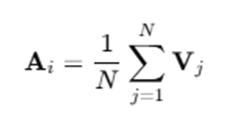
Where:
- Vj is the velocity (step vector) of neighbor j
Alignment helps synchronize movement and supports smooth convergence.
Cohesion (Moving Toward Center of Neighbors)
Cohesion models the attraction of dragonflies toward the center of mass of neighboring individuals.
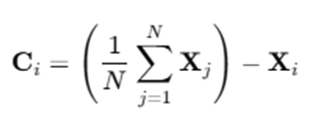
This behavior promotes exploitation by grouping dragonflies around promising regions.
Attraction Toward Food Source
Food represents the best solution found so far in the optimization process.
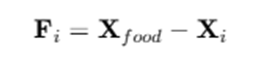
This term accelerates convergence toward optimal solutions.
Distraction Away from Enemy
Enemy refers to the worst solution found so far, which dragonflies try to avoid.
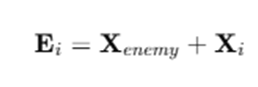
This component prevents stagnation around poor solutions.
Step Vector Update
The step (velocity) of each dragonfly is updated using weighted contributions from all behaviors:

Where:
- s,a,c,f,e are behavioral weights
- w is inertia weight
- t is the iteration number
Position Update
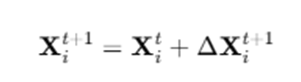
If a dragonfly has no neighbors, a Levy Flight mechanism is used to enhance exploration.
The Dragonfly Algorithm begins by initializing a population of dragonflies randomly distributed across the search space. Each dragonfly represents a candidate solution, and its position corresponds to a potential answer to the optimization problem. Initially, behavioral weights and neighborhood radius are defined to control interaction among dragonflies.
During each iteration, the fitness of every dragonfly is evaluated using the objective function. Based on these fitness values, the best solution is identified as the food source, while the worst solution is labeled as the enemy. These two elements guide the swarm toward better solutions while avoiding poor regions. For each dragonfly, neighboring individuals within a predefined radius are identified. The algorithm then computes separation, alignment, and cohesion vectors based on neighbor positions and velocities. Simultaneously, attraction toward food and distraction from enemy vectors are calculated.
These behavioral vectors are combined using weighted coefficients to update the step vector of each dragonfly. The step vector determines the direction and magnitude of movement in the search space. The position of each dragonfly is then updated accordingly.
If a dragonfly does not have neighbors, it performs a Levy flight, which introduces random long-distance movement to explore new areas. Over iterations, the neighborhood radius gradually increases, allowing the algorithm to transition smoothly from exploration to exploitation. The process continues until a termination condition, such as maximum iterations or convergence threshold, is met.
How Dragonfly Algorithm Works
- Problem Scenario: Global Optimization: To understand the working of the Dragonfly Algorithm, consider the problem of optimizing a mathematical function to find its global minimum. In this context, each dragonfly represents a candidate solution, and its position in the search space corresponds to a possible solution value. At the beginning of the algorithm, dragonflies are randomly initialized across the search space. This randomness ensures diversity in solutions and helps the algorithm explore multiple regions simultaneously.
- Exploration Phase: During the early iterations, the algorithm emphasizes exploration. Dragonflies spread widely across the search space due to stronger separation and alignment behaviors. This phase allows the swarm to investigate unexplored areas and reduces the risk of premature convergence to local optima.
- Exploitation Phase: As the iterations progress, the influence of cohesion and attraction toward the food source increases. Dragonflies begin to form swarms around promising regions where better solutions are found. The food source, representing the current best solution, pulls dragonflies closer, while the enemy (worst solution) pushes them away from unproductive areas.
- Convergence to Optimal Solution: Gradually, the swarm’s movement becomes more focused, and dragonflies converge toward the global optimum. This transition from exploration to exploitation is controlled by adaptive parameters such as neighborhood radius and inertia weight.
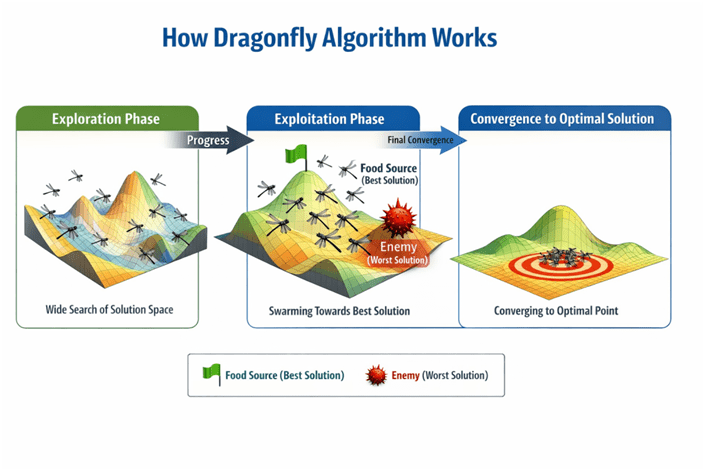
This digital diagram illustrates how dragonflies update their positions using collective intelligence, demonstrating that optimization is achieved through social interaction rather than individual decisions.
Advantages and Disadvantages of Dragonfly Algorithm
Advantages
- Balanced Exploration and Exploitation: The Dragonfly Algorithm provides a well-balanced mechanism for managing exploration and exploitation, enabling an extensive search of the solution space during the initial iterations while gradually concentrating on promising regions in later stages. This adaptive balance helps the algorithm avoid premature convergence and significantly improves the likelihood of identifying global optimal solutions.
- Simple and Intuitive Mathematical Formulation: One of the major strengths of the Dragonfly Algorithm lies in its simple and intuitive mathematical formulation, which is derived from natural social behaviors such as separation, alignment, and cohesion. These biologically inspired concepts make the algorithm easier to understand, implement, and modify compared to many other metaheuristic optimization techniques.
- Effectiveness in High-Dimensional Problems: The algorithm is particularly effective for high-dimensional optimization problems, where conventional optimization methods often fail due to complex and irregular search landscapes. By leveraging swarm intelligence and neighborhood interactions, the Dragonfly Algorithm can efficiently explore large and complex solution spaces.
- Ability to Escape Local Optima: Another important advantage of the Dragonfly Algorithm is its ability to escape local optima efficiently. The combined influence of neighborhood-based movement and Levy flight–based exploration enables dragonflies to move away from stagnated regions and continue searching for better solutions, thereby enhancing global search capability.
- Suitability for Multi-Objective Optimization: Furthermore, the Dragonfly Algorithm is well suited for multi-objective optimization problems. With appropriate extensions using Pareto dominance and external archives, the algorithm can handle multiple conflicting objectives and generate a diverse set of optimal trade-off solutions.
Disadvantages
- High Computational Cost: Despite its notable advantages, the Dragonfly Algorithm has certain limitations. One of the primary drawbacks is that the computational cost increases with population size, as the algorithm must evaluate interactions among a large number of dragonflies. This can become time-consuming for large-scale and complex optimization problems.
- Sensitivity to Parameter Tuning: The algorithm’s performance depends heavily on parameter tuning, including behavioral weights, inertia factors, and neighborhood radius. Selecting inappropriate parameter values may lead to poor convergence behavior or suboptimal solutions, often requiring extensive trial-and-error or problem-specific tuning.
- Slower Convergence for Simple Problems: For very simple or low-dimensional optimization problems, the Dragonfly Algorithm may exhibit slower convergence compared to classical optimization techniques, which can reach optimal solutions more directly with fewer computational steps.
- Critical Neighborhood Radius Selection: Additionally, the selection of neighborhood radius is critical to the stability and effectiveness of the algorithm. An excessively small radius may limit interactions among dragonflies and slow convergence, while an overly large radius may reduce population diversity and lead to premature convergence, negatively affecting overall solution quality.
Applications of Dragonfly Algorithm
- Applications in Machine Learning and Data Analysis: The Dragonfly Algorithm is widely used in machine learning for tasks such as feature selection, where it helps identify the most relevant features while reducing dimensionality and improving model performance. It is also applied in data clustering, enabling efficient grouping of data points by optimizing cluster centers and similarity measures.
- Applications in Image Processing: In the field of image processing, the Dragonfly Algorithm is employed for image segmentation and clustering. By optimizing threshold values and region boundaries, the algorithm enhances segmentation accuracy, making it useful in medical imaging, satellite imagery analysis, and computer vision applications.
- Applications in Power and Energy Systems: The Dragonfly Algorithm has proven effective in power system optimization, including economic load dispatch, voltage control, and renewable energy integration. Its ability to handle nonlinear and multi-objective problems makes it suitable for optimizing energy efficiency and system reliability.
- Applications in Scheduling and Resource Allocation: In scheduling and resource allocation problems, the Dragonfly Algorithm is used to optimize task assignments, job sequencing, and resource utilization. It helps minimize completion time, cost, and energy consumption in manufacturing systems, cloud computing, and project management.
- Applications in Control Systems: The algorithm is applied to control system parameter tuning, where it optimizes controller parameters such as PID gains. This results in improved system stability, faster response, and reduced overshoot in dynamic systems.
- Applications in Wireless Sensor Networks: In wireless sensor network routing, the Dragonfly Algorithm is used to determine optimal routing paths and cluster head selection. This improves network lifetime, reduces energy consumption, and enhances communication efficiency.
- Applications in Engineering Design Optimization: The Dragonfly Algorithm is extensively applied in engineering design optimization, including structural design, mechanical component optimization, and aerodynamic modeling. Its adaptability allows engineers to handle complex constraints and multiple objectives effectively.
- Academic and Industrial Relevance: Due to its flexibility, robustness, and ability to solve complex nonlinear problems, the Dragonfly Algorithm is suitable for both academic research and industrial applications, making it a valuable tool in modern optimization practice.
Conclusion
The Dragonfly Algorithm (DA) stands out as a powerful and intelligent swarm-based optimization technique inspired by the natural collective behaviors of dragonflies. By mathematically modeling separation, alignment, cohesion, attraction toward food sources, and distraction away from enemies, the algorithm successfully balances the two most critical aspects of optimization: exploration and exploitation. This balance enables DA to explore the search space extensively during the early stages while gradually focusing on promising regions to refine solutions as the algorithm progresses.
One of the key strengths of the Dragonfly Algorithm is its flexible and adaptive structure, which allows it to be applied to a wide range of optimization problems, including continuous, discrete, and multi-objective scenarios. Its ability to escape local optima, supported by neighborhood-based interactions and Levy flight mechanisms, makes it particularly effective for complex, nonlinear, and high-dimensional problems. As a result, DA has found successful applications in diverse fields such as engineering optimization, data science, machine learning, image processing, power systems, and artificial intelligence.
Despite its many advantages, the performance of the Dragonfly Algorithm can be influenced by parameter sensitivity, especially the selection of behavioral weights, neighborhood radius, and inertia factors. However, with careful tuning and problem-specific adaptations, these limitations can be mitigated. Overall, the Dragonfly Algorithm remains a competitive, versatile, and research-relevant optimization method, continuing to attract attention in both academic studies and industrial applications.
Frequently Asked Questions (FAQs)
Is the Dragonfly Algorithm suitable for discrete problems?
Yes, the Dragonfly Algorithm can be adapted for discrete and combinatorial optimization problems by employing suitable solution encoding techniques and modifying position update rules. Such adaptations enable DA to handle problems like scheduling, routing, and feature selection effectively.
How is the Dragonfly Algorithm different from Particle Swarm Optimization (PSO)?
While both DA and PSO are swarm intelligence algorithms, DA incorporates multiple social behaviors and relies on local neighborhood interactions, whereas PSO primarily depends on velocity updates influenced by personal best and global best solutions. This makes DA more flexible in balancing exploration and exploitation.
What is the role of Levy flight in the Dragonfly Algorithm?
Levy flight plays a crucial role in enhancing exploration, particularly when a dragonfly has no neighboring individuals. It introduces long-distance random movements that help the algorithm escape stagnation and explore unexplored regions of the search space.
Can the Dragonfly Algorithm handle multi-objective optimization problems?
Yes, the Dragonfly Algorithm can be extended to multi-objective optimization by incorporating Pareto dominance concepts and external archives. These extensions allow DA to find a set of optimal trade-off solutions for conflicting objectives.
Which parameters are most critical in the Dragonfly Algorithm?
The most critical parameters influencing DA’s performance include behavioral weights (separation, alignment, cohesion, attraction, and distraction), neighborhood radius, and inertia weight. Proper tuning of these parameters is essential for achieving fast convergence and high-quality solutions.