
Firefly Algorithm
Xin-She Yang created the Firefly Algorithm (FA), a metaheuristic optimization method inspired by nature, in 2008. It draws inspiration from fireflies’ bioluminescent communication, in which they use light to warn predators or attract partners. Fireflies travel toward brighter (better) solutions in the search space, and the method uses the firefly’s brightness to reflect a solution’s fitness value. Key Concepts of Firefly Algorithm:
- Attractiveness: Better solutions with greater brightness draw fireflies more.
- Intensity or brightness: This varies in proportion to the fitness function that is being optimized.
- Distance-Based Movement: As fireflies get farther apart, they become less appealing to one another.
- Randomness: A tiny quantity of randomness guarantees that FA successfully searches the search space and stays clear of local optima.
Firefly Algorithm Used for, because FA can efficiently explore the search space and avoid local optima, it is frequently employed to solve difficult optimization issues in fields including engineering design, machine learning, image processing, and scheduling.
Introduction of Firefly Algorithm
Dr. Xin-She Yang first presented the Firefly Algorithm (FA), a metaheuristic optimization algorithm inspired by nature, in 2008. It is based on how fireflies naturally behave, especially how they use bioluminescent flashing patterns to attract, communicate, and survive.
Inspiration Behind FA are, In order to attract mates or prey, fireflies use their capacity to generate light. One of the most important factors in judging a firefly’s appeal is its brightness. The Firefly Algorithm, which takes inspiration from this behavior, models optimization issues in which the brightness (or intensity) of each firefly symbolizes the quality (fitness value) of the solution. Brighter fireflies draw in more people, which improves the search space’s solutions iteratively.
Key Characteristics of Firefly Algorithm,
- Attractiveness and Brightness: Brighter fireflies (better solutions) attract other fireflies. A firefly’s attraction is determined by its intensity (fitness value). Close fireflies are more appealing since brightness diminishes with distance.
- Random Exploration: In order to aid in global search and avoid premature convergence, fireflies move randomly when there are no brighter fireflies nearby.
- Distance-Based Movement: The evolution of solutions is controlled by the firefly’ decreasing attraction to one another as distance rises.
Why Use Firefly Algorithm?
- Easy to use and straightforward
- Effective in resolving issues related to global optimization
- Prevents becoming trapped in local optima
- Adaptable to many different fields, including scheduling, machine learning, and engineering.
Detailed Firefly Algorithm
The Firefly technique (FA) is an iterative optimization technique that finds the best solution to a given issue by simulating the flashing behavior of fireflies. In order to explore the search space, it moves fireflies, or candidate solutions, in the direction of brighter (better) solutions while preserving some unpredictability.
Steps of the Firefly Algorithm
Step 1: Initialize the Population
- Define the number of fireflies n.
- Randomly initialize fireflies in the search space.
- Define the objective function f(x) (fitness function) that needs to be optimized.
- Assign an initial brightness (fitness value) to each firefly based on f(x).
Step 2: Define Firefly Movement and Attraction
Each firefly’s movement is based on two main rules:
- Fireflies with lower brightness move toward brighter fireflies (better solutions).
- If no firefly is brighter, a firefly moves randomly (to maintain exploration).
The attractiveness β of a firefly is defined by:

Where:
- β0 = Maximum attractiveness at r=0.
- γ= Light absorption coefficient (controls how quickly brightness fades).
- r= Distance between two fireflies.
The distance rij between two fireflies i and j is calculated as:
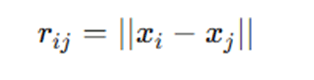
Where xi and xj are the positions of fireflies i and j.
Step 3: Update Firefly Positions
The position of firefly i moving toward firefly j is updated using:

Where:
- x i = Position of firefly i.
- xj = Position of firefly j (brighter firefly).
- β = Attractiveness of firefly j.
- α = Randomization factor (controls exploration).
- ϵ = A random number drawn from a uniform or Gaussian distribution.
This equation ensures that fireflies move toward better solutions while exploring the search space.
Step 4: Evaluate New Solutions
- Compute the new brightness f(xi) for each firefly.
- Sort fireflies based on brightness (best solutions move to the top).
Step 5: Check Stopping Criteria
- Repeat the movement process until a stopping condition is met, such as:
- Maximum number of iterations is reached.
- The best solution does not improve significantly over multiple iterations.
Firefly Algorithm Pseudo-Code
Initialize fireflies with random positions
Define objective function f(x)
Evaluate brightness of each firefly
while (stopping condition not met):
for each firefly i:
for each firefly j:
if brightness(i) < brightness(j):
Move firefly i towards firefly j
Update position using movement equation
Apply random movement to ensure exploration
Update brightness of fireflies
Rank fireflies based on brightness
Return the best solution found
Advantages and Limitations of Firefly Algorithm (FA)
The Firefly Algorithm (FA) is a powerful metaheuristic optimization technique, but like any algorithm, it has both strengths and weaknesses.
Advantages of Firefly Algorithm
- Efficient Global Search Capability: By letting fireflies use both attraction and randomness to traverse the search space, FA successfully avoids local minima. FA can locate the global optimum even in intricate, multimodal functions, in contrast to hill-climbing methods.
- Simple and Easy to Implement: Because of its simple criteria based on brightness and attraction, the FA is simple to code and apply to a variety of optimization issues. Compared to other algorithms such as Simulated Annealing (SA) or Genetic Algorithm (GA), it necessitates less mathematical derivations.
- Robust and Flexible: FA excels in a number of issue areas, including as wireless sensor networks, machine learning, and engineering design.
o Issues with scheduling and routing o Image processing - Faster Convergence Than Other Algorithms: Because of its adaptive movement mechanism, FA can converge to optimal solutions faster than Genetic Algorithm (GA) and Particle Swarm Optimization (PSO).
- High Exploration and Exploitation Balance: Diverse exploration of the search space is aided by the randomness component (α). The exploitation of good solutions is guaranteed by the attractiveness function (β).
- Parallel Processing Advantage: FA is highly parallelizable, making it suitable for large-scale optimization in high-performance computing.
Limitations of Firefly Algorithm
- Sensitive to Algorithm Parameters: Proper tuning of the light absorption coefficient (γ), which affects movement and appearance, is essential for FA performance. The randomization factor (α) governs exploration. o The rate of convergence is influenced by the attractiveness parameter (β).
Slow convergence or subpar performance can result from incorrect parameter settings. - Higher Computational Cost for Large Problems : Every iteration of FA necessitates pairwise comparisons between every firefly. For large-scale issues, the temporal complexity, O(n2), can be computationally costly.
- Slower Convergence in Some Cases: FA may require more iterations to converge in cases when the fitness landscape is flat or contains a large number of comparable solutions, even though it is faster than certain other methods.
- Requires a Good Balance of Exploration and Exploitation: FA does not converge rapidly if exploration is set too high (big randomness α). FA may become trapped in local optima if exploitation is excessively strong (low randomness α). To balance these factors, careful parameter tweaking is needed.
- Not Always the Best for High-Dimensional Optimization: Premature convergence may result from FA’s difficulties with diversity loss in very high-dimensional problems (d>100). To improve performance, hybrid strategies—such as FA + Genetic Algorithm—are frequently employed.
Comparison with Other Metaheuristic Algorithms
| Feature | Firefly Algorithm (FA) | Genetic Algorithm (GA) | Particle Swarm Optimization (PSO) |
| Inspiration | Firefly bioluminescence | Natural selection & evolution | Bird flocking behavior |
| Exploration | High, controlled by α\alphaα | High (mutation & crossover) | Moderate (velocity updates) |
| Exploitation | Strong (brightness attraction) | Medium | Strong (converges to best particles) |
| Convergence Speed | Fast, but parameter-dependent | Slower | Fast, but may get stuck in local optima |
| Computational Cost | Higher (O(n²)) | Moderate | Low (O(n)) |
| Ease of Implementation | Very Easy | Moderate | Easy |
The Firefly technique is a nature-inspired optimization technique that is strong, adaptable, and effective. It works effectively for many applications because it strikes a good mix between exploration (searching the space) and exploitation (refining solutions). It does, however, have several drawbacks, including slower convergence in some situations, high computational cost for large problems, and parameter sensitivity. These disadvantages can be reduced with the right tuning and hybrid strategies.
Applications of Firefly Algorithm (FA)
The Firefly Algorithm (FA) is widely used in various fields due to its efficiency, adaptability, and ability to handle complex optimization problems. Below are some of the major applications of FA:
Engineering Optimization
FA is extensively used to optimize engineering design problems, including:
- Structural Optimization – Used in civil engineering for truss design, bridge structure optimization, and material selection.
- Antenna Design – Helps in optimal placement and shape of antennas to maximize signal strength.
- Power Systems Optimization – Applied in load dispatch, voltage regulation, and power loss minimization.
Example: FA has been used to optimize robotic arm design for better flexibility and efficiency.
Machine Learning and Neural Networks
FA helps in training and optimizing machine learning models, including:
- Feature Selection – Selecting the most relevant features to improve classification accuracy.
- Hyperparameter Tuning – Optimizing parameters in deep learning models like neural networks and support vector machines (SVM).
- Clustering Problems – Used for unsupervised learning tasks, such as image segmentation and customer segmentation.
Example: FA has been used to optimize hyperparameters in deep learning models for image classification tasks.
Image Processing and Computer Vision
FA has proven effective in image enhancement, segmentation, and object detection.
- Edge Detection – Detecting edges in an image by optimizing filter parameters.
- Image Segmentation – Used for segmenting medical images (e.g., X-ray, MRI scans) for disease detection.
- Noise Reduction – Helps in improving image quality by removing unwanted noise.
Example: FA has been applied in MRI image segmentation to detect brain tumors.
Wireless Sensor Networks (WSN) and Communication Systems
FA plays a crucial role in optimizing network communication and data transmission.
- Energy-Efficient Routing – FA is used in wireless networks to minimize energy consumption and improve sensor lifespan.
- Optimal Node Placement – Helps in determining the best placement of sensors to ensure maximum coverage.
- Data Clustering in IoT Networks – FA is used in Internet of Things (IoT) applications to efficiently cluster sensor nodes.
Example: FA is used in 5G network optimization to enhance signal quality and reduce interference.
Bioinformatics and Medical Applications
FA is applied in solving biological and healthcare-related optimization problems, such as:
- DNA Sequence Alignment – Optimizing sequence matching for genetic analysis.
- Disease Diagnosis – Used in AI-based medical diagnostic systems to classify diseases.
- Drug Discovery – Helps in predicting molecular structures for new drugs.
Example: FA has been used to improve early-stage cancer detection algorithms.
Supply Chain and Logistics Optimization
FA is useful for route planning, inventory management, and warehouse optimization.
- Vehicle Routing Problem (VRP) – FA optimizes the shortest and most efficient delivery routes.
- Inventory Control – Helps in managing stock levels efficiently.
- Supply Chain Cost Reduction – Used to minimize transportation and distribution costs.
Example: FA is used by e-commerce companies to optimize delivery routes for faster shipments.
Financial Market Prediction and Portfolio Optimization
FA is applied in financial markets to improve investment strategies.
- Stock Market Prediction – FA is used for predicting stock prices based on historical data.
- Portfolio Optimization – Helps in selecting the best combination of assets to maximize returns and minimize risks.
- Fraud Detection – FA-based machine learning models detect suspicious transactions in banking systems.
Example: FA has been integrated into algorithmic trading systems to improve decision-making.
Scheduling and Timetabling
FA helps in optimizing scheduling problems in various domains:
- Job Scheduling in Manufacturing – Optimizing production schedules to reduce delays.
- University Timetabling – Assigning courses, classrooms, and faculty schedules efficiently.
- Hospital Resource Allocation – Managing doctor-patient appointments and emergency room scheduling.
Example: FA has been applied to optimize airline crew scheduling for cost efficiency.
Robotics and Autonomous Systems
FA is widely used in robotics for path planning and swarm intelligence.
- Robot Path Planning – FA helps robots navigate complex environments.
- Multi-Robot Coordination – Used in swarm robotics to coordinate multiple robots efficiently.
- Obstacle Avoidance – Optimizing motion planning to avoid collisions.
Example: FA has been used to optimize autonomous drone flight paths for surveillance.
Renewable Energy Optimization
FA is applied in optimizing renewable energy systems for better efficiency.
- Solar Panel Placement Optimization – Maximizing solar energy absorption.
- Wind Farm Layout Optimization – Determining the optimal placement of wind turbines.
- Energy Load Forecasting – FA helps in predicting electricity demand to balance power grids.
Example: FA is used in smart grid management to optimize energy distribution.
Conclusion
The Firefly Algorithm (FA) is a potent metaheuristic optimization method that is inspired by nature and imitates the bioluminescent behavior of fireflies. FA was created by Dr. Xin-She Yang in 2008 and has become quite popular because of its ease of use, effectiveness, and capacity to steer clear of local optima in challenging optimization issues. The two main tenets of FA are attraction (the drive for better solutions) and brightness (the fitness function). Fireflies can efficiently explore and take advantage of the search space because to this technique, which makes FA appropriate for resolving high-dimensional, multimodal, and nonlinear optimization issues.
FA has many drawbacks, including sensitivity to parameter adjustment, computational expense for large-scale problems, and slower convergence in certain situations, despite its benefits, which include simplicity of implementation, resilience, and parallelization capabilities. Nevertheless, adaptive tuning, hybridization with other algorithms, and parallel computing approaches can help overcome these difficulties. FA has been effectively used in supply chain management, robotics, bioinformatics, wireless networks, image processing, machine learning, engineering design, and renewable energy optimization. Because of its adaptability, it is currently one of the most used bio-inspired algorithms.
Frequently Asked Questions (FAQs)
Q1. What is the main inspiration behind the Firefly Algorithm?
The bioluminescent flashing activity of fireflies served as the inspiration for the Firefly Algorithm (FA). Brighter fireflies attract others, and they use light to communicate or attract mates. Fireflies migrate toward brighter solutions in FA, simulating the process of identifying the best ones. Brightness in FA stands for a solution’s fitness value.
Q2. How does the brightness and attractiveness mechanism work in FA?
- The fitness function, or how well a firefly symbolizes a solution, determines how bright it is.
- Fireflies are more attracted to one another when they are closer together; the attraction between fireflies diminishes with distance.
- As fireflies with lower brightness migrate toward those with higher brightness, the quality of the solution gradually improves.
- To balance exploration and exploitation, the movement is governed by the attraction formula and a randomness component.
Q3. What are the key advantages of the Firefly Algorithm compared to other optimization techniques?
- Simple to implement with fewer control parameters.
- Avoids local optima better than some traditional algorithms like hill climbing.
- Faster convergence than Genetic Algorithm (GA) in many cases.
- Highly flexible and adaptable to various types of optimization problems.
- Can be parallelized for faster computation in large-scale problems.
Q4. In which real-world problems is the Firefly Algorithm commonly used?
FA is widely used in:
- Engineering optimization (e.g., structural design, antenna design).
- Machine learning (e.g., feature selection, neural network training).
- Image processing (e.g., edge detection, segmentation).
- Wireless networks (e.g., routing, sensor placement).
- Finance and economics (e.g., portfolio optimization, fraud detection).
- Medical applications (e.g., disease diagnosis, bioinformatics).
Q5. How can the performance of the Firefly Algorithm be improved?
To enhance FA’s performance, researchers suggest:
- Adaptive parameter tuning, which dynamically modifies appeal and randomness.
- Combining FA with other algorithms, such as Particle Swarm Optimization or Genetic Algorithm.
- For better exploration, use chaotic maps or Levy flight.
- Parallel processing to expedite the resolution of complex issues.