The Transformer algorithm is a deep learning approach that builds contextual representations of data using attention mechanisms. Instead of processing a sequence strictly one element at a time, a Transformer can compare many tokens in parallel and learn which other tokens matter most for understanding each position. First introduced for sequence-to-sequence learning in the paper “Attention Is All You Need”, the architecture has become central to modern natural language processing and has also been adapted for images, audio, time series, scientific data, and multimodal learning.
This tutorial explains the Transformer from its foundations through equations, training, inference, a worked translation example, a digital workflow diagram, pseudocode, limitations, applications, FAQs, and references. It describes the original encoder–decoder Transformer; models such as BERT, GPT, and Vision Transformer use related components but change the architecture to suit their tasks.
What Is the Transformer Algorithm?
The Transformer is a neural-network architecture for learning relationships between elements in a sequence or a set of input tokens. A token may be a word, subword, character, image patch, audio segment, or numerical feature vector. The architecture maps tokens to dense vectors, adds information about their positions when order matters, and applies layers containing attention and feed-forward transformations.
The key operation is self-attention. For each token, self-attention calculates how strongly it should use information from other tokens. In a sentence such as “The animal did not cross the road because it was tired,” the representation of “it” can draw information from “animal” and the wider context. Learned attention weights let the network form context-dependent representations rather than assigning one fixed vector to each word.
In the original encoder–decoder design, the encoder reads the input sequence and produces contextual representations. The decoder produces the output sequence one token at a time, attending to earlier output tokens and to the encoder’s representations. This is useful for translation, summarization, and other sequence-to-sequence tasks.
Transformer is an architecture, not one single immutable algorithm or a guarantee of correct output. Implementations vary in layer count, attention type, positional encoding, normalization, and training objective. The common ingredients are learned projections, attention, feed-forward layers, residual connections, normalization, and a task-specific output head.
Introduction to the Transformer Algorithm
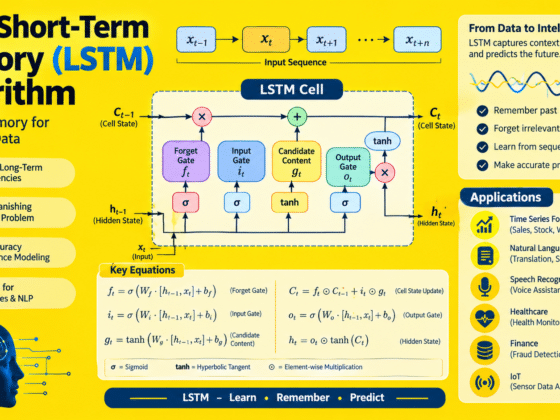
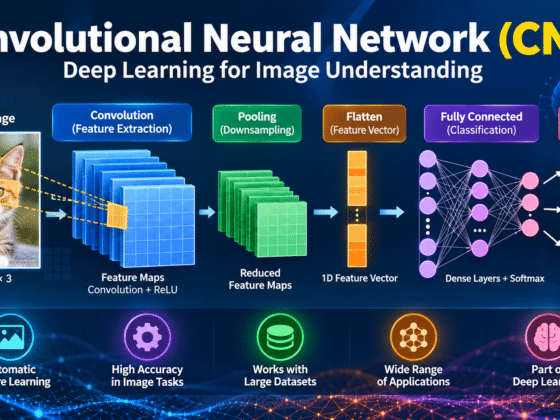
Before Transformers, recurrent neural networks (RNNs), long short-term memory networks (LSTMs), and convolutional models were widely used for sequence learning. Recurrent models update a hidden state sequentially, which can make training difficult to parallelize across a long sequence. Convolutional models can process local regions efficiently but require stacked or dilated layers to connect distant positions. Attention had already been added to some sequence-to-sequence systems, but the original Transformer made attention the core mechanism and removed recurrence and convolution from its main sequence-processing stack.
In the 2017 paper, Vaswani and colleagues demonstrated the encoder–decoder Transformer on machine translation. The design permits a training example’s input positions to be processed in parallel within the encoder and permits parallel teacher-forced computation of target positions in the decoder, with a causal mask preventing access to future target tokens. During generation, the next output token still depends on the tokens already generated, so ordinary autoregressive decoding remains sequential across output steps.
Three concepts make the architecture easier to understand:
- Contextualization: a token representation is updated using relationships to other relevant tokens.
- Multiple attention heads: several learned attention projections can capture different relationships in parallel.
- Position information: attention alone is permutation-equivariant, so sequence order must be represented through positional embeddings, positional encodings, relative-position biases, or another suitable mechanism.
A standard Transformer may be configured with an embedding dimension, number of attention heads, number of encoder and decoder layers, feed-forward dimension, dropout rate, vocabulary, and maximum context length. These are design choices, not universal fixed values. The PyTorch Transformer documentation describes a reference implementation and its principal configuration options.
Detailed Transformer Algorithm
Step 1: Prepare and tokenize the input
Raw text is normalized according to the task and divided into tokens using a vocabulary or subword tokenizer. Each token maps to an integer ID. Special tokens may mark sequence boundaries, padding, separators, or unknown values. For a source sequence of length n, the token IDs can be written as (x_1,x_2,\ldots,x_n). Padding masks identify positions that should not contribute to attention or loss. Tokenization is task-dependent; numerical, image, and audio Transformers use suitable patching or feature-tokenization steps instead.
Step 2: Convert tokens to embeddings
An embedding table (E\in\mathbb{R}^{|V|\times d_{model}}) maps each token ID to a vector of dimension (d_{model}). The embedded sequence is (X= [E_{x_1};E_{x_2};\ldots;E_{x_n}]\in\mathbb{R}^{n\times d_{model}}). These continuous vectors are trainable representations. They enable the network to learn similarities and distinctions useful for the task.
Step 3: Add positional information
Because self-attention does not by itself encode the order in which tokens appear, the model adds position information. In the original Transformer, sinusoidal positional encodings were used:
Here, (pos) is the token’s position and (i) indexes the embedding dimensions. The input to the first layer becomes (H^{(0)}=X+PE). The sinusoidal method is one option; learned absolute embeddings and relative position methods are also common. For image or unordered tabular inputs, positional or structural signals must be chosen to reflect the data’s geometry.
Step 4: Project representations into queries, keys, and values
Attention uses three learned transformations of the current hidden representations (H): queries (Q), keys (K), and values (V). They are calculated as:
The matrices (W^Q\), (W^K\), and (W^V\) are learned projection weights. Intuitively, a query expresses what a token is looking for, a key expresses what a token offers for matching, and a value carries the information that can be combined. These are learned vector roles, not hand-written linguistic labels.
Step 5: Calculate scaled dot-product attention
For each query, the model compares it with the keys using dot products. It scales the scores by the square root of the key dimension (d_k), applies any attention mask, and normalizes the scores using softmax:
Here, (M) represents an optional mask or additive bias. Forbidden locations are assigned a very large negative value before softmax, effectively giving them zero probability. Scaling helps control the magnitude of the dot products, reducing softmax saturation when the key dimension is large. The resulting attention weights sum to one across the allowed positions, and the weighted sum of value vectors gives each token a context-informed representation.
Step 6: Apply multi-head attention
Instead of relying on one attention operation, the Transformer calculates multiple attention heads with independent learned projections. For head (j):
The head outputs are concatenated and projected:
Multiple heads can learn different patterns, such as nearby dependencies, agreement, topic clues, or long-range associations. It is not guaranteed that every head has a clean human-interpretable role. If the model dimension is (d_{model}) and there are (h) equal-sized heads, each head typically uses a dimension near (d_{model}/h).
Step 7: Add residual connections and layer normalization
Transformer sublayers use residual paths to help information and gradients flow through deeper networks. One common post-normalization form is:
The exact ordering of normalization and sublayers varies among model families. In a pre-normalization design, normalization is applied before the attention or feed-forward sublayer. Dropout can regularize training by randomly zeroing selected activations; it is typically disabled during inference.
Step 8: Apply a position-wise feed-forward network
Each token representation passes through the same feed-forward network independently of other positions. A typical form is:
Here, (W_1) expands the representation to an inner dimension, (sigma) is a nonlinear activation such as ReLU or GELU, and (W_2) projects it back to (d_{model}). Another residual connection and normalization produce the layer output. Attention mixes information across token positions; the feed-forward network transforms each position’s features. Stacking multiple layers repeatedly refines the representations.
Step 9: Process the input through encoder layers
The encoder consists of a stack of similar layers. Every layer commonly contains self-attention followed by a feed-forward sublayer, with residual connections, normalization, and usually dropout. The final encoder matrix (Z\in\mathbb{R}^{n\times d_{model}}) contains contextual representations of the source tokens. In an encoder-only architecture such as BERT, this output is passed to a task-specific classification, tagging, retrieval, or other head rather than to a translation decoder.
Step 10: Use masked self-attention and cross-attention in the decoder
The original decoder receives the target sequence shifted right during training, so each position predicts the next target token. A causal mask prevents a position from attending to future target positions. The decoder also includes cross-attention: decoder queries attend to encoder keys and values. Conceptually, masked self-attention constructs a representation using only previously available target tokens, while cross-attention retrieves relevant information from the source sequence.
For autoregressive prediction, the conditional probability of a target sequence is factorized as:
The decoder produces hidden states for target positions. A linear layer maps them to vocabulary-sized logits, and softmax converts the logits into next-token probabilities.
Step 11: Calculate the output probabilities and loss
For a vocabulary of size (|V|), a target-position hidden state (h_t) is mapped to logits (o_t=h_tW_{vocab}+b). The probability for token (v) is:
With teacher forcing, the correct previous target tokens are supplied during training. A common objective is token-level cross-entropy:
Padding tokens are normally excluded from the loss. Depending on the task, training may use additional objectives such as label smoothing, masked-token prediction, contrastive loss, or regression loss. Backpropagation computes gradients, and an optimizer such as Adam updates the weights.
Step 12: Generate predictions during inference
At inference time, the model receives the input and begins with a start token or an appropriate prompt. It predicts the next token, appends the selected token, and repeats until an end token or a generation limit is reached. Greedy decoding selects the highest-probability token; beam search tracks several candidate sequences; sampling methods draw tokens from a probability distribution and can use temperature or top-k/top-p filtering. The best method depends on whether the task prioritizes deterministic output, diversity, or sequence-level quality. Decoder-only language models use a related next-token process, whereas encoder-only models commonly produce predictions in a single forward pass.
Explanation of the Transformer Algorithm
The Transformer can be understood as a pipeline that changes raw input into representations, uses attention to contextualize those representations, and converts the result into the task’s output. First, text is tokenized because the network operates on numeric IDs rather than raw characters. The IDs are looked up in an embedding table to create vectors of equal length. Position information is added so that sequences such as “dog bites person” and “person bites dog” are not treated as equivalent merely because they contain the same words.
Next, each layer projects the current vectors into queries, keys, and values. The attention score for a query-key pair measures compatibility. After scaling and softmax, the model obtains a distribution of attention weights over allowed positions. It multiplies these weights by the value vectors and combines the results. Thus, the representation of a word can change depending on its surrounding words. Multi-head attention performs several versions of this process in parallel, concatenating them to create a richer representation.
Residual connections then add a sublayer’s transformed output back to its input, while normalization stabilizes the activation scale. The feed-forward network applies nonlinear transformations independently at each position. Repeating this structure gives the model opportunities to build progressively more abstract features. The encoder processes source positions together, while the decoder’s masked attention is restricted to the prefix already available at each target position. Cross-attention lets the decoder use the encoded source when generating a translation or summary.
During training, the network predicts known target tokens and compares its probability distribution with the correct sequence. Cross-entropy penalizes the model when it assigns low probability to the correct token. Gradients from that loss adjust the embeddings, attention projections, feed-forward weights, and output layer. Training repeats over batches until the selected stopping criteria are met. During inference, target answers are not provided; the decoder repeatedly predicts and appends a token. This distinction explains why decoder training can be parallelized across target positions under a causal mask, yet ordinary autoregressive text generation still takes multiple sequential decoding steps.
Example: How the Transformer Algorithm Works
Consider a simplified English-to-French translation task. The input sentence is “The cat is sleeping.” A tokenizer might represent it as [The, cat, is, sleeping, .]. Each token is mapped to an embedding and combined with position information. In the encoder, self-attention lets “sleeping” attend to “cat” and “is,” while “cat” can attend to “The” and the rest of the sentence. The learned attention values are examples of how context is integrated; the actual numeric weights depend on the trained model and cannot be inferred from the sentence alone.
The decoder begins with a start-of-sequence marker. At the first step, it uses masked self-attention over the available target prefix and cross-attention over encoder outputs. Suppose the model assigns the largest probability to “Le.” It appends that token. At the next step, the decoder receives the prefix “Le” and might predict “chat.” The process continues with “dort” and punctuation, producing “Le chat dort.” In a real translation system, choices depend on tokenizer conventions, training data, model weights, and decoding settings; the example illustrates the process rather than reporting an experiment or measured probability.
A classification use case is simpler. For sentiment analysis, an encoder-only Transformer processes a review such as “The camera is compact, but the battery is poor.” A classification token or pooled representation is passed to a classifier that estimates probabilities for classes such as positive, neutral, and negative. Context matters because “but” changes the relationship between the favorable camera feature and unfavorable battery feature. The exact output should be assessed on labelled test data; attention is a computational mechanism and should not automatically be treated as a faithful explanation of the model’s decision.
Digital Diagram for the Transformer Algorithm
The following diagram summarizes a traditional encoder–decoder Transformer. The encoder and decoder contain repeated layers; the decoder combines causal self-attention with cross-attention to the encoder output.
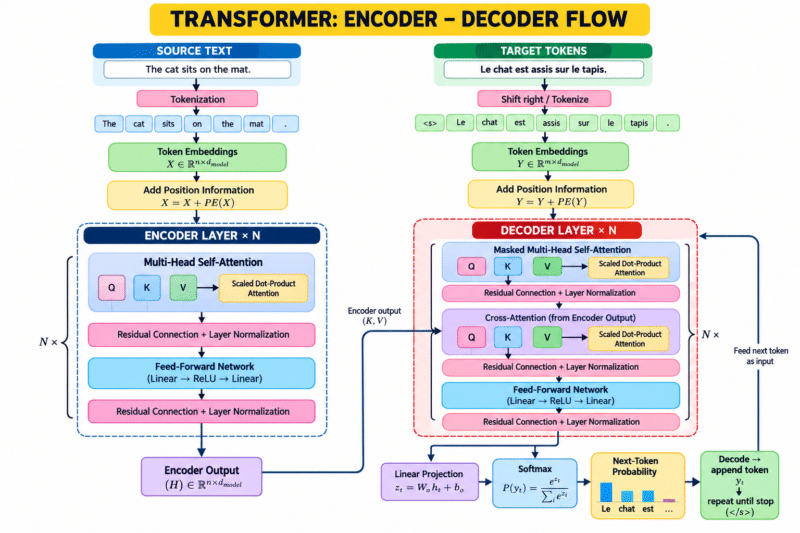
Figure 1. Conceptual flow of the original encoder–decoder Transformer. “× N” denotes a stack of repeated layers; implementations may vary in layer ordering and position encoding.
Pseudocode for the Transformer Algorithm
The pseudocode below represents high-level supervised training for an encoder–decoder Transformer. Matrix dimensions and implementation details are simplified for readability.
Algorithm: Train an Encoder–Decoder Transformer

Input:
    Parallel training pairs D = {(source, target)}
    Vocabulary V, number of layers N, attention heads h
    Model dimension d_model, feed-forward dimension d_ff
    Learning rate η, number of epochs E

Initialize:
    Token embeddings and position representations
    Encoder and decoder attention/feed-forward parameters
    Output projection and optimizer

For epoch = 1 to E:
    For each mini-batch (src, tgt) in D:
        src_ids ← Tokenize(src)
        tgt_ids ← Tokenize(tgt)

        encoder_input ← Embed(src_ids) + PositionInfo(src_ids)
        encoder_output ← Encoder(encoder_input, padding_mask)

        decoder_input ← ShiftRight(tgt_ids)
        decoder_input ← Embed(decoder_input) + PositionInfo(decoder_input)

        decoder_output ← Decoder(
            decoder_input,
            encoder_output,
            causal_mask,
            source_padding_mask
        )

        logits ← OutputProjection(decoder_output)
        loss ← CrossEntropy(logits, tgt_ids,
                            ignore_padding = true)

        gradients ← Backpropagate(loss)
        optimizer.Update(parameters, gradients, learning_rate = η)

    Validate model and apply the stopping/checkpoint policy

Return trained Transformer

Inference:
    encoded ← Encoder(Tokenize(source))
    output ← [START]
    While last token is not END and length < maximum_length:
        logits ← DecoderAndOutput(output, encoded, causal_mask)
        next_token ← Decode(logits, greedy / beam / sampling)
        Append next_token to output
    Return output
In real code, the encoder and decoder use batched tensor operations and masks with carefully chosen shapes. Training also normally includes validation, checkpointing, gradient clipping where useful, learning-rate scheduling, and reproducibility controls. Efficient implementations cache decoder keys and values during generation rather than recalculating every previous state from scratch.
Advantages and Disadvantages
Advantages
- Parallel processing in training: attention operations can process multiple input positions together, making better use of modern accelerators than strictly sequential recurrent computation in many settings.
- Long-range relationships: self-attention can connect distant positions directly in a layer, which helps model dependencies across long contexts.
- Flexible input representations: the token concept can cover text, image patches, audio frames, time steps, and multimodal tokens.
- Transfer learning and fine-tuning: pretrained Transformer representations can be adapted to classification, extraction, summarization, retrieval, and many domain-specific tasks.
- Composable architecture: attention, feed-forward blocks, normalization, and output heads can be combined into encoder-only, decoder-only, or encoder–decoder models.
Disadvantages
- High memory and compute costs: dense self-attention generally constructs interactions among pairs of positions, giving a sequence-length component that scales quadratically in standard attention.
- Data and training demands: large models may require substantial labelled or self-supervised corpora, accelerator time, storage, and careful optimization.
- Generation latency: autoregressive decoders typically generate one token after another, even when each step is efficiently implemented.
- Limited context and positional design: a model’s useful context is constrained by architecture, training, and available memory; extending the context does not automatically guarantee accurate long-range reasoning.
- Interpretability and reliability: the model can produce biased, inaccurate, or fabricated outputs. Individual attention maps do not by themselves provide a complete explanation of a prediction.
- Deployment complexity: latency, memory use, quantization, batching, and hardware requirements must be evaluated for the intended production setting.
Applications of the Transformer Algorithm
Natural language processing
Transformers support machine translation, text classification, named-entity recognition, question answering, summarization, semantic search, and language generation. Encoder-focused models are often suitable for contextual understanding, decoder-focused models for autoregressive generation, and encoder–decoder models for mapping an input sequence to an output sequence. A useful starting point for implementation concepts is Harvard NLP’s Annotated Transformer.
Computer vision
Vision Transformers split images into patches and treat patch representations as tokens. Attention can learn relationships between different image regions. Applications include image classification, object detection, segmentation, image retrieval, and multimodal vision-language systems. Vision tasks may still combine attention with convolutional components depending on their efficiency and spatial requirements.
Speech and audio processing
Transformers can represent acoustic frames or learned audio tokens and are applied to speech recognition, speech synthesis, speaker-related analysis, audio classification, and music modelling. Real-time systems must consider chunking, streaming latency, and the cost of processing long audio sequences.
Time-series forecasting
In finance, energy, transport, healthcare operations, and e-commerce, time steps and covariates can be encoded as tokens. A Transformer may learn relationships across historical periods and variables to forecast future demand or sensor readings. A sound study should compare it with suitable baselines, use temporal train-validation-test splits, and avoid leakage from future observations.
Healthcare and scientific research
Transformer-based systems can assist with clinical-text representation, biomedical literature analysis, protein and molecular representation, medical imaging, and scientific sequence modelling. Use in clinical or other high-stakes workflows requires privacy protection, domain-specific validation, bias analysis, calibration where appropriate, and qualified human oversight; a model’s output should not be treated as a verified diagnosis or scientific finding without evidence.
Recommendation and multimodal learning
Transformers can process sequences of user interactions, product attributes, reviews, text, images, and other modalities. Shared or cross-attention layers can align different representations. In recommendation, evaluation should reflect time and user separation and examine relevance, diversity, latency, and unintended feedback loops, not just one accuracy metric.
Conclusion
The Transformer algorithm changed sequence modelling by making attention the central operation for learning contextual relationships. Its fundamental pipeline includes tokenization, embeddings, positional information, query-key-value projections, scaled dot-product attention, multiple attention heads, residual connections, normalization, feed-forward networks, and a task-specific output mechanism. In the original encoder–decoder design, masked decoder attention and cross-attention support conditional sequence generation.
Transformers offer strong parallelism during training and flexible representation learning, but their compute requirements, memory costs, sequential autoregressive generation, and reliability limitations must be considered. Successful research therefore requires more than selecting a fashionable architecture: define the task, establish relevant baselines, prevent data leakage, tune hyperparameters, report appropriate metrics, document the experimental environment, and assess failure cases. The best architecture is the one that meets the problem’s accuracy, efficiency, interpretability, and deployment requirements.
Frequently Asked Questions (FAQs)
1. What is the main purpose of a Transformer?
Its purpose is to learn contextual relationships between tokens using attention. The resulting representations support tasks such as language understanding, translation, text generation, vision, audio processing, and time-series modelling.
2. What is self-attention in a Transformer?
Self-attention compares queries and keys derived from the same sequence, normalizes the scores, and uses the weights to combine value vectors. This allows each position to incorporate relevant information from other allowed positions.
3. Why are positional encodings required?
Attention alone does not intrinsically tell the model which token came first. Positional encodings, embeddings, or relative-position mechanisms provide order or structural information so that sequence position can affect the representation.
4. What is the difference between encoder-only, decoder-only, and encoder–decoder Transformers?
Encoder-only models build contextual representations for understanding tasks; decoder-only models use causal attention to predict the next token; encoder–decoder models encode an input and then decode a related output while attending to the encoded input.
5. How does a Transformer learn?
During training, the model computes predictions and compares them with target labels using a loss function such as cross-entropy. Backpropagation calculates gradients, and an optimizer updates model parameters over many mini-batches.
6. Are Transformers always better than RNNs or CNNs?
No. Transformers are powerful and flexible, but may be unnecessarily expensive for small datasets, low-power devices, or tasks where local inductive biases are useful. Compare architectures on the same data splits and compute budget for the actual use case.
7. How can I implement a Transformer algorithm?
For a learning implementation, study the original paper and an annotated tutorial, then use a framework such as PyTorch or a higher-level model library. Start with a small dataset, verify tensor shapes and masks, track a validation metric, and compare against a simple baseline before scaling up.
References
- Vaswani, A., Shazeer, N., Parmar, N., Uszkoreit, J., Jones, L., Gomez, A. N., Kaiser, Ł., & Polosukhin, I. (2017). Attention Is All You Need. Advances in Neural Information Processing Systems 30. https://arxiv.org/abs/1706.03762.
- Rush, A. (and subsequent contributors). The Annotated Transformer. Harvard NLP. https://nlp.seas.harvard.edu/annotated-transformer/.
- Alammar, J. (2018). The Illustrated Transformer. https://jalammar.github.io/illustrated-transformer/.
- PyTorch. torch.nn.Transformer — PyTorch documentation. https://docs.pytorch.org/docs/stable/generated/torch.nn.Transformer.html.
- Devlin, J., Chang, M.-W., Lee, K., & Toutanova, K. (2019). BERT: Pre-training of Deep Bidirectional Transformers for Language Understanding. Proceedings of NAACL-HLT 2019. https://arxiv.org/abs/1810.04805.