
Lion Optimization Algorithm (LOA)
Based on lions’ social behavior and hunting tactics, the Lion Optimization Algorithm (LOA) is a metaheuristic optimization algorithm inspired by nature. In order to find the best answers to challenging optimization issues, it imitates how lions seek for food, defend their territory, live in prides, and procreate. Key Features of LOA,
- Motivated by Lion Behavior: LOA is founded on mating, hunting, territorial defense, pride formation, and nomadic travel.
- The population-based algorithm is made up of several lions, or solutions, that change as iterations go through.
- Exploration and Exploitation Balance: The algorithm makes sure that migratory lions are used for a variety of searches (exploration) and pride-based hunting and reproduction are used for refined solutions (exploitation).
- Competitive and Adaptive: The algorithm mimics survival of the fittest by incorporating mechanisms for territorial takeovers, in which stronger lions supplant weaker ones.
Basic Working Principle:
- A set of candidate solutions (lions) is initialized.
- The population is divided into pride lions (residents) and nomads.
- Resident lions hunt and defend their territory, improving their solutions.
- Nomadic lions explore new search spaces, avoiding local optima.
- The best solutions (lions) reproduce and evolve.
- Weak lions are replaced by stronger ones.
- The algorithm converges when an optimal or near-optimal solution is found.
Because of its effectiveness and resilience, LOA is frequently utilized in engineering, machine learning, image processing, and optimization challenges.
Introduction to LOA
A bio-inspired metaheuristic algorithm, the Lion Optimization Algorithm (LOA) mimics the social and predatory tendencies of lions in the wild. It was created to represent how lions hunt, protect their territory, and procreate in order to effectively tackle complicated optimization issues.
High-dimensional, multimodal, and nonlinear issues are frequently difficult for conventional optimization techniques like gradient-based approaches to solve. Exploration (looking for new solutions) and exploitation (improving on existing solutions) are balanced in LOA’s stochastic, population-based methodology.
Lions are unique among big cats because they live in social groups called prides, unlike solitary hunters such as tigers and leopards. Their behavior includes:
- Pride Formation: Lionesses hunt together in groups called “prides,” in which males rule.
- Hunting Strategy: Like cooperative problem-solvers, lionesses collaborate to catch prey.
- Nomadic Exploration: Young male lions wander about looking for new areas after being kicked out of prides.
- Territorial Takeover: To ensure the survival of the fittest, stronger male lions in a pride challenge and displace weaker ones.
- Evolution and Reproduction: The lions with the best adaptations mate and pass on their characteristics to the following generation.
Core Idea of LOA in Optimization,
- Lions (Solutions): Show potential fixes for an optimization issue.
- Nomads and Pride: While some solutions explore new areas (nomads), others narrow down the search field (pride).
- Hunting Process: Uses collaborative search to enhance current solutions.
- Territorial Takeover: Better solutions are substituted for weak ones.
- Convergence: The algorithm keeps running until it finds an ideal or nearly ideal answer.
Key Advantages of LOA,
- Suitable for high-dimensional, complicated, and nonlinear problems
- Avoids premature convergence
- Balances exploration and exploitation
- Adaptable to dynamic contexts
Because of its effectiveness and resilience, LOA has been used with success in engineering design, image processing, machine learning, power system optimization, and financial market forecasting.
Detailed Lion Optimization Algorithm (LOA) Algorithm
By concentrating on lions’ hunting, territory defense, breeding, and nomadic exploration, the Lion Optimization Algorithm (LOA) simulates the behavior of lions in the wild. To identify the best answers to challenging optimization issues, the algorithm goes through a number of processes.
Step-by-Step Explanation of LOA
Step 1: Initialization
- Define the search space and objective function.
- Set parameters:
- N → Total number of lions (solutions).
- α → Percentage of pride lions.
- β → Percentage of nomadic lions.
- P f→ Percentage of females in pride.
- Nm → Percentage of male lions in pride.
- Randomly initialize N lions (solutions) in the search space.
Step 2: Divide Lions into Prides and Nomads
- Pride Lions (Resident Lions)
- Comprise α% of the population.
- Mainly responsible for hunting, defending territory, and reproducing.
- Males dominate, females hunt.
- Nomadic Lions
- Comprise β % of the population.
- Constantly move in the search space (exploration).
- Some nomads try to invade prides (territory takeover).
Step 3: Pride Lion Movement (Exploitation & Hunting)

- where:
is the position of lion i at iteration t.
- Xbest is the best position found so far.
- r is a random number between 0 and 1.
Step 4: Nomadic Lion Movement (Exploration)
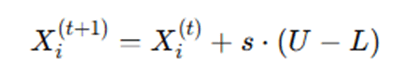
Where:
- U,L are the upper and lower bounds of the search space.
- s is a step size factor.
Step 5: Mating (Reproduction & Genetic Operators)

Where:
- w1,w2 are weights assigned to parent solutions.
- Mutation & Crossover Applied:
- Introduce diversity to prevent premature convergence.
Step 6: Territory Takeover (Survival of the Fittest)
- Nomadic males challenge weak pride males.
- If a nomadic lion is stronger than a pride male, it replaces the pride male.
- The weakest lions are removed from the population.
Step 7: Convergence & Termination
- The algorithm stops when one of the following conditions is met:
- A satisfactory solution is found.
- Maximum number of iterations is reached.
- The best solution found is returned.
Applications of Lion Optimization Algorithm (LOA)
Because of its effectiveness, versatility, and resilience in resolving challenging optimization issues, the Lion Optimization Algorithm (LOA) is extensively employed in many different domains. Here are a few important uses:
A. Engineering Design Optimization
In engineering domains, LOA aids in the optimization of design parameters:
- Structural Design: Improving the strength and efficiency of bridge, building, and mechanical component designs.
- Power Systems: Improving energy distribution, voltage control, and load flow in electrical grids.
- Antenna Design: Optimizing antenna layouts and forms to increase the effectiveness of wireless communication.
B. Machine Learning and Data Science
Machine learning models are trained and optimized using LOA:
- Hyperparameter tuning: Determining the optimal neural network layer configurations, batch size, and learning rate.
- Feature Selection: To increase model accuracy and decrease complexity, the most crucial characteristics are chosen.
- Classification and Clustering: Improving clustering algorithms, such as K-means, to better segment datasets.
C. Image Processing and Computer Vision
LOA is used for picture enhancement and analysis:
- Edge Detection: Improving filters to more precisely identify edges in pictures.
- Picture Segmentation: Enhancing object detection, satellite, and medical picture segmentation.
- Object Detection: Improving tracking algorithms for autonomous systems and video surveillance.
D. Wireless Sensor Networks (WSN) Optimization
LOA works well for energy management and network routing: Achieving optimal coverage with the fewest number of sensors is known as optimal sensor placement. Energy-Efficient Routing: Reducing power usage to increase the lifespan of sensor networks. WSN Clustering: Increasing the effectiveness of data aggregation and transmission
E. Financial and Economic Modeling
- Economic forecasting, portfolio optimization, and stock market prediction are all done with LOA:
- Stock Market Prediction: Improving financial forecasting through parameter optimization in predictive models.
- Portfolio optimization is the process of choosing the optimum investment plan to reduce risk and increase profits.
- Risk assessment: Using optimization and pattern recognition algorithms to identify financial risks.
F. Robotics and Path Planning
Robot motion planning and navigation both make extensive use of LOA: Robot path optimization is the process of determining the safest and shortest route for self-governing robots. Swarm robotics: maximizing the cooperative motions of several robots to carry out tasks effectively. Obstacle Avoidance: Enhancing instantaneous decision-making in ever-changing settings.
G. Biomedical Applications
LOA is beneficial for medical research and healthcare:
Diagnosis of Disease: Improving machine learning models to detect diseases early.
Medical Image Processing: Improving the analysis of ultrasound, CT, and MRI images. Optimizing chemical compositions for effective drug formulation is known as drug discovery.
H. Renewable Energy Optimization
LOA facilitates the optimization of energy management and production:
- Solar Power Optimization: Enhancing the positioning and efficiency of solar panels.
- Wind Farm Layout Design: Determining the optimal sites for turbines to optimize the production of wind energy.
- Energy Load Balancing: Smart grids that effectively distribute electricity demand.
I. Supply Chain and Logistics
LOA improves resource allocation, scheduling, and logistics:
- Vehicle Routing: identifying the best delivery routes for conveyance.
- Inventory management: Improving supply chain efficiency through storage and replenishment optimization.
- Optimizing warehouse layout: enhancing systems for storage and retrieval.
J. Cybersecurity and Network Security
- LOA is employed to protect systems and data networks: Finding cyberthreats and irregularities in network traffic is known as intrusion detection.
- Cryptography: Improving encryption techniques to ensure safe correspondence.
- Spam Detection: Improving filters to identify phishing and fraudulent emails
An effective, flexible, and multi-domain optimization technique is the Lion Optimization Algorithm (LOA). It is appropriate for applications in engineering, artificial intelligence, finance, healthcare, and cybersecurity because to its capacity to strike a balance between exploration and exploitation.
Conclusion
The Lion Optimization Algorithm (LOA) is a powerful nature-inspired optimization technique that mimics the social behavior, hunting strategies, and territorial dominance of lions. It effectively balances exploration (global search) and exploitation (local search), making it highly suitable for solving complex and high-dimensional optimization problems. LOA has demonstrated efficient problem-solving capabilities across various fields, including engineering, artificial intelligence, finance, healthcare, and cybersecurity. Its robust exploration and exploitation mechanisms, driven by hunting strategies, nomadic movement, and territorial takeovers, help prevent premature convergence, ensuring optimal performance. The algorithm’s versatility extends to machine learning, image processing, power systems, logistics, and robotics, where it has been successfully applied. Additionally, its adaptive strategy, built around a dynamic pride-nomad system, ensures diversity in the search space, enhancing solution accuracy and efficiency.
Looking ahead, several areas offer opportunities for further research and improvement in LOA. Integrating LOA with deep learning and hybrid optimization techniques could enhance its effectiveness in AI-driven applications. Additionally, refining parameter tuning methods would enable better adaptability to dynamic and real-time problems. Moreover, expanding LOA’s applications to emerging fields such as quantum computing and climate modeling could unlock new possibilities in optimization research. In conclusion, the Lion Optimization Algorithm (LOA) is a reliable, adaptive, and efficient metaheuristic approach, making it a valuable tool for solving modern optimization challenges across multiple domains.
Frequently Asked Questions (FAQs)
Q1. What makes LOA different from other optimization algorithms like PSO and GA?
LOA is distinct because it balances exploration (nomads) with exploitation (pride hunting), imitating the social organization and hunting techniques of lions. LOA is flexible and effective in complicated optimization issues because it introduces territorial takeover, mating strategies, and dynamic role distribution, in contrast to PSO, which is swarm-based, and GA, which employs selection and mutation.
Q2. How does LOA balance exploration and exploitation?
LOA achieves balance by:
- Exploration: To avoid local optima, nomadic lions travel freely throughout the search space.
- Exploitation: Pride lions use joint hunting and reproduction to hone the best solutions.
- Territorial Takeover: To ensure diversity and avoid stagnation, weak solutions are swapped out for stronger ones.
Q3. What are the key parameters affecting LOA’s performance?
Key parameters include:
- The fraction of pride lions, or α, regulates the ratio of local to global search.
- The percentage of nomadic lions, or β, determines the capacity for exploration.
- P (female lion ratio): Impacts the effectiveness of hunting.
- Territorial takeovers are influenced by the male-to-lion ratio (N).
- Crossover and mutation rates: Affect the variety of solutions.
Q4. Can LOA be applied to real-world engineering and AI problems?
Yes, LOA is widely used in:
- Engineering Design: Antenna, power, and structural design.
- Machine learning includes feature selection, classification, and hyperparameter tweaking.
- Image processing: object tracking, edge detection, and segmentation.
- Logistics and Supply Chain: Inventory control and route optimization.
- Finance & Healthcare: Risk analysis, medical diagnostics, and stock forecasting.
Q5. How does LOA prevent premature convergence to local optima?
LOA avoids local optima through:
- A wide search space is ensured by the diverse role assignment (prides & nomads).
- Hunting and mating tactics: These enable ongoing solution development.
- Territorial takeovers: Put stronger solutions in place of weaker ones.
- Adaptive movement systems: Promote dynamic experimentation and improvement.