What is Superpixel Segmentation (SLIC) ?
Superpixel segmentation is a fundamental concept in computer vision that aims to group pixels into perceptually meaningful atomic regions called superpixels. Instead of processing millions of individual pixels, superpixel methods cluster neighboring pixels that share similar characteristics such as color, texture, and spatial proximity. Among the various superpixel algorithms proposed over the years, the Simple Linear Iterative Clustering (SLIC) algorithm has emerged as one of the most popular and widely adopted techniques due to its simplicity, efficiency, and effectiveness. The SLIC algorithm segments an image into compact, nearly uniform regions by adapting the well-known k-means clustering method to the image domain. Each superpixel represents a cluster of pixels that are similar in appearance and spatially close to each other. By reducing the number of image primitives from pixels to superpixels, SLIC significantly decreases computational complexity while preserving essential structural information. In essence, the Superpixel Segmentation (SLIC) algorithm transforms an image from a dense grid of pixels into a higher-level representation that is more suitable for tasks such as object detection, image segmentation, medical image analysis, and remote sensing. The algorithm strikes an effective balance between segmentation quality and computational efficiency, making it a preferred choice in both academic research and real-world applications.
Introduction of Superpixel Segmentation
The concept of superpixels was introduced to address the inefficiency of pixel-level image processing. Traditional computer vision algorithms often treat each pixel independently, which leads to high computational cost and sensitivity to noise. Superpixels provide a mid-level representation by grouping pixels into coherent regions, enabling algorithms to operate on meaningful image parts rather than raw pixels. The SLIC algorithm was introduced by Radhakrishna Achanta et al. as an efficient alternative to earlier superpixel methods such as Normalized Cuts, Graph-based Segmentation, and Mean Shift. These earlier approaches, although effective, were often computationally expensive and difficult to scale to high-resolution images. SLIC was designed to be fast, memory-efficient, and easy to implement, while still producing high-quality superpixels.
SLIC works by performing clustering in a five-dimensional feature space that combines color information and spatial coordinates. Typically, color information is represented in the CIELAB (Lab) color space because it is perceptually uniform, meaning that Euclidean distances in this space correspond well to human perception of color differences. Spatial coordinates ensure that the resulting superpixels are spatially compact. One of the defining features of SLIC is its use of a localized search region. Unlike traditional k-means clustering, which considers all data points for each cluster center, SLIC restricts the search to a limited neighborhood around each cluster center. This design choice dramatically reduces computational complexity and enables near-linear time performance with respect to the number of pixels.
Detailed Superpixel Segmentation (SLIC) Algorithm
The SLIC algorithm can be described as an iterative clustering process that partitions an image into a predefined number of superpixels. The algorithm consists of several well-defined steps, each supported by mathematical formulations.
Step 1: Image Representation in Feature Space
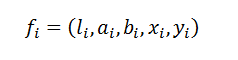
Given an input image with N pixels, each pixel is represented in a five-dimensional feature space:
where:
- li,ai,bi, are the color components of pixel i in the CIELAB color space
- xi,yi, are the spatial coordinates of pixel i
This representation allows the algorithm to jointly consider color similarity and spatial proximity.
Step 2: Initialization of Cluster Centers
Suppose the desired number of superpixels is K. The approximate grid interval S between cluster centers is computed as:
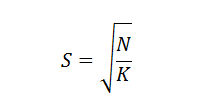
Cluster centers are initialized on a regular grid across the image, with spacing S in both horizontal and vertical directions. Each cluster center Ck is defined as:
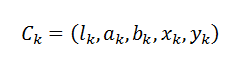
To avoid placing cluster centers on edges or noisy pixels, each center is typically moved to the position within a 3×3 neighborhood that has the lowest image gradient magnitude.
Step 3: Distance Measure
The core of the SLIC algorithm is its distance measure, which combines color distance and spatial distance.
Color distance:

Spatial distance:
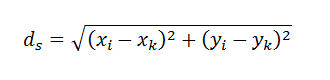
These two distances are combined into a single metric:
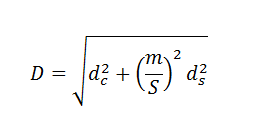
where:
- m is the compactness parameter that controls the trade-off between color similarity and spatial proximity
- S is the grid interval
A larger value of m results in more compact, regular superpixels, while a smaller value allows superpixels to adhere more closely to object boundaries.
Step 4: Assignment Step
For each cluster center, pixels are searched only within a square region of size 2S×2S around the center. Each pixel within this region is assigned to the cluster whose center yields the minimum distance D.
This localized search greatly reduces computational complexity compared to global k-means clustering.
Step 5: Update Step
After all pixels have been assigned to clusters, each cluster center is updated by computing the mean of all pixels assigned to it:
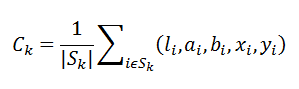
where Sk is the set of pixels assigned to cluster k.
Step 6: Iterative Optimization
Steps 4 and 5 are repeated until convergence, typically when the change in cluster centers falls below a predefined threshold or after a fixed number of iterations (usually around 10).
Step 7: Connectivity Enforcement
To ensure that each superpixel is a connected region, a post-processing step is applied. Small isolated pixel regions are reassigned to the nearest large neighboring superpixel, enforcing spatial connectivity.
The SLIC algorithm begins by transforming the input image into a perceptually uniform color space and augmenting each pixel with its spatial coordinates. This combined representation allows the algorithm to consider both visual appearance and spatial layout simultaneously. Once the feature space is defined, the algorithm initializes cluster centers on a regular grid, ensuring even coverage of the image. These initial centers are slightly adjusted to avoid high-gradient regions, which helps improve boundary adherence. Next, the algorithm enters an iterative clustering phase. For each cluster center, only pixels within a limited spatial neighborhood are considered. This localized search is a key innovation of SLIC, as it dramatically reduces computational cost while maintaining high segmentation quality. Each pixel is assigned to the cluster whose center minimizes a carefully designed distance function that balances color similarity and spatial proximity. After assigning pixels to clusters, the algorithm updates each cluster center by averaging the features of all pixels assigned to it. This step refines the cluster centers and improves segmentation accuracy. The assignment and update steps are repeated iteratively until the cluster centers stabilize. Finally, a connectivity enforcement step ensures that each superpixel forms a single connected region, eliminating small stray segments and producing a clean, coherent segmentation result.
Example of How Superpixel Segmentation (SLIC) Works
Consider a simple color image of a flower against a green background. When SLIC is applied, the algorithm initially places cluster centers uniformly across the image. During the first iteration, pixels are loosely grouped based on proximity. As iterations proceed, superpixels begin to align with meaningful regions such as petals, leaves, and background.
Below is a simplified digital diagram illustrating the SLIC process:
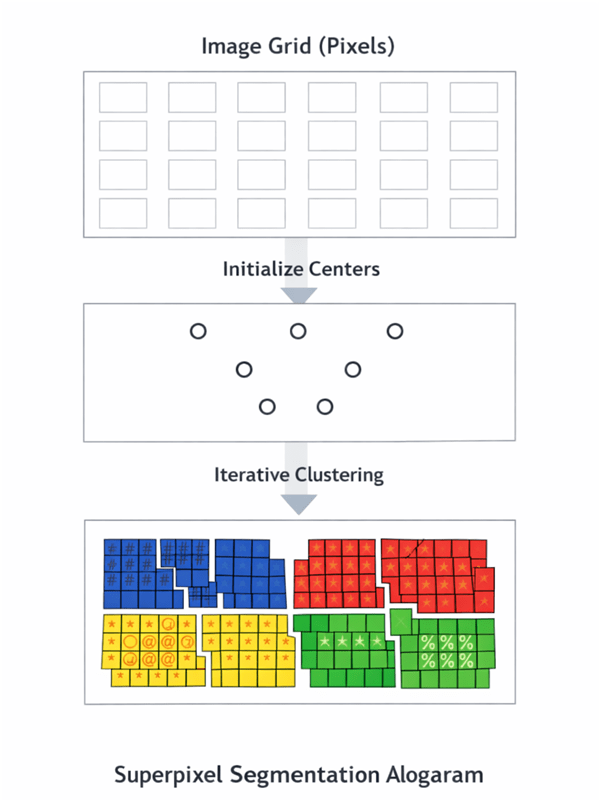
Each symbol represents a superpixel region formed by grouping similar and neighboring pixels.
Advantages and Disadvantages
Advantages
- Computational Efficiency: One of the major strengths of the Superpixel Segmentation (SLIC) algorithm is its high computational efficiency. Instead of performing global optimization or graph-based computations, SLIC restricts the clustering process to local neighborhoods around each cluster center. By limiting the search space in this way, the algorithm achieves near-linear time complexity, approximately O(N), where N is the number of pixels in the image. This efficient design allows SLIC to scale well to high-resolution images and large datasets, making it suitable for real-time and large-scale computer vision applications.
- Simplicity of Algorithmic Design: The SLIC algorithm is derived from the classical k-means clustering framework and requires only minor modifications to adapt it for image segmentation. This simplicity makes the algorithm easy to understand, implement, and extend. Its transparent mathematical formulation ensures reproducibility, which is particularly important in academic research. Due to these properties, SLIC is frequently used as a baseline method or as a preprocessing step in many computer vision and image analysis pipelines.
- Compact and Spatially Coherent Superpixels: SLIC explicitly incorporates spatial coordinates into its distance metric, ensuring that superpixels remain localized within a limited region of the image. This prevents superpixels from spreading across distant areas and results in compact, regular, and spatially coherent regions. Such compactness improves consistency in region-based analysis and reduces ambiguity in downstream tasks such as image classification, object recognition, and segmentation refinement.
- Good Adherence to Object Boundaries: Another important advantage of SLIC is its ability to adhere well to object boundaries. When the compactness parameter is properly tuned, SLIC superpixels align closely with natural image edges and object contours. This boundary-preserving behavior makes the algorithm particularly effective for applications that require accurate region delineation, such as medical image segmentation and scene understanding.
- Flexibility and Adaptability: The SLIC algorithm is highly flexible and adaptable to different types of data. It can be applied to grayscale and RGB images, as well as to hyperspectral and multimodal image data with minimal modifications. Furthermore, SLIC can be extended to three-dimensional volumetric data, such as MRI and CT scans, and adapted for temporal data in video sequences. This versatility broadens its applicability across multiple domains in computer vision and image processing.
Disadvantages
- Predefined Number of Superpixels (K): One of the primary limitations of the SLIC algorithm is the requirement to predefine the number of superpixels (K). In many real-world applications, the optimal number of regions is not known in advance. An inappropriate choice of K can result in over-segmentation or under-segmentation, negatively affecting segmentation quality. This dependency introduces subjectivity and often requires empirical tuning based on the dataset and application.
- Sensitivity to Compactness Parameter (m): SLIC is sensitive to the choice of the compactness parameter (m), which controls the balance between color similarity and spatial proximity. When m is set too high, the algorithm produces overly regular, grid-like superpixels that may ignore important object boundaries. Conversely, a low value of m can result in irregular and fragmented superpixels. Selecting an optimal value typically requires experimentation and domain-specific knowledge.
- Dependence on Low-Level Features: The SLIC algorithm relies primarily on low-level features, specifically color and spatial information. As a result, it may perform poorly in images with complex textures, weak contrast, or significant illumination variations. In such situations, important boundaries may not be captured accurately, limiting the effectiveness of the segmentation.
- Lack of Semantic Awareness: SLIC does not incorporate high-level semantic or contextual information, such as object identity or scene understanding. Consequently, it cannot perform semantic segmentation independently and must be combined with higher-level models, such as convolutional neural networks (CNNs), for tasks that require semantic interpretation. This limits its effectiveness in complex, high-level vision applications.
- Disconnected Regions: Although SLIC enforces spatial connectivity through post-processing, small isolated or disconnected regions may still appear, particularly in complex or noisy images. These artifacts often require additional refinement steps to ensure consistent and meaningful segmentation results.
Applications of Superpixel Segmentation
- Medical Imaging: In medical imaging, SLIC is widely used for segmenting anatomical structures such as organs, tissues, tumors, and blood vessels. By grouping pixels into homogeneous regions, the algorithm reduces noise and improves region-level consistency. It is extensively applied in MRI, CT, PET, and ultrasound imaging to support diagnosis, organ boundary extraction, and disease progression analysis.
- Remote Sensing and Satellite Image Analysis: SLIC plays a significant role in processing large-scale and high-resolution satellite imagery. It is used for land cover classification, urban and infrastructure mapping, vegetation monitoring, and disaster assessment. By enabling region-based feature extraction instead of pixel-level analysis, SLIC improves classification accuracy and computational efficiency in geospatial applications.
- Object Detection and Recognition: In object detection and recognition systems, SLIC is commonly used as a preprocessing technique. Superpixels reduce the dimensionality of image data and provide meaningful region proposals, allowing machine learning and deep learning models to focus on relevant image structures. This is particularly useful in saliency detection, object proposal generation, and scene understanding.
- Video Analysis: SLIC-based superpixels are applied in video analysis tasks such as motion segmentation, object tracking, and action recognition. When extended temporally, superpixels help maintain consistency across video frames, enabling efficient processing of large video datasets.
- Autonomous Driving and Robotics: In autonomous driving and robotic systems, SLIC contributes to real-time perception tasks including road and lane detection, obstacle recognition, and environment mapping. By simplifying scene representation, superpixels support faster and more reliable decision-making in safety-critical systems.
- Other Applications: Additional applications of SLIC include image compression, image editing and enhancement, augmented and virtual reality (AR/VR), biometric systems, document image analysis, and surveillance and security systems. In all these domains, SLIC provides a compact and meaningful representation of visual data that improves efficiency and analysis quality.
Conclusion
The Superpixel Segmentation (SLIC) algorithm represents a landmark contribution to the field of computer vision and image processing. By effectively clustering pixels into perceptually meaningful regions, SLIC bridges the gap between low-level pixel representations and higher-level image understanding. Its foundation in a modified k-means framework enables a powerful combination of simplicity, efficiency, and segmentation quality. From a theoretical perspective, SLIC demonstrates how incorporating spatial constraints into clustering can significantly improve segmentation performance while maintaining computational feasibility. From a practical standpoint, its widespread adoption across domains such as medical imaging, remote sensing, autonomous systems, and video analysis highlights its robustness and adaptability. However, SLIC is not without limitations. Its dependence on parameter selection, lack of semantic awareness, and reliance on low-level features necessitate its integration with more advanced models in complex applications. Despite these challenges, SLIC remains a foundational preprocessing technique and a benchmark against which newer superpixel methods are often compared. In summary, the SLIC algorithm continues to play a vital role in modern computer vision pipelines, offering an effective balance between efficiency, accuracy, and implementation simplicity.
Frequently Asked Questions (FAQs)
Q1. Why are superpixels preferred over individual pixels in image processing?
Superpixels reduce computational complexity by grouping similar pixels into meaningful regions, allowing algorithms to operate on fewer and more informative units rather than millions of individual pixels.
Q2. What makes SLIC faster than traditional superpixel algorithms?
SLIC limits clustering to local neighborhoods around each cluster center, significantly reducing distance computations and achieving near-linear time complexity.
Q3. How does the compactness parameter affect SLIC results?
The compactness parameter controls the balance between color similarity and spatial proximity. Higher values produce more regular superpixels, while lower values improve boundary adherence but reduce compactness.
Q4. Can SLIC be used with deep learning models?
Yes. SLIC is commonly used as a preprocessing step in deep learning pipelines to reduce noise, improve region consistency, and decrease computational cost.
Q5. Is SLIC suitable for real-time and large-scale applications?
Yes. Due to its efficiency, low memory usage, and scalability, SLIC is well-suited for real-time systems and large-scale image processing tasks.