Genetic Algorithm (GA)
The search and optimization method known as a genetic algorithm (GA) is based on the ideas of evolution and natural selection. It is a heuristic method that simulates the course of biological evolution to tackle challenging optimization problems. Key Concepts of GA,
- Darwin’s Theory of Evolution (Survival of the Fittest) serves as its foundation.
- Instead of using a single answer, it works with a population of potential solutions.
- Employs genetic operators like crossover, mutation, and selection to evolve solutions over several generations.
- Uses a fitness function to assess each candidate’s quality.
Basic Steps of GA:
- Initialization – Randomly generate an initial population of potential solutions.
- Fitness Evaluation – Assess each solution using a predefined fitness function.
- Selection – Choose the best solutions based on fitness scores.
- Crossover (Recombination) – Combine parts of selected solutions to create offspring.
- Mutation – Introduce small random changes to maintain diversity.
- Replacement – Form the new population by replacing less fit solutions.
- Termination – Repeat the process until a stopping criterion is met (e.g., max generations or solution quality).
Why Use Genetic Algorithms?
- Effective in wide search spaces: When conventional techniques don’t work, it can locate nearly ideal solutions.
- Addresses intricate and nonlinear issues — Beneficial in situations when defining mathematical models is challenging.
- No gradient information is required: GA uses only function evaluations, as opposed to gradient-based optimization.
Example Applications of GA:
- Logistics route optimization
- In machine learning, feature selection
- Task scheduling and planning
- Optimization of engineering designs
- Forecasts for financial markets
In essence, by utilizing the concepts of natural selection and evolution, genetic algorithms offer a reliable and adaptable method for resolving a variety of optimization issues.
Introduction of Genetic Algorithm (GA)
An evolutionary-based optimization method called a genetic algorithm (GA) imitates the processes of genetic inheritance and natural selection in order to identify the best answers. It is frequently used to resolve challenging search and optimization issues where conventional methods fall short.
Origins and History of GA
- Presented by John Holland as a computational parallel to biological evolution in the 1970s.
- Developed further by David E. Goldberg for real-world engineering and optimization applications.
- Motivated by Darwin’s Theory of Evolution, which places a strong emphasis on genetic variation and survival of the fittest.
How Does GA Work?
Three essential genetic operators are used by GA to evolve a population of potential solutions over generations:
- Selection: Picking the most fit individuals to procreate.
- Crossover (Recombination): Creating children by combining the genetic material of parents.
- Mutation: Altering genes at random to preserve diversity and investigate novel approaches.
Why Use Genetic Algorithms?
- Adaptive and robust: Able to manage multi-dimensional, complicated, and non-linear search spaces.
- Global Optimization: By examining a variety of solutions, GA avoids local optima in contrast to gradient-based techniques.
- Broad Applicability: Utilized in domains such as biology, engineering, finance, logistics, and artificial intelligence.
By mimicking natural evolution, genetic algorithms offer a strong and adaptable method for resolving optimization issues, and their capacity to effectively explore vast solution spaces makes them appropriate for a variety of real-world applications.
Detailed Genetic Algorithm (GA)
The Genetic Algorithm (GA) is an iterative process that evolves a population of potential solutions to an optimization problem. It uses natural selection, crossover, and mutation to find optimal or near-optimal solutions. Here’s a step-by-step breakdown of the GA process, including key formulas used in each step.
Step 1: Initialization
The chromosomes, also known as a population of N potential solutions, are randomly generated and are usually represented as a binary string, a vector of real numbers, or another encoding format.

- The size of the population (N) is predefined.
Step 2: Fitness Evaluation
Each chromosome is evaluated using a fitness function, which determines how well the solution satisfies the optimization criteria.

- Example: If solving Maximize f(x) = x2, the fitness function might be:
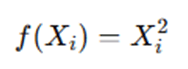
- Higher fitness values indicate better solutions.
Step 3: Selection (Parent Selection)
The selection process chooses the fittest individuals for reproduction. Common selection methods include:
- Roulette Wheel Selection (Proportional Selection)
- Probability of selection:
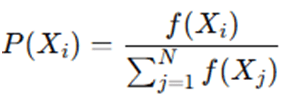
- Chromosomes with higher fitness values have a higher probability of being selected.
- Tournament Selection
- Randomly select a group of individuals and pick the best one.
- Faster and easier to implement than roulette selection.
- Rank-Based Selection
- Rank individuals by fitness and assign probabilities based on ranking instead of raw fitness.
Step 4: Crossover (Recombination)
Crossover creates offspring by combining genetic material from selected parents. Common crossover types:
- Single-Point Crossover
- A random crossover point is selected, and parent genes are swapped.
Example:
Parent1: 101|0110
Parent2: 110|1001
Offspring1: 1011001
Offspring2: 1100110
- Two-Point Crossover
- Two crossover points are selected, and genes between them are swapped.
- Uniform Crossover
- Each gene is independently chosen from either parent with a probability of 0.5.

Where, p is a probability factor.
Step 5: Mutation
Mutation introduces random changes to offspring genes to maintain genetic diversity. This prevents premature convergence to local optima.
- Bit-Flip Mutation (for binary encoding)
- Randomly flips a bit (0 → 1 or 1 → 0).
makefile
CopyEdit
Before: 1010110
After: 1000110
- Gaussian Mutation (for real values)
- Adds a small random value drawn from a Gaussian distribution:
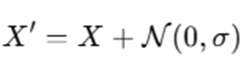
where σ is the mutation step size.
- Swap Mutation
- Randomly swaps two positions in the chromosome.
Mutation rate (Pm) is usually low (0.01 to 0.05) to avoid excessive randomness.
Step 6: Elitism (Preserving Best Solutions)
- Elitism ensures that the best individuals from the previous generation are carried over to the next generation without modification.
- This prevents the loss of high-quality solutions during crossover and mutation.
Xbest→Next Generation
Step 7: Termination Condition
Until a halting condition is satisfied or a predetermined number of generations have passed, the algorithm keeps running:
- The intended fitness threshold is reached by a solution.
- There has been no discernible increase in fitness across several generations.
- There is a maximum number of generations.
By simulating natural evolution, genetic algorithms effectively evolve solutions for challenging optimization problems. across order to find the optimal solution across vast solution spaces, GA iteratively applies selection, crossover, and mutation. It is an effective tool in a variety of domains, including AI, engineering, and finance, due to its capacity to avoid local optima.
Advantages and Limitations of Genetic Algorithm (GA)
Although genetic algorithms (GA) are frequently employed to solve optimization problems, they have advantages and disadvantages. A thorough examination of their benefits and drawbacks may be found below.
Advantages of Genetic Algorithm (GA)
- Global Optimization Ability: In contrast to conventional optimization techniques (such as gradient descent), GA efficiently searches a global search space and avoids becoming trapped in local optima. Helpful in resolving multi-modal issues, or issues when the solution space has several peaks.
- Does Not Require Gradient Information: In contrast to gradient-based algorithms, GA doesn’t require gradient computations or derivatives—just a fitness function evaluation. Fit for resolving difficult, non-differentiable, and discontinuous functions.
- Works Well in Large and Complex Search Spaces: Capable of managing multi-objective and high-dimensional optimization issues.Effective when a thorough search is not feasible.
- Robustness and Adaptability: GA is appropriate for real-world optimization issues (such as traffic management, robotics, and financial modeling) because it can operate in dynamic or changing situations. Suitable for both continuous and discrete optimization issues.
- Parallelism and Diversity: Because GA works with a population of solutions, parallel computing can be used to achieve faster results. Premature convergence is less likely when genetic variety is preserved.
- Ability to Handle Multi-Objective Optimization: A lot of real-world issues include several competing goals (e.g., boosting efficiency while minimizing expense). GA can provide a trade-off between goals by evolving Pareto-optimal solutions.
- Flexibility in Representation and Encoding: Capable of working with representations that are binary, real-valued, integer-based, and permutation-based. Capable of adjusting to various problem restrictions.
- Useful in Machine Learning and AI: GA aids in machine learning model hyperparameter adjustment. Able to develop neural network topologies without the need for human assistance.
Limitations of Genetic Algorithm (GA)
- High Computational Cost: GA is computationally costly since it necessitates analyzing several people in each generation. Slow convergence in contrast to optimization techniques based on gradients.
- Performance Depends on Parameter Tuning: Selecting the appropriate population size, crossover rate, mutation rate, and selection approach all affect GA’s effectiveness. Premature convergence or excessive unpredictability may result from improper parameter selection.
- No Guarantee of Optimality: GA typically finds an approximate or near-optimal solution rather than the ideal one. The population’s diversity and number of generations affect the solution’s quality.
- Premature Convergence: The method may converge early to a less-than-ideal solution if the mutation rate is too low. Over generations, genetic variety may decline, which would limit the capacity to investigate novel options.
- Requires Large Population for Complex Problems: Poor performance could result from a small population’s inability to capture adequate diversity. A huge population uses more memory and takes longer to compute.
- No Theoretical Framework for Stopping Criterion: Heuristic termination conditions, such as maximum generations, no fitness improvement, or a time limit, are frequently used. Determining the optimal number of generations is challenging.
- Sensitive to Fitness Function Design: The design of the fitness function determines the quality of the GA’s solution. Biased evolution or deceptive solutions might result from poorly constructed fitness functions.
Comparison of GA with Other Optimization Techniques
| Feature | Genetic Algorithm (GA) | Gradient Descent | Simulated Annealing |
| Global Search | Yes | No (Local Search) | Yes |
| Handles Discrete & Continuous | Yes | Mostly Continuous | Yes |
| Uses Derivatives | No | Yes | No |
| Parallel Processing | Yes | No | No |
| Computational Cost | High | Low | Medium |
| Convergence Speed | Slow | Fast | Medium |
| Robustness | High | Low | Medium |
Applications of Genetic Algorithm (GA)
Genetic Algorithms (GA) are widely used in various fields due to their ability to solve complex, nonlinear, and multi-objective optimization problems. Below are some key applications of GA across different industries.
Machine Learning and Artificial Intelligence
- Feature Selection: GA helps in selecting the most relevant features in datasets for machine learning models, improving accuracy and reducing computational cost.
- Hyperparameter Tuning: Optimizes hyperparameters of machine learning models such as neural networks, support vector machines (SVM), and decision trees.
- Neural Network Optimization: GA is used for evolving the architecture and weights of deep learning models.
- Reinforcement Learning: Enhances training by optimizing reward functions and policy selection.
Example: Using GA to optimize neural network weights in image classification tasks.
Engineering Design Optimization
- Structural Design: GA optimizes designs of bridges, buildings, and mechanical structures to improve strength and minimize material usage.
- Robotics: Used for optimizing robotic motion, path planning, and control systems.
- Aerospace Engineering: GA is applied to aircraft wing design, fuel efficiency optimization, and spacecraft trajectory planning.
- Electronic Circuit Design: Helps in designing low-power, high-performance circuits by optimizing component placements and configurations.
Example: NASA has used GA for satellite antenna design to maximize signal strength.
Bioinformatics and Medical Applications
- DNA and Protein Sequence Analysis: GA is used for gene sequencing, protein structure prediction, and drug discovery.
- Medical Image Processing: Helps in segmenting medical images such as X-rays, MRIs, and CT scans for disease detection.
- Disease Diagnosis: GA is used in machine learning models for cancer detection, diabetes prediction, and heart disease classification.
- Drug Discovery and Molecular Docking: GA helps in identifying potential drug molecules that can bind to specific proteins.
Example: GA is used in protein folding optimization to predict 3D structures of proteins.
Financial and Business Optimization
- Stock Market Prediction: GA is used in predicting stock trends, portfolio optimization, and risk management.
- Algorithmic Trading: Helps in designing automated trading strategies by optimizing buy/sell decisions.
- Credit Risk Analysis: Banks use GA to assess loan applicants and minimize default risks.
- Supply Chain and Logistics: Optimizes inventory management, warehouse allocation, and delivery routes.
Example: GA is used in portfolio optimization to maximize returns while minimizing risk.
Route Planning and Transportation
- Traveling Salesman Problem (TSP): GA finds the shortest possible route for a salesman to visit multiple cities.
- Traffic Flow Optimization: Helps in reducing traffic congestion by optimizing traffic light timings and vehicle routing.
- Autonomous Vehicles: GA optimizes pathfinding algorithms for self-driving cars.
- Drone Route Optimization: Used in UAV (Unmanned Aerial Vehicle) navigation for efficient package delivery.
Example: GA is used by Google Maps and GPS navigation systems to find optimal routes.
Cryptography and Cybersecurity
- Cryptanalysis: GA is used to break cryptographic codes by optimizing decryption keys.
- Password Cracking: Helps in testing security measures by simulating password attack models.
- Intrusion Detection Systems (IDS): GA is used to detect anomalies in network traffic to prevent cyber attacks.
Example: GA is used to optimize encryption algorithms for securing online transactions.
Gaming and Entertainment
- Game AI: GA is used to train intelligent bots for games like chess, poker, and real-time strategy (RTS) games.
- Character Evolution: Used in games to evolve player strategies or enhance NPC behavior.
- Procedural Content Generation: Helps in creating randomized levels, maps, and textures dynamically.
Example: GA is used in game development for automatic level generation in RPG games.
Industrial and Manufacturing Optimization
- Job Scheduling: GA optimizes task scheduling to reduce manufacturing costs and improve efficiency.
- Production Line Balancing: Helps in assigning tasks optimally to minimize idle time and maximize output.
- Predictive Maintenance: GA helps in predicting machine failures and optimizing maintenance schedules.
Example: Toyota and Ford use GA for assembly line optimization.
Telecommunications and Signal Processing
- Antenna Design: GA is used to design wireless antennas with optimal frequency response.
- Data Compression: Helps in reducing data size while maintaining quality.
- Wireless Network Optimization: Optimizes channel allocation, signal strength, and bandwidth management.
Example: GA is used in 5G network optimization to reduce interference.
Agriculture and Environmental Science
- Crop Yield Optimization: Helps in optimizing fertilizer use, irrigation schedules, and planting strategies.
- Climate Change Modeling: GA is used to predict climate patterns and extreme weather events.
- Water Resource Management: Helps in optimizing water distribution systems.
Example: GA is used in precision farming to increase agricultural productivity.
Conclusion
Natural selection and genetics serve as the inspiration for the potent evolutionary optimization method known as the Genetic Algorithm (GA). It offers a reliable, adaptable, and effective method for resolving challenging optimization issues in a variety of fields, such as robotics, machine learning, engineering, finance, and healthcare. One of GA’s main benefits is its capacity for global optimization, which enables it to efficiently explore the whole solution space while avoiding local optima. GA is appropriate for addressing non-differentiable, discontinuous, and extremely complicated functions because it does not require gradient information, in contrast to conventional optimization techniques. Furthermore, GA performs well in high-dimensional and multi-objective optimization situations and has outstanding scalability and adaptability. AI, bioinformatics, financial modeling, route optimization, and cybersecurity are just a few of its many applications. The fact that GA works on a population of solutions allows for effective parallel processing while preserving genetic variation, which is another important advantage.
GA has various drawbacks and restrictions in spite of these benefits. Its high computational cost is one of its primary disadvantages because it takes a lot of computing power to evaluate numerous solutions over several generations. Furthermore, GA is extremely parameter-sensitive, which means that the right adjustment of population size, crossover rates, and mutation rates is crucial to its effectiveness. Premature convergence is another issue; if genetic variety is lost too quickly, the algorithm may settle into less-than-ideal solutions. Hybrid strategies that combine GA with deep learning, reinforcement learning, and quantum computing are showing promise as research avenues to address these constraints.
To sum up, genetic algorithms are an essential tool for tackling problems in the real world since they maximize solutions by simulating evolution. GA will remain a crucial component of upcoming technological developments and artificial intelligence-driven decision-making because of its capacity to manage uncertainty, complexity, and dynamic situations.
Frequently Asked Questions (FAQs)
Q1. What is the main purpose of Genetic Algorithm (GA)?
The primary purpose of Genetic Algorithm (GA) is to find optimal or near-optimal solutions for complex optimization problems by mimicking the process of natural evolution. GA is widely used in machine learning, engineering design, route planning, finance, and bioinformatics to optimize solutions where traditional methods struggle.
Q2. How does selection work in Genetic Algorithm?
Selection is the process of choosing parent solutions for reproduction based on their fitness values. Common selection methods include:
- Roulette Wheel Selection – Higher fitness solutions have a greater chance of selection.
- Tournament Selection – A subset of individuals competes, and the fittest one is chosen.
- Rank-Based Selection – Individuals are ranked and assigned selection probabilities.
Q3. What are the key differences between Genetic Algorithm and traditional optimization methods?
| Feature | Genetic Algorithm (GA) | Traditional Optimization (e.g., Gradient Descent) |
| Search Strategy | Population-based | Single-solution-based |
| Handles Nonlinear Problems | Yes | Limited |
| Requires Gradient Information | No | Yes |
| Avoids Local Optima | Yes | No |
| Computational Cost | High | Low |
| Convergence Speed | Slower | Faster |
Q4. How do crossover and mutation affect the performance of GA?
- Crossover is the process of combining genetic information from two parents to create new offspring. It ensures diversity and helps GA explore new solutions.
- Mutation introduces random changes in offspring genes to prevent premature convergence and maintain diversity.
- The right balance between crossover rate and mutation rate is crucial for achieving the best results.
Q5. What are the best practices for tuning Genetic Algorithm parameters?
- To improve GA performance, consider:
- Choosing an appropriate population size – Too small reduces diversity; too large increases computation time.
- Setting a suitable crossover rate (~0.7 – 0.9) – Ensures effective recombination.
- Using a small mutation rate (~0.01 – 0.05) – Prevents excessive randomness while maintaining diversity.
- Implementing Elitism – Ensures the best solutions are carried forward.
- Selecting a good stopping criterion – Use maximum generations, fitness threshold, or no improvement detection.