
PSO Algorithm
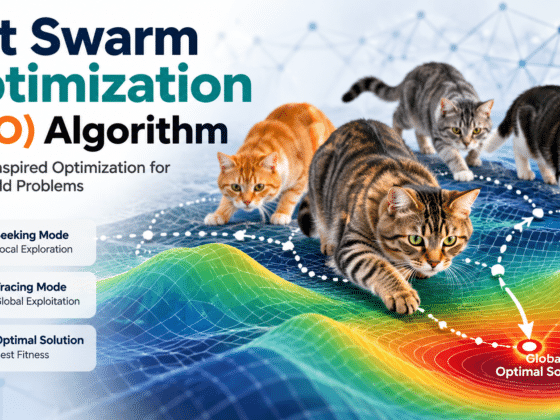
The metaheuristic optimization technique known as Particle Swarm Optimization (PSO) was motivated by the collective movement of fish schools or flocks of birds. It is used to iteratively improve candidate solutions based on a specific fitness function in order to identify the best answer to complicated issues.
Key Concepts of PSO:
- Swarm Intelligence: PSO is a population-based optimization method in which the search space is traversed by several particles, or solutions.
- Particles: Every particle is a possible fix for the issue.
- Velocity and Position Update: Particles modify their positions according to the swarm’s optimal solution (global best) and their individual experience (personal best).
- No Evolutionary Operators: PSO depends on location and velocity updates rather than crossover or mutation like Genetic Algorithms (GA) do.
The social behavior of animals that travel in groups—such as fish schools or flocks of birds—is the foundation of PSO. Every person modifies their position according to:
- Its own greatest experience (pBest, or personal best)
- The group’s overall greatest experience (global best, gBest)
The swarm can effectively converge towards an ideal solution because to this cooperative learning process.
Introduction to PSO Algorithm
In 1995, James Kennedy and Russell Eberhart presented Particle Swarm Optimization (PSO), an optimization method based on fish and avian social behavior. By iteratively modifying a collection of potential solutions (particles), this population-based metaheuristic algorithm effectively finds the best answers.
PSO uses swarm intelligence, in which a collection of particles (possible solutions) navigates the search space and modifies their positions in response to:
- Their most renowned status (Personal Best, or pBest)
- Global Best, or gBest, is the most well-known location that each particle in the swarm has discovered.
Every particle travels according to a velocity update equation that strikes a balance between exploitation (concentrating on promising solutions) and exploration (exploring new areas).
Detailed Particle Swarm Optimization (PSO) Algorithm
Through iterative improvement of candidate solutions based on their mobility in the search space, the Particle Swarm Optimization (PSO) algorithm determines the best solution. Using velocity and location updates, the particle swarm modifies its course in the direction of the most well-known solutions.
Detailed Description of the PSO Algorithm
Step 1: Initialize the Swarm
- Define N particles (potential solutions) in a D-dimensional search space.
- Each particle i has:
- A position vector xi representing a possible solution.
- A velocity vector vi controlling movement.
- A personal best position pBest, the best solution found by that particle.
- Identify the global best position gBest, the best solution found by any particle.
- Set algorithm parameters:
- Inertia weight www (controls balance between exploration and exploitation).
- Acceleration coefficients c1,c2 (influence of personal and global best positions).
- Random factors r1,r2 (randomization in movement).
Step 2: Assess the Function of Fitness
- Using an objective function f(x), determine each particle’s fitness value.
• If the particle’s current position is better, update pBesti for each particle.
• If a pBest enhances the global best solution, update gBest accordingly.
Step 3: Update Velocity and Position
These update rules are used by each particle as it travels across the search space:
Velocity Update Equation:

Where:
- vi(t) = current velocity of particle iii at iteration ttt.
- w = inertia weight (controls momentum of particles, typically in range 0.4 – 0.9).
- c1,c2 = cognitive and social learning factors (typically in range 1.5 – 2.5).
- r1,r2 = random numbers in range [0,1] for randomness in movement.
- pBesti= best position found by the particle.
- gBest = best position found by the swarm.
Position Update Equation:
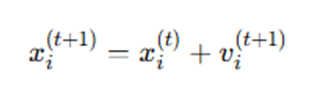
Where:
- xi(t) = current position of particle i.
- vi(t+1) = updated velocity.
Step 4: Check for Stopping Criteria
- Repeat steps 2 and 3 until one of the following conditions is met:
- Maximum iterations reached.
- Fitness value reaches a predefined threshold.
- Minimal change in gBestgBestgBest over successive iterations (convergence).
Algorithm Pseudocode
1. Initialize swarm with random positions and velocities.2. Evaluate fitness of each particle.3. Initialize pBest for each particle and gBest for the swarm.4. While stopping condition is not met: a. For each particle: i. Update velocity using velocity update equation. ii. Update position using position update equation. iii. Evaluate new fitness. iv. Update pBest if current position is better. v. Update gBest if pBest is better than previous gBest.5. Return gBest as the optimal solution.Advantages and Limitations of Particle Swarm Optimization (PSO) Algorithm
The ease and effectiveness of particle swarm optimization (PSO) make it popular, but like any optimization algorithm, it has advantages and disadvantages.
Advantages of PSO
- Easy to Understand and Use: PSO is simpler and easier to use than other evolutionary algorithms (like the Genetic Algorithm), and it requires less parameters.
- Fast Convergence: Because particles in PSO travel in the direction of the optimal solution without the need for gradient computations, PSO frequently converges more quickly than conventional optimization techniques.
- No Requirement for Gradient Information: PSO is capable of optimizing highly complex, discontinuous, and non-differentiable functions, in contrast to gradient-based approaches.
- Fewer Tuning Parameters: Compared to other optimization techniques, PSO is simpler to tune because it only relies on the inertia weight (w), acceleration coefficients (c1, c2), and swarm size (N).
- Performs Well in Multi-Dimensional Spaces: PSO is helpful for large-scale optimization issues because it can effectively manage high-dimensional search spaces.
- Global Search Capability: Compared to some conventional techniques, the swarm-based search process is better at avoiding becoming trapped in local optima.
- Broad Range of Applications: Used for a variety of optimization tasks in image processing, robotics, engineering design, finance, healthcare, and machine learning.
Limitations of PSO
- Propensity to Get Stuck in Local Optima: Particles may converge too soon if the inertia weight (w) is too little, which would hinder the search for better solutions.
- Sensitive to Parameter Selection: Selecting suitable values for w,c1,c2 is essential to PSO performance. Oscillations or sluggish convergence may result from improper tuning.
- PSO is primarily intended for unconstrained optimization, hence it is not appropriate for highly constrained problems. More changes or hybrid approaches are required for problems with severe limitations.
- PSO is slower for combinatorial and discrete optimization; it performs best in continuous search spaces. Specific adjustments (like Binary PSO) are needed for discrete situations (like scheduling and routing).
- Computational Cost in Large Swarms: PSO is ineffective for some large-scale issues when the swarm size (N) is too large since it takes longer to compute.
Applications of Particle Swarm Optimization (PSO) Algorithm
Particle Swarm Optimization (PSO) is widely used across various fields due to its effectiveness in solving complex optimization problems. One of the key areas where PSO is applied is engineering optimization. In electrical engineering, PSO improves power system networks by assisting in fault detection and load balancing, while also fine-tuning neural networks for better control system performance. In mechanical engineering, it plays a crucial role in aerospace design by reducing weight while maintaining structural integrity, as well as optimizing structures such as bridges, buildings, and automotive parts. Additionally, in robotics, PSO is instrumental in optimizing robot motion paths and enhancing obstacle avoidance techniques.
In the field of machine learning and artificial intelligence (AI), PSO contributes significantly by enhancing learning models and optimizing parameters. It is widely used for feature selection, ensuring that only the most relevant features are used to improve classification accuracy. It also plays a role in hyperparameter tuning, optimizing key parameters like learning rates and batch sizes to enhance machine learning model performance. Moreover, in deep learning, PSO helps improve neural network training by optimizing weight initialization, leading to faster convergence and better generalization.
In image processing and computer vision, PSO is utilized for tasks such as automatic thresholding in medical image segmentation and object recognition, where it enhances feature extraction techniques for both object and face recognition. The financial and economic sectors also benefit from PSO, as it is used for stock market forecasting, improving predictive models to better account for fluctuations in stock prices, and portfolio optimization, helping investors determine the best asset allocation to minimize risks while maximizing returns.
PSO is also applied in wireless sensor networks (WSN) and communication systems to enhance network efficiency. It is particularly useful for routing optimization, where it determines the most efficient paths for data transmission, and node deployment, optimizing sensor placement to improve coverage while reducing energy consumption. In the healthcare and biomedical domain, PSO optimizes predictive models for diseases such as cancer and heart disease, improving their accuracy. It also plays a role in bioinformatics, aiding in the study of DNA sequences and the prediction of protein structures.
Additionally, supply chain and logistics optimization benefit from PSO in areas such as vehicle routing problems (VRP), where it helps logistics companies find the shortest and most efficient delivery routes. It also aids in inventory management, optimizing stock levels to reduce costs while ensuring demand is met efficiently. Given its ability to quickly identify optimal solutions, PSO has become a powerful optimization tool across diverse sectors, including healthcare, finance, AI, and engineering.
Conclusion
- The collective behavior of fish and birds served as the inspiration for the potent metaheuristic optimization technique known as particle swarm optimization (PSO). It is frequently used to solve challenging optimization issues in a variety of fields, such as logistics, engineering, machine learning, finance, and healthcare.
- PSO is notable for its ease of use, quick convergence, and capacity to deal with non-differentiable functions. PSO is useful for nonlinear and high-dimensional problems because it uses both personal and global best experiences to explore the search space, in contrast to classic optimization techniques that rely on gradients.
- PSO does have certain drawbacks, too, namely the need for precise parameter tweaking and the tendency to become stuck in local optima. Researchers have developed variants such as Adaptive PSO, Hybrid PSO, and Multi-Objective PSO to enhance its performance.
- All things considered, PSO is still among the most widely used and effective optimization algorithms, particularly for practical uses where gradient-based approaches fall short. It is a useful tool for engineers and academics because of its speedy discovery of near-optimal solutions.
Frequently Asked Questions (FAQs)
Q1: How does Particle Swarm Optimization (PSO) work?
Answer: PSO is a population-based optimization technique that finds the best solution by moving a collection of potential solutions, or particles, through the search space. Using velocity and position update equations, each particle modifies its location according to its individual best solution (pBest) and the swarm’s best solution (gBest).
Q2: What are the key parameters of PSO?
Answer: The main parameters in PSO include:
- Inertia weight (w): Regulates how exploration and exploitation are balanced.
- The amount that a particle learns from its own greatest performance is determined by the cognitive coefficient (c1).
- The amount that a particle learns from the swarm’s optimal solution is determined by the social coefficient (c2).Population size (N): The total number of swarm particles.
- Maximum iterations: Specifies the threshold for halting.
Q3: What are the main advantages of PSO over other optimization algorithms?
Answer:
- Easy to use and straightforward.
- In comparison to Genetic Algorithms (GA), it uses fewer parameters.
- It is helpful for complicated, non-differentiable situations because it does not require gradient information.
- In many optimization jobs, there is fast convergence.
Q4: What are the limitations of PSO?
Answer:
- Particularly in multimodal functions, it is possible to become trapped in local optima.
- Sensitive to parameter adjustment; learning factors and inertia weight must be carefully chosen.
- Discrete optimization problems may not always be appropriate for this approach; Binary PSO and other modified versions are needed.
Q5: How does PSO get used in the real world?
PSO is extensively utilized in a number of fields, such as:
- Machine learning: Feature selection and hyperparameter tuning.
- Engineering: power system optimization, robotics path planning.
- Finance: stock market predictions and portfolio optimization.
- Healthcare: Disease diagnosis and medical image segmentation.
- Wireless networks: sensor placement and routing optimization.