Introduction
Because mobile ad hoc networks (MANETs) lack centralized infrastructure and have a dynamic topology, effective routing is a basic difficulty. Whether proactive or reactive, traditional routing protocols frequently have difficulty balancing control overhead, scalability, and speed. The Zone Routing Protocol (ZRP) is essential in this situation. ZRP, a hybrid routing system, cleverly blends the advantages of proactive and reactive strategies to maximize efficiency. ZRP efficiently reduces needless routing overhead while guaranteeing speedy data delivery by proactively preserving local routes and finding distant routes as needed. We will examine ZRP’s operation, evaluate its benefits and uses, and contrast it with other popular routing protocols in ad hoc network settings in this blog article.
What is Zone Routing Protocol (ZRP)?
A hybrid routing system designed for mobile ad hoc networks (MANETs) is called Zone Routing system (ZRP). In order to overcome the drawbacks of utilizing either proactive or reactive routing strategies alone, it combines their finest features. Every node in ZRP establishes a routing zone around itself according to a predetermined number of hops, or the zone radius. The Intra-zone Routing Protocol (IARP) is used by the node to proactively preserve route information within this zone. By doing this, latency is decreased and adjacent nodes are guaranteed instant access to route data. In order to save bandwidth and lower control message overhead, the node employs a reactive technique known as the Inter-zone Routing Protocol (IERP) to find routes only when necessary for targets outside the zone. The Bordercast Resolution Protocol (BRP), which ZRP introduces to further improve efficiency, makes sure that route discovery messages are only forwarded to border nodes, or those that are precisely at the zone’s edge, avoiding needless network flooding. In ZRP is ideal for large-scale, dynamic, and mobile wireless networks where efficiency, scalability, and performance are critical since it is made to dynamically adjust to changes in network topology.
How Zone Routing Protocol (ZRP) Works?
By splitting the network into overlapping zones, each centered on a node and delineated by a predetermined zone radius expressed in hops, the Zone Routing Protocol (ZRP) works. ZRP makes use of a hybrid strategy that combines reactive routing across zones with proactive routing within each zone. This is how it works:
- Zone Definition: Every node establishes a local zone that encompasses all nodes within a specific number of hops, such as two or three. Although these zones may overlap, each node is responsible for maintaining its own zone on its own.
- Intra-zone Routing – IARP (Intra-zone Routing Protocol): IARP is used to proactively preserve routing information for nodes that are inside the zone (i.e., within the zone radius). In order to ensure prompt and direct connection with neighboring nodes, the node continuously updates and saves routes to every other node in its zone in a local table.
- Inter-zone Routing: A node uses the reactive Inter-zone Routing Protocol (IERP) when it has to send data to a destination outside of its zone. Only when the destination cannot be located in the local IARP database does it start a route discovery operation.
- Effective Querying with BRP (Bordercast Resolution Protocol): ZRP employs BRP to bordercast the query messages to only those nodes that are on the edge of the zone, known as border nodes, rather than broadcasting route queries throughout the network (as in purely reactive protocols). Within their respective zones, these nodes then go on with the query process.
- Route Discovery and Reply: The path is established by sending a route reply back to the source after the query reaches a node whose zone contains the destination. Data packets can then be forwarded via this path.
This hybrid process ensures that ZRP avoids the delays of pure reactive protocols and the overhead of pure proactive ones, making it efficient and scalable for dynamic wireless networks.
Example of Zone Routing Protocol (ZRP)
Let’s consider a mobile ad hoc network with several nodes, and assume that the zone radius is set to 2 hops. In this scenario, each node considers any other node within 2 hops as part of its local zone.
Suppose Node S wants to send data to Node D.
- First, Node S uses the Intra-zone Routing Protocol (IARP) to determine if Node D is located within its 2-hop zone.
- If Node D is located within the 2-hop zone, Node S must start a route discovery procedure; otherwise, the path is already known proactively and Node S sends the data straight using the route recorded in its local routing table.
- Node S uses the Bordercast Resolution Protocol (BRP) to send the route request only to its border nodes, which are precisely two hops distant, rather than broadcasting it to every node.
- Next, these boundary nodes determine whether Node D is within their respective zones. If not, they use the Inter-zone Routing Protocol (IERP) to send the query to the appropriate border nodes.
- The query eventually reaches a node that has Node D in its local zone. The discovery is completed when that node replies to Node S with a route reply.
- Using the path that was found, Node S can now send the data to Node D.
This example shows how ZRP intelligently restricts route discovery to border nodes, thereby minimizing control overhead and speeding up the routing process compared to traditional flooding-based methods.
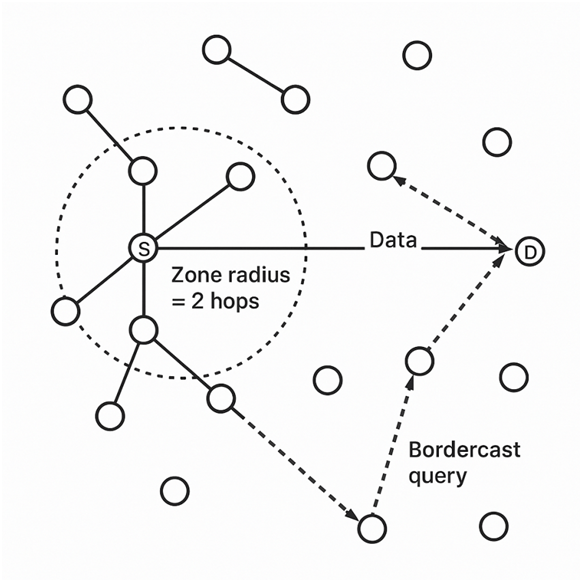
Consider a scenario in which Node S wishes to speak with Node D in a mobile ad hoc network, with a zone radius of two hops, as defined by the Zone Routing Protocol (ZRP). In order to determine whether Node D is within its 2-hop zone, Node S first looks through its local routing table, which is kept up to date by the Intra-zone Routing Protocol (IARP). Since proactive updates are already in place, Node S can deliver the data utilizing the current route right away if Node D is situated inside this zone. On the other hand, Node S turns to the Inter-zone Routing Protocol (IERP) in order to find a route if Node D is outside the 2-hop zone. ZRP employs the Bordercast Resolution Protocol (BRP) to convey the route request just to border nodes, or nodes that are precisely two hops away from Node S, rather than broadcasting it throughout the network. These border nodes either further bordercast the query or locate Node D within their own zones. Node S utilizes this path to transmit the data after receiving a route reply from Node D once it has located Node D within its local zone. By integrating the advantages of proactive and reactive routing techniques, this hybrid system minimizes superfluous network traffic and guarantees effective route finding.
Key Features of Zone Routing Protocol (ZRP)
The Zone Routing Protocol (ZRP) stands out for its hybrid approach and intelligent use of local zones. Here are the key features that define ZRP:
- Hybrid Routing Mechanism: ZRP optimizes performance for a range of network scenarios by combining proactive and reactive routing techniques, which are reactive for nodes outside of a local zone and proactive for nodes inside.
- Zone-Based Structure: Usually expressed in hops, each node establishes a routing zone around itself. This localized structure enables various routing choices while reducing control overhead.
- Intra-zone Routing Protocol (IARP): IARP keeps track of the most recent route data for every node in the immediate area. This guarantees instantaneous access to neighboring nodes.
- Inter-zone Routing Protocol (IERP): IERP minimizes needless bandwidth use by handling on-demand route discovery for targets beyond the local zone.
- Bordercast Resolution Protocol (BRP): BRP sends queries solely to border nodes, or nodes that are precisely at the zone radius’s boundary, reducing flooding during route finding.
- Scalability: Because of its modular design and adjustable zone radius, ZRP scales well with network growth and mobility.
- Less Control Traffic: ZRP minimizes routing control traffic by restricting proactive changes to local zones and effectively utilizing reactive queries.
- Faster Local Communication: Communication within zones is dependable and quick because routes to neighboring nodes are kept up to date proactively.
- Adaptability: The protocol is appropriate for highly mobile environments such as MANETs and VANETs because it dynamically adjusts to changes in topology.
- Modular Architecture: Developers can customize the protocol to meet particular requirements by independently implementing or optimizing each component (IARP, IERP, and BRP).
These features make ZRP a strong candidate for deployment in dynamic wireless networks where both efficiency and scalability are required.
Advantages and Disadvantages of Zone Routing Protocol (ZRP)
The Zone Routing Protocol (ZRP) provides a balanced solution by combining the strengths of proactive and reactive routing strategies. However, like any protocol, it comes with its own set of advantages and disadvantages:
Advantages of ZRP
- Effective Use of Bandwidth: ZRP drastically lowers control packet overhead when compared to strictly proactive or reactive protocols by restricting proactive updates to local zones and reactive queries to border nodes.
- Faster Local Communication: By proactively routing within a zone, local communication latency is reduced and neighboring nodes are guaranteed rapid route availability.
- Scalable in Dense Networks: ZRP’s zone-based design and modular architecture allow it to scale effectively in dense or huge networks.
- Reduces Network Congestion: ZRP lowers the possibility of network flooding and congestion by relying on bordercasting rather than global broadcasts.
- Adaptability to Topology Changes: ZRP adapts effectively to node mobility by just updating zone-specific data, making it easier to handle in dynamic settings such as MANETs.
- Customizable Zone Radius: Depending on node density and mobility patterns, network administrators can adjust the zone radius to maximize performance.
Disadvantages of ZRP
- Implementation Complexity: IARP, IERP, and BRP must coordinate and use more complex logic when combining proactive and reactive methods.
- Zone Radius Affects Performance: Selecting the ideal zone radius is essential. While a high radius raises proactive maintenance costs, a small radius increases reactive overhead.
- Redundant Information in Overlapping Zones: Nodes may store redundant route information due to zone overlap, which results in inefficient memory use.
- Processing Overhead on Border Nodes: The processing and forwarding of route queries places additional strain on border nodes, which may lead to an imbalance in processing or energy resources.
- Not Suitable for Sparse Networks: Because there are fewer intra-zone connections in networks with low node densities, zone-based communication may function poorly.
| Aspect | Advantages | Disadvantages |
| Bandwidth Efficiency | Reduces flooding and overhead | May still have control overhead if zones are large |
| Communication Delay | Fast for local nodes | Delays can occur if zone radius is too small |
| Scalability | Works well in large, dense networks | Poor performance in very sparse networks |
| Implementation | Modular and adaptable | Complex to develop and fine-tune |
ZRP strikes a useful balance for many applications, but its success heavily relies on optimal configuration and the characteristics of the network environment.
Applications of Zone Routing Protocol (ZRP)
The Zone Routing Protocol (ZRP) is well-suited for dynamic, decentralized, and infrastructure-less environments. Its hybrid nature makes it a versatile choice across a variety of wireless network scenarios. Below are some notable applications:
- Mobile Ad Hoc Networks (MANETs): ZRP is especially made for MANETs, which have mobile nodes and a constantly shifting network topology. In such dynamic contexts, it facilitates effective routing with low overhead.
- Disaster Recovery and Emergency Communication: ZRP facilitates the quick deployment of communication networks between rescue teams, drones, and mobility units with effective local and global routing in disaster-affected areas where current infrastructure is destroyed or unavailable.
- Vehicle Ad Hoc Networks (VANETs): ZRP’s quick local route finding and adaptive routing behavior in high-mobility situations, such as highways or urban traffic networks, make it appropriate for vehicle-to-vehicle (V2V) communication.
- Military Tactical Networks: Highly mobile units that need secure, scalable, and delay-tolerant communication are frequently used in military operations. For these kinds of mission-critical settings, ZRP’s zone-based and modular routing is perfect.
- UAV and Drone Swarm Networks: ZRP can be used by unmanned aerial vehicles (UAVs) working in clusters to proactively maintain intra-swarm communication and reactively find inter-swarm paths, maximizing bandwidth and energy consumption.
- Wireless Mesh Networks: By reducing needless data propagation and guaranteeing reliable connectivity, ZRP offers effective route management in mesh networks where nodes serve as both hosts and routers.
- Internet of Things (IoT) with Mobility: ZRP facilitates dependable communication between wearables, sensors, and devices that move around a lot in mobile IoT systems, including smart logistics or mobile healthcare.
- Space and Interplanetary Communication: ZRP’s modular and adaptive routing features provide effective data management between mobile and sporadically linked nodes in delay-tolerant networks used in space missions.
ZRP’s adaptability, scalability, and efficient control overhead make it a strong fit for any environment where mobility, decentralized operation, and network dynamism are significant factors.
Zone Routing Protocol Comparison with Other Protocols
The Zone Routing Protocol (ZRP) offers a balanced solution between the two traditional routing approaches—proactive and reactive—used in mobile ad hoc networks (MANETs). To understand where ZRP stands, let’s compare it with other popular routing protocols:
| Protocol | Routing Type | Route Discovery | Routing Overhead | Latency | Scalability | Best Used In |
| ZRP | Hybrid (Proactive + Reactive) | Local (Proactive), Global (Reactive via border nodes) | Moderate | Low (local), Moderate (global) | High | Dynamic, medium-to-large networks |
| AODV (Ad hoc On-demand Distance Vector) | Reactive | On-demand via network-wide broadcast | Low to Medium | High (due to discovery delay) | Moderate | Small to medium mobile networks |
| DSDV (Destination-Sequenced Distance Vector) | Proactive | Full routing table maintained at all times | High | Low (always available) | Low to Moderate | Static or low-mobility networks |
| DSR (Dynamic Source Routing) | Reactive | On-demand, source-routing with route caching | Low | High (route discovery delay) | Low to Moderate | Low-mobility networks |
| OLSR (Optimized Link State Routing) | Proactive | Maintains topology via multipoint relays | High | Low | Moderate | Dense and stable topologies |
Key Observations:
- ZRP vs. AODV: AODV floods the whole network, even for local destinations, but ZRP minimizes route finding delays for nearby nodes. ZRP uses BRP to restrict flooding to border nodes as well.
- ZRP vs. DSDV: ZRP only proactively updates the local zone, lowering overall overhead while maintaining quick local routing, in contrast to DSDV’s full-table updates.
- ZRP vs. DSR: Because DSR is fully reactive, it may take longer to find and maintain routes than ZRP, which avoids lengthy delays in route discovery for local destinations.
- ZRP vs. OLSR: While both employ proactive routing within a certain scope, ZRP improves performance by skipping global proactive updates, in contrast to OLSR, which keeps track of global topology data continuously.
ZRP effectively fills the gap between the speed of proactive protocols and the efficiency of reactive ones, making it a smart choice for modern wireless network applications with varied mobility and scalability demands.
Conclusion
One cutting-edge hybrid routing system that skillfully blends the advantages of proactive and reactive approaches is the Zone Routing system (ZRP). ZRP strikes a compromise between speed, scalability, and control overhead by keeping up-to-date routes inside a local zone and finding routes for remote nodes reactively. It is flexible and effective for a range of dynamic wireless situations, including disaster recovery operations, mobile ad hoc networks, and vehicular communication systems, thanks to its modular structure, which consists of IARP, IERP, and BRP. However, the proper zone radius setting, which establishes the trade-off between proactive maintenance and reactive discovery, is crucial to ZRP’s efficacy. When properly adjusted, ZRP speeds up communication and drastically cuts down on superfluous routing traffic, especially in medium-sized to large, high-mobility networks. In ZRP is a potent routing solution that offers flexible, zone-based routing, addressing the drawbacks of conventional protocols and making it extremely relevant for the changing needs of networks today.
Frequently Asked Questions (FAQs)
What is the main purpose of ZRP in wireless networks?
ZRP is designed to provide efficient and scalable routing in mobile ad hoc networks (MANETs) by combining proactive and reactive routing strategies. It aims to reduce overhead while maintaining quick access to routing information.
How does ZRP reduce routing overhead compared to traditional protocols?
ZRP limits proactive updates to a node’s local zone and uses bordercasting (not flooding) for route discovery, significantly reducing control message overhead and network congestion.
What are border nodes in ZRP?
Border nodes are nodes that lie exactly at the edge of a node’s zone (i.e., at a distance equal to the zone radius). They are responsible for forwarding route discovery queries to nodes outside the source node’s local zone.
What happens if the zone radius in ZRP is too small or too large?
A small zone radius leads to more frequent reactive route discoveries, increasing delay. A large zone radius increases the amount of proactive maintenance, causing more control traffic. So, selecting an optimal radius is crucial for balancing performance.
In what types of applications is ZRP most suitable?
ZRP is ideal for dynamic, decentralized networks such as MANETs, disaster recovery networks, vehicular ad hoc networks (VANETs), and UAV/drone communication systems, where both fast local communication and scalable routing are needed.