

Introduction
The requirement for reliable and effective routing protocols in Mobile Ad Hoc Networks (MANETs) has grown in significance in the current era of pervasive wireless communication. MANETs are self-organizing networks made up of mobile devices that speak to each other directly without the use of permanent infrastructure such as base stations or routers, in contrast to conventional wired or infrastructure-based wireless networks. Because of its adaptability, MANETs are perfect for a variety of applications, including remote sensing, emergency response, military operations, and vehicular networks. However, maintaining precise and effective routes is extremely difficult in MANETs due to their dynamic and unpredictable character, as nodes join, depart, and shift throughout the network regularly. Selecting the appropriate routing protocol is essential for maximizing bandwidth utilization, reducing latency, and guaranteeing dependable data delivery.
One of the most popular proactive (table-driven) routing protocols created especially for MANETs is Optimized Link State Routing (OLSR). It improves scalability in wireless contexts and lowers control message overhead by extending traditional link-state routing principles with creative enhancements. Through the constant maintenance of current routing data, OLSR facilitates quicker route discovery and guarantees that data packets may be delivered promptly, even in topologies that are changing frequently.
To give you a thorough grasp of why OLSR is still a mainstay in the field of wireless ad hoc networking, we’ll go over what OLSR is, how it operates, its salient characteristics, pros and cons, common applications, and how it stacks up against other ad hoc routing protocols in this blog post.
What is Optimized Link State Routing?
A Proactive Routing Protocol created especially for Mobile Ad Hoc Networks (MANETs) is called Optimized Link State Routing (OLSR). It is an improvement on conventional link-state routing protocols that have been modified to function effectively in the resource-constrained and dynamic setting of wireless ad hoc networks. OLSR was created to overcome the drawbacks of traditional link-state algorithms, such as OSPF, which are employed in wired networks and produce a lot of control traffic when applied carelessly to MANETs. OLSR minimizes bandwidth consumption and speeds up route establishment by optimizing the way routing information is distributed and employing ingenious techniques to cut overhead.
In order to proactively create and maintain routing tables with the most recent routes to every reachable destination in the network, OLSR works by routinely sending Hello and Topology Control (TC) messages between nodes. This eliminates the delays brought on by route discovery as a node already has a route available when it wants to transfer data. The introduction of Multipoint Relays (MPRs), a crucial breakthrough in OLSR, drastically lowers the quantity of redundant control message transmissions. Only selected nodes (MPRs) forward link-state updates rather than all nodes rebroadcasting them, which significantly reduces message flooding and enhances scalability.
After being standardized as RFC 3626 by the IETF MANET Working Group, the OLSR protocol became an official protocol that is often used in both academic and real-world applications. For wireless multi-hop networks, the OLSR is a proactive, table-driven routing protocol that offers dependable and effective routing in situations where infrastructure is impractical or absent.
How OLSR – Optimized Link State Routing Works
Through the periodic exchange of control messages, the proactive (table-driven) OLSR protocol continuously maintains new routes to every node in the network. Its operation is centered on the novel idea of Multipoint Relays (MPRs) and two primary message kinds. Here’s a step-by-step breakdown of how OLSR works:
Neighbor Discovery with Hello Messages: Every node periodically greets its close neighbors with Hello messages. Link sensing is based on these Hello messages, which enable nodes to identify and save data about one-hop and two-hop neighbors.
Selection of Multipoint Relays (MPRs): Instead of having every node broadcast routing updates, OLSR uses a small set of strategically chosen nodes called Multipoint Relays (MPRs).
- To reach all of its two-hop neighbors, each node chooses MPRs from its one-hop neighbors.
- Compared to traditional floods, these MPRs are the only ones in charge of conveying topology information, significantly lowering the number of redundant broadcasts and control overhead.
Topology Control (TC) Messages: Nodes selected as MPRs periodically send Topology Control (TC) messages, which advertise link information to the rest of the network.
- The MPR set is used by TC messages to propagate throughout the network, guaranteeing effective topological data distribution without overburdening the network with pointless messages.
Link State Information Maintenance: Every node keeps an updated routing table with the shortest pathways to every other node using the data from Hello and TC messages.
- OLSR uses a modified version of Dijkstra’s algorithm to compute the best routes based on the collected link-state information.
Route Calculation and Updating: Every node continuously recalculates routes anytime the topology changes (for example, a node moving out of range) because OLSR is proactive. This guarantees that routes are available right away when data packets need to be transmitted.
Key Takeaways of OLSR Operation
- Fast route availability due to proactive approach
- Reduced control message flooding thanks to MPRs
- Periodic updates to adapt to changes in network topology
In essence, OLSR combines the robustness of link-state routing with smart optimizations like MPRs to minimize overhead, making it highly efficient for dynamic, dense wireless networks.
Example of OLSR – Optimized Link State Routing
Scenario: Imagine a small ad hoc network with 6 nodes (A, B, C, D, E, F) arranged as shown below. Each node can directly communicate with its immediate neighbors within its radio range.
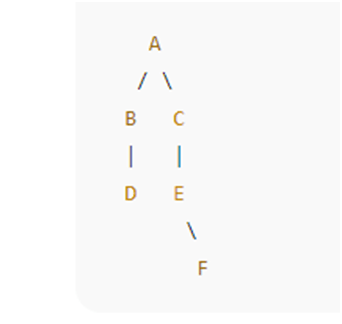
Neighbor Discovery
- Node A sends periodic Hello messages.
- It discovers B and C as its one-hop neighbors.
- Through them, it learns about D, E, and F as two-hop neighbors.
Multipoint Relay (MPR) Selection
- To reach all two-hop neighbors, Node A chooses B and C as MPRs, since:
- B can reach D,
- C can reach E and F.
Topology Information Propagation
- Only MPR nodes B and C will forward A’s topology information via TC messages.
- This reduces overhead because:
- Instead of flooding updates from every node,
- Only MPRs rebroadcast, covering all nodes efficiently.
Routing Table Calculation
Using information from Hello and TC messages, each node builds a routing table with shortest paths to all other nodes. For example:
- Node A’s routing table would show:
- A → B → D
- A → C → E
- A → C → F
Benefits in the Example
- Without MPRs: All nodes would rebroadcast each update → high overhead.
- With MPRs: Only B and C forward updates → efficient communication.
MPR Concept
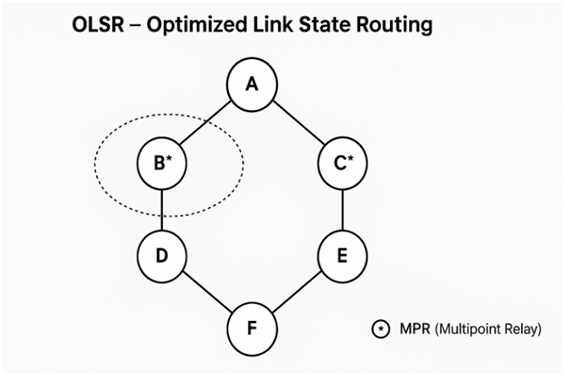
- A’s one-hop neighbors: B, C
- A’s two-hop neighbors: D, E, F
- MPRs (marked with *): B, C → they forward A’s topology updates to cover all nodes.
By selecting B and C as MPRs, OLSR ensures that A’s routing information efficiently reaches the entire network, avoiding redundant broadcasts and minimizing bandwidth usage — this is the essence of OLSR’s optimization.
Key Features of OLSR
- Multipoint Relays (MPRs): The most notable aspect of OLSR is its utilization of MPRs, which reduce flooding of control messages by assigning topological information to just specific nodes. Comparing this to traditional link-state protocols, overhead is significantly reduced.
- Proactive Routing: OLSR always keeps its routing databases current, guaranteeing that data packets have access to routes right away without having to wait for route discovery.
- Periodic TC and Hello Messages: Nodes communicate Topology Control (TC) messages to provide link-state information and Hello messages to identify one-hop and two-hop neighbors, allowing all nodes to have consistent network knowledge.
- Optimized Link-State Dissemination: OLSR’s MPR mechanism makes sure that link-state updates efficiently reach every node, minimizing redundant transmissions, as opposed to distributing them to the whole network.
- Support for IPv4 and IPv6: OLSR offers flexibility in contemporary networks by being made to function with both IPv4 and IPv6.
- Less Control Overhead in Dense Networks: The protocol’s MPR mechanism keeps control messages from flooding the network, which makes it a brilliant design in dense networks.
- Hop-by-Hop Routing: Each node utilizes its routing database to send packets along the best route to the destination when using OLSR’s hop-by-hop forwarding technique.
- RFC Standardized: The IETF defines OLSR in RFC 3626, guaranteeing a generally recognized, uniform implementation for compatibility.
Advantages and Disadvantages of OLSR
Advantages
- Immediate Route Availability: On-demand discovery protocols don’t have to wait for routes to be ready when data needs to be transmitted since OLSR keeps routing tables up to date.
- Effective Propagation of Control Messages: Multipoint Relays (MPRs) significantly cut down on redundant broadcasts, which makes OLSR scalable and effective, particularly in crowded networks.
- Improved Performance in Static or Low-Mobility Networks: When network topology does not change frequently, OLSR’s proactive approach guarantees stable routing.
- Optimized for Dense Networks: OLSR works well for networks with a large number of participants since MPRs maintain a minimal control overhead even as the number of nodes rises.
- Standardized Protocol: OLSR has standardized implementations that guarantee compatibility and interoperability across many systems, as defined in RFC 3626.
Disadvantages
- High Overhead in Sparse or Highly Mobile Networks: In sparse or rapidly changing topologies, periodic Hello and TC messages waste bandwidth even in the absence of data flow.
- Limited Adaptability to Rapid Mobility: If nodes move frequently between Hello or TC intervals, OLSR may continue to use out-of-date routes, which could result in packet losses or less-than-ideal routes.
- Increased Resource Consumption: For devices with limited resources, the requirement for constant processing of link-state data might lead to an increase in CPU and memory utilization.
- Inefficiency in Small Networks: Compared to reactive protocols like AODV or DSR, proactive updates may add needless overhead in small or lightly loaded networks.
Applications of OLSR
- Military Communication Networks: In tactical MANETs, when troops or vehicles require a dependable, infrastructure-free network that offers instantaneous voice, data, or video pathways in situations requiring fast deployment, OLSR is extensively utilized.
- Emergency and Disaster Recovery Networks: Fixed infrastructure may sustain damage or become unavailable during major emergencies or natural disasters. Rescue teams, first responders, and coordination centers can all communicate with one other swiftly thanks to OLSR.
- Wireless Mesh Networks (WMNs): To offer dependable multi-hop connectivity without depending on centralized routers, OLSR is frequently utilized in community networks, rural broadband initiatives, and citywide mesh installations.
- Vehicular Ad Hoc Networks (VANETs): OLSR can aid with entertainment, traffic management, and collision avoidance by facilitating vehicle-to-vehicle (V2V) and vehicle-to-infrastructure (V2I) connections in smart transportation systems.
- Temporary Event Networks: Without requiring permanent infrastructure, OLSR allows event planners to build up temporary Wi-Fi networks for major outdoor gatherings, festivals, or sporting competitions.
- Industrial and IoT Deployments: OLSR’s proactive routing can guarantee timely data transmission in industrial settings or IoT ecosystems that demand dependable communication among sensors, robots, or smart devices.
- Research Testbeds and Simulations: OLSR is widely utilized as a baseline proactive protocol for performance evaluation and protocol comparisons in academic projects and experimental MANET testbeds.
OLSR in Comparison with Other Protocols
To better understand OLSR’s strengths and limitations, it’s useful to compare it with other widely used MANET routing protocols, both proactive and reactive:
OLSR vs. AODV (Ad hoc On-Demand Distance Vector)
- OLSR is proactive: it maintains routes at all times, ensuring immediate availability.
- AODV is reactive: it finds routes only when needed, reducing control overhead in low-traffic or sparse networks.
- OLSR is better for dense, stable networks; AODV adapts better to high-mobility, low-bandwidth environments.
OLSR vs. DSR (Dynamic Source Routing)
- OLSR uses hop-by-hop routing with tables maintained proactively.
- DSR uses source routing: packets carry the complete route, adding overhead to data packets.
- OLSR offers faster forwarding thanks to hop-by-hop routing; DSR avoids routing tables but is inefficient for long paths or large networks.
OLSR vs. TBRPF (Topology Broadcast based on Reverse-Path Forwarding)
- Both are proactive link-state protocols optimized for MANETs.
- TBRPF updates only parts of the topology that have changed (differential updates), often resulting in lower control overhead than OLSR.
- OLSR uses MPRs for optimized flooding; TBRPF uses a spanning tree approach.
OLSR vs. DSDV (Destination-Sequenced Distance-Vector)
- Both are proactive protocols.
- DSDV is based on distance-vector routing and sends entire routing tables periodically.
- OLSR is based on link-state routing with optimized flooding using MPRs, resulting in better scalability in dense networks.
Summary Comparison Table,
| Feature | OLSR | AODV | DSR | DSDV |
| Type | Proactive | Reactive | Reactive | Proactive |
| Control Overhead | Medium–High | Low–Medium | Low–Medium | High |
| Route Discovery | Immediate | On-demand | On-demand | Immediate |
| Scalability | Good in dense | Better in sparse | Poor in large networks | Limited scalability |
| Mobility Handling | Limited in high mobility | Good | Good | Poor |
| Optimization | MPRs for flooding | Expanding Ring Search | Source routing | Sequence numbers |
Conclusion
One particularly effective proactive routing system designed for the dynamic surroundings of Mobile Ad Hoc Networks (MANETs) is Optimized Link State Routing (OLSR). OLSR is an effective option for dense and moderately mobile networks because it drastically lowers control message overhead by fusing conventional link-state concepts with the creative application of Multipoint Relays (MPRs). In situations when communication delays are undesirable, such military operations, emergency response, or wireless mesh networks, OLSR guarantees instant route availability, which is crucial. It’s critical to understand its limitations, too, as the protocol’s proactive approach might not be able to keep up with frequent topology changes, and its periodic control messages may waste bandwidth in highly mobile or sparse networks. In the end, OLSR is a foundational protocol in the field of ad hoc networking and a useful tool for researchers, developers, and network planners since its merits lay in situations where scalability and fast, dependable routes are more crucial than minimizing control overhead.
Frequently Asked Questions (FAQ)
What problem does OLSR solve?
By proactively updating routing tables, OLSR ensures instant route availability when data has to be transferred, resolving the problem of rapidly locating and maintaining routes in dynamic wireless ad hoc networks.
How do Multipoint Relays (MPRs) make OLSR more efficient?
By permitting only specific nodes to forward topology updates, MPRs lessen duplicate flooding of control messages. Control overhead is greatly reduced by this technique, particularly in crowded networks.
Is OLSR suitable for highly mobile networks?
Not all the time. Static or low-mobility situations are ideal for OLSR performance. Routes may rapidly become out-of-date in highly mobile circumstances, resulting in packet losses or less-than-ideal routes.
Does OLSR support both IPv4 and IPv6?
Indeed. OLSR is adaptable to both current and future network installations because it is made to function with both IPv4 and IPv6.
What are some real-world applications of OLSR?
OLSR is utilized in emergency response networks, military communication systems, industrial IoT applications when infrastructure is absent, vehicle networks, wireless mesh networks for rural access, and temporary event networks.