
Introduction
Reliable, long-range, and energy-efficient communication solutions are more important than ever in the quickly developing Internet of Things (IoT) space. Conventional short-range methods like Wi-Fi or Bluetooth are inadequate when billions of devices are anticipated to connect and exchange data, particularly in distant or expansive outdoor settings. LoRaWAN (Long Range Wide Area Network) becomes a potent remedy in this situation. A Low Power Wide Area Network (LPWAN) protocol called LoRaWAN was created to wirelessly link long-distance battery-operated devices to the internet. It is perfect for applications like smart cities, smart agriculture, industrial IoT, and environmental monitoring since it allows low data rate communication over a wide range with little power consumption. LoRaWAN, created and managed by the LoRa Alliance, provides a scalable, flexible, and safe method of establishing extensive networks of Internet of Things sensors and devices. This blog will offer a thorough analysis of LoRaWAN, including its main functions, practical uses, benefits, and comparisons to other communication protocols in the Internet of Things environment.
What is LoRaWAN?
A communication protocol called LoRaWAN (Long Range Wide Area Network) was created especially for long-distance, low-power wireless communication between Internet of Things devices. LoRaWAN functions as the Media Access Control (MAC) layer protocol that regulates data transmission and reception across the network, while LoRa (Long Range) is the physical layer (radio frequency modulation technology) upon which it operates. Through gateways and network servers, LoRaWAN makes it possible for end devices, such as sensors or actuators, to connect to the internet. It is best suited for uses where devices must occasionally communicate modest amounts of data and run for years on a single charge. LoRaWAN networks are appropriate for wide-area deployments because they can span several kilometers in rural regions and up to a few kilometers in urban areas. The protocol allows for a star-of-stars architecture, in which gateways and end devices use LoRa to interact directly. The gateways then use common IP connections to send the data to a central network server. Data is then sent to application servers so that it can be processed. Key points about LoRaWAN are:
- Developed and maintained by the LoRa Alliance.
- Operates in unlicensed ISM bands (e.g., 868 MHz in Europe, 915 MHz in North America).
- Uses AES-128 encryption to ensure secure communication.
- Supports different device classes (A, B, and C) to accommodate various energy and latency needs.
In essence, LoRaWAN bridges the gap between long-range connectivity and low-power consumption, making it a cornerstone technology for IoT deployments that demand wide coverage, minimal infrastructure, and extended device battery life.
How LoRaWAN (Long Range Wide Area Network) Works?
LoRaWAN makes it possible for low-power Internet of Things devices to wirelessly connect to a central network across great distances while consuming very little power. It employs a star-of-stars topology in which gateways connect to a network server that controls data flow and network integrity after end devices (such as sensors or meters) communicate with them. After that, the server forwards the information to the appropriate application servers for processing or archiving. Here’s a breakdown of how LoRaWAN works are:
1. End Devices (Nodes): These are IoT devices that run on batteries and have LoRa transceivers installed, such as temperature sensors and trackers. They communicate with the closest gateway on a regular basis by sending uplink messages, which are little data packets. Additionally, the network may send them downlink signals based on their class (A, B, or C).
- Class A: Most energy-efficient. Devices only open receive windows after sending data.
- Class B: Scheduled receive slots using synchronized beacons.
- Class C: Continuously listening (lowest latency, highest power use).
2. Gateways: Gateways act as bridges between the end devices and the internet. They receive LoRa radio signals from nearby devices and forward them over IP (via Ethernet, Wi-Fi, or cellular) to the central network server. Gateways are transparent—they don’t process or alter the data.
3. Network Server: The network server authenticates devices, manages the network, filters duplicate messages, performs adaptive data rate control, and ensures secure data delivery. It’s the brain of the LoRaWAN system.
4. Application Server: The application server receives data from the network server and presents it to users or other systems. For example, data from a water-level sensor might be visualized on a dashboard or used to trigger alerts.
5. Communication Characteristics:
- Uplink (Device to Network): Devices send data packets to the gateway.
- Downlink (Network to Device): Server sends messages (e.g., commands or acknowledgments) back to the device.
- Spreading Factor (SF): LoRaWAN uses adaptive data rate (ADR) to adjust the spreading factor, balancing range and power efficiency.
Because LoRaWAN uses unlicensed ISM frequency channels, it can be deployed freely and publicly without the need for expensive spectrum licensing. It offers long-range capability and strong resilience against interference through the use of chirp spread spectrum modulation. To put it briefly, LoRaWAN connects basic, low-power devices to a central network via gateways over long distances. It is perfect for extensive IoT networks because of its architecture, which allows for scalability, flexibility, and long battery life.
Example of LoRaWAN (Long Range Wide Area Network)
To better understand how LoRaWAN functions in the real world, let’s look at a practical example: Smart Agriculture using LoRaWAN.
Scenario: Smart Irrigation System on a Farm
Numerous weather stations, temperature sensors, and soil moisture sensors are positioned throughout the fields of a sizable farm. All of these battery-operated gadgets must periodically send tiny amounts of data in order to monitor environmental conditions and optimize irrigation.
How LoRaWAN Is Used:
- Deployment of End Devices: Moisture and temperature sensors are installed in various zones of the farm. These devices are equipped with LoRa transceivers and configured to transmit data every hour.
- Communication with Gateways: The sensors send data packets wirelessly to nearby LoRaWAN gateways. Even if some sensors are several kilometers away, the long-range capability of LoRa allows communication without the need for repeaters.
- Data Transmission to the Network Server: The gateways receive signals and forward the raw sensor data to a central network server via the internet. The gateway itself doesn’t process the data—it simply relays it.
- Data Processing and Decision Making: The network server validates the data and routes it to an application server, where it is analyzed. The system can determine which zones need irrigation based on real-time moisture levels.
- Automated Actions (Downlink Communication): If irrigation is needed in a particular area, a command is sent back via LoRaWAN to activate a smart valve connected to a water supply. This is a downlink message sent from the application server to the field device.
- Low Power and Maintenance: Because of LoRaWAN’s low energy consumption, the devices can run on batteries for several years without needing replacement, even in remote parts of the farm.
Benefits in This Example:
- Wide coverage without laying cables or installing cellular towers.
- Real-time monitoring and control, improving crop yield and resource efficiency.
- Minimal operational cost due to unlicensed spectrum use and low power consumption.
This example highlights how LoRaWAN can enable cost–effective, efficient, and scalable IoT solutions in challenging environments—demonstrating its suitability for agriculture, smart cities, and beyond.
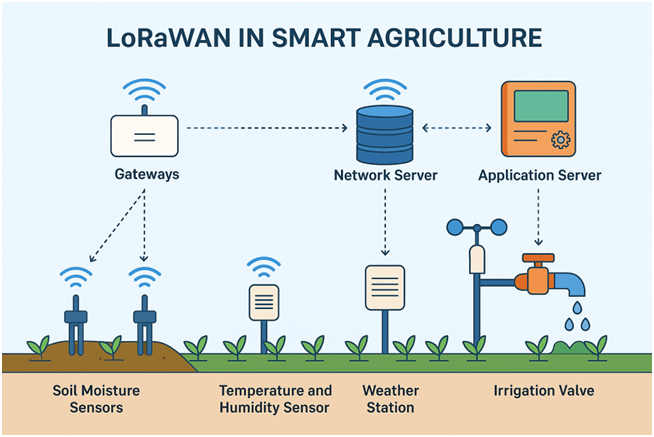
LoRaWAN is essential for monitoring environmental conditions and optimizing irrigation over vast farmlands in a smart agriculture scenario. Consider a farm that has several sensors positioned around the fields, such as weather monitoring equipment, temperature and humidity sensors, and soil moisture sensors. Long-range wireless communication is made possible by the LoRa module that powers each of these battery-operated sensors. These gadgets send data to a LoRaWAN gateway at the farm’s edge on a regular basis (once every hour, for example). The gateway gathers this information and sends it to a central network server over the internet. The data is then sent to an application server, where it is examined to ascertain each crop zone’s present water needs and environmental circumstances. Through the LoRaWAN network, a command is transmitted back to activate an irrigation valve in a designated zone of the field if it becomes excessively dry. All of this communication is made possible by LoRaWAN’s long-range capacity, which allows it to occur even over kilometers without the need for substantial cable or cellular access. Additionally, the sensors can operate for several years on tiny batteries due to their low power consumption, which lowers labor and maintenance expenses. This illustration amply illustrates how LoRaWAN uses effective, scalable, and energy-efficient technology to improve agricultural productivity, save water, and facilitate data-driven farming.
Key Features of LoRaWAN (Long Range Wide Area Network)
A strong and adaptable communication protocol, LoRaWAN was created to meet the particular needs of Internet of Things (IoT) applications. Its many advantages make it perfect for secure, low-power, long-range wireless communication in a variety of industries. Here are the key features of LoRaAN are:
- Long-Range Communication: In rural areas, LoRaWAN can send data up to 15 km, while in urban areas, it can send data up to 2–5 km. Chirp spread spectrum modulation, which is impervious to interference and signal deterioration, is used to provide this extensive coverage.
- Low Power Consumption: LoRaWAN’s extremely low power consumption is one of its most important characteristics. Depending on how they are used and configured, devices can run for five to ten years on a single battery. For remote, battery-operated sensors, this makes it perfect.
- Operates in Unlicensed Spectrum: LoRaWAN lowers operating costs and permits public or private network deployments without the requirement for expensive licensing by utilizing free-to-use ISM bands (such as 868 MHz in Europe and 915 MHz in North America).
- Scalability: LoRaWAN networks can be deployed across the country or as tiny local networks (like those on a school or farm). Large-scale IoT projects can benefit from a single gateway’s ability to manage thousands of devices at once.
- Bidirectional Communication: Uplink (device to server) and downlink (server to device) communication are both supported by LoRaWAN. This makes it possible to remotely control and configure field devices in addition to reporting data.
- Multiple Device Classes: LoRaWAN supports three classes of devices to meet different energy and latency needs:
- Class A: Ultra-low power, communication only after transmission (default).
- Class B: Scheduled receive windows using time-synchronized beacons.
- Class C: Almost continuous listening, higher power usage.
- Adaptive Data Rate (ADR): The network server can optimize data transmission using adaptive data rate settings. This improves battery life and network capacity by adjusting the spreading factor based on signal strength and distance.
- Strong Security: LoRaWAN implements end-to-end AES-128 encryption for data integrity and confidentiality. It uses two layers of encryption:
- Network-level encryption for authentication.
- Application-level encryption for data privacy.
- GPS-Free Localization: Using signal triangulation between gateways, LoRaWAN facilitates geolocation. This lowers costs and battery usage by enabling device monitoring without the requirement for GPS hardware.
- Low-Cost Infrastructure: LoRaWAN provides a low-cost substitute for cellular and satellite connectivity, particularly in remote or rural installations, due to its low infrastructure needs (gateways, servers) and unlicensed spectrum operation.
With its long-range, inexpensive, and energy-efficient communication capabilities, LoRaWAN is a potent enabler for a wide range of applications, from industrial IoT and asset tracking to smart cities and smart agriculture.
Advantages and Disadvantages of LoRaWAN
LoRaWAN is a well-liked option for Internet of Things applications due to its many advantages, particularly when low power consumption and long-range communication are crucial. It does have some restrictions, though, just like any other technology. A fair summary of LoRaWAN’s benefits and drawbacks may be found here.
Advantages of LoRaWAN
- Long-Range Communication: LoRaWAN is perfect for rural, agricultural, or industrial settings with dispersed infrastructure since it can send data across several kilometers.
- Ultra-Low Power Consumption: Depending on the setup and transmission frequency, LoRaWAN-enabled devices can run on batteries for five to ten years. This is perfect for places that are difficult to access and lowers maintenance.
- Uses Unlicensed Spectrum: It makes use of open ISM bands, such as 868 MHz in Europe and 915 MHz in North America, which lowers spectrum licensing costs and permits adaptable public or private network configurations.
- Scalability: LoRaWAN is scalable for both small- and large-scale deployments, with the ability to accommodate thousands of devices per gateway.
- Bi-Directional Communication: Facilitates remote device administration and control by supporting both uplink (sensor data) and downlink (device commands).
- Secure Data Transmission: Provides strong security by implementing end-to-end AES-128 encryption, which includes payload encryption and device authentication.
- Cost-Effective Infrastructure: Compared to cellular or satellite alternatives, LoRaWAN networks are significantly less expensive due to their utilization of unlicensed spectrum and the low hardware requirements (gateways and servers).
- GPS-Free Geolocation: This technology does not require costly and energy-intensive GPS modules because it uses signal triangulation to track location.
Disadvantages of LoRaWAN
- Low Data Rates: LoRaWAN is intended for sparse, episodic data transmissions. Large file transfers or other high-data applications like streaming videos are not appropriate for it.
- Limited Bandwidth: Devices are limited in how frequently they can transmit due to regional duty cycle constraints and narrowband operation, which may not be appropriate for all use cases.
- Congestion and Interference: Because LoRaWAN operates in unlicensed channels, it may be vulnerable to interference from other devices that share the same frequency range, particularly in locations with a high population density.
- Latency: Time-sensitive applications shouldn’t use LoRaWAN. When real-time communication is required, uplink and downlink delays, particularly in Class A devices, might impact performance.
- Limited Quality of Service (QoS): It may not always provide dependable message transmission due to its low bandwidth and duty cycle limits, particularly during network congestion.
- Infrastructure Issues in Urban regions: Although LoRaWAN works well in rural regions, signal attenuation in densely populated urban areas may necessitate the use of additional gateways to sustain coverage.
| Feature | Advantage | Disadvantage |
| Range | Long-range (up to 15 km) | May require more gateways in cities |
| Power | Long battery life | Not suitable for high-power tasks |
| Cost | Low infrastructure cost | Limited QoS guarantees |
| Security | Strong AES-128 encryption | Requires secure provisioning |
| Data | Bi-directional communication | Low bandwidth and speed |
To sum up, LoRaWAN works well for applications like asset tracking, smart farming, and environmental monitoring that require long-range, low-power, and low-data-rate communication. However, other protocols like NB-IoT or Wi-Fi can be better suitable for real-time, high-speed, or large-data requirements.
Applications of LoRaWAN (Long Range Wide Area Network)
LoRaWAN is a low-power, long-range, and cost-effective communication technology widely adopted across industries, particularly where devices must operate in remote or hard-to-reach areas with minimal maintenance. Its ability to transmit small amounts of data over long distances while conserving energy makes it an ideal solution for a variety of IoT applications.
- Smart Agriculture: LoRaWAN supports monitoring of soil moisture, temperature, humidity, and livestock movement, helping farmers optimize irrigation, conserve water, and boost crop yields. For example, soil sensors can transmit data to automate irrigation schedules, reducing both labor and water usage.
- Smart Cities: Urban applications of LoRaWAN include street lighting control, waste management, air quality monitoring, and parking management. It enables cities to reduce operational costs and energy consumption while improving service efficiency. A typical use case is smart bins that send alerts when full, allowing for optimized waste collection routes.
- Environmental Monitoring: LoRaWAN networks enable real-time tracking of pollution levels, water quality, flood risks, and forest fire threats. Early warning systems, such as river level sensors in flood-prone areas, send immediate alerts to authorities, enabling timely intervention and disaster prevention.
- Asset Tracking: From vehicles and shipping containers to packages and livestock, LoRaWAN facilitates low-power, long-distance tracking. GPS trackers equipped with LoRaWAN can monitor container movement in real time, improving visibility and preventing theft.
- Industrial IoT (IIoT): Industries use LoRaWAN to monitor equipment performance, perform predictive maintenance, and detect leaks in pipelines or machinery. For instance, oil pipeline sensors can instantly alert operators to leaks, reducing response time and minimizing environmental damage.
- Smart Buildings: In building automation, LoRaWAN enables energy monitoring, HVAC control, occupancy detection, and leak detection. Air quality sensors can adjust ventilation systems automatically, ensuring comfort, safety, and energy efficiency.
- Utilities and Energy Management: LoRaWAN powers smart metering systems for electricity, water, and gas, enabling remote meter reading and reducing the need for manual data collection. This improves billing accuracy and operational efficiency as smart meters transmit real-time consumption data to utility providers.
- Healthcare and Elderly Care: Hospitals and care facilities benefit from LoRaWAN through patient monitoring, medical asset tracking, and elderly fall detection systems. Wearable devices can alert caregivers if a patient falls or leaves a designated area, improving safety and response times.
- Logistics and Supply Chain: In logistics, LoRaWAN ensures real-time monitoring of temperature-sensitive goods and warehouse inventory. Cold chain sensors, for example, track conditions during vaccine transport to maintain quality and compliance.
- Disaster Management and Public Safety: LoRaWAN plays a role in earthquake detection, landslide monitoring, and emergency coordination. Early warning systems using LoRaWAN nodes can send alerts to affected areas, enabling rapid response and potentially saving lives.
LoRaWAN’s versatility, long-range communication, and energy efficiency make it a key enabler of smarter and more effective systems in diverse sectors. Whether deployed in rural farmlands, dense urban centers, industrial facilities, or healthcare environments, it reduces infrastructure needs while providing reliable and scalable connectivity.
LoRaWAN Compare with Other Protocols
Several Low Power Wide Area Network (LPWAN) technologies, including LoRaWAN, are intended for long-distance, low-power Internet of Things communications. While it is unique in many respects, it is also limited in comparison to other protocols such as Wi-Fi, Sigfox, Zigbee, and NB-IoT. Determining LoRaWAN’s applicability for particular IoT use cases is made easier by knowing how it compares.
A thorough comparison of LoRaWAN and other protocols can be found below:
Comparison Table: LoRaWAN vs Other IoT Protocols
| Feature | LoRaWAN | NB-IoT | Sigfox | Zigbee | Wi-Fi |
| Range | 2–15 km | 1–10 km | 3–10 km | 10–100 m | 20–100 m |
| Power Consumption | Very Low | Low | Very Low | Medium | High |
| Bandwidth / Data Rate | Low (0.3–50 kbps) | Medium (up to 250 kbps) | Very Low (100 bps) | High (250 kbps) | Very High (Mbps) |
| License Requirement | No (unlicensed) | Yes (licensed cellular spectrum) | No (unlicensed) | No (unlicensed) | No (unlicensed) |
| Network Type | Public/Private | Public (operator-based) | Public | Private | Private |
| Deployment Cost | Low | High (operator dependent) | Low | Medium | High |
| Scalability | High | Very High | Medium | Low | Low |
| Latency | Medium to High | Low | High | Low | Very Low |
| Security | AES-128 encryption | SIM-based & encryption | Basic encryption | AES-128 encryption | WPA/WPA2/WPA3 |
| Use Case Suitability | Agriculture, smart cities, asset tracking | Industrial, smart metering | Basic sensing, rural areas | Home automation | High-speed data (CCTV, laptops) |
LoRaWAN vs NB-IoT
- LoRaWAN is ideal for battery-powered and rural IoT devices with infrequent data transmission.
- NB-IoT offers better QoS and supports higher data volumes, but it requires SIM cards and licensed spectrum, which adds cost and complexity.
LoRaWAN vs Sigfox
- Both use unlicensed spectrum and focus on low-power, long-range communication.
- LoRaWAN supports bidirectional communication and local private networks, while Sigfox is limited to uplink and relies on a centralized global operator.
LoRaWAN vs Zigbee
- LoRaWAN is for long-range, low-data applications, whereas Zigbee is for short-range, mesh network setups like home automation.
- Zigbee supports higher data rates, but requires more power and dense deployment of nodes.
LoRaWAN vs Wi-Fi
- LoRaWAN is not a replacement for Wi-Fi, as it handles very small data packets with low frequency.
- Wi-Fi is suitable for high-speed, high-volume, short-range communication, but is power-hungry and not ideal for battery-powered IoT devices.
| Protocol | Best For |
| LoRaWAN | Wide-area, low-power, low-data IoT (e.g., agriculture, environmental monitoring) |
| NB-IoT | Carrier-grade, moderate-power, real-time applications (e.g., smart metering, healthcare) |
| Sigfox | Ultra-simple, low-volume uplink-only applications (e.g., rural sensors) |
| Zigbee | Indoor, mesh-based, moderate-power applications (e.g., smart homes) |
| Wi-Fi | High-speed local communication (e.g., video, computers, real-time control) |
Applications needing long-range coverage, low power consumption, and low data throughput—particularly in rural or remote areas—benefit greatly from LoRaWAN. For many IoT use cases, its affordability, adaptability, and simplicity of deployment make it a great option, even though it might not be able to match the data rate or latency performance of other technologies like NB-IoT or Wi-Fi.
Conclusion
Long Range Wide Area Network, or LoRaWAN, has become a potent and adaptable communication protocol designed to meet the expanding needs of the Internet of Things (IoT). Smart cities, smart agriculture, industrial automation, and environmental monitoring are just a few of the many applications that benefit greatly from its long-range, low-power, and reasonably priced wireless communication. Even in remote or infrastructure-poor areas, LoRaWAN’s scalable and sustainable IoT deployments are made possible by its adaptable design, support for battery-powered devices, and unlicensed spectrum operation. Although it has latency and data rate restrictions, its capabilities are in safely and efficiently sending little data packets across large distances. LoRaWAN is a significant facilitator of low-power wide-area networking that helps close the gap between connected devices and actionable data as cities and industry continue to embrace digital transformation. In the upcoming years, its use is anticipated to increase quickly, confirming its position as a key technology in the Internet of Things ecosystem.
Frequently Asked Questions (FAQs)
What is the difference between LoRa and LoRaWAN?
Answer: The physical layer (radio modulation method) that makes long-distance communication possible is called LoRa. Conversely, LoRaWAN is the network protocol that specifies how information is exchanged between devices and the network infrastructure via LoRa. To put it simply, LoRaWAN is the software protocol that is utilized on top of LoRa, which is the hardware-level technology.
How far can LoRaWAN transmit data?
Answer: Depending on variables including geography, antenna height, and environmental interference, LoRaWAN can send data up to 15 km in rural areas and 2–5 km in urban settings. The real range varies according to device power and network configuration.
Is LoRaWAN secure for data communication?
Answer: LoRaWAN is safe, yes. For both network-level and application-level security, it employs AES-128 encryption, guaranteeing data protection from beginning to end. Additionally, every device has a unique key for message integrity and safe authentication.
Can LoRaWAN be used indoors?
Answer: It is possible to use LoRaWAN indoors, particularly in commercial or industrial facilities. However, obstructions like floors and walls might weaken the signal. Adding more gateways can enhance coverage indoors.
What types of applications are best suited for LoRaWAN?
Answer: Low-data-rate, battery-powered applications that need long-range communication are the ideal fit for LoRaWAN. Smart metering, asset tracking, environmental monitoring, smart agriculture, and smart city infrastructure like trash management and street lighting are typical examples.