
Introduction
Millions of smart devices are being deployed in settings where power, memory, and network dependability are significant limitations in the quickly changing Internet of Things (IoT) ecosystem. These settings are frequently referred to as Low-power and Lossy Networks (LLNs), and include smart homes, industrial systems, and environmental monitoring networks. Such restricted contexts are not well suited for conventional routing protocols, which is why customized protocols have been developed to satisfy their particular needs. RPL (Routing Protocol for Low-power and Lossy Networks) is one such protocol that was first presented by the Internet Engineering Task Force (IETF) in RFC 6550. A distance-vector routing protocol called RPL was created especially for IPv6-based networks that have high error rates, frequent topology changes, and low resources. By creating optimum routes with a flexible and adaptive framework, it guarantees dependable and effective routing. This blog post offers a thorough explanation of RPL, including its primary functions, benefits and drawbacks, and applications in a range of IoT sectors. Understanding RPL is crucial for creating effective and long-lasting network solutions, regardless of your level of familiarity with networking or your exploration of IoT communication stacks as an engineer.
What is RPL ?
The Internet Engineering Task Force (IETF) created the specialized routing protocol known as RPL (Routing Protocol for Low-power and Lossy Networks) for IPv6-based LLNs. It is a component of the IPv6 over Low-Power Wireless Personal Area Networks (6LoWPAN) framework and was standardized in RFC 6550 in 2012. LLNs usually consist of embedded devices including sensors, actuators, and microcontrollers that are subject to stringent limitations, such being battery-operated, having a small amount of memory and computing power, and communicating via erratic wireless networks. Because of their overhead and presumptions on network capacity and stability, traditional IP routing protocols like OSPF and RIP are inappropriate for these kinds of networks. RPL addresses these limitations by:
- In order to depict the routes taken by devices to a central root (such as a border router), a Destination-Oriented Directed Acyclic Graph (DODAG) must be created.
- Facilitating various traffic flow types, including Point-to-Point (P2P), Multipoint-to-Point (MP2P), and Point-to-Multipoint (P2MP).
- Through Objective Functions (OFs), which specify how routing parameters like hop count, link quality, or energy are used to construct paths, bespoke routing behavior is made possible.
RPL is essentially an energy-efficient, flexible, and lightweight routing protocol that is tailored to the difficulties and constraints of LLNs. It is extensively utilized in Internet of Things applications where dependable communication over limited networks is essential, such as smart grid systems, industrial automation, and environmental monitoring.
How RPL (Routing Protocol for Low-power and Lossy Networks) Works?
A unique routing structure known as a Destination-Oriented Directed Acyclic Graph (DODAG) is created by RPL. Data can move effectively from a number of network devices to a central root node (usually a gateway or border router) thanks to this graph. In a network where devices may join, depart, or migrate often, the structure guarantees loop-free and efficient pathways. Key Components of RPL Operation:
1. DODAG (Destination-Oriented Directed Acyclic Graph):
- A DODAG is a tree-like structure in which, according to specific metrics, each node chooses a preferred parent.
- The majority of traffic goes to the root node, while other nodes arrange themselves in levels (referred to as ranks) according to how far away or expensive they are from the root.
- Each node avoids loops by never choosing a child as a parent, and nodes with lower ranks are nearer the root.
2. RPL Control Messages:
RPL uses ICMPv6 control messages to build and maintain the DODAG:
- DIO (DODAG Information Object): Advertises DODAG configuration and helps nodes discover and join the network.
- DAO (Destination Advertisement Object): Used by nodes to inform their parents or the root about downward routes.
- DIS (DODAG Information Solicitation): Sent by nodes to request DIOs from neighbors when they want to join or learn about the network.
3. Objective Function (OF):
- Determines how a node chooses its preferred parent based on metrics like link reliability, hop count, residual energy, or latency.
- Examples include OF0 (Objective Function Zero) and MRHOF (Minimum Rank with Hysteresis Objective Function).
4. Routing Directions:
- Upward Routing (MP2P – Multipoint to Point): Traffic from many nodes flows toward the root.
- Downward Routing (P2MP – Point to Multipoint): The root sends data to child nodes using either storing or non-storing modes.
- Point to Point (P2P): Nodes communicate directly using the structure defined by the DODAG.
Example Flow:
- The root node sends DIO messages.
- Other nodes receive these and calculate their rank.
- Each node selects a parent and sends DAO to inform about reachable destinations.
- Routes are maintained dynamically as nodes adjust to changes in topology or link quality.
Example of RPL (Routing Protocol for Low-power and Lossy Networks)
Let’s look at a smart agricultural scenario where multiple sensor nodes are placed throughout a sizable farm to track temperature, humidity, and soil moisture in order to gain a better understanding of how RPL functions in real life. For processing and decision-making, these sensor nodes—which are low-power devices that make up a wireless network—must transmit their data to a root node, which is the central control unit.
Network Setup:
- Sensor Nodes: Spread across the farm in different zones.
- Root Node: Located in a control room with internet connectivity.
- The nodes form an IPv6-based LLN using RPL as the routing protocol.
Step-by-Step RPL Operation in This Example:
- DODAG Creation: The root node (control unit) starts by sending DIO (DODAG Information Object) messages. Neighboring sensor nodes receive these DIOs and calculate their rank based on link quality, signal strength, or hop count.
- Parent Selection: Each sensor node selects a preferred parent (usually the neighbor with the lowest rank and best link quality). This parent-child relationship continues until all nodes are connected, forming a DODAG rooted at the control unit.
- Data Transmission: Sensor nodes begin to send upward traffic (MP2P) through their parents toward the root node. The root node receives and stores this data for monitoring and analysis.
- Route Advertisement: If the root needs to send configuration commands back to specific nodes (e.g., change sampling frequency), it sends DAO (Destination Advertisement Object) messages to learn downward paths. Once paths are known, P2MP (Point-to-Multipoint) communication occurs from the root to the nodes.
- Dynamic Maintenance: If a node detects poor connectivity or failure in its current parent, it can switch to a better alternative by receiving new DIOs and updating its rank. This dynamic repair mechanism ensures resilience in changing field conditions (like a node running out of battery or moving signal barriers).
In a smart agriculture scenario, dozens of low-power sensor nodes are scattered across a large farm to monitor soil moisture, temperature, and humidity levels. At the center of the network is a root node, typically a control unit or gateway connected to the internet. RPL begins its operation when the root node sends DODAG Information Object (DIO) messages to announce its presence. Nearby sensor nodes receive these messages, calculate their rank based on factors like link quality and hop count, and select the most suitable preferred parent to forward their data toward the root. This process repeats across the network until all nodes are connected, forming a Destination-Oriented Directed Acyclic Graph (DODAG). Once established, the sensors transmit their readings as upward traffic toward the root, which collects and processes the data. If the control unit needs to send configuration updates or commands to specific sensors, it uses Destination Advertisement Object (DAO) messages to learn downward routes, enabling point-to-multipoint communication. Over time, if any sensor detects poor connectivity—perhaps due to interference or a dead battery—it dynamically switches to a better parent node without disrupting the entire network. This self-healing, energy-efficient, and reliable routing process demonstrates why RPL is widely used in large-scale IoT deployments such as agriculture, smart cities, and environmental monitoring.
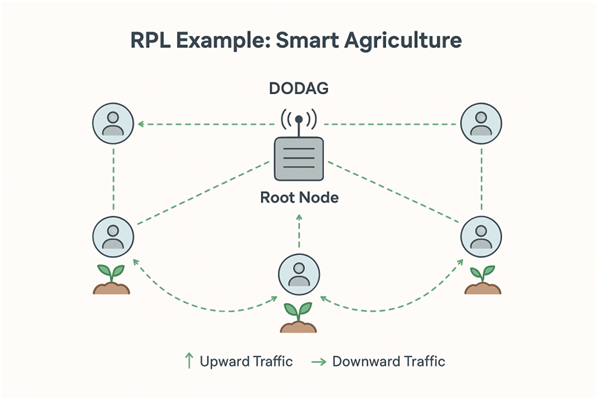
In practical IoT applications, this straightforward example demonstrates how RPL makes energy-efficient, scalable, and dependable routing possible for LLNs. RPL makes sure that even the tiniest sensor devices can remain connected and send vital data over erratic wireless networks, whether the application is smart cities, smart farming, or industrial monitoring.
Key Features of RPL (Routing Protocol for Low-power and Lossy Networks)
RPL is especially well-suited for low-power and lossy networks, such those seen in wireless sensor systems and the Internet of Things, because to its many potent characteristics. In dynamic and limited network situations, these features prioritize assuring dependability, energy efficiency, flexibility, and adaptation.
- Destination-Oriented Directed Acyclic Graph (DODAG) : RPL builds a tree-like structure where each node joins the network based on its position relative to a root node. The DODAG ensures loop-free and optimized routes for data transmission toward the destination.
- Support for Multiple Traffic Patterns
- Multipoint-to-Point (MP2P): Devices send data to a central collector (most common in sensor networks).
- Point-to-Multipoint (P2MP): A central controller sends data to multiple devices (e.g., commands or updates).
- Point-to-Point (P2P): Communication between two devices in the network.
- Objective Function (OF) Flexibility: RPL supports different Objective Functions, allowing network designers to optimize routes based on metrics like: Hop count, Link reliability, Energy availability and Latency. This makes RPL highly adaptable to diverse application needs.
- Loop Avoidance and Detection: RPL enforces a rigorous rank-based hierarchy to guarantee loop-free routing. Routing loops are avoided since nodes are unable to select peers or children as parents. RPL occasionally has tools to dynamically identify and fix loops.
- Energy Efficiency: This feature is essential for battery-operated devices since it minimizes control overhead and lowers energy usage. Nodes save electricity and bandwidth by only sending control messages when required (trickle algorithm).
- Support for Multiple Instances: RPL enables the operation of several separate DODAGs (referred to as RPL instances) on the same network. This makes it possible for various traffic types—such as essential and non-critical—to employ distinct routing criteria.
- Scalability: Because of its lightweight design and hierarchical routing methodology, RPL can accommodate networks with hundreds or thousands of nodes. Even in large-scale deployments, effective communication is guaranteed by its modular design.
- IPv6 Interoperability: RPL is compatible with contemporary internet architectures and worldwide connection because it is built to function flawlessly with IPv6 over 6LoWPAN.
Advantages and Disadvantages of RPL
While RPL offers several benefits that make it suitable for low-power and lossy networks (LLNs), it also comes with certain limitations. Understanding both its strengths and weaknesses is essential for designing reliable IoT systems.
Advantages of RPL:
- Energy Efficiency: Low-power devices were considered in the design of RPL. By employing techniques like the Trickle Algorithm, it lowers control message overhead and contributes to battery conservation.
- Scalability: Because of its hierarchical DODAG structure, it can accommodate massive networks with hundreds or even thousands of nodes. performs admirably in networks that are sparse or crowded.
- Flexibility with Objective Functions: Enables routing decisions to be tailored using Objective Functions according to requirements particular to an application, such as energy, dependability, or latency.
- Accommodates Various Traffic Patterns: effectively manages P2P (Point-to-Point), MP2P (Multipoint-to-Point), and P2MP (Point-to-Multipoint) communication. Perfect for applications ranging from basic data gathering to bidirectional device control.
- Loop-Free Routing: This technique ensures steady and predictable communication channels by avoiding routing loops using a rank-based method.
- IPv6 Compatibility: It is appropriate for internet-connected IoT systems since it fully supports IPv6 via 6LoWPAN.
Disadvantages of RPL:
- Complexity in Configuration: For non-experts, setting up RPL, particularly selecting the appropriate Objective Function and parameters, might be challenging.
- Limited Mobility Support: Because route maintenance is not quick enough to manage abrupt topology changes, RPL is not a good fit for networks with a lot of node movement (such as mobile devices).
- High Memory Requirement in Storing Mode: Devices with low memory may experience issues when intermediary nodes are required to maintain routing tables for their offspring when in storing mode.
- Inconsistent Interoperability: Devices from various vendors may not work together due to variations in RPL implementations.
- Security Issues: Although RPL offers optional security protections, resource limitations frequently prevent lightweight devices from implementing them, leaving networks open to attacks like sinkhole or rank spoofing.
All things considered, RPL is a reliable and flexible protocol for LLNs, particularly in situations where the network is largely static and power-constrained. However, depending on the requirements of the application, it necessitates careful design, tuning, and occasionally trade-offs.
Applications of RPL
RPL is a routing protocol specifically designed for IPv6-based Low-Power and Lossy Networks (LLNs), commonly found in Internet of Things (IoT) deployments. With its scalable, energy-efficient, and adaptable architecture, RPL is ideal for scenarios where network topology frequently changes and devices operate under strict power constraints. Its ability to maintain connectivity, conserve energy, and self-heal makes it suitable for a wide range of real-world applications.
- Smart Agriculture: In large-scale farmlands, RPL supports soil moisture, temperature, and humidity sensors that gather environmental data. It ensures reliable routing across vast outdoor areas where devices are widely spaced and battery-powered, maintaining connectivity in challenging conditions.
- Smart Grid and Energy Monitoring: RPL plays a vital role in connecting electricity meters, substations, and home energy monitoring systems to utility providers. It enables efficient data collection and control message exchange over highly distributed and often lossy energy networks, ensuring real-time monitoring and management.
- Industrial IoT (IIoT): Factories use RPL for monitoring machinery performance, environmental conditions, and predictive maintenance tasks. It supports highly reliable and low-latency communication for static industrial deployments, making it suitable for mission-critical operations.
- Smart Cities: Urban infrastructure applications such as street lighting, waste management, air quality monitoring, and parking sensors benefit from RPL’s ability to support thousands of nodes. It provides robust communication over lossy wireless links in dense city environments.
- Environmental Monitoring: In remote environments like forests, oceans, or mountainous areas, RPL enables long-lasting, autonomous sensor networks that monitor pollution, climate variables, or wildlife movement. Its self-healing capabilities allow networks to operate without human intervention.
- Home Automation: RPL is well-suited for low-power home devices such as smart thermostats, security systems, and appliance controls. By operating over 6LoWPAN networks, it delivers lightweight and efficient communication that preserves battery life.
- Building Automation: Commercial buildings use RPL to manage HVAC systems, lighting controls, and occupancy sensors. Its stable routing supports dense deployments with varying traffic loads, ensuring energy-efficient operation and reliable data delivery.
In all these domains, RPL empowers devices to function autonomously, extend battery life, and maintain stable communication even in unreliable network environments. Its extensive use in 6LoWPAN and IoT applications underscores its critical role in building resilient, low-power connected systems.
RPL Compare with Other Protocols
RPL was created especially to address the shortcomings of conventional routing protocols in Low-power and Lossy Networks (LLNs). Comparing RPL with other widely used routing protocols in wireless and Internet of Things networks, like AODV, OLSR, DSR, and custom IoT protocols, will help you better grasp its advantages and disadvantages.
RPL vs. AODV (Ad hoc On-demand Distance Vector)
| Feature | RPL | AODV |
| Routing Type | Proactive (uses DODAG) | Reactive (on-demand route discovery) |
| Power Efficiency | High (optimized for LLNs) | Low (more control message overhead) |
| Suitability for LLNs | Excellent | Poor |
| Loop Avoidance | Built-in rank system | Uses sequence numbers |
| Mobility Support | Limited | Better mobility handling |
RPL is better suited for static, low-power sensor networks, while AODV may work better in mobile ad hoc networks.
RPL vs. OLSR (Optimized Link State Routing)
| Feature | RPL | OLSR |
| Routing Type | Proactive with hierarchical structure | Proactive link-state protocol |
| Control Overhead | Low (uses trickle algorithm) | High (frequent updates) |
| Network Size Handling | Scalable | Moderate scalability |
| Target Use Case | IoT, WSN | Mobile ad hoc networks (MANETs) |
RPL is more resource-efficient and suited to constrained environments compared to the bandwidth-heavy OLSR.
RPL vs. DSR (Dynamic Source Routing)
| Feature | RPL | DSR |
| Route Discovery | Maintains routes via DODAG | On-demand (source routing) |
| Packet Size | Small | Larger (includes full route in header) |
| Power Usage | Optimized | High |
| Node Memory Requirement | Medium to High (in storing mode) | Low |
RPL is more efficient for power and bandwidth-constrained devices, whereas DSR can be simpler in smaller or mobile networks.
RPL vs. Zigbee and Other Proprietary Protocols
| Feature | RPL | Zigbee (Proprietary Stack) |
| Open Standard | Yes (IETF) | Partially open, often vendor-specific |
| IPv6 Support | Native (via 6LoWPAN) | Requires translation or bridging |
| Interoperability | High | Depends on vendor implementation |
RPL offers better integration with IP-based systems, making it more future-proof and interoperable.
Summary of Comparison, RPL excels in static, large-scale, low-power networks like smart cities, agriculture, and industrial monitoring. Other protocols like AODV and DSR are more suited for mobile or general-purpose ad hoc networking, but consume more power and bandwidth. Zigbee and similar stacks may offer simplicity, but lack the openness and scalability of RPL with IPv6.
Conclusion
One of the key technologies for effective communication in wireless sensor networks and the Internet of Things is the Routing Protocol for Low-power and Lossy Networks (RPL). RPL was created by the IETF for IPv6-based LLNs and is specifically designed to manage the limitations of devices with constrained processor, memory, and battery capacities that are connected to erratic wireless networks. It is appropriate for a variety of real-world applications, ranging from smart cities and home automation to smart agriculture and industrial monitoring, thanks to its adaptable DODAG structure, support for different traffic flows, and adjustable Objective Functions. Additionally noteworthy are RPL’s scalability, energy economy, and IPv6 compatibility—all of which are essential for the development of networked systems in the future. RPL does, however, have several drawbacks, such as configuration complexity, restricted mobility support, and possible security issues in contexts with low resources. During implementation, these need to be carefully taken into account. In conclusion, RPL is still among the most dependable and effective routing protocols for lossy and low-power networks, which makes it an essential tool for developers and engineers creating next-generation IoT infrastructures.
Frequently Asked Questions (FAQs)
What does RPL stand for?
Routing Protocol for Low-power and Lossy Networks is referred to as RPL. This proactive distance-vector routing protocol was created for IPv6-based LLNs, particularly those seen in Internet of Things settings.
Is RPL only used with IPv6?
It is true that RPL is made especially to function with IPv6 networks, especially those that use 6LoWPAN (IPv6 over Low-Power Wireless Personal Area Networks). Making IP-based communication scalable for the Internet of Things is one of the IETF’s goals.
What is a DODAG in RPL?
The hierarchical routing structure that RPL produces is called a Destination-Oriented Directed Acyclic Graph (DODAG). It guarantees loop-free communication and arranges nodes according to their rank, or distance, from a root node.
How does RPL handle routing loops?
RPL avoids loops by using a rank-based system. A node cannot make circular pathways and can only select a parent of lower rank. If loops do exist, additional mechanisms aid in their dynamic detection and correction.
What are Objective Functions in RPL?
The criteria used to choose the optimal parent and routing path in the DODAG are defined by Objective Functions (OFs). They might take into account variables like latency, energy, hop count, and link quality. Examples are MRHOF and OF0.
Is RPL suitable for mobile networks?
Topologies that are static or change slowly are ideal for RPL. Its route maintenance is not suited for rapid mobility, which makes it ineffective in highly dynamic networks with frequent node movements.
What are the two routing modes in RPL?
RPL supports:
- Storing Mode: Intermediate nodes keep routing tables for downward traffic.
- Non-Storing Mode: The root handles all downward routing and includes full source routes in packets.
Is RPL secure?
Optional security options (pre-installed keys, authenticated, and unprotected) are available in RPL. However, many installations omit advanced security measures because of device constraints, which could result in vulnerabilities if left unchecked.
Can RPL be used in large networks?
Because of its effective and hierarchical design, RPL is indeed very scalable and capable of managing networks with thousands of nodes.
What are some alternatives to RPL?
Other options for general-purpose ad hoc networks are AODV, DSR, and OLSR. Thread and Zigbee for low-power mesh-based IoT. RPL is recommended, therefore, in situations where power efficiency and IPv6 compatibility are crucial.