Introduction
Because of their infrastructure-less and self-configuring characteristics, Mobile Ad Hoc Networks (MANETs) have drawn a lot of attention in the rapidly changing field of wireless communication. These networks are made up of mobile nodes that speak to one another independently of centralized authorities or fixed infrastructure. However, creating effective routing protocols is extremely difficult due to MANETs’ changeable topology and constrained bandwidth. The Cluster-Based Routing Protocol (CBRP) is one of several routing algorithms that have been developed to address these problems. CBRP groups nodes into clusters to create a hierarchical routing method. A selected cluster head oversees each cluster, which streamlines routing choices and lowers network overhead. Particularly in expansive and extremely dynamic contexts, this structure improves the network’s overall performance, scalability, and stability. The basics of CBRP are examined in this blog post, along with its main functions, advantages, and comparisons to other well-known routing protocols.
What is Cluster-Based Routing Protocol?
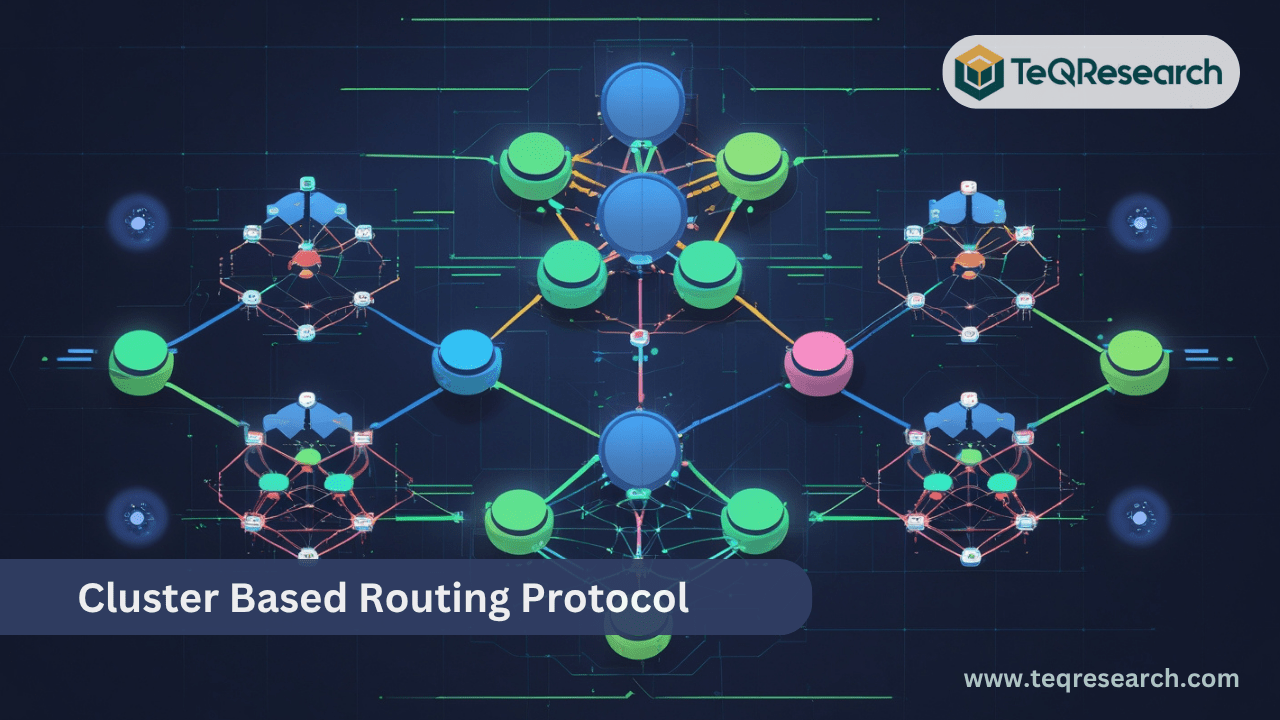
A hierarchical routing protocol created especially for Mobile Ad Hoc Networks (MANETs) is called Cluster-Based Routing Protocol, or CBRP. CBRP organizes nodes into logical clusters to expedite the routing process, in contrast to conventional flat routing protocols where each node separately manages its own routes. Each cluster in CBRP is made up of a collection of mobile nodes, and the cluster head (CH) is chosen from among these nodes. In addition to facilitating communication between clusters through gateway nodes, the cluster head is in charge of overseeing communication and routing information within the cluster. Because of its increased scalability and decreased routing overhead, CBRP is particularly well-suited for large or highly mobile networks. Key elements of CBRP include:
- Cluster Heads: Act as local coordinators for routing and topology management within clusters.
- Gateway Nodes: Connect different clusters and help route packets between them.
- Ordinary Nodes: Regular members of a cluster that rely on their cluster head for route information.
CBRP is considered a proactive intra-cluster and reactive inter-cluster protocol. This indicates that while routes between clusters are created as needed, routing information is continuously kept within each cluster. This hybrid nature aids in striking a compromise between the need to decrease control traffic and the requirement for current information. By restricting the range of route finding, reducing broadcast storms, and facilitating improved organization in extremely dynamic contexts, CBRP enhances MANET performance overall.
How Cluster-Based Routing Protocol Works?
In Mobile Ad Hoc Networks (MANETs), the Cluster-Based Routing Protocol (CBRP) streamlines routing and lowers costs by arranging the network into a hierarchical structure of clusters. To effectively handle data transfer, the protocol employs two-level routing mechanisms: intra-cluster and inter-cluster. Here’s a step-by-step explanation of how CBRP works:
1. Cluster Formation
- Nodes broadcast HELLO messages to identify their one-hop neighbors when the network is first set up.
- If no cluster head (CH) is identified in the vicinity, a node elects itself as a CH based on certain criteria like node ID or connectedness degree.
- Upon receiving this declaration, nearby nodes that aren’t already a part of another cluster become cluster members and join the CH.
- Clusters are connected by gateway nodes, which are nodes that are within two or more cluster heads’ communication range.
2. Intra-Cluster Communication
- Communication is rather easy inside each cluster. Direct or indirect communication between nodes is possible via the cluster head.
- To ensure effective intra-cluster data transfer, the cluster head manages local routing and keeps track of members.
3. Inter-Cluster Communication
- The cluster head receives the request when a node needs to send data to a location outside of its cluster.
- The cluster head then connects to the CH of the nearby cluster via gateway nodes.
- Until the destination is reached, the Route Request (RREQ) message travels via cluster heads and gateways.
- Cluster heads and gateways create a route between the source and destination clusters after receiving the Route Reply (RREP).
4. Route Maintenance
- Routes are dynamically maintained. Route Error (RERR) notifications are issued to the impacted nodes in the event that a link or node fails.
- If there isn’t another path accessible, nodes may start the route discovery process over.
5. Re-Clustering
- The topology shifts as nodes move. Detecting changes is aided with periodic HELLO messages.
- Re-clustering may occur if a node leaves the range of its cluster and joins another cluster or becomes a new CH.
In networks with frequent topology changes, CBRP’s cluster-based and hybrid routing approach dramatically lowers control packet overhead, boosts route stability, and boosts overall efficiency.
Example of Cluster-Based Routing Protocol
Let’s understand how CBRP – Cluster-Based Routing Protocol works through a simple example scenario in a Mobile Ad Hoc Network (MANET):
Scenario:
Suppose we have a network with 10 mobile nodes, labeled N1 to N10. These nodes are scattered across a geographic area and need to communicate without fixed infrastructure. CBRP is used as the routing protocol.
Step-by-Step Explanation:
- Cluster Formation:
- Nodes start broadcasting HELLO messages to identify one-hop neighbors.
- Based on predefined criteria (e.g., lowest ID), nodes N2 and N7 elect themselves as Cluster Heads (CHs).
- Nodes near N2 (say, N1, N3, N4, N5) join its cluster, and nodes near N7 (say, N6, N8, N9, N10) join N7’s cluster.
- Node N5, which is within the transmission range of both N2 and N7, acts as a Gateway Node to connect the two clusters.
- Intra-Cluster Communication:
- If N1 wants to send a message to N4, it directly communicates within the cluster through Cluster Head N2.
- The route might look like: N1 → N2 → N4.
- Inter-Cluster Communication:
- Suppose N1 (in Cluster A) wants to send data to N9 (in Cluster B).
- N1 forwards the packet to Cluster Head N2.
- N2 uses Gateway Node N5 to forward the packet to Cluster Head N7 of Cluster B.
- N7 then routes the data to the destination N9.
The route would be:
N1 → N2 (Cluster Head A) → N5 (Gateway Node) → N7 (Cluster Head B) → N9
- Mobility and Re-clustering:
- If node N9 moves out of N7’s range and closer to Cluster A, it may rejoin Cluster A, or become a new cluster head, triggering a local re-clustering process.
Summary of Roles:
- N2, N7: Cluster Heads managing routing in their clusters.
- N5: Gateway node connecting two clusters.
- N1, N4, N9: Ordinary nodes sending or receiving data.
This example shows how CBRP minimizes the quantity of route requests that are flooded throughout the network, hence reducing routing complexity. Rather, route discovery and maintenance are mainly handled by cluster heads and gateways, which makes the protocol effective and scalable for bigger networks.
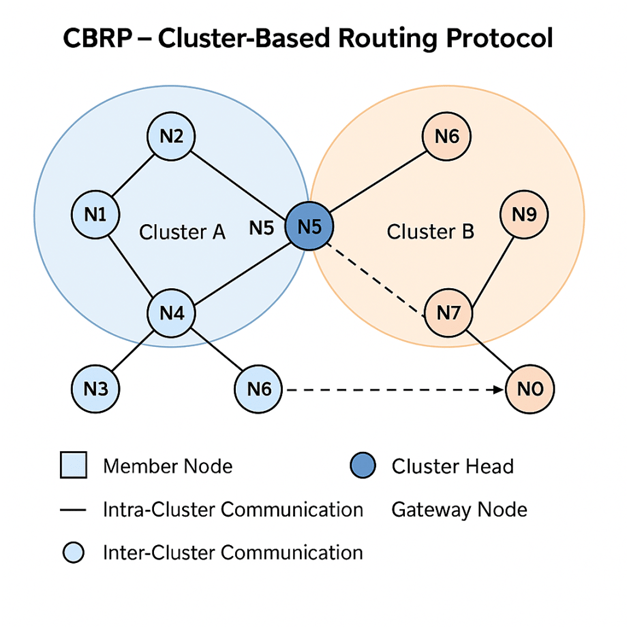
The Cluster-Based Routing Protocol (CBRP) first groups the 10 mobile nodes (designated N1 through N10) in a Mobile Ad Hoc Network (MANET) into clusters. For example, predetermined criteria like the lowest ID or the highest connectivity may be used to chose nodes N2 and N7 as cluster chiefs. Cluster A is made up of nodes that are close to N2, such N1, N3, N4, and N5, and Cluster B is made up of nodes that are close to N7, like N6, N8, N9, and N10. The two clusters are connected via a gateway node, such as N5, which is a unique node that is within communication range of both cluster heads. The packet can now be sent straight within Cluster A via the cluster head N2 if node N1 wishes to deliver data to node N4. On the other hand, if N1 wishes to send data to node N9 in Cluster B, the routing process involves a number of cluster-level hops: N1 sends the data to its cluster head, N2, who then forwards it to the gateway, N5, who then forwards it to Cluster B’s cluster head, N7, who then delivers it to N9. This arrangement minimizes needless broadcasts while guaranteeing effective route finding and communication. A node may rejoin the new cluster even if it moves—for instance, if N9 shifts positions and moves into Cluster A’s range—causing localized re-clustering that doesn’t impact the network as a whole. This illustration shows how CBRP effectively manages routing, particularly in dynamic and expansive networks, by utilizing a hierarchical design.
Key Features of Cluster-Based Routing Protocol
The Cluster-Based Routing Protocol (CBRP) incorporates several features that make it efficient and scalable for routing in Mobile Ad Hoc Networks (MANETs). Its hierarchical structure and hybrid approach offer significant advantages in dynamic wireless environments. Here are the key features of CBRP:
- Hierarchical Clustering Structure: CBRP organizes the network into clusters. Each cluster has a Cluster Head (CH) that manages communication within the cluster. Gateway nodes link adjacent clusters, facilitating inter-cluster communication.
- Hybrid Routing Mechanism: CBRP uses a combination of proactive and reactive routing: Intra-cluster routing is proactive – routing tables are maintained regularly and Inter-cluster routing is reactive – routes are discovered on-demand. This hybrid nature reduces overhead while maintaining up-to-date local information.
- Efficient Route Discovery: Route requests (RREQ) are not flooded network-wide. Instead, they are passed between cluster heads and gateway nodes, minimizing broadcast storms.
- Reduced Control Overhead: By limiting routing updates and broadcasts to cluster heads and gateways, CBRP reduces control traffic. Ordinary nodes are less burdened with routing responsibilities.
- Dynamic Cluster Maintenance: Clusters adapt to node mobility through periodic HELLO messages. Nodes can re-elect cluster heads or switch clusters when topology changes.
- Scalability: Suitable for large-scale networks due to its layered structure. Limits the number of nodes involved in routing decisions, enhancing performance in dense networks.
- Support for Mobility: Designed to work well in highly mobile environments. Clustering helps maintain stable routes even as individual nodes move frequently.
- Localized Routing Information: Each cluster head maintains only local topology information. Reduces the memory and processing requirements on individual nodes.
In CBRP’s design principles—such as clustering, hybrid routing, and gateway-based forwarding—make it a powerful protocol for efficient, scalable, and adaptive routing in MANET environments.
Advantages and Disadvantages of CBRP
The Cluster-Based Routing Protocol (CBRP) offers a number of benefits due to its hierarchical and hybrid nature, but it also comes with some limitations. Understanding both sides helps in determining whether CBRP is the right fit for a given network environment.
Advantages of CBRP
- Less Routing Overhead: Cluster heads and gateways manage the majority of routing choices, which reduces the network’s need for control messages.
- Increased Scalability: CBRP effectively supports large-scale networks by segmenting the network into clusters, which makes it appropriate for dense and wide-area MANETs.
- Controlled Flooding: To avoid broadcast storms, messages are routed through a small group of nodes (CHs and gateways) rather than broadcasting route requests across all nodes.
- Effective Route Discovery: Routes are reactively found across clusters only as required, conserving power and bandwidth.
- Improved Mobility Handling: By localizing topology changes, clusters lessen the effect that node mobility has on the network as a whole.
- Localized Management: Each cluster head maintains only local topology information, which reduces memory and processing burden on regular nodes.
Disadvantages of CBRP
- Cluster Head Overload: Cluster heads are responsible for traffic control and route maintenance, which might result in processing overhead and a quicker battery depletion.
- Frequent Re-Clustering: Clusters may need to be reconfigured regularly in high-mobility settings, which adds delay and control traffic.
- Gateway Bottlenecks: Because gateway nodes serve as the connection between clusters, they might develop into bottlenecks, particularly in settings with high traffic or density.
- Unequal Load Distribution: Performance deterioration may occur in certain cluster heads or gateways if the clustering technique does not distribute load equally.
- Complex Setup: Cluster creation and upkeep require more parameters and logic (such as CH election), which makes implementation more difficult.
CBRP is best suited for moderately dynamic and large-scale ad hoc networks where efficient route management and low overhead are critical. However, it may face challenges in extremely dynamic environments with frequent topology changes.
Applications of Cluster-Based Routing Protocol
The Cluster-Based Routing Protocol (CBRP) works especially well in settings where resource optimization, network scalability, and mobility are major considerations. Because of its hierarchical structure, it performs effectively in a range of real-world situations in dynamic network environments such as Mobile Ad Hoc Networks (MANETs). Below are some of the key applications of CBRP:
- Military Communication Networks: In tactical warfare situations, command units, vehicles, and soldiers create a dynamic ad hoc network. In spite of continuous movement and node density, CBRP aids in preserving reliable, scalable, and organized communication.
- Disaster Recovery and Emergency Response: Rescue crews set up makeshift wireless networks when there is no infrastructure, such as following floods or earthquakes. CBRP guarantees low-overhead, effective routing between responders, facilitating quicker coordination and communication.
- Vehicular Ad Hoc Networks (VANETs): In high-mobility settings like smart cities or highways, vehicles can communicate with one another. Vehicles can be dynamically clustered using CBRP, which also simplifies routing for traffic alerts and location-based services.
- Industrial and Construction Sites: Ad hoc wireless communication is frequently used by mobile people and equipment in expansive industrial zones or construction sites. CBRP facilitates efficient communication flow organization by lowering delays and interference.
- Remote Environmental Monitoring: Nodes may travel or function in difficult terrain in sensor-based MANETs set up for environmental observation (forests, oceans, mountains, etc.). Scalable and energy-efficient routing is made possible by CBRP, particularly when sensor nodes are arranged in logical clusters.
- Unmanned Aerial Vehicle (UAV) Networks: For mapping, distribution, or surveillance, drones or UAVs create mobile ad hoc networks. CBRP is perfect for UAVs operating over large or shifting geographic areas since it allows dynamic grouping.
- Temporary Event Networks: Temporary wireless networks may be set up during events such as political rallies, sporting events, or festivals. Communication between participants, employees, or security personnel can be managed using CBRP without the need for established infrastructure.
To sum up, CBRP works best in situations where the network topology is constantly changing and scalability, efficiency, and traffic control must be balanced. Routing in a variety of unexpected mobile situations is made easier and more organized by its clustering method.
Cluster-Based Routing Protocol Comparison with Other Protocols
Among mobile ad hoc network (MANET) protocols, the Cluster-Based Routing Protocol (CBRP) is unique because of its hybrid, hierarchical structure. It is useful to compare it with other popular routing protocols such as AODV, DSR, DSDV, and TORA in order to comprehend its advantages and disadvantages.
CBRP vs. AODV (Ad hoc On-demand Distance Vector)
| Feature | CBRP | AODV |
| Routing Type | Hybrid (Proactive within clusters, Reactive between clusters) | Reactive (On-demand) |
| Structure | Hierarchical (Clusters with CHs and Gateways) | Flat |
| Routing Overhead | Lower due to localized route discovery | Higher due to network-wide broadcasts |
| Scalability | Better in large, dense networks | Less scalable due to route flooding |
| Mobility Handling | Localized reconfiguration within clusters | Route breaks may require full rediscovery |
CBRP is more scalable and efficient in large networks, while AODV is simpler but may suffer in high-density scenarios.
CBRP vs. DSR (Dynamic Source Routing)
| Feature | CBRP | DSR |
| Routing Type | Hybrid | Reactive |
| Routing Info | Maintained by cluster heads | Source routing (entire path stored in packet) |
| Overhead | Reduced by hierarchical design | Higher, especially for long routes |
| Route Maintenance | Localized in clusters | Re-discovery required for route failure |
| Scalability | High | Poor in large or dense networks |
CBRP is more efficient in large or high-mobility environments, while DSR is better for small, low-mobility networks.
CBRP vs. DSDV (Destination-Sequenced Distance Vector)
| Feature | CBRP | DSDV |
| Routing Type | Hybrid | Proactive |
| Updates | Cluster-based updates | Periodic updates across the network |
| Routing Overhead | Lower | High, due to continuous updates |
| Convergence Time | Faster in dynamic environments | Slower due to network-wide updates |
| Scalability | Better | Limited in large networks |
CBRP provides better adaptability in mobile environments, while DSDV is useful for relatively static networks with consistent topology.
CBRP vs. TORA (Temporally Ordered Routing Algorithm)
| Feature | CBRP | TORA |
| Routing Type | Hybrid | Reactive (Link-reversal) |
| Structure | Cluster-based | Flat |
| Route Maintenance | Localized within clusters | Highly adaptive but complex |
| Overhead | Moderate | High in frequent topology changes |
| Loop Prevention | Handled by clustering | Achieved through DAGs (Directed Acyclic Graphs) |
CBRP is simpler to implement and control, while TORA is highly adaptive but more complex and resource-intensive.
| Protocol | Routing Type | Structure | Best Use Case |
| CBRP | Hybrid | Hierarchical | Large-scale, mobile MANETs |
| AODV | Reactive | Flat | Medium-sized, moderately mobile networks |
| DSR | Reactive | Flat | Small networks with low mobility |
| DSDV | Proactive | Flat | Static or slowly changing networks |
| TORA | Reactive | Flat | Highly dynamic topologies with frequent changes |
CBRP offers a balanced approach that combines the strengths of proactive and reactive strategies, enhanced by its cluster-based structure. It is especially suitable for scalable, mobile, and dense MANET environments, whereas flat protocols may struggle with overhead and efficiency in such scenarios.
Conclusion
An important development in routing techniques for Mobile Ad Hoc Networks (MANETs) is the Cluster-Based Routing Protocol (CBRP). The common issues of dynamic topologies, constrained bandwidth, and scalability in wireless networks are successfully addressed by CBRP by utilizing a hybrid routing strategy in conjunction with a hierarchical clustering architecture. Compared to conventional flat routing protocols, CBRP guarantees more effective communication, lowers routing costs, and localizes route management through the employment of cluster heads and gateway nodes. It is especially well-suited for large-scale, mobile, or mission-critical networks like military operations, disaster recovery efforts, and vehicle networks because of its structure, which enables rapid adaptation to topology changes. Nevertheless, there are trade-offs associated with CBRP. Careful management is required to address problems including gateway node bottlenecks, frequent re-clustering in high-mobility scenarios, and cluster head overburden. Notwithstanding these difficulties, the protocol is a strong option in many practical applications due to its advantages in route optimization, control traffic reduction, and scalability. In conclusion, CBRP is a flexible and reliable protocol in the changing field of ad hoc wireless communication because it achieves a balance between routing efficiency and scalability.
Frequently Asked Questions (FAQs)
What is the main idea behind CBRP?
A cluster head oversees each of the clusters that CBRP creates from a mobile ad hoc network. Cluster heads and gateway nodes make the majority of routing choices, which lowers routing overhead and increases scalability.
How are cluster heads selected in CBRP?
Typically, predetermined measures such the lowest node ID, maximum degree of connectivity, or remaining battery power are used to choose cluster heads. The selection procedure seeks to guarantee the stability and effectiveness of cluster heads.
How does CBRP reduce control packet overhead?
By restricting routing requests and updates to cluster heads and gateway nodes, CBRP reduces control packet overhead. Regular nodes avoid needless traffic by abstaining from global broadcasts.
Is CBRP suitable for high-mobility networks?
In contexts with moderate to high mobility, CBRP is effective, but performance may be impacted by frequent re-clustering. In many situations, its tailored routing aids in mobility management more effectively than flat protocols.
What is the difference between intra-cluster and inter-cluster communication in CBRP?
- Intra-cluster communication takes place within the same cluster and usually entails routing through the cluster head or direct communication.
- Data transfer between various clusters via gateway nodes and cluster heads is known as inter-cluster communication.
What are the main limitations of CBRP?
- Possible bottlenecks at gateway nodes; frequent cluster maintenance in dynamic contexts; and overload on cluster heads are some of the main drawbacks.
- It is nonetheless more scalable than many flat routing technologies in spite of them.
Can CBRP be used in sensor networks?
Indeed, CBRP can be modified for Wireless Sensor Networks (WSNs), particularly in situations where scalable, energy-efficient routing is required when sensor nodes are mobile. Clustering aids in power conservation and load balancing.