Introduction
Mobile Ad Hoc Networks (MANETs) have become a crucial field of study and application in the rapidly changing field of wireless communication. These networks are mobile node systems that are dynamic and self-configuring, allowing communication without the need for a fixed infrastructure. The creation of effective and scalable routing protocols that can manage frequent topology changes, limiting bandwidth, and limited energy resources is one of the main problems in MANETs. Researchers have put forth a number of routing techniques, such as proactive, reactive, and hybrid protocols, to address these issues. But as the network gets bigger, it gets harder to keep the routing information up to current, which results in more control overhead and worse performance. Hierarchical State Routing (HSR) is useful in this situation. A link-state-based, hierarchical routing protocol called HSR was created to increase the scalability and effectiveness of routing in dense, big networks. HSR reduces the overhead related to global state maintenance and guarantees quicker route discovery by grouping nodes into clusters and preserving routing data at various levels of hierarchy. This blog article will go over the basics of HSR, explain how it works, examine its benefits and drawbacks, and compare it to other routing protocols in the context of MANETs.
What is Hierarchical State Routing?
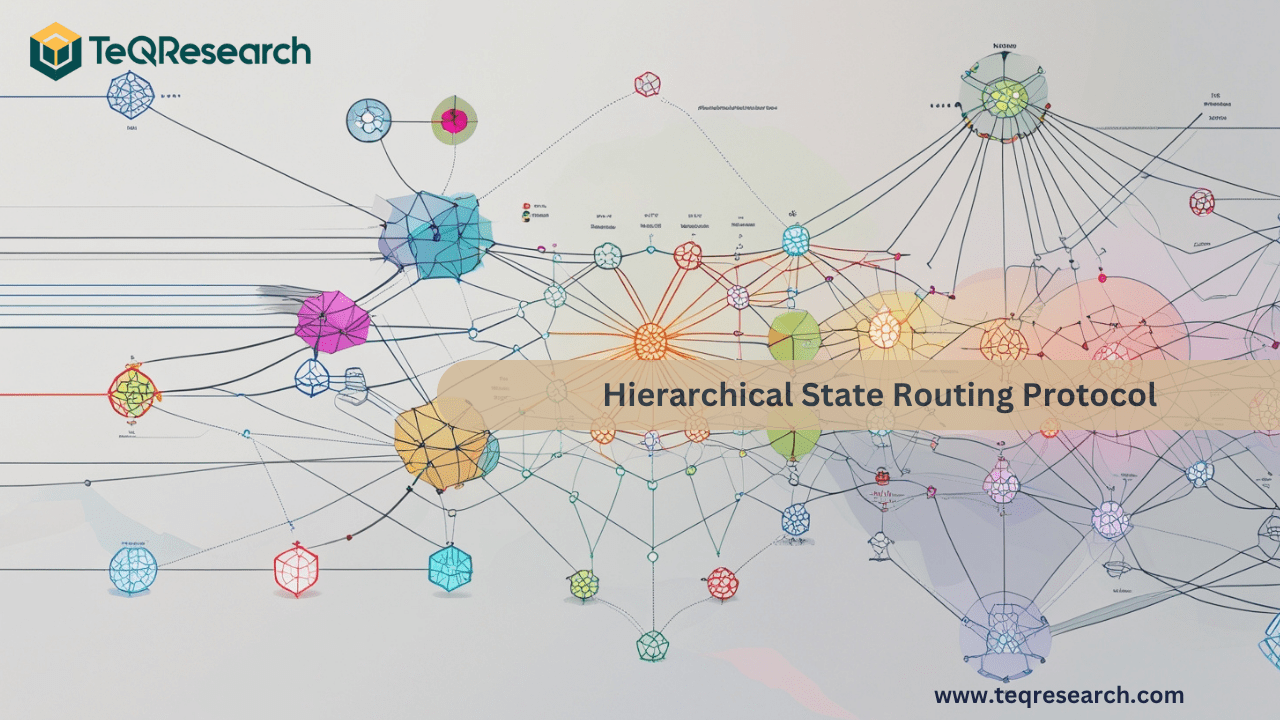
In order to improve scalability, efficiency, and manageability in large-scale and extremely dynamic contexts, the hierarchical link-state routing protocol known as Hierarchical State Routing (HSR) was created especially for Mobile Ad Hoc Networks (MANETs).
By assembling nodes into clusters, HSR creates a multi-level hierarchical structure in contrast to flat routing protocols, in which each node keeps comprehensive information about the entire network. The task of overseeing communication both within and across clusters falls to the chosen cluster head in each cluster. Because the network architecture is constructed recursively, each level can control routing to a certain extent. In HSR:
- Nodes exchange link-state information only within their clusters to maintain local routes.
- Cluster heads summarize and forward routing information to higher levels of the hierarchy.
- This structure helps reduce control message overhead and enables localized route updates, improving overall network performance.
HSR is a hybrid protocol that combines the advantages of both proactive and reactive routing:
- Proactive within clusters (link-state maintenance).
- Reactive or on-demand between clusters (route discovery as needed).
This combination, along with its layered design, makes HSR particularly suitable for large, mobile, and resource-constrained networks, where maintaining global routing information is inefficient or infeasible.
How Hierarchical State Routing Works?
In order to effectively manage routing in mobile ad hoc networks (MANETs), Hierarchical State Routing (HSR) groups nodes into clusters utilizing a multi-level hierarchical structure. By restricting the range of routing updates and decisions, the protocol aims to lower control overhead and boost scalability. Here’s a step-by-step explanation of how HSR works:
1. Network Hierarchy Formation
- The network is divided into clusters, each managed by a cluster head.
- Cluster heads are selected based on specific criteria (e.g., node ID, connectivity, energy).
- Clusters may be further grouped into super-clusters, forming a multi-level hierarchy.
- This structure can scale up or down depending on network size.
2. Intra-Cluster Routing (Local Communication)
- Inside each cluster, nodes maintain link-state information about other members.
- Nodes periodically exchange routing information within the cluster.
- All nodes in a cluster can communicate directly or through multi-hop paths managed proactively.
3. Inter-Cluster Routing (Global Communication)
- When communication is needed between nodes in different clusters:
- The source node sends the packet to its cluster head.
- The cluster head forwards the packet to other cluster heads using the higher-level hierarchy.
- Eventually, the packet reaches the destination cluster, where it is forwarded to the destination node.
4. Route Maintenance
- Nodes and cluster heads exchange periodic updates to maintain current route information.
- Local topology changes (e.g., node movement within a cluster) are handled within the cluster.
- Global topology changes (e.g., cluster head mobility) are handled at higher levels to minimize network-wide impact.
5. Control Overhead Reduction
- By limiting routing updates to the relevant level (local or global), HSR reduces unnecessary broadcasting.
- Each node only needs to store detailed routing information for its own cluster and summary information for higher levels.
6. Example Workflow
- Scenario: Node A (in Cluster X) wants to send data to Node B (in Cluster Y).
- Node A checks its routing table; since Node B is not in the same cluster, it sends the packet to Cluster Head X.
- Cluster Head X checks its inter-cluster routing information and forwards the packet to Cluster Head Y.
- Cluster Head Y forwards the packet to Node B via intra-cluster routing.
By maintaining localized link-state information and using hierarchical forwarding, HSR achieves a balance between routing accuracy and network scalability. It’s particularly useful in large networks where a flat routing approach would be inefficient.
Example of Hierarchical State Routing(HSR)
Let’s consider a simplified example to understand how Hierarchical State Routing (HSR) works in a real-world scenario. This example uses a two-level hierarchical structure to illustrate intra-cluster and inter-cluster communication.
Network Topology Overview:
- Cluster 1: Nodes A, B, C
- Cluster Head: Node C
- Cluster 2: Nodes D, E, F
- Cluster Head: Node D
- Cluster 3: Nodes G, H, I
- Cluster Head: Node H
- All cluster heads (C, D, H) form a higher-level network (super-cluster).
Communication Scenario:
Node A (in Cluster 1) wants to send data to Node F (in Cluster 2).
Routing Process:
- Intra-Cluster Phase (Cluster 1):
- Node A checks its routing table and realizes that Node F is not in the same cluster.
- It sends the data packet to its cluster head (Node C).
- Inter-Cluster Phase (Between Cluster Heads):
- Node C, being the cluster head, uses the higher-level routing table and determines that Cluster 2 is reachable through Cluster Head D.
- Node C forwards the packet to Cluster Head D.
- Intra-Cluster Phase (Cluster 2):
- Cluster Head D receives the packet and checks its local routing table.
- It forwards the packet to Node F, completing the transmission.

- CH: Cluster Head
- Arrows indicate the routing path: A → C → D → F
This example highlights how HSR:
- Uses cluster heads for managing inter-cluster communication.
- Maintains efficient route discovery with minimal overhead.
- Handles intra-cluster and inter-cluster routing independently to reduce complexity and improve scalability.
The network is separated into three clusters in the provided HSR example: Cluster 1 (containing nodes A, B, and C), Cluster 2 (containing nodes D, E, and F), and Cluster 3 (containing nodes G, H, and I). Node C is the cluster head for Cluster 1, Node D is the cluster head for Cluster 2, and Node H is the cluster head for Cluster 3. Communication between clusters is made possible by the higher-level network formed by these cluster heads. Assume that Cluster 1’s Node A wishes to communicate with Cluster 2’s Node F. Node A transmits the packet to its cluster head, Node C, because Node F is not in the same cluster. Node C determines the path to Cluster Head D, which oversees Cluster 2, using the higher-level routing data. The packet is subsequently forwarded to Node D. Node D uses intra-cluster routing to send the data to Node F after receiving the packet and consulting its local routing database. By employing summarized routes between cluster heads and preserving precise routing solely within clusters, this procedure illustrates how HSR lowers routing overhead. The hierarchy is effective for big and mobile networks because it streamlines route discovery, facilitates scaling, and maintains local control traffic.
Key Features of HSR
For Mobile Ad Hoc Networks (MANETs), Hierarchical State Routing (HSR) is a potent and scalable routing protocol thanks to a number of cutting-edge features. The following are the salient characteristics that characterize the conduct and benefits of HSR:
- Hierarchical Architecture: The network is arranged into several tiers of clusters and sub-clusters using HSR. The cluster head at each level oversees group routing, enhancing management and scalability.
- Link-State Routing inside Clusters: Proactive link-state routing is used by nodes inside each cluster to keep pathways to other cluster members current. This guarantees minimal latency and rapid access to intra-cluster nodes.
- Summary Routing Between Clusters: To facilitate communication with neighboring clusters, cluster chiefs keep track of summarized routing information. This limits pointless changes throughout the network and shrinks the size of the routing table.
- Localized Route Maintenance: Individual clusters are frequently the only places where route modifications brought on by node mobility occur. The frequency and extent of global updates are decreased by this local processing of changes.
- Scalability: Networks with thousands of nodes can be supported by the hierarchical design. Even when the network expands, routing overhead and complexity are still controllable.
- Combining Proactive and Reactive Strategies: To facilitate quick communication inside clusters, proactive (link-state) routing is employed. For inter-cluster communication, reactive (on-demand) routing strikes a balance between speed and efficiency.
- Reduced Control Overhead: By limiting the scope of routing information exchanges, HSR reduces bandwidth consumption and improves energy efficiency. Nodes don’t need global network knowledge, which conserves resources.
- Support for Mobility: The protocol is made to adjust to changing topologies brought on by node migration. To keep connectivity, route changes and cluster reorganization are done effectively.
- Flexibility and Modularity: The hierarchical layers can be adjusted based on network size and density. Easy integration with other routing techniques or optimization mechanisms.
These features make HSR a robust and scalable routing protocol, especially suitable for large, mobile, and resource-constrained environments such as military operations, disaster zones, and vehicular networks.
Advantages and Disadvantages of HSR
Like any routing protocol, Hierarchical State Routing (HSR) has its own set of strengths and limitations. Its hierarchical structure and hybrid routing strategy make it especially useful for large and dynamic networks, but it also introduces some complexity in cluster management.
Advantages of HSR – Hierarchical State Routing
- Scalability: By dividing enormous networks into manageable portions, the hierarchical clustering structure enables HSR to handle them effectively.
- Less Control Overhead: By restricting routing updates to pertinent clusters or hierarchy levels, extraneous broadcasting is reduced and bandwidth is conserved.
- Effective Route Discovery: Proactive routing speeds up intra-cluster communication, while on-demand management of inter-cluster communication ensures a balanced strategy.
- Localized Route Maintenance: Updates are quicker and more localized because topology changes (such as node migration) typically only impact one cluster.
- Better Use of Resources: In situations with limited resources, such as sensor networks, lower overhead and route summarization aid in lowering energy use.
- Better Organization: In dense or complex topologies, the layered structure makes network management and decision-making easier.
Disadvantages of HSR – Hierarchical State Routing
- Complexity of Cluster Formation: Choosing and sustaining cluster heads might demand a lot of resources and sophisticated algorithms, particularly in mobile circumstances.
- Cluster Maintenance Overhead: Node mobility may result in frequent re-clustering, which adds to the processing and control messages.
- Latency in Inter-Cluster Communication: End-to-end delay may increase when communication between clusters requires several hops through cluster heads.
- Single Point of Failure: Cluster heads are crucial; network performance may suffer if one fails and is not promptly replaced.
- Initial Setup Overhead: In highly dynamic networks, the hierarchical structure necessitates initial setup and organizing, which could take a lot of time.
- Inequitable Load Distribution: Cluster chiefs frequently manage higher processing and traffic volumes, which may cause bottlenecks or accelerate battery drain in those nodes.
| Aspect | Advantage | Disadvantage |
| Scalability | Excellent for large networks | — |
| Overhead | Reduced due to localized updates | High during re-clustering |
| Latency | Low for intra-cluster communication | Higher for inter-cluster communication |
| Energy Efficiency | Better due to fewer global updates | Cluster heads may deplete energy faster |
| Mobility Handling | Local changes managed efficiently | Frequent re-clustering in highly mobile setups |
Understanding these pros and cons helps in deciding when and where HSR is best applied, such as in military, vehicular, or emergency communication networks where scalability and localized routing are critical.
Applications of Hierarchical State Routing (HSR)
Hierarchical State Routing (HSR) is particularly well-suited for environments that require scalability, efficient bandwidth usage, and adaptability to mobility. Its hierarchical structure and hybrid routing mechanism make it ideal for various practical applications, especially in large and dynamic mobile ad hoc networks (MANETs). Below are some key areas where HSR can be effectively applied:
- Military Communication Networks: Troops and vehicles are frequently deployed in wide and dynamic locations during military operations. HSR facilitates scalable and organized communication between unmanned devices, command centers, and soldiers. Its hierarchical structure improves command and control by simulating military organization (battalions, platoons, and squads).
- Emergency Response and Disaster Recovery: HSR can provide a temporary communication network between rescue teams in the event that infrastructure is destroyed during a disaster. When time and resources are few, the protocol’s quick route finding and low overhead are essential. aids in coordination between different mobile units, such as field hospitals, drones, and ambulances.
- Vehicular Ad Hoc Networks (VANETs): Real-time data sharing between vehicles and roadside equipment is essential to intelligent transportation systems. For the purpose of managing traffic updates, hazard warnings, and coordination, HSR can be utilized to create dynamic clusters of moving cars. maintains communication even when there is a lot of movement.
- Wireless Sensor Networks (WSNs): By restricting updates to clusters, HSR helps lower overhead in sensor networks with a high number of nodes (such as environmental monitoring). beneficial in industrial areas, farms, and woods where sensors must effectively send data to a base station.
- Smart Cities and Urban Infrastructure: HSR can help different IoT-enabled equipment, such as traffic sensors, smart meters, and streetlights, communicate with one another. In densely populated locations, clustering aids in bandwidth management and guarantees low-latency data collection and transmission.
- big-Scale Campus or Industrial Networks: HSR offers structured communication in big corporate or educational campuses with mobility users (such as maintenance crews and security personnel). divides users into logical groups, which lowers data traffic and enhances route management.
- UAV Swarm Communication: HSR can sustain steady communication even when drones move around a lot in drone fleets employed for environmental data collecting, distribution, or surveillance. Clustering guarantees local communication between each UAV subset while transmitting data to a central control system.
Hierarchical State Routing Comparison with Other Protocols
To better understand the strengths and weaknesses of Hierarchical State Routing (HSR), it’s helpful to compare it with other commonly used routing protocols in Mobile Ad Hoc Networks (MANETs). Below, HSR is compared with AODV (Ad hoc On-Demand Distance Vector), DSR (Dynamic Source Routing), and ZRP (Zone Routing Protocol)—each representing different routing approaches: reactive, proactive, and hybrid.
1. HSR vs AODV (Reactive Protocol)
| Aspect | HSR | AODV |
| Routing Type | Hybrid (Hierarchical + Proactive + Reactive) | Reactive (On-demand) |
| Scalability | High – due to hierarchical clustering | Moderate – floods the network for route discovery |
| Routing Overhead | Low – localized updates | High – due to flooding during route discovery |
| Mobility Handling | Good – local changes handled within clusters | Good – but frequent route breaks may increase overhead |
| Route Discovery Speed | Faster for intra-cluster; efficient for inter-cluster | Slower due to on-demand route setup |
| Suitable for Large Networks | Yes | Not ideal – performance drops as size increases |
2. HSR vs DSR (Reactive Protocol)
| Aspect | HSR | DSR |
| Route Maintenance | Periodic within clusters, reactive between clusters | Source routing; full route in packet header |
| Memory Usage | Moderate – summary tables at each level | High – source routes stored in every packet |
| Route Discovery | Hierarchical, efficient | Flood-based; less efficient in large networks |
| Loop Prevention | Handled via hierarchy and state information | Handled via source routing |
| Overhead in Large Networks | Low | High |
3. HSR vs ZRP (Zone Routing Protocol – Hybrid)
| Aspect | HSR | ZRP |
| Hierarchical Design | Yes – multi-level clustering | No – flat zones defined by radius |
| Intra-Zone Routing | Proactive (link-state) | Proactive (IARP) |
| Inter-Zone Routing | Reactive (on-demand) | Reactive (IERP) |
| Scalability | Higher due to multi-tier design | Moderate – depends on zone radius |
| Cluster Management | Requires cluster head selection | No clusters – simpler management |
| Routing Table Size | Smaller – summary routing at higher levels | Varies – depends on zone configuration |
Key Takeaways:
- HSR vs Reactive Protocols (AODV, DSR):
HSR significantly reduces control overhead and improves scalability by using hierarchical clustering and local updates, whereas AODV and DSR suffer from flooding-based route discovery and are less efficient in large, dense networks. - HSR vs Hybrid Protocols (ZRP):
Both are hybrid, but HSR’s hierarchical nature enables better network management and scalability, especially in extremely large networks, while ZRP is simpler and better suited to moderate-sized networks.
| Protocol | Type | Best For | Scalability | Control Overhead | Complexity |
| HSR | Hybrid (Hierarchical) | Large, dynamic MANETs | High | Low | High |
| AODV | Reactive | Small to medium networks | Moderate | High | Low |
| DSR | Reactive | Small, low-mobility networks | Low | High | Medium |
| ZRP | Hybrid | Medium-sized networks with some mobility | Moderate | Medium | Medium |
HSR stands out in scenarios where network size, node mobility, and resource efficiency are critical—making it a preferred choice for complex and mission-critical MANET applications.
Conclusion
In Mobile Ad Hoc Networks (MANETs), Hierarchical State Routing (HSR) offers a robust and scalable routing solution, particularly in expansive and dynamic settings. HSR effectively tackles the issues of high mobility, constrained bandwidth, and routing overhead by implementing a multi-level hierarchical structure and integrating proactive and reactive routing techniques. By ensuring localized routing decisions and updates through the use of cluster-based organization, it lowers superfluous control traffic and enhances network performance. Because of this, HSR is especially well-suited for uses where scalability, rapid route finding, and economical resource use are crucial, including in smart city infrastructure, military communications, disaster recovery, and vehicle networks. HSR does, however, have some complications, particularly with regard to cluster formation and maintenance, just like any other protocol. Notwithstanding these difficulties, it is a strong option for contemporary ad hoc networking requirements due to its benefits in scalability, lower costs, and organized communication. In conclusion, HSR is a very successful protocol for next-generation wireless and mobile network situations because it achieves a balance between network scalability and routing efficiency.
Frequently Asked Questions (FAQs)
What is the main purpose of HSR in MANETs?
By arranging nodes in a hierarchical cluster-based topology, reducing routing overhead, and streamlining route management, HSR is intended to increase scalability and routing efficiency in sizable mobile ad hoc networks.
How is HSR different from traditional flat routing protocols like AODV and DSR?
HSR employs cluster heads and hierarchy levels to restrict the scope of routing information, lowering control traffic and increasing scalability in contrast to flat routing protocols where every node stores complete network information.
Does HSR support both proactive and reactive routing?
Indeed, HSR is a hybrid protocol since it employs reactive (on-demand) routing between clusters via higher hierarchy levels in addition to proactive link-state routing inside clusters.
What happens when a cluster head fails in HSR?
A new cluster head is usually re-elected based on predetermined criteria (such as node ID, energy level, or connectivity) in the event that the current one fails. Within that cluster, this procedure guarantees ongoing routing functioning.
In what types of applications is HSR most effective?
Large-scale mobile ad hoc networks (such as those in the military or disaster areas); vehicle ad hoc networks (VANETs); sensor networks; smart cities and infrastructure-less communication systems are the applications where HSR works best.