
Introduction
The ability to create smooth and effective communication without a fixed infrastructure is essential in the era of wireless communication and mobile networking. Mobile ad hoc networks (MANETs) are useful in this situation. Instead than depending on centralized access points or pre-existing infrastructure, these networks are made up of mobile devices that dynamically create a network on the fly. Routing, or figuring out a way for data packets to go from their source to their destination, is one of the main problems in these kinds of networks. Conventional routing techniques, which perform well in static networks, sometimes falter in dynamic settings where node mobility can cause network structure to change quickly. Specialized routing protocols have been created for MANETs in order to overcome these difficulties. Dynamic Source Routing, or DSR, is one such protocol. DSR is an on-demand, reactive protocol made especially for ad hoc networks. DSR reduces overhead and conserves bandwidth by only discovering and maintaining routes when necessary, as contrast to proactive systems that maintain continuous route updates. This blog article will go over the fundamental ideas of DSR, explain how it operates using an example, and look at its main characteristics, benefits, drawbacks, practical uses, and comparison to other routing protocols.
What is DSR?
A reactive routing system called Dynamic Source Routing (DSR) was created especially for usage in wireless mesh networks and mobile ad hoc networks (MANETs). DSR permits each data packet to carry the entire path to its destination in the packet header, enabling dynamic and flexible routing as the name implies. DSR employs an on-demand strategy in contrast to conventional routing protocols, which depend on recurring updates or routing tables at each node. This implies that it only starts a route discovery procedure when a source node has to transfer data and is unsure of how to get there. Because of this substantial reduction in control overhead, DSR is appropriate for settings in which nodes join or depart the network on a regular basis. The two core mechanisms in DSR are:
- Route Discovery – When a source needs a route to a destination, it broadcasts a Route Request (RREQ) across the network.
- Route Maintenance – Once a route is established, the network monitors its usability. If a route becomes broken due to node mobility, the protocol initiates Route Error (RERR) handling to update or discard invalid paths.
The source routing feature of DSR, which allows each packet to contain a list of all intermediary nodes it should pass through, is noteworthy. This increases the packet header size, particularly in large or complex networks, but it also offers transparency and control over the routing path. In DSR is a lightweight, flexible, and effective protocol that is perfect for dynamic and resource-constrained wireless networks because it allows for quick changes in network topology without requiring constant control traffic.
How Dynamic Source Routing Works
DSR operates entirely on-demand, meaning it finds and maintains routes only when necessary. It consists of two fundamental mechanisms:
1. Route Discovery: When a source node wants to send data to a destination and doesn’t already have a route in its cache, it initiates Route Discovery. This process works as follows:
- The source node broadcasts a Route Request (RREQ) packet to its neighbors.
- Each receiving node adds its own address to the packet and forwards it further, avoiding duplicates.
- When the RREQ reaches the destination (or an intermediate node that knows the route), a Route Reply (RREP) is generated.
- The RREP is sent back to the source using the reverse of the path collected in the RREQ.
- The source caches the route for future use.
2. Route Maintenance: Once a route is established, DSR keeps monitoring it. If any part of the route becomes broken (e.g., due to node mobility or link failure), the following happens:
- The node detecting the failure sends a Route Error (RERR) message back to the source.
- The source node removes the broken link from its cache.
- If alternative routes are available in the cache, they are used; otherwise, a new Route Discovery is initiated.
3. Source Routing: A unique feature of DSR is that each data packet carries the full list of nodes (hops) it must traverse. This eliminates the need for routing tables at each intermediate node, as the path is explicitly defined in the packet header.
4. Route Caching: Every node maintains a cache of known routes, including those it overhears from other packets. This caching reduces the number of Route Discovery processes, improving efficiency. However, stale routes can cause delivery failures if not handled properly.
Key Characteristics of DSR Operation are,
| Feature | Description |
| Routing Type | Reactive (On-demand) |
| Route Stored | In packet header (source routing) |
| Routing Table | Not needed at intermediate nodes |
| Control Messages | RREQ, RREP, RERR |
| Overhead | Low when mobility is low; higher with many hops due to large headers |
In DSR’s routing process is highly flexible and efficient for dynamic networks. However, because it embeds the route in each packet, it may become less scalable in larger networks due to increased header size.
Example of DSR
To understand how DSR works in practice, let’s walk through a simple example of how a route is discovered and used in a small ad hoc network.
Assume we have the following network topology:
Nodes: A, B, C, D
Objective: Node A wants to send data to Node D.
Step-by-Step Route Discovery Process
- Initial State:
- Node A has no route to D in its cache.
- It initiates Route Discovery by broadcasting a Route Request (RREQ).
- Broadcasting RREQ:
- RREQ includes the source (A), destination (D), and a route record.
- As the RREQ propagates, each intermediate node appends its address:
- A sends → B → appends B → sends to C → appends C → sends to D.
- Receiving RREQ at D:
- When D receives the RREQ, the full route [A, B, C, D] is recorded.
- D sends a Route Reply (RREP) back to A using the reverse path.
- Source Routing Begins:
- A now sends data packets to D, embedding the full route [A, B, C, D] in the packet header.
- Each intermediate node simply forwards the packet to the next node listed in the header.
Route Maintenance Example
- Suppose the link between B and C breaks.
- Node B detects the failure and sends a Route Error (RERR) message to A.
- A removes the broken route from its cache.
- If A has an alternate cached route to D, it uses that. Otherwise, it starts a new Route Discovery.
Visual Diagram of the Route Discovery and Data Transmission:
I’ve created a high-quality digital diagram below to represent the process:
[High-Quality Diagram – DSR Route Discovery & Data Flow]
(Note: Diagram includes nodes A → B → C → D, arrows for RREQ/RREP, and path illustration for source routing.)
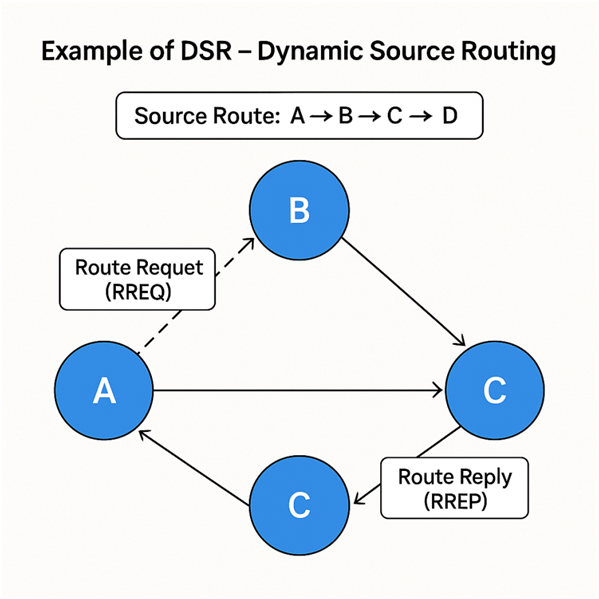
In a typical DSR routing example, consider four nodes: A, B, C, and D. Suppose node A wants to send data to node D but has no route to it in its cache. To find a route, A initiates a Route Discovery process by broadcasting a Route Request (RREQ) packet to its immediate neighbor B. This RREQ includes the source node (A), the destination node (D), and a list to record the path taken. As the RREQ travels through the network, each intermediate node appends its address to the route record. When B receives the RREQ, it appends its ID and forwards the request to C, and C, in turn, appends its ID and forwards it to D. Once D receives the RREQ, it has the complete route [A, B, C, D] recorded in the message.
At this point, D generates a Route Reply (RREP) and sends it back to A using the reverse of the discovered path. Now, node A can begin sending data packets to D, embedding the entire route [A, B, C, D] in the header of each packet. As a result, each intermediate node (B and C) simply reads the next hop from the header and forwards the packet accordingly, without maintaining its own routing table. If, during communication, a link (e.g., between B and C) breaks, the node detecting the failure sends a Route Error (RERR) message back to A. Upon receiving the error, A removes the broken route from its cache and either uses an alternate cached route (if available) or initiates a new Route Discovery process. This example clearly illustrates DSR’s source routing, caching, and error handling capabilities in a dynamic network environment.
Key Features of DSR – Dynamic Source Routing
Dynamic Source Routing (DSR) offers several distinctive features that make it well-suited for mobile ad hoc networks (MANETs) and other dynamic wireless environments. Below are the key features that define how DSR operates and performs:
- On-Demand (Reactive) Protocol: Routes are discovered only when needed. This avoids the overhead of periodic control messages, conserving bandwidth and energy.
- Source Routing: The entire route to the destination is included in the packet header. Intermediate nodes do not need to maintain routing tables or make forwarding decisions—each packet carries its path.
- Route Caching: Each node maintains a route cache to store learned routes. Caches help avoid redundant route discoveries, improving efficiency and reducing delays.
- No Periodic Updates: Unlike proactive protocols, DSR doesn’t require regular broadcasting of topology updates. Reduces unnecessary communication overhead in the network.
- Support for Unidirectional Links: DSR supports unidirectional (asymmetric) links, allowing more flexibility in real-world wireless networks.
- Loop-Free Routing: Since the full route is known and defined at the source, DSR inherently avoids routing loops.
- Route Maintenance via RERR Messages: If a link breaks during communication, a Route Error (RERR) is sent back to the source. This triggers the source to use an alternate route (if available) or start a new route discovery.
- Scalability in Small-to-Medium Networks: DSR performs well in smaller or moderately sized networks with limited mobility. However, its performance may degrade in large or highly mobile environments due to increased header size and stale caches.
- Minimal Configuration Required: DSR is self-organizing and self-configuring, making it ideal for rapidly deployable and infrastructure-less networks. These features make DSR a flexible and efficient choice in environments where bandwidth is limited, node mobility is high, and rapid configuration is essential.
Advantages and Disadvantages of DSR – Dynamic Source Routing
Like any routing protocol, Dynamic Source Routing (DSR) has its strengths and weaknesses. Understanding both helps determine when and where the protocol is most effective.
Advantages of DSR
- No Need for Frequent Updates: Since routes are only found when required, this saves bandwidth and lowers overhead.
- Effective Route Discovery: By responding to queries using cached routes, intermediate nodes can minimize needless flooding.
- Source Routing Simplifies Intermediate Nodes: Intermediate nodes don’t require complicated decision-making or routing tables.
- Supports Multiple Routes: DSR adds redundancy by enabling the source node to keep track of several cached routes to the same location.
- Supports Unidirectional Links: Provides more flexibility in routing, particularly in wireless situations that are asymmetric.
- Self-Organizing and Self-Configuring: Perfect for settings like disaster recovery or military operations when there is no established infrastructure.
Disadvantages of DSR
- Header Overhead: Particularly in big networks with lots of hops, each packet carries the full path, increasing packet size.
- Problems with Route Caching: In highly mobile networks, cached routes may rapidly become out of date, resulting in delivery failures.
- Not Scalable for Large Networks: Route discovery and maintenance become less effective as network size and node mobility grow.
- High Latency for Initial Transmission: Before data transmission starts, route discovery causes a delay for the first packet.
- Limited Quality of Service (QoS) Support: DSR is not built to meet QoS specifications such as latency assurances or bandwidth.
In DSR is best suited for small to medium-sized mobile networks with moderate mobility and limited bandwidth, where simplicity and rapid setup are more important than scalability.
Applications of DSR
Dynamic Source Routing (DSR) works especially effectively in settings that need communication that is quick, adaptable, and infrastructure-free. Its self-configuring, on-demand capabilities make it useful in a variety of real-world situations, particularly those where bandwidth efficiency, mobility, and flexibility are crucial. Here are some of the primary application areas:
- Disaster Recovery and Emergency Response: In natural disasters (e.g., earthquakes, floods), fixed communication infrastructure may be damaged or non-existent. DSR allows rescue teams to quickly form ad hoc communication networks using mobile devices, ensuring real-time coordination without needing base stations.
- Military and Tactical Networks: Military operations often occur in hostile or infrastructure-less environments. DSR supports mobile battlefield communication by enabling dynamic, secure, and self-configuring routing between soldiers, vehicles, and drones.
- Vehicular Ad Hoc Networks (VANETs): Vehicles in a city or highway setting can form temporary networks to share information like traffic conditions, accidents, or road closures. DSR helps by dynamically routing data as cars move in and out of each other’s range.
- Wireless Sensor Networks (WSNs): In environmental monitoring, agricultural fields, or industrial sites, sensors may be scattered across large areas. DSR allows sensors to relay data through intermediate nodes back to a central base station without needing a permanent infrastructure.
- Mobile Conferencing and Ad Hoc Collaboration: In remote areas or on-the-go business meetings, users can form temporary wireless networks using laptops or mobile devices. DSR ensures participants can share files or stream media without a central router or access point.
- Space and Aerial Networks: In satellite constellations or drone swarms where topology changes frequently, DSR can be adapted to provide lightweight and responsive routing.
Why DSR is Chosen in These Applications,
- Requires no fixed infrastructure.
- Quick to deploy and adapt.
- Handles dynamic topologies effectively.
- Efficient in bandwidth- and energy-constrained environments.
In DSR is ideal for situations where network infrastructure is unavailable, unreliable, or constantly changing, making it an essential component in modern mobile networking scenarios.
DSR -Comparison with Other Protocols
While DSR is a popular reactive routing protocol, it’s essential to understand how it compares with other well-known routing protocols in mobile ad hoc networks (MANETs). The comparison helps determine the right protocol based on network size, mobility, and application requirements.
DSR vs AODV (Ad hoc On-Demand Distance Vector)
| Aspect | DSR | AODV |
| Routing Type | Reactive (on-demand) | Reactive (on-demand) |
| Routing Method | Source routing (route in packet header) | Hop-by-hop routing |
| Route Maintenance | Route Error (RERR) messages | Route Error and Hello messages |
| Route Storage | Route cache at each node | Routing tables |
| Packet Overhead | Higher (due to full path in headers) | Lower (only destination address needed) |
| Mobility Handling | Less efficient in high mobility | Better performance in dynamic environments |
| Loop-Free | Yes | Yes |
DSR vs DSDV (Destination-Sequenced Distance Vector)
| Aspect | DSR | DSDV |
| Routing Type | Reactive | Proactive |
| Route Updates | On-demand | Periodic |
| Routing Table | Not required | Maintains full routing table at all times |
| Control Overhead | Lower in static scenarios | High due to frequent table updates |
| Latency | Higher for first packet | Low latency due to pre-established routes |
| Scalability | Moderate | Limited due to control overhead |
DSR vs TORA (Temporally Ordered Routing Algorithm)
| Aspect | DSR | TORA |
| Routing Type | Reactive | Reactive |
| Complexity | Low to medium | High (more complex algorithm) |
| Route Maintenance | Basic (via RERR) | Adaptive to topology changes |
| Loop-Free | Yes | Yes |
| Overhead | Lower | Moderate to high |
| Best Use Case | Simple, small networks | Highly dynamic and large networks |
Summary Table,
| Protocol | Type | Routing Style | Overhead | Mobility Handling | Best For |
| DSR | Reactive | Source Routing | Medium | Moderate | Small, less dynamic networks |
| AODV | Reactive | Hop-by-Hop | Low | High | Large, mobile networks |
| DSDV | Proactive | Table-Based | High | Low | Stable, latency-sensitive |
| TORA | Reactive | Link-Reversal Based | High | Very High | Dynamic, large networks |
While DSR offers simplicity and low overhead in stable networks, it may not be the best fit for large-scale or rapidly changing environments. Choosing between DSR and other protocols depends on factors like mobility patterns, network size, energy constraints, and required latency.
Conclusion
A robust and adaptable routing system, Dynamic Source Routing (DSR) was created to address the particular difficulties faced by mobile ad hoc networks (MANETs). DSR is the perfect answer for dynamic and infrastructure-less situations since it does not require complicated infrastructure or recurring routing updates by relying on on-demand route discovery, source routing, and route caching. Its simplicity, minimal overhead under steady conditions, and versatility in a range of wireless applications, such as military communications, disaster recovery, and vehicular networks, are its main advantages. However, DSR has drawbacks in terms of performance and scalability in high mobility scenarios, where it could not be as effective as alternatives like AODV. To put it briefly, DSR works best in small to medium-sized networks with limited bandwidth and modest mobility, where autonomous operation and rapid deployment are essential. Network designers and researchers can decide when and where to successfully implement DSR by being aware of its mechanics, advantages, and disadvantages.
Frequently Asked Questions (FAQs)
Is DSR a proactive or reactive routing protocol?
DSR is a reactive (on-demand) routing protocol. It only discovers and maintains routes when a node has data to send, which helps reduce unnecessary control traffic.
What is the main difference between DSR and AODV?
The main difference lies in how routes are managed:
- DSR uses source routing, embedding the entire path in the packet header.
- AODV uses hop-by-hop routing, where each node only knows the next hop toward the destination.
Does DSR support unidirectional links?
Yes, DSR supports unidirectional (asymmetric) links, offering more flexibility in dynamic and heterogeneous wireless environments.
What are the challenges of using DSR in large networks?
In large networks, DSR can face:
- Increased packet header size (due to source routing).
- Stale route cache issues.
- Higher route discovery delays when many nodes are present or frequently moving.
In what scenarios is DSR most effective?
DSR is most effective in:
- Small to medium-sized networks
- Low to moderate mobility conditions
- Environments with limited bandwidth or infrastructure, such as disaster zones, military operations, and sensor networks.