

What is Walktrap Algorithm?
The Walktrap Algorithm is a community detection technique used in network analysis to identify clusters (or communities) within a graph. It is based on the principle that random walks tend to stay within the same community because nodes inside a community are more densely connected than nodes outside it. In simple terms, the algorithm simulates short random walks on a network and uses the results to measure how similar nodes are. Nodes that are frequently visited together during these walks are grouped into the same community. Walktrap is widely used in fields like social network analysis, biological systems, and recommendation systems, where understanding hidden structures in complex networks is crucial.
Introduction of Walktrap Algorithm
Community detection is an essential concept in graph theory and network science. Many real-world systems—such as social networks, transportation systems, and biological interactions—can be represented as graphs. Identifying meaningful clusters within these graphs helps in understanding their structure and behavior. The Walktrap Algorithm was introduced by Pascal Pons and Matthieu Latapy (2005). It belongs to the category of hierarchical clustering algorithms, meaning it builds communities step by step by merging smaller groups into larger ones.
Key Idea:
- Random walks capture the local structure of a graph.
- Nodes within the same community are more likely to be reached during short random walks.
- By measuring distances between nodes using these walks, the algorithm groups similar nodes.
Key Features:
- Works on undirected and weighted graphs
- Produces a hierarchical tree (dendrogram)
- Uses random walk distances for clustering
Detailed Walktrap Algorithm
The Walktrap Algorithm involves several mathematical and computational steps. Let’s break it down in detail.
Step 1: Represent the Graph
Let the graph be:

Where:
- V = set of nodes
- E = set of edges
Define:
- A = adjacency matrix
- di = degree of node i
Step 2: Transition Probability Matrix
The probability of moving from node i to node j:

This defines the random walk transition matrix.
Step 3: Random Walk Distribution
After t steps, the probability distribution starting from node i:

This represents the probability of reaching every node after t steps.
Step 4: Distance Between Nodes
Distance between nodes i and j:
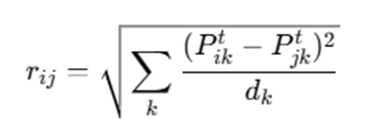
This measures how similar the two nodes are based on their random walk distributions.
Step 5: Initial Communities
- Start with each node as its own community.
- Total communities = ∣V∣
Step 6: Merge Communities
At each step:
- Find the pair of communities with minimum distance
- Merge them into a new community
Step 7: Update Distances
After merging communities C1 and C2, update distances using:

Step 8: Repeat Until One Community
- Continue merging until all nodes form a single cluster.
- Store all intermediate steps in a dendrogram
Step 9: Select Optimal Partition
Choose the best clustering based on:
- Modularity optimization
- Minimum distance structure
The Walktrap Algorithm begins by representing a network as a graph consisting of nodes and edges. Each node initially forms its own community, creating a large number of small clusters. The algorithm then simulates random walks across the graph to understand how nodes are connected. A random walk is a process where we move from one node to another based on transition probabilities derived from the adjacency matrix.
The key insight behind Walktrap is that short random walks are more likely to stay within the same community because nodes within a community are densely connected. Using this idea, the algorithm computes the probability distribution of reaching different nodes after a fixed number of steps. These distributions are then used to calculate distances between nodes. If two nodes have similar distributions, they are considered close and likely belong to the same community.
Once distances are computed, the algorithm proceeds with a hierarchical clustering approach. It identifies the pair of communities with the smallest distance and merges them into a single community. After merging, distances between the new community and all other communities are updated using a weighted formula. This ensures that the clustering process maintains consistency and accuracy.
This merging process continues iteratively, gradually reducing the number of communities. At each step, the algorithm records the structure of clusters, forming a dendrogram that represents the hierarchical organization of the graph. Finally, the algorithm selects the optimal level of clustering based on a quality metric such as modularity, which measures how well the graph is partitioned into communities.
Example of How Walktrap Algorithm Works
Consider a small social network:
- Nodes: A, B, C, D, E, F
- Edges:
- A–B, A–C, B–C (Community 1)
- D–E, E–F, D–F (Community 2)
Process:
- Each node starts as its own community
- Random walks show:
- A, B, C are closely connected
- D, E, F are closely connected
- Merge:
- A + B → AB
- AB + C → ABC
- D + E → DE
- DE + F → DEF
- Final communities:
- {A, B, C}
- {D, E, F}

Advantages and Disadvantages of Walktrap Algorithm
Advantages
- Captures Local Structure Effectively: One of the strongest advantages of the Walktrap Algorithm is its ability to capture the local structure of a network. Since it relies on short random walks, the algorithm naturally explores nearby nodes more frequently than distant ones. In real-world networks, nodes within the same community are densely connected, so a random walker tends to remain inside that community for a longer time. This behavior allows Walktrap to accurately detect tightly knit groups without requiring global information about the entire graph. As a result, it performs particularly well in networks where communities are clearly defined and locally dense.
- High Accuracy in Community Detection: Walktrap is known for producing high-quality community partitions, especially in medium-sized graphs. By using probability distributions derived from random walks, it captures subtle similarities between nodes that simple edge-based methods might miss. This leads to more meaningful clustering results. Additionally, the use of distance measures based on random walks ensures that nodes are grouped not just by direct connections but also by their structural roles within the network, improving overall detection accuracy.
- Supports Weighted Graphs: Unlike some basic clustering algorithms, Walktrap can handle weighted graphs, where edges have different strengths or importance. This is crucial in real-world applications such as social networks (where relationships vary in intensity) or transportation networks (where routes have different capacities). The transition probabilities in the random walk are influenced by edge weights, allowing the algorithm to reflect the true significance of connections. This makes Walktrap highly adaptable to practical scenarios.
- Provides Hierarchical Clustering Output: Walktrap follows a bottom-up hierarchical clustering approach, meaning it starts with individual nodes and progressively merges them into larger communities. This process generates a dendrogram (tree structure) that represents multiple levels of clustering. Users can analyze the network at different granularities—either focusing on small, detailed communities or broader, high-level clusters. This flexibility is extremely useful in exploratory data analysis, where the optimal number of communities is not known beforehand.
- Conceptually Intuitive and Easy to Understand: The concept behind Walktrap—random walks staying within communities—is intuitive and easy to grasp, even for beginners in graph theory. Unlike more complex algorithms that rely on heavy optimization or deep mathematical abstractions, Walktrap’s logic can be explained using simple probability and graph traversal ideas. This makes it a popular choice for teaching and for applications where interpretability is important.
Disadvantages
- High Computational Complexity: One of the main drawbacks of Walktrap is its computational cost. The algorithm requires calculating distances between communities repeatedly and updating them after each merge. These operations can become expensive as the number of nodes increases. The time complexity is typically around O(n² log n) in many implementations, making it less suitable for very large-scale networks with millions of nodes.
- Memory Intensive: Walktrap requires storing several large data structures, including: Transition probability matrices , Distance matrices between nodes or communities and Intermediate clustering results . As the graph size grows, these memory requirements increase significantly. This can become a bottleneck when working with large datasets, especially on systems with limited resources.
- Sensitivity to Walk Length (t): The performance of Walktrap depends heavily on the parameter t, which defines the length of the random walk. If t is too small, the algorithm may only capture very local structures and miss larger communities. If t is too large, the random walk may lose its locality and mix across different communities. Choosing the optimal value of t often requires experimentation or domain knowledge, which can be a limitation in practical applications.
- Not Suitable for Dynamic Graphs: Walktrap is designed for static networks, where the structure does not change over time. In dynamic graphs (such as real-time social networks or streaming data systems), nodes and edges are constantly added or removed. Since Walktrap does not efficiently update communities incrementally, the algorithm often needs to be rerun from scratch, making it inefficient for such scenarios.
- Limited Scalability Compared to Modern Algorithms: While Walktrap is effective, it does not scale as well as more modern community detection algorithms like Louvain or Leiden methods. These newer algorithms are optimized for large-scale networks and can process millions of nodes efficiently. In contrast, Walktrap becomes slower and less practical as the dataset grows, limiting its use in big data environments.
Applications of Walktrap Algorithm
The Walktrap Algorithm is widely used to detect communities in complex networks by analyzing random walks. Its applications include:
- Social Network Analysis: In platforms like Facebook, Twitter, and LinkedIn, Walktrap identifies user communities such as friend groups and interest clusters, helping in targeted marketing and understanding social behavior.
- Biological Networks: It is used to analyze protein and gene interaction networks, helping scientists discover functional modules, understand biological pathways, and identify disease-related gene clusters.
- Recommendation Systems: Platforms like Amazon, Netflix, and Spotify use Walktrap to group users with similar preferences, improving personalized recommendations and user engagement.
- Information Networks: Walktrap clusters related documents, web pages, or research papers, helping improve search results, topic classification, and knowledge discovery.
- Transportation Networks: It identifies highly connected regions and traffic clusters, supporting better route planning, traffic management, and infrastructure optimization.
- Cybersecurity: Walktrap detects unusual communication patterns, helping identify cyber threats such as botnets, intrusions, and abnormal network activities.
Conclusion
The Walktrap Algorithm stands out as a powerful and intuitive approach for community detection in complex networks. Its foundation on random walks provides a natural and effective way to explore graph structures. Since random walks tend to remain within densely connected regions, the algorithm successfully captures the local connectivity patterns that define communities. This makes Walktrap particularly effective in identifying meaningful clusters that reflect real-world relationships within data. One of the key strengths of Walktrap is its hierarchical clustering mechanism. Instead of producing just a single flat partition, it builds a dendrogram that represents multiple levels of community structure. This allows analysts and researchers to examine the network at different granularities, making it highly flexible for exploratory analysis. Whether the goal is to identify small, tightly knit groups or broader, high-level communities, Walktrap provides the necessary structure to do so.
Another important advantage is its interpretability. The concept of grouping nodes based on random walk similarity is relatively easy to understand compared to more complex optimization-based algorithms. This makes Walktrap not only useful for research but also suitable for teaching and practical applications where clarity is important. However, the algorithm is not without limitations. Its computational complexity and memory requirements can become significant as the size of the network increases. For very large-scale graphs, more optimized algorithms may be preferred. Despite this, Walktrap continues to be widely used because of its accuracy and ability to uncover subtle structural patterns that simpler methods might overlook. In today’s data-driven world, where networks are becoming increasingly complex—ranging from social media interactions to biological systems—the importance of community detection algorithms is growing rapidly. Walktrap plays a crucial role in this space by enabling researchers and practitioners to discover hidden relationships, improve decision-making, and gain deeper insights into network behavior. Overall, it remains a valuable and reliable tool in the field of network science.
Frequently Asked Questions (FAQs)
What is the main idea behind the Walktrap Algorithm?
The main idea behind the Walktrap Algorithm is that random walks tend to stay within the same community. Nodes that are frequently visited together during short random walks are likely to belong to the same cluster, and the algorithm groups them accordingly.
What type of graphs can Walktrap handle?
Walktrap is designed to work with undirected graphs and can also handle weighted networks. This makes it suitable for a wide range of real-world applications where connections may have varying strengths.
How does Walktrap differ from other clustering algorithms?
Unlike traditional clustering methods that rely mainly on edge density or direct connections, Walktrap uses random walk-based distances. This allows it to capture deeper structural similarities between nodes, providing a more dynamic and accurate representation of communities.
What is the role of the parameter t in Walktrap?
The parameter t represents the length of the random walk. It determines how far the algorithm explores the network:
- A small t captures local structures
- A larger t explores broader connections Choosing the right value of t is important for achieving optimal results.
Is Walktrap suitable for large-scale networks?
Walktrap is highly accurate but may not be ideal for very large-scale networks due to its computational and memory requirements. In such cases, faster algorithms like Louvain are often preferred, although Walktrap may still be used when accuracy and interpretability are more important than speed.


