
Introduction
Effective routing is essential to ensure that data is delivered swiftly, consistently, and with the least amount of overhead in the quickly changing world of wireless and mobile communication. Choosing the best routing protocol becomes difficult, particularly in settings like Mobile Ad Hoc Networks (MANETs), where node mobility can cause the network architecture to alter regularly. The two main categories of routing protocols for these dynamic networks are reactive (on-demand) and proactive (table-driven). One proactive protocol that stands out is Global State Routing (GSR), which exchanges topological information with nearby nodes on a regular basis to keep the network’s knowledge current. GSR uses intelligent link-state exchanges and continuous updates to provide loop-free, effective, and low-latency routing. Medium-sized mobile networks, where reliable route availability is more crucial than lowering control overhead, are best suited for it. In this blog article, we’ll examine how GSR operates, analyze its architecture using examples and diagrams, highlight its features, weigh its advantages and disadvantages, and compare it to other routing protocols. Regardless of your background—student, researcher, or network engineer—this tutorial will give you important knowledge about the Global State Routing protocol.
What is Global State Routing?
A proactive (table-driven) routing system created especially for mobile ad hoc networks (MANETs) is called Global State Routing (GSR). Each node in GSR keeps a comprehensive view of the network architecture and utilizes it to choose the best paths for data packets. By periodically exchanging connection state information with nearby nodes, GSR continuously updates routing information, in contrast to reactive protocols that create routes only when necessary. Global State Routing gets its name from the fact that it guarantees that each node in the network keeps a global view of the network. Key Concepts of GSR are:
- Proactive Protocol: Routes are maintained and updated regularly, regardless of traffic demand.
- Link-State Based: Nodes exchange information about which neighbors they are directly connected to.
- Routing Tables: Each node stores several tables, such as the neighbor table, topology table, next-hop table, and distance table.
- Loop-Free Routing: Since GSR uses global topology knowledge, it avoids routing loops and ensures consistent paths.
Why was GSR introduced? Because of their high overhead and centralized design, traditional link-state protocols such as OSPF (Open Shortest Path First) are too complex for ad hoc networks. For mobile, infrastructure-less situations where nodes must adjust to frequent changes without depending on a stable backbone, GSR was created as a lightweight substitute. In GSR is a structured and scalable protocol that maintains a thorough yet localized grasp of the network state to enable effective routing for MANETs.
How Global State Routing Works?
As a proactive link-state routing system, Global State Routing (GSR) keeps track of the most recent routing data at every node. By frequently exchanging topology information with its immediate neighbors, it guarantees dependable, loop-free communication. Core Working Principle is,
Each node in the network:
- Maintains knowledge of the entire network topology.
- Periodically exchanges link state updates with its neighbors.
- Uses this information to compute shortest paths to all other nodes using algorithms like Dijkstra’s Algorithm.
GSR uses four main tables at each node:
| Table | Description |
| Neighbor Table | Lists all directly connected nodes (1-hop neighbors). |
| Topology Table | Stores the link state information received from all neighbors. |
| Next-Hop Table | Records the immediate next hop for reaching every other node in the network. |
| Distance Table | Maintains the shortest distance (in hops) to all other nodes. |
Information Exchange Process: Every so often, nodes broadcast information about their neighbors to all of their nearby neighbors. Using this data, every node modifies its topology table. The node uses the new topology to recalculate the routing pathways upon receiving changes.
Routing Path Computation: The GSR algorithm uses Dijkstra’s Shortest Path First (SPF) algorithm after obtaining updated neighbor information. The algorithm determines the quickest, loop-free route to each destination using the topology table. The distance table and next-hop table are updated using the outcome.
Key Characteristics of GSR’s Operation,
- In small-to-medium networks, it is scalable.
- Effective use of bandwidth because updates are local and selected.
- Proactive updates allow for quicker route recovery.
- Because routes are pre-established, there is little latency for data transmission.
Example of Global State Routing (GSR)
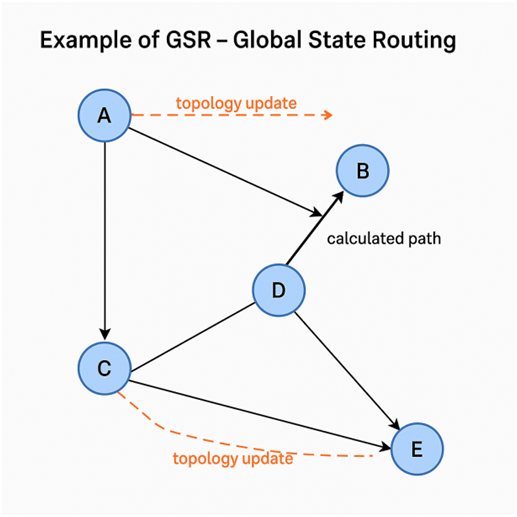
Let’s examine a basic example utilizing a tiny ad hoc network to better understand how Global State Routing (GSR) works. This will show how nodes compute shortest pathways, exchange link-state information, and maintain routing tables.
Network Topology Example
Assume we have the following mobile ad hoc network with 5 nodes:
Initial Neighbor Tables
Each node knows only its direct neighbors:
| Node | Direct Neighbors |
| A | B, C |
| B | A, D |
| C | A, D, E |
| D | B, C |
| E | C |
Step-by-Step Process
- Link-State Exchange:
- Each node periodically sends its list of direct neighbors to its neighbors.
- For example, Node A sends B, C to B and C.
- Topology Table Update:
- After a few exchanges, each node builds a complete view of the network topology using the link-state info from all nodes.
- Route Computation:
- Each node applies Dijkstra’s algorithm to compute the shortest path to all other nodes.
Example: Route from A to E
- A receives topology info and constructs the following path:
- A → C → E (2 hops)
- It updates its next-hop table:
- For destination E, next hop is C, total cost = 2 hops
Simplified Routing Table at Node A
| Destination | Next Hop | Distance (Hops) |
| B | B | 1 |
| C | C | 1 |
| D | C | 2 |
| E | C | 2 |
Key Takeaways from the Example,
- Nodes proactively keep their routing information current.
- Every node is fully knowledgeable about topology.
- Link-state data is used to calculate optimal and loop-free routes.
- GSR guarantees prompt delivery with little delay in route discovery.
In the given example of Global State Routing (GSR), we consider a simple mobile ad hoc network consisting of five nodes: A, B, C, D, and E. These nodes are interconnected such that A is directly connected to B and C, B is connected to A and D, C is connected to A, D, and E, D is connected to B and C, and E is connected only to C. Initially, each node knows only its immediate neighbors and stores this information in its neighbor table. During the periodic update process, nodes exchange their neighbor lists with adjacent nodes. For example, Node A shares its neighbor list (B and C) with B and C. As the updates propagate, each node builds a topology table that reflects the current network structure. Once this table is complete, nodes use Dijkstra’s algorithm to compute the shortest paths to every other node. In this case, Node A calculates the shortest path to Node E as A → C → E, a two-hop route. The next-hop table and distance table at Node A are updated accordingly, showing that C is the next hop for reaching E with a distance of two hops. This proactive and consistent route calculation ensures that data packets can be sent efficiently and without delay, as routing paths are always available and loop-free. The GSR protocol’s use of local neighbor exchanges to build a global view makes it both structured and adaptable for dynamic wireless environments.
Key Features of Global State Routing (GSR)
For mobile ad hoc networks (MANETs), Global State Routing (GSR) is a dependable and scalable proactive routing technology due to its many distinguishing characteristics. These characteristics guarantee that GSR maintains its effectiveness in settings with frequent node movement and changing topologies.
- Proactive (Table-Driven) Approach: GSR exchanges topology updates with neighbors on a regular basis to ensure consistent, current routing information. By doing away with the necessity of route finding prior to data transmission, this lowers latency and enhances real-time communication.
- Link-State Based Mechanism: GSR communicates link-state data rather than complete routing tables, in contrast to distance-vector protocols. This selective distribution of updates enhances scalability and lowers bandwidth usage.
- Loop-Free Routing: GSR ensures loop-free routing paths by keeping a comprehensive picture of the network architecture and utilizing methods such as Dijkstra’s Shortest Path First, which enhances data delivery stability and dependability.
- Multiple Routing Tables
- Every node in GSR keeps track of the following:
- Topology Table (global link-state data);
- Neighbor Table (direct connections);
- Next-Hop Table (decisions about routing)
- Distance Table (distances depending on hops)
These tables work together to optimize routing decisions dynamically.
- Fast Route Computation: Since the full network view is available at each node, paths can be computed quickly and locally using efficient algorithms. This ensures low latency, especially in time-sensitive applications.
- Scalable for Medium-Sized Networks: GSR is well-suited for small to medium ad hoc networks, where node density and mobility are moderate. Its bandwidth-efficient design helps manage control overhead effectively.
- Resilient to Topology Changes: The frequent exchange of link-state information allows GSR to quickly adapt to changes in the network, such as link breakages or node mobility, ensuring minimal disruption in communication.
- Consistency and Synchronization: All nodes work with the same set of topology data, ensuring consistent decision-making across the network and avoiding route discrepancies.
Advantages and Disadvantages of Global State Routing (GSR)
Like all routing protocols, Global State Routing (GSR) comes with a unique set of strengths and limitations. Understanding these helps in evaluating its suitability for specific network environments, especially in mobile ad hoc networks (MANETs).
Advantages of GSR
- Low Latency in Data Transmission: Proactive maintenance and precomputed routes are used. Before packets are sent, there is no delay for route discovery.
- Loop-Free and Reliable Routing: To guarantee loop-free pathways, Dijkstra’s algorithm and knowledge of global topology are used.
- Effective Bandwidth Use: Complete routing tables are not shared; only neighbor information is. This optimizes the utilization of scarce wireless bandwidth and lowers overhead.
- Consistent and Synchronized Topology View: Stable and synchronized routing decisions are ensured by all nodes maintaining the same topology structure.
- Fast Adaptation to Topology Changes: Frequent link-state updates facilitate the prompt identification and correction of connection failures or node mobility.
- Scalable for Medium-Size Networks: Performs well in networks with moderate node density and limited mobility, making it ideal for certain tactical or emergency deployment scenarios.
Disadvantages of GSR
- High Memory and Processing Overhead: On low-power systems, each node must compute pathways using methods like Dijkstra’s and maintain several tables, which can be resource-intensive.
- Control Message Overhead: As the number of nodes rises, frequent link-state broadcasts use up network capacity.
- Less Effective in Big or Highly Dynamic Networks: As a network gets bigger, it gets harder and more expensive to maintain accurate topology tables and figure out the shortest paths.
- Redundant Information Exchange: Constant updates may become superfluous and waste bandwidth in situations with low mobility or staticity.
- Lack of Support for Multicast or QoS (by default): GSR prioritizes unicast routing and does not include integrated multicast/broadcast optimization or Quality of Service (QoS) techniques.
| Aspect | Advantages | Disadvantages |
| Latency | Low (precomputed routes) | — |
| Resource Use | Bandwidth-efficient updates | High memory/CPU usage |
| Scalability | Medium networks | Poor performance in large/high-mobility networks |
| Reliability | Loop-free and stable | Vulnerable to overhead during frequent updates |
| Adaptability | Fast route recovery | May not scale well with increasing node count |
Applications of Global State Routing (GSR)
Global State Routing (GSR) was created especially for situations in which nodes must cooperate to stay connected in the absence of a centralized infrastructure. It is appropriate for a variety of real-world situations due to its proactive, loop-free, and bandwidth-efficient characteristics, especially in mobile ad hoc networks (MANETs).
- Military and Tactical Networks: Real-time communication between soldiers, vehicles, and drones in battlefield environments. Why GSR?: Provides low-latency, precomputed routes and can handle moderate node mobility with quick recovery from failures.
- Disaster Recovery and Emergency Services: Coordinating rescue operations during natural disasters like earthquakes or floods where infrastructure is destroyed. Why GSR?: Offers fast route setup and reliable communication without the need for existing infrastructure.
- Vehicular Ad Hoc Networks (VANETs): Communication between vehicles in traffic control or accident alert systems. Why GSR?: Suitable for city-level deployments where mobility is moderate and updates are frequent but manageable.
- Remote Environmental Monitoring: Sensor networks in forests, glaciers, or oceans collecting data on temperature, wildlife, or pollution. Why GSR?: Proactive routing ensures consistent delivery of environmental data from sensor nodes to central collectors.
- Academic Research and Protocol Benchmarking: Studying protocol performance in controlled simulations or experimental testbeds. Why GSR?: Its simple, table-driven architecture makes it easy to analyze and compare with other routing strategies.
- Temporary Ad Hoc Networks for Events or Camps: Setting up wireless communication at remote events, music festivals, or research camps. Why GSR?: Quickly deployable and ensures stable connectivity in a predefined geographic area.
- Mobile Mesh Networks: Extending internet access in underserved rural areas using mesh-connected mobile devices. Why GSR?: Can support basic routing needs where infrastructure is scarce but mobility is predictable.
GSR Comparison with Other Protocols
Comparing Global State Routing (GSR) to other well-known routing protocols utilized in Mobile Ad Hoc Networks (MANETs) is crucial to assessing its efficacy. With varying design philosophies, these encompass both proactive and reactive strategies.
Comparison with Other Routing Protocols
| Protocol | Type | Routing Mechanism | Latency | Overhead | Loop-Free? | Scalability | Use Case Suitability |
| GSR | Proactive | Link-state via neighbor updates | Low (precomputed) | Moderate | Yes | Medium | Medium networks with moderate mobility |
| DSDV | Proactive | Distance-vector with sequence no | Low | High | Yes | Low | Small networks with stable topology |
| OLSR | Proactive | Optimized link-state using MPRs | Low | Low–Moderate | Yes | High | Dense, large-scale networks |
| AODV | Reactive | On-demand route discovery | High (initial) | Low | Yes | Medium–High | High mobility, dynamic topologies |
| DSR | Reactive | Source routing + caching | High (initial) | Low | Yes | Medium | Small to medium highly dynamic networks |
Advantages of GSR over Reactive Protocols (AODV, DSR):
- No route discovery delay; routes are always available.
- Better suited for time-sensitive applications (e.g., VoIP, real-time video).
Limitations Compared to OLSR:
- OLSR uses Multipoint Relays (MPRs) to reduce redundant broadcasts, making it more efficient in dense networks.
- GSR lacks optimization for large node densities and can incur more overhead.
Compared to DSDV:
- GSR is more scalable than DSDV due to selective link-state updates instead of full-table updates.
- Offers better bandwidth utilization.
Which Protocol to Choose?
| Scenario | Recommended Protocol |
| Low mobility, small network | DSDV |
| Moderate mobility, medium network | GSR |
| High-density, large-scale network | OLSR |
| High mobility, unpredictable topology | AODV or DSR |
| Delay-sensitive applications | GSR or OLSR |
GSR balances performance and overhead in moderately sized, moderately mobile situations, but it is not the best option for very large or highly dynamic networks. When low latency and predictable routing are required, its proactive nature, loop-free pathways, and link-state mechanism make it a compelling option.
Conclusion
For mobile ad hoc networks (MANETs), Global State Routing (GSR) is a proactive and effective routing technology. Through the use of link-state exchanges with near neighbors and the maintenance of current routing information, GSR guarantees low-latency, loop-free network communication. Because of its architecture, which is based on several routing tables and techniques like Dijkstra’s, every node may determine the best routes on its own without assistance from a central authority. Although GSR works best in medium-sized networks with moderate mobility, real-time applications like disaster recovery, military communication, and mobile sensor networks benefit greatly from its reliable performance, rapid topology change adaptation, and decreased route discovery latency. However, because of the overhead of frequent updates and memory utilization, it might not scale as effectively in very large or highly dynamic networks. In conclusion, GSR is a useful solution in some wireless networking contexts because it effectively balances proactive dependability and routing efficiency.
Frequently Asked Questions (FAQs)
What type of routing protocol is GSR?
GSR is a proactive (table-driven) routing system that uses recurring link-state data exchange to keep routing information current at every node.
How does GSR ensure loop-free routing?
GSR employs Dijkstra’s shortest path algorithm with a global view of the network architecture to guarantee that every routing path is optimum and free of loops.
What makes GSR different from reactive protocols like AODV?
Whereas reactive protocols like AODV only find routes when necessary, which might result in initial slowness, GSR maintains routes constantly, removing route discovery delays.
In what scenarios is GSR most effective?
GSR is perfect for medium-sized, somewhat mobile networks where low-latency communication is crucial, like military operations, emergency response settings, and automotive ad hoc networks.
What are the major drawbacks of GSR?
In very large or very dynamic networks, GSR’s control message exchanges might not scale effectively, and it might result in significant memory and processing overhead.