
Introduction
Millions of gadgets, ranging from industrial sensors to smart thermostats, are continuously sharing little bits of data online in the quickly developing realm of the Internet of Things (IoT). These gadgets frequently have low processing, memory, and power capacities. They therefore need efficient, lightweight communication methods that function effectively even in limited settings. CoAP (Constrained Application Protocol) is useful in this situation. CoAP offers a straightforward and effective method for low-power and resource-constrained devices to communicate over the internet. Similar to HTTP, it allows web-like interactions but is geared for low-resource devices and uses UDP rather than TCP to cut down on overhead. This article will explain what CoAP is, how it functions, its salient characteristics, pros and cons, and how it stacks up against other widely used IoT protocols. Working with contemporary IoT systems requires an awareness of CoAP, regardless of whether you’re a developer, student, or tech enthusiast.
What is CoAP (Constrained Application Protocol)?
A lightweight web transmission protocol called CoAP (confined Application Protocol) was created especially for usage in situations with constraints, such Internet of Things devices with confined memory, computing power, and energy. The IETF Constrained RESTful Environments (CoRE) Working Group created it, and RFC 7252 serves as its standard. Including HTTP, CoAP is built on the REST architecture and offers well-known functions including GET, POST, PUT, and DELETE. However, CoAP uses UDP to maintain quick and resource-efficient communication, in contrast to HTTP, which uses TCP. Here are some defining characteristics of CoAP:
- Designed for Low-Power Devices: It allows limited-capacity devices, such as sensors, actuators, and controllers, to communicate with one another.
- Asynchronous Messaging: Confirmable, Non-confirmable, Acknowledgment, and Reset are the four message types that CoAP offers for asynchronous communication.
- MIME and URI Support: Similar to HTTP, CoAP supports several media types through Content-Format headers and identifies resources using Uniform Resource Identifiers (URIs).
- Interoperability with HTTP: CoAP can be seamlessly integrated with the current web because it is made to be readily translated to HTTP using a proxy.
In CoAP provides a compact, reliable, and efficient way for resource-constrained devices to communicate, making it an essential protocol in the IoT ecosystem.
How CoAP (Constrained Application Protocol) Works?
Similar to HTTP, CoAP (Constrained Application Protocol) uses a client-server architecture, however it is intended to use UDP rather than TCP. As a result, CoAP is lighter, faster, and more appropriate for low-resource devices. Here’s a step-by-step breakdown of how CoAP works:
1. Communication Model
- CoAP follows a Request/Response model.
- A CoAP client sends a request to a CoAP server to access or manipulate a resource.
- The server processes the request and sends back a response.
- It supports RESTful methods like:
- GET – Retrieve a resource
- POST – Create or update a resource
- PUT – Update a resource
- DELETE – Remove a resource
2. Message Types
CoAP uses four types of messages, each with a specific purpose:
| Message Type | Purpose |
| Confirmable (CON) | Requires acknowledgment (reliable) |
| Non-confirmable (NON) | No acknowledgment needed (best-effort) |
| Acknowledgement (ACK) | Response to a CON message |
| Reset (RST) | Used when a message is not understood |
Example:
A temperature sensor (client) sends a Confirmable GET request to the server to fetch the current temperature. The server replies with an Acknowledgement carrying the response.
3. Resource Discovery
CoAP allows clients to discover available resources on a device using the “.well-known/core” URI. This feature helps in dynamically identifying services offered by a device.
Example:
GET coap://sensor.local/.well-known/core returns a list of available resources like /temperature, /humidity, etc.
4. Observe Option (Publish/Subscribe Model)
CoAP supports a powerful feature called “Observe”, allowing clients to subscribe to a resource and get updates automatically whenever the resource changes. This is useful in real-time monitoring.
5. CoAP Over UDP + DTLS
- CoAP works on UDP, making it lightweight and fast.
- For security, it uses DTLS (Datagram Transport Layer Security) to ensure encryption, integrity, and authentication.
Summary:
- Client-server RESTful protocol
- Operates over UDP (not TCP)
- Four message types: CON, NON, ACK, RST
- Built-in support for discovery and observation
- Can be proxied to HTTP for interoperability
- Secure using DTLS
This simple yet powerful model allows efficient communication in IoT networks, even when devices are severely limited in memory, power, or connectivity.
Example of CoAP (Constrained Application Protocol)
To better understand how CoAP works, let’s walk through a real-world example involving a smart home temperature sensor and a central monitoring server.
Scenario: Smart Temperature Monitoring
Imagine you have a smart home setup where a temperature sensor (CoAP client) sends temperature readings to a central home server (CoAP server). The server stores the data and displays it on a user interface like a dashboard. Step-by-Step Communication,
- Client Sends Request (GET)
The client (temperature sensor) sends a Confirmable (CON) GET request to the server to retrieve the latest temperature reading.
Request:
Method: GET
URI: coap://192.168.1.10/temperature
Type: CON (Confirmable)
Message ID: 1234
- Server Responds with Acknowledgement (ACK)
The server receives the request and sends back a response with the current temperature value.
Response:
Type: ACK
Message ID: 1234
Payload: 26.5°C
Content-Format: text/plain
- Using the Observe Option
If the client wants to monitor the temperature continuously, it adds the Observe option to the GET request. The server will then send updates automatically whenever the temperature changes.
CoAP Message Flow Diagram,
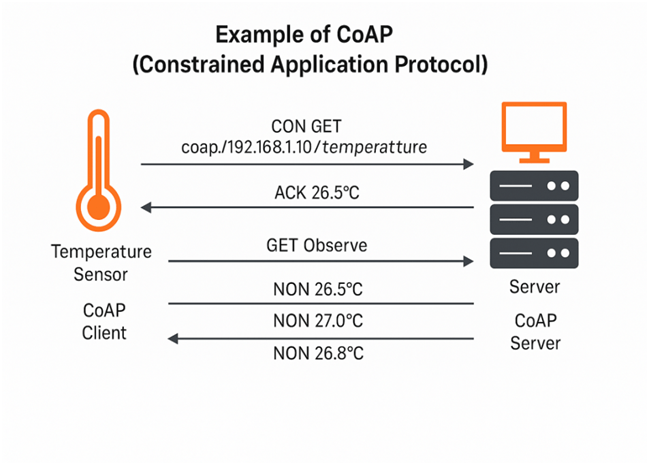
Key Points in This Example,
- The sensor acts as a CoAP client.
- The central server acts as a CoAP server.
- Communication is done over UDP using lightweight messages.
- Observe option enables automatic push updates.
- Message IDs help match requests with responses.
This example illustrates how CoAP enables efficient, low-overhead communication between devices in IoT applications, making it ideal for real-time monitoring in smart homes, healthcare systems, and industrial environments.
Consider a temperature sensor that routinely checks the room temperature and sends the information to a central server in a typical smart home setup. The server serves as a CoAP server, and the sensor as a CoAP client. The client uses the URI, coap://192.168.1.10/temperature, to submit a Confirmable (CON) GET request to the server in order to obtain the current temperature. This message is perfect for the sensor’s constrained power and bandwidth because it is lightweight and sent over UDP. The server receives the request, processes it, and returns an Acknowledgment (ACK) message with the temperature reading (e.g., “26.5°C”) and the same message ID for matching.

The client can additionally submit the request using the Observe option to increase the system’s automation and efficiency. The client can now subscribe to temperature resource changes as a result. Without requiring repeated requests, the server notifies the client of temperature changes. Unless reliability is required, these updates are usually provided via Non-confirmable (NON) messages to minimize communication overhead. This configuration is perfect for battery-powered Internet of Things devices since it enables real-time temperature monitoring with low energy usage. The strength and usefulness of CoAP in IoT systems are demonstrated by the communication’s compactness, speed, and ability to function flawlessly in confined spaces.
Key Features of CoAP (Constrained Application Protocol)
CoAP was created especially for IoT devices with limited resources. It has a number of strong qualities that make it effective, portable, and appropriate for low-power communication.
1. Lightweight and Low Overhead: CoAP uses UDP instead of TCP, reducing the communication overhead. The protocol headers are small and optimized for minimal processing and memory usage, which is ideal for embedded devices.
2. RESTful Architecture: CoAP is based on the REST model, similar to HTTP. It supports standard methods like GET, POST, PUT, and DELETE, making it intuitive and interoperable with web technologies.
3. Four Message Types
CoAP uses a simple messaging model with four types:
- Confirmable (CON) – Requires acknowledgment (reliable).
- Non-confirmable (NON) – No acknowledgment needed (faster, best-effort).
- Acknowledgement (ACK) – Confirms receipt of a CON message.
- Reset (RST) – Indicates that a message could not be processed.
4. Asynchronous Communication: CoAP allows non-blocking communication, enabling devices to send or receive data when available without waiting on continuous connections.
5. Observe Mechanism: Devices can subscribe to a resource using the Observe option.The server notifies subscribed clients whenever the resource’s state changes (similar to publish-subscribe).
6. Resource Discovery
- Clients can discover available resources on a CoAP server using the special URI:
GET /.well-known/core
- This feature helps in dynamically understanding what services are provided by a device.
7. Proxy and Caching Support: CoAP supports proxies, allowing translation between CoAP and HTTP. Built-in caching mechanisms help reduce repeated data transmission, saving bandwidth and energy.
8. Multicast Support: CoAP can send requests to multiple devices simultaneously using IP multicast, which is useful for broadcasting control messages (e.g., turn off all lights).
9. Security with DTLS
- CoAP supports Datagram Transport Layer Security (DTLS) to ensure:
- Data confidentiality
- Message integrity
- Authentication
10. Interoperability with HTTP
- CoAP is designed to be easily translated to/from HTTP, enabling integration with the broader internet via gateways and proxies.
| Feature | Description |
| Lightweight Protocol | Optimized for low-power, constrained devices |
| RESTful Interface | Uses HTTP-like methods (GET, POST, PUT, DELETE) |
| Asynchronous Messaging | Supports non-blocking communication |
| Observe Option | Enables push notifications for resource changes |
| Resource Discovery | Allows clients to find available resources dynamically |
| Proxy & Caching Support | Reduces bandwidth and allows HTTP interoperability |
| Multicast Support | Sends messages to multiple devices at once |
| Security via DTLS | Secures data with encryption and authentication |
These features make CoAP an ideal protocol for IoT ecosystems, enabling efficient, secure, and scalable communication across a wide range of smart devices.
Advantages and Disadvantages of CoAP
IoT devices with constrained resources are the target audience for the Constrained Application Protocol (CoAP). Like any technologies, it has advantages and disadvantages. Here is a fair assessment of its benefits and drawbacks:
Advantages of CoAP
- Lightweight and Effective: CoAP use UDP, which has lower overhead than TCP. Perfect for gadgets with constrained power, memory, and CPU.
- RESTful Architecture: Provides GET, POST, PUT, and DELETE methods similar to those of HTTP. Simple to comprehend and incorporate into pre-existing web services.
- Low Bandwidth Usage: Small messages and headers reduce bandwidth usage. Ideal for low-data-rate, wireless networks such as 6LoWPAN.
- Built-in Resource Discovery: Devices can announce their available resources using: GET /.well-known/core, Enables dynamic discovery and interaction in IoT systems.
- Support for Multicast: A client can send a single message to several devices thanks to CoAP’s support for multicast communication.
- Asynchronous and Observable Communication: Supports asynchronous interactions. Real-time alerts when a resource changes (such as temperature updates) are possible using the Observe option.
- Security using DTLS: Datagram Transport Layer Security (DTLS) guarantees safe communication. provides integrity, secrecy, and verification.
- HTTP Interoperability: Enables integration with cloud platforms and web-based systems by translating data to and from HTTP via proxies.
Disadvantages of CoAP
- Unreliable Transport Layer (UDP): In contrast to TCP, UDP does not ensure packet order or delivery. Despite using Confirmable messages to implement reliability at the application layer, CoAP is not as resilient as TCP.
- Limited QoS (Quality of Service): In contrast to protocols like MQTT, CoAP lacks fine-grained control over QoS and offers only basic dependability features.
- DTLS Security Overhead: Although DTLS improves security, it also adds complexity and processing overhead, which can be problematic for devices with very low power consumption.
- NAT and Firewall Issues: NAT traversal and firewall setups may present difficulties for CoAP’s use of UDP, particularly in public networks.
- Not Suitable for High-Bandwidth Applications: CoAP is not appropriate for high-data-rate applications, video streaming, or massive file transfers.
Applications of CoAP
Because it is lightweight and energy-efficient, CoAP (Constrained Application Protocol) is commonly utilized in Internet of Things (IoT) contexts. It works particularly well when communicating between devices that have little amounts of memory, computing power, or battery life. Below are the key areas where CoAP is actively applied:
- Smart Homes: Use Case: Sensors and actuators in smart homes use CoAP to communicate with home automation systems. Examples: Temperature and humidity sensors, Smart lights and smart locks, Motion detectors and alarms
- Industrial IoT (IIoT): Use Case: CoAP enables industrial equipment and machines to report their status or receive commands in real-time. Examples, Factory automation systems, Machine health monitoring, Smart meters in energy grids
- Smart Cities: Use Case: CoAP supports infrastructure monitoring and public utility control in smart cities. Examples: Smart street lighting, Waste management sensors, Environmental monitoring (e.g., air quality, noise)
- Healthcare and Wearable Devices: Use Case: CoAP facilitates communication between medical sensors and health data aggregators or servers. Examples: Heart rate and blood pressure monitors, Fitness trackers and Remote patient monitoring systems
- Environmental Monitoring: Use Case: CoAP is ideal for networks of sensors deployed in fields, forests, or oceans for continuous data collection. Examples: Soil moisture sensors in agriculture, River level and flood detection sensors and Weather stations
- Smart Agriculture: Use Case: CoAP is used to control irrigation systems, monitor soil conditions, and optimize farming operations. Examples: Automated watering systems, Livestock tracking, and Greenhouse climate control
- Building Automation: Use Case: CoAP connects HVAC systems, lighting, and access control within commercial buildings. Examples: Thermostats, Energy-efficient lighting systems and Fire and security alarm systems
- Connected Vehicles: Use Case: In some vehicular networks, CoAP is explored for lightweight communication between vehicle sensors and infrastructure. Examples: Vehicle-to-infrastructure (V2I) messaging and Tire pressure and fuel monitoring sensors
| Application Area | Examples |
| Smart Homes | Lights, sensors, smart locks |
| Industrial IoT | Machines, sensors, automation systems |
| Smart Cities | Street lights, waste bins, air quality monitors |
| Healthcare | Wearables, remote monitoring devices |
| Environmental Monitoring | Soil, water, air sensors |
| Smart Agriculture | Irrigation, greenhouse automation |
| Building Automation | HVAC, alarms, energy control |
| Connected Vehicles | Sensor communication, vehicle telemetry |
CoAP’s ability to deliver low-power, reliable, and scalable communication makes it a perfect fit for a wide range of real-world IoT and M2M (Machine-to-Machine) applications.
Constrained Application Protocol Compare with Other Protocols
Among the various protocols created for communication in Internet of Things settings is CoAP. Knowing how CoAP stacks up against other well-known protocols like HTTP, MQTT, and AMQP is crucial for selecting the appropriate protocol for a particular application.
CoAP vs HTTP
| Feature | CoAP | HTTP |
| Transport Protocol | UDP | TCP |
| Lightweight | Yes (low overhead) | No (heavy for constrained devices) |
| Message Format | Binary (compact) | Text-based (larger size) |
| Designed For | IoT, constrained devices | Web browsers, full-featured clients |
| Security | DTLS | TLS |
| Multicast Support | Yes | No |
| Observability | Yes (via Observe option) | No native support |
| Proxy Support | Yes (CoAP-HTTP proxy possible) | Yes |
CoAP is more suitable for low-power IoT devices, while HTTP is best for general web applications.
CoAP vs MQTT
| Feature | CoAP | MQTT |
| Communication Model | Request/Response (RESTful) | Publish/Subscribe |
| Transport Protocol | UDP | TCP |
| Message Reliability | Basic (via Confirmable messages) | Strong (QoS levels 0, 1, 2) |
| Observability | Yes (Observe option) | Yes (native publish-subscribe) |
| Payload Format | Any (binary/text) | Any (binary/text) |
| Resource Discovery | Built-in via /.well-known/core | Not built-in |
| Use Case Suitability | REST-based IoT communication | Event-driven IoT applications |
- Choose CoAP for RESTful APIs and low-power networks.
- Choose MQTT for real-time event-based messaging with reliable delivery.
CoAP vs AMQP
| Feature | CoAP | AMQP |
| Transport Protocol | UDP | TCP |
| Communication Model | Request/Response | Message Queue (Broker-based) |
| Message Reliability | Basic | High (Transactional messaging) |
| Resource Constraints | Suitable for constrained devices | Not ideal for constrained devices |
| Security | DTLS | TLS |
| Protocol Complexity | Simple | Complex |
| Use Case Suitability | Lightweight IoT systems | Enterprise messaging systems |
- Use CoAP in embedded IoT scenarios.
- Use AMQP in secure, enterprise-level, high-throughput systems.
CoAP vs WebSockets
| Feature | CoAP | WebSockets |
| Communication Style | RESTful | Full-duplex (real-time) |
| Transport Protocol | UDP | TCP |
| Protocol Overhead | Low | Medium |
| Use Case Suitability | Sensor networks, lightweight comms | Real-time apps like chat, games |
- Use CoAP for sensor networks.
- Use WebSockets when persistent real-time connection is needed.
Overall Summary,
| Protocol | Transport | Model | Best For | Complexity | Reliability |
| CoAP | UDP | RESTful | Low-power IoT, sensor networks | Low | Moderate |
| HTTP | TCP | RESTful | Web services, cloud APIs | High | High |
| MQTT | TCP | Pub/Sub | Real-time IoT with reliable delivery | Medium | High |
| AMQP | TCP | Brokered Messaging | Enterprise systems with transaction needs | High | Very High |
| WebSockets | TCP | Full-Duplex | Real-time communication apps | Medium | High |
CoAP is a great option for contexts with limitations, particularly when low power usage, multicast capability, and RESTful interaction are needed. The network conditions, device capabilities, and communication requirements of your application will always determine the optimal protocol selection.
Conclusion
Lightweight, effective, and adaptable, the Constrained Application Protocol (CoAP) was created especially for the Internet of Things and devices with limited resources. It introduces HTTP’s well-known RESTful architecture to settings where low power consumption, low bandwidth, and constrained processor power are important considerations. CoAP facilitates resource observation, multicast support, easy and dependable UDP communication, and seamless web integration through proxying to HTTP. It is an effective tool for creating smart cities, homes, healthcare systems, and industrial applications because of its asynchronous communication paradigm and integrated security via DTLS. CoAP works well in low-power, sensor-based contexts where lightweight messaging and RESTful access are required, but it might not be appropriate for high-bandwidth or extremely dependable use cases (where protocols like MQTT or AMQP might be better). To sum up, CoAP is a key part of the current IoT protocol stack, and developers and engineers creating the next generation of linked devices must comprehend how it operates.
Frequently Asked Questions (FAQs)
What transport layer does CoAP use?
The transport layer of CoAP is UDP (User Datagram Protocol). This makes it perfect for low-power and limited devices by lowering communication overhead.
Is CoAP secure?
Yes, CoAP supports security through DTLS (Datagram Transport Layer Security), which provides encryption, integrity, and authentication similar to HTTPS (which uses TLS).
How is CoAP different from HTTP?
- CoAP is designed for resource-constrained devices and uses UDP, while HTTP uses TCP.
- CoAP has a smaller message size, supports multicast, and has lower overhead than HTTP.
- Despite their differences, CoAP can be translated to HTTP via proxy gateways.
Can CoAP be used in real-time applications?
Indeed, near-real-time applications can make advantage of CoAP, particularly when paired with the Observe option. However, protocols like WebSockets or MQTT can be more appropriate for stringent real-time requirements.
What are some popular libraries or tools for implementing CoAP?
Some popular CoAP implementations include:
- libcoap (C)
- Eclipse Californium (Java)
- CoAPthon (Python)
- Node-CoAP (Node.js)
These libraries help developers integrate CoAP into their applications across different platforms.