Introduction
Allowing numerous users to share the same frequency spectrum without interference has long been one of the most difficult problems in the fast-paced world of mobile communication. Although they provided answers, conventional techniques like frequency division and time division have drawbacks in terms of call quality, capacity, and efficiency. This is where the spread spectrum technology known as Code Division Multiple Access (or CDMA) transformed the market. Since CDMA allowed millions of customers to easily receive voice and data services over the same channel, it became a fundamental component of mobile networks, particularly in the 2G and 3G eras. In contrast to previous technologies, CDMA uses distinct codes that permit signals to overlap while maintaining their ability to be distinguished, rather than allocating a fixed frequency or time slot to every user. In addition to increasing spectrum efficiency, this innovation increased communication system security, data throughput, and call quality.
What is CDMA (Code Division Multiple Access)?
Spread spectrum techniques are used by CDMA (Code Division several Access), a digital cellular technology, to enable several users to share a frequency band at the same time. In contrast to previous techniques like Time Division Multiple Access (TDMA), in which each user transmits during a designated time slot, or Frequency Division Multiple Access (FDMA), in which each user is assigned a separate frequency channel, CDMA enables all users to transmit simultaneously on the same frequency. The secret to CDMA is giving each user’s signal a distinct code, or pseudo-random sequence. Unintentional receivers may see these codes as noise because they disperse the signal over a large bandwidth. The original signal is extracted and additional signals are filtered out at the receiving end using the same code. Multiple conversations or data streams can coexist on the same frequency without interfering with one another because to this mechanism.
CDMA gained widespread use in 2G and 3G networks (such as CDMA2000 and WCDMA) for mobile voice and data. It was a breakthrough technology in mobile communications, offering increased security, greater data rates, and improved speech clarity in addition to improved spectral efficiency.
How CDMA (Code Division Multiple Access) Works?
Spread spectrum technology and the employment of distinct codes to distinguish between various users form the foundation of CDMA’s operation. CDMA enables all users to broadcast simultaneously on the same frequency band, as opposed to assigning each user a different frequency (as in FDMA) or a time slot (as in TDMA). The coding method is what enables this.
- Signal Encoding: Each user’s voice or data is converted into a digital signal and then multiplied by a unique pseudo-random code. This spreads the signal over a much wider bandwidth than the original data would require.
- Transmission over Shared Spectrum: Because all signals are spread using different codes, they overlap in both frequency and time. To an outsider, the combined signals appear as random noise.
- Signal Reception and Decoding: At the receiver’s end, the same unique code is used to despread the desired signal. Since the receiver knows the correct code, it can extract the intended message while treating all other signals as background noise.
- Error Correction and Security: The spread spectrum method not only minimizes interference but also provides resistance against eavesdropping, signal fading, and jamming. This makes CDMA more reliable compared to earlier multiple access methods.
In essence, CDMA works like a party where everyone is speaking at once, but each pair of people uses a different language (code). Even though all voices overlap, each listener can easily pick out the conversation in their own language while ignoring the rest.
Example of CDMA – Spread Spectrum for Mobile Voice/Data in Action
To gain a better understanding of CDMA, let’s look at a practical example. Consider yourself in a busy café where numerous groups of individuals are conversing simultaneously. It would be hard to tell one talk from another if everyone spoke the same language. You might easily focus on your own talk and disregard the others, though, if each pair spoke a different language. In mobile communication, CDMA operates in just this manner. In practice, when multiple users make phone calls or access mobile data over a CDMA network:
- Each user’s voice or data is assigned a unique code sequence.
- All users transmit their signals simultaneously on the same frequency band.
- At the receiver’s end, the system applies the same code sequence to extract the intended user’s signal, while treating other signals as noise.
For instance, the signals of five people making phone calls simultaneously are sent jointly. Each call is distinguished by its own code, which ensures great speech quality and less interference, thanks to CDMA’s spread spectrum approach. The same is true for data transmission; numerous users can stream, download, or browse without interfering with one another’s use of the frequency spectrum. CDMA was groundbreaking in mobile networks because it allowed several users to share the same channel at the same time.
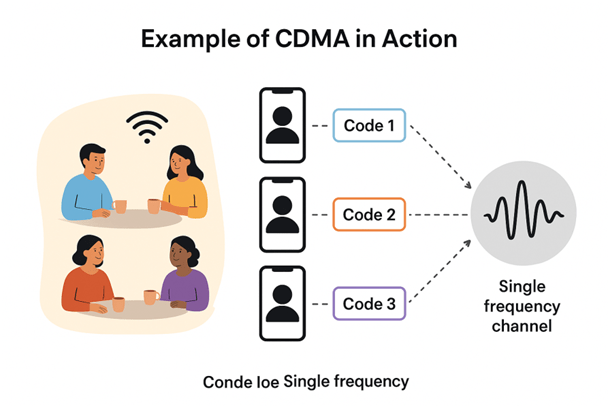
Consider a busy café with numerous groups of people conversing simultaneously to get a sense of how CDMA functions in real life. It would be extremely difficult to distinguish one talk from another if everyone spoke the same language. If every group spoke a different language, though, it would be simple to concentrate on your own discussion and disregard the others. In terms of mobile communication, CDMA functions similarly. Each user’s signal is given a distinct code when they make calls or access data simultaneously. These distinct codes allow the receiver to recognize and extract only the intended signal while considering the others as background noise, even though all signals are sent simultaneously over the same frequency band. For instance, if five people are using a CDMA network to make phone calls, their discussions are carried simultaneously but are free from interference since each person’s code keeps them apart. The key factor that made CDMA a groundbreaking technology for voice and data transmission was its capacity to allow numerous users to share a single channel with ease.
Key Features of CDMA
CDMA introduced several groundbreaking features that set it apart from earlier mobile communication technologies. Some of the most notable features include:
- Spread Spectrum Technology: CDMA spreads each user’s signal across a wide frequency band, which makes the transmission more robust against noise, interference, and signal fading.
- Unique Code Assignment: Every user is assigned a unique pseudo-random code, ensuring multiple signals can coexist on the same frequency without clashing.
- High Spectral Efficiency: By allowing many users to share the same bandwidth simultaneously, CDMA makes far more efficient use of spectrum compared to FDMA and TDMA.
- Soft Handoff: Unlike GSM (which uses hard handoffs), CDMA supports soft handoff, meaning a mobile device can communicate with multiple base stations at the same time during a transition. This reduces call drops and improves reliability.
- Enhanced Privacy and Security: Since signals are encoded with unique codes, they appear as noise to unintended receivers, making it difficult to intercept conversations or data.
- Resistance to Multipath Interference: CDMA is well-suited for urban environments where signals may bounce off buildings and objects. Its design helps minimize distortion caused by multipath propagation.
- Support for Higher Capacity: By efficiently handling overlapping signals, CDMA networks can accommodate a larger number of users compared to older access technologies.
Advantages and Disadvantages of CDMA
Like any mobile communication technology, CDMA (Code Division Multiple Access) has its strengths and limitations. Understanding both gives a balanced view of its role in mobile voice and data transmission.
Advantages of CDMA
- Effective Spectrum Utilization: By allowing multiple users to share a frequency band at once, available bandwidth can be used more effectively.
- Better Call Quality: When compared to prior technologies, CDMA offers clearer speech transmission and less interference.
- Enhanced Security: Signals encoded with distinct codes are difficult for outsiders to detect or eavesdrop on because they seem as noise.
- Soft Handoff Capability: This feature ensures seamless connectivity by allowing users to move between base stations without missing calls.
- High Capacity: Compared to FDMA or TDMA-based systems, CDMA can accommodate more users per MHz of bandwidth.
- Resistance to Multipath and Interference: CDMA effectively manages signal reflections, which is especially helpful in urban settings.
Disadvantages of CDMA
- Complex System Design: Deployment is more costly due to the sophisticated infrastructure needed for the encoding and decoding processes.
- Power management Issues: Since several users share a frequency, precise power management is required to prevent one strong signal from overpowering others (a issue referred to as the near-far problem).
- Limited Global Adoption: CDMA only saw significant adoption in areas like the United States and parts of Asia, in contrast to GSM, which became a global standard.
- Performance Degradation at High Load: Call quality and data speeds may suffer as more users join the network.
- Transition Limitations: Compared to GSM networks, moving from CDMA-based systems to more recent technologies like LTE/5G has proven more difficult.
Applications of CDMA
CDMA’s unique ability to allow multiple users to share the same frequency band efficiently has led to its adoption in various fields of communication. Some key applications include:
- Mobile Voice Communication: CDMA became a core technology in 2G and 3G mobile networks, enabling clear voice calls with reduced interference and better call handling.
- Mobile Data Services: Technologies such as CDMA2000 and WCDMA (Wideband CDMA) provided higher data transfer speeds, supporting internet browsing, video streaming, and multimedia messaging.
- 3G Wireless Networks: CDMA played a central role in the 3G era, powering global networks and paving the way for faster mobile internet before LTE and 4G took over.
- Military Communications: Due to its spread spectrum and anti-jamming capabilities, CDMA has been widely used in military radios and secure communication systems.
- Satellite Communications: Many satellite systems use CDMA for efficient spectrum sharing, reduced interference, and secure transmission.
- Wireless Broadband Services: CDMA technology has been applied in fixed wireless internet solutions, especially in rural or remote areas with limited wired infrastructure.
- Internet of Things (IoT) (Legacy Use): While newer protocols dominate today, earlier IoT applications and telemetry systems used CDMA networks for connectivity.
CDMA in Compare with Other Protocols
CDMA is one of several multiple-access technologies developed to manage how users share limited radio spectrum. To understand its strengths and limitations, it’s useful to compare CDMA with other major protocols:
CDMA vs GSM (Global System for Mobile Communication)
- CDMA: Uses code sequences to allow multiple users to share the same frequency at the same time.
- GSM: Based on TDMA (Time Division Multiple Access), where each user gets a specific time slot.
- Result: CDMA provides higher capacity and better call quality under heavy usage, while GSM gained more popularity due to global standardization and easier roaming.
CDMA vs TDMA (Time Division Multiple Access)
- CDMA: All users transmit simultaneously with unique codes, reducing interference and improving efficiency.
- TDMA: Users take turns transmitting in fixed time slots on the same frequency.
- Result: CDMA generally supports more users per MHz of spectrum than TDMA, but TDMA is simpler to implement.
CDMA vs FDMA (Frequency Division Multiple Access)
- CDMA: All users share the same frequency, distinguished by codes.
- FDMA: Each user is assigned a unique frequency channel.
- Result: CDMA offers better bandwidth utilization and higher capacity, while FDMA wastes spectrum when channels are idle.
CDMA vs OFDMA (Orthogonal Frequency Division Multiple Access – used in LTE/5G)
- CDMA: Best suited for earlier mobile generations (2G/3G), with efficient spectrum use but complex power control.
- OFDMA: Divides spectrum into many orthogonal subcarriers, allowing flexible allocation for different users and services.
- Result: OFDMA offers greater efficiency, flexibility, and scalability, which is why it replaced CDMA in 4G LTE and 5G networks.
Conclusion
The development of mobile communication was revolutionized by CDMA (Code Division Multiple Access). It made it possible for several users to share a frequency band at once by employing spread spectrum technology and distinct codes to keep users apart, something that previous systems like FDMA and TDMA were unable to do effectively. Many 2G and 3G mobile networks throughout the world now use CDMA as their backbone because of the advancement’s better security, increased network capacity, and crisper speech quality. Even if newer technologies like LTE (4G) and 5G, which depend on OFDMA for even higher efficiency and speed, have essentially superseded CDMA, its influence is still felt. It opened the door for worldwide mobile communication by bridging the gap between early analog systems and modern high-speed digital networks.
Frequently Asked Questions (FAQs)
Q1. When was CDMA first introduced in mobile networks?
Qualcomm was a key player in the development and standardization of CDMA, which was first made available for purchase in the early 1990s.
Q2. Is CDMA still used today?
CDMA is gradually being phased out worldwide. Most carriers have migrated to newer technologies such as LTE (4G) and 5G.
Q3. How is CDMA different from GSM?
GSM depends on time slots and frequency separation, whereas CDMA uses unique codes to allow all users to share the same frequency simultaneously.
Q4. What are the main applications of CDMA?
Mobile voice conversations, satellite systems, military communications, and data services (2G/3G) have all made extensive use of CDMA.
Q5. Why was CDMA replaced by LTE and 5G?
Despite its efficiency, CDMA’s scalability and flexibility were limited. Higher speeds, improved spectrum efficiency, and support for contemporary data-intensive applications are offered by LTE and 5G (based on OFDMA).