What is Opportunistic Load Balancing Algorithm?
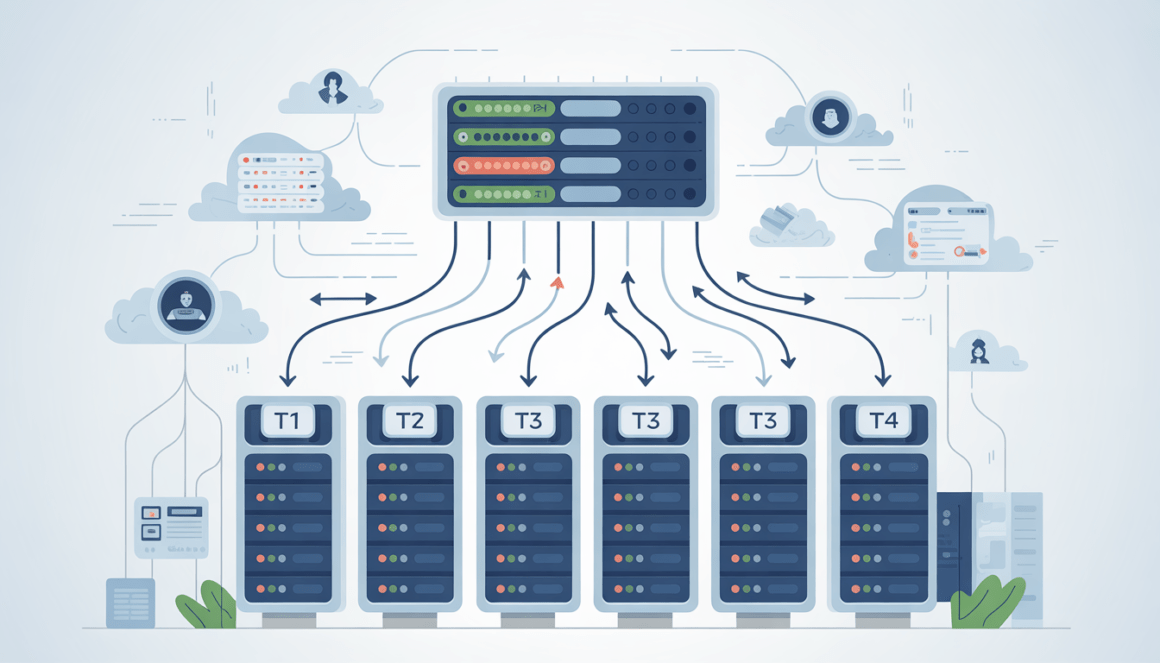
The Opportunistic Load Balancing (OLB) Algorithm is a classical static load balancing technique primarily used in parallel computing and cloud computing environments. The core idea behind OLB is simple: assign tasks to the next available resource without considering the current load or execution time of that resource. The algorithm focuses on maximizing resource utilization by keeping all processing units busy, rather than minimizing task completion time.
In OLB, tasks are dispatched opportunistically whenever a machine becomes free. Unlike intelligent or dynamic load balancing approaches, OLB does not rely on performance prediction, task profiling, or system state monitoring. This makes it computationally lightweight and easy to implement, but also limits its effectiveness in heterogeneous or dynamic environments.
OLB is often used as:
- A baseline algorithm for performance comparison
- A reference model in research studies
- A simple scheduling policy in controlled environments
Introduction to OLB Algorithm
Load balancing is a core problem in distributed systems, cloud computing, grid computing, and high-performance computing (HPC) environments, where multiple computational resources collaboratively execute large numbers of tasks. The primary goal of load balancing is to distribute workloads efficiently across available resources—such as processors, virtual machines (VMs), or servers—in order to improve overall system performance, increase throughput, reduce execution time, and ensure optimal utilization of computing infrastructure. As modern applications continue to grow in complexity and scale, effective load balancing has become essential for maintaining system stability and performance.
In distributed and cloud-based systems, workloads often arrive dynamically and vary significantly in size, computational complexity, and execution requirements. Without an appropriate load balancing mechanism, some resources may become overloaded while others remain underutilized, leading to increased response time, resource wastage, and degraded user experience. To address this challenge, numerous scheduling and load balancing algorithms have been proposed, ranging from simple static approaches to advanced dynamic and intelligent techniques that leverage heuristics, metaheuristics, and machine learning models.
Among the earliest and simplest scheduling strategies proposed for parallel and distributed systems is the Opportunistic Load Balancing (OLB) Algorithm. OLB was designed at a time when computational environments were relatively homogeneous and the overhead of complex scheduling decisions was considered undesirable. The algorithm follows a straightforward philosophy: whenever a computing resource becomes available, it should immediately be assigned a task from the waiting queue. This opportunistic assignment ensures that no resource remains idle as long as tasks are pending execution.
Unlike optimization-driven scheduling algorithms, the primary objective of OLB is not to minimize execution time or makespan, but rather to maintain continuous utilization of available resources. The algorithm deliberately ignores task execution time, resource processing speed, and system heterogeneity. Instead, it assumes that keeping all machines busy will naturally lead to acceptable performance. This assumption simplifies the scheduling process and significantly reduces decision-making overhead, making OLB computationally lightweight and easy to implement.
The OLB algorithm emphasizes fairness and immediacy in task allocation, treating all tasks and resources equally. Tasks are assigned in the order of arrival without prioritization or performance estimation, and resources are considered interchangeable. This design choice makes OLB highly predictable and deterministic, characteristics that are valuable in theoretical analysis, educational demonstrations, and baseline performance evaluation.
However, the simplicity of OLB comes at the cost of efficiency in modern computing environments. As cloud and distributed systems have evolved to become highly heterogeneous and dynamic, the limitations of opportunistic scheduling have become more apparent. Nevertheless, OLB continues to play an important role as a foundational algorithm, offering insights into the trade-offs between scheduling simplicity and performance optimization. Understanding OLB is essential for appreciating the motivation behind more advanced load balancing strategies and for establishing meaningful benchmarks in scheduling research.
Detailed Opportunistic Load Balancing Algorithm
3.1 System Model Assumptions
Let us define the system model used by the Opportunistic Load Balancing Algorithm.
- Let T = {T₁, T₂, T₃, …, T} be a set of independent tasks
- Let R = {R₁, R₂, R₃, …, R} be a set of available computing resources (processors or VMs)
- Tasks are non-preemptive
- Resources are assumed to be available and operational
- No task execution time estimation is performed
3.2 Objective Function
The primary objective of OLB is:

Unlike makespan-oriented algorithms, OLB does not minimize total execution time. Instead, it ensures that no resource remains idle if there is a task waiting.
3.3 Opportunistic Load Balancing Algorithm – Steps
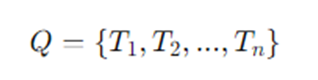
Step 1: Initialize Task Queue
All tasks are placed in a global queue in the order of arrival.
Step 2: Monitor Resource Availability
The scheduler continuously checks the availability of resources:

Step 3: Opportunistic Task Assignment
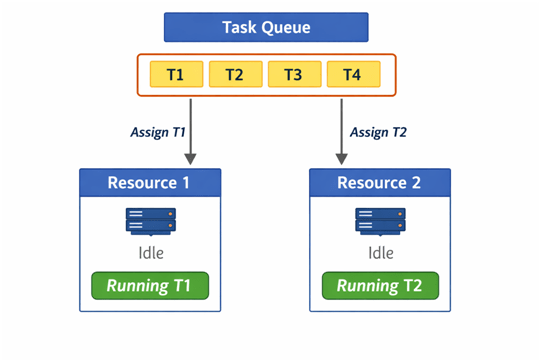
When a resource becomes free, the scheduler assigns the next task in the queue, regardless of: Resource speed, Task size and Expected completion time.

Step 4: Task Execution
The assigned task executes on the selected resource until completion.

Where:
- ETij = execution time of task Ti on resource Rj
Step 5: Repeat Until Completion
The process continues until:
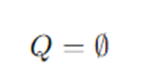
3.4 Pseudocode of Opportunistic Load Balancing Algorithm
Initialize Task Queue Q
Initialize Resource List R

while Q is not empty:
    for each resource Rj in R:
        if Rj is idle:
            Ti = dequeue(Q)
            assign Ti to Rj
        end if
    end for
end while
The Opportunistic Load Balancing Algorithm begins by collecting all incoming tasks into a centralized queue without any prioritization or classification. These tasks may vary in size, complexity, or execution time, but the algorithm deliberately ignores such characteristics. The scheduler then monitors the pool of available resources and waits for any resource to become idle.
Once a resource becomes free, the scheduler immediately assigns the next available task from the queue to that resource. This decision is made opportunistically, meaning no analysis is performed to determine whether the selected resource is best suited for the task. The guiding principle is that assigning a task quickly is more important than assigning it optimally.
After the task is assigned, the resource executes it until completion. During this time, the scheduler does not interfere with execution or perform task migration. When execution completes, the resource is marked as idle again, making it eligible to receive another task. This cycle repeats until all tasks in the queue have been executed.
By continuously assigning tasks to idle resources, OLB ensures that system resources are rarely idle. However, because it ignores execution time and resource heterogeneity, faster resources may end up processing long tasks while slower resources process short tasks, leading to suboptimal overall performance.
Example: How Opportunistic Load Balancing Algorithm Works
5.1 Example Scenario
Tasks:
- T₁ = 10 units
- T₂ = 2 units
- T₃ = 8 units
- T₄ = 1 unit
Resources:
- R₁ (Fast)
- R₂ (Slow)
5.2 Task Assignment (OLB)
| Time | Resource | Assigned Task |
| 0 | R₁ | T₁ |
| 0 | R₂ | T₂ |
| 2 | R₂ | T₃ |
| 10 | R₁ | T₄ |
Here, tasks are assigned as resources become available, without considering execution efficiency.
Advantages and Disadvantages
Advantages
- Simple Implementation: One of the most significant advantages of the Opportunistic Load Balancing Algorithm is its extreme simplicity. The algorithm does not require complex data structures, historical execution data, predictive models, or optimization logic. Task assignment decisions are made solely based on resource availability, which makes OLB easy to design, code, test, and deploy. This simplicity is especially beneficial for educational purposes, experimental setups, and environments where rapid deployment is more important than optimal performance.
- Low Scheduling Overhead: OLB incurs negligible computational overhead during scheduling. Since it does not compute task execution times, resource capabilities, or cost metrics, the scheduling decision is almost instantaneous. This low overhead ensures that the scheduler itself does not become a bottleneck, particularly in systems with a large number of incoming tasks. As a result, OLB performs well in scenarios where scheduling latency must be minimal and task dispatching must occur rapidly.
- High Resource Utilization: The algorithm is designed to maximize resource utilization by ensuring that no computing resource remains idle as long as tasks are available. Whenever a resource becomes free, it is immediately assigned a new task. This opportunistic behavior helps keep processors continuously busy, which can be advantageous in homogeneous systems where all resources have similar computational power. High utilization is particularly useful in batch processing environments where throughput is prioritized over individual task performance.
- Predictable and Deterministic Behavior: Opportunistic Load Balancing follows a deterministic scheduling pattern, meaning that given the same task arrival order and resource availability, the scheduling outcome will always be the same. This predictability makes the algorithm easy to analyze, debug, and model mathematically. Researchers and system designers often favor such deterministic algorithms when studying scheduling behavior, performance bounds, and theoretical properties of distributed systems.
- Useful Baseline Algorithm for Research and Benchmarking: OLB is widely used as a baseline or reference algorithm in research studies. Many advanced load balancing and task scheduling algorithms—such as Min-Min, Max-Min, genetic algorithms, particle swarm optimization, and deep reinforcement learning–based schedulers—are evaluated by comparing their performance against OLB. Its straightforward behavior provides a clear benchmark that highlights the performance improvements achieved by more intelligent scheduling approaches.
Disadvantages
- Ignores Task Execution Time: A major drawback of OLB is that it completely ignores task execution time during scheduling. Tasks are assigned without considering how long they will take to execute on a particular resource. This often results in long-running tasks being assigned to slower resources, while short tasks may be assigned to faster ones. Such mismatches significantly increase the overall completion time (makespan) of the workload and reduce system efficiency.
- Not Suitable for Heterogeneous Systems: Modern cloud and distributed computing environments are inherently heterogeneous, consisting of resources with varying processing power, memory, bandwidth, and energy efficiency. OLB treats all resources as identical and does not account for their capabilities. As a result, it performs poorly in heterogeneous environments, where intelligent mapping of tasks to suitable resources is essential for achieving optimal performance.
- No QoS or SLA Awareness: Opportunistic Load Balancing does not consider Quality of Service (QoS) parameters such as deadlines, priorities, latency requirements, or Service Level Agreements (SLAs). This makes it unsuitable for real-time, mission-critical, or user-facing cloud applications where meeting performance guarantees is crucial. In such contexts, failure to satisfy QoS constraints can lead to SLA violations and reduced user satisfaction.
- High Overall Completion Time: Although OLB maximizes resource utilization, it often results in a high makespan due to poor task-to-resource mapping. Since tasks are assigned without optimization, system-wide performance metrics such as turnaround time, response time, and throughput are negatively impacted. This inefficiency becomes more pronounced as workload size and system heterogeneity increase.
- No Fault Tolerance or Adaptability: OLB lacks mechanisms for fault tolerance, task migration, or rescheduling. If a resource fails during execution, the algorithm does not dynamically reassign or recover affected tasks. Additionally, OLB does not adapt to changing system conditions such as fluctuating workloads or resource performance degradation. This rigid behavior limits its applicability in dynamic and large-scale cloud environments.
Applications of Opportunistic Load Balancing Algorithm
- Parallel Computing Systems: OLB is commonly used in parallel computing environments where tasks are independent and resources are homogeneous. In such systems, the primary goal is often to keep all processors busy, making OLB a reasonable scheduling choice, especially for batch-oriented workloads.
- Grid Computing: In early grid computing systems, where resource heterogeneity was limited and workloads were relatively static, OLB was employed for basic task distribution. It served as a simple scheduling strategy before the adoption of more advanced and adaptive grid schedulers.
- Educational Simulations and Academic Teaching: OLB is extensively used in academic courses and simulations related to operating systems, cloud computing, and distributed systems. Its straightforward logic makes it ideal for demonstrating fundamental concepts of task scheduling and load balancing without overwhelming learners with complexity.
- Benchmarking Load Balancing Algorithms: Many research studies use OLB as a benchmark algorithm to evaluate the effectiveness of new scheduling and optimization techniques. By comparing advanced algorithms against OLB, researchers can clearly demonstrate performance improvements in terms of makespan, throughput, energy efficiency, and QoS satisfaction.
- Research Comparisons and Experimental Studies: In experimental research, OLB is often included as a control algorithm alongside heuristic, metaheuristic, and AI-based schedulers. Its inclusion provides a reference point that helps quantify the benefits of intelligent decision-making in modern scheduling frameworks.
- Homogeneous Cluster Environments: In environments where all computing nodes have similar hardware configurations, OLB can still perform reasonably well. The absence of significant performance variation among resources reduces the negative impact of its non-optimized task assignment strategy.
- Static Task Scheduling Scenarios: OLB is suitable for static scheduling scenarios where tasks are known in advance, execution conditions remain stable, and optimization is not a critical requirement. Such scenarios include offline batch processing and controlled experimental workloads.
Conclusion
The Opportunistic Load Balancing Algorithm represents one of the simplest approaches to task scheduling in distributed and parallel computing environments. By focusing on immediate task assignment and maximizing resource utilization, OLB offers a lightweight and easily implementable solution. However, its lack of intelligence, awareness of execution time, and inability to adapt to heterogeneous environments significantly limit its real-world applicability. In modern cloud computing systems, OLB is rarely used as a standalone solution but remains highly valuable as a baseline model for evaluating advanced load balancing and scheduling algorithms. Understanding OLB is essential for researchers and practitioners, as it lays the foundation for more sophisticated, intelligent, and adaptive scheduling strategies.
Frequently Asked Questions (FAQs)
Q1. Is Opportunistic Load Balancing suitable for cloud computing?
OLB can be used in cloud environments for baseline testing, but it is not suitable for production systems due to lack of QoS awareness.
Q2. What is the main goal of OLB?
The primary goal is to keep all resources busy by assigning tasks opportunistically.
Q3. Is OLB a static or dynamic load balancing algorithm?
OLB is a static load balancing algorithm.
Q4. How does OLB differ from Min-Min algorithm?
Min-Min considers execution time and resource capability, whereas OLB ignores both.
Q5. Why is OLB still used in research?
It serves as a simple baseline for comparing the performance of advanced scheduling algorithms.