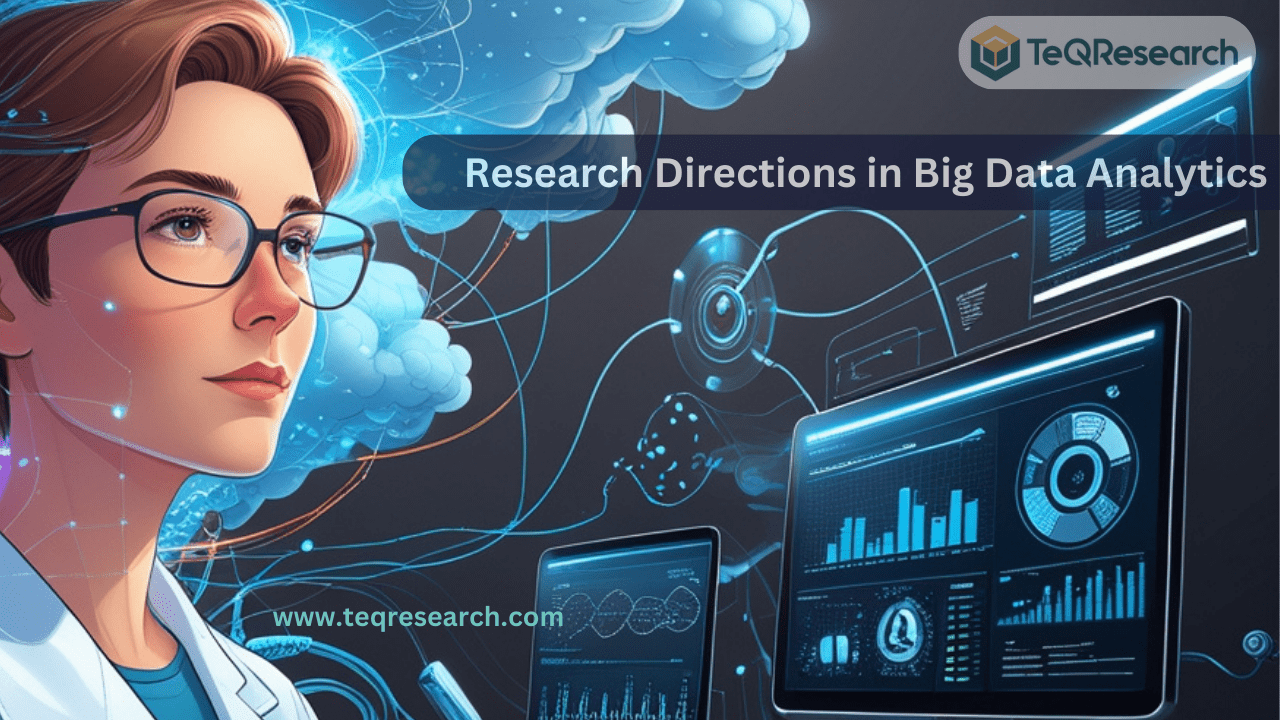
Big data’s introduction has completely changed how information is processed and decisions are made in a variety of fields, including the social sciences, astrophysics, healthcare, and finance. The difficulties in analyzing data increase in tandem with its increasing volume, pace, diversity, and truthfulness. Big data analytics is a rich field of study full of intricate technical, moral, and computational issues for research academics, especially those working in data science, computer engineering, and applied mathematics. This article explores the present challenges in big data analytics and identifies interesting research avenues that should be given top priority by academics in order to advance the discipline in the years to come.
Scalability and Performance Optimization
Creating algorithms and systems that scale effectively with growing data quantities is one of the core difficulties in big data analytics. Petabyte-scale datasets cannot be handled by conventional single-node computing architectures. In order to overcome this difficulty, distributed computing frameworks like Apache Hadoop and Apache Spark have been developed; however, they also face difficulties associated with disk I/O, network latency, and synchronization overhead.
Research Opportunities:
- Designing decentralized and asynchronous algorithms for data processing.
- Development of scalable graph processing engines.
- Leveraging in-memory computation and GPU acceleration for big data tasks.
- Adaptive workload distribution in heterogeneous computing environments.
Data Quality and Preprocessing
The quality of insights derived by analytical models is significantly impacted by the noisy, inconsistent, or incomplete nature of real-world data. Cleaning, normalization, and transformation are examples of data preprocessing that is nevertheless a time-consuming and error-prone procedure. Using intelligent technologies to automate these steps is a difficult undertaking.
Research Opportunities:
- Developing AI-powered data wrangling and cleaning tools.
- Investigating robust statistical techniques for outlier detection and imputation.
- Creating standardized metadata schemas for heterogeneous datasets.
Real-Time Analytics and Stream Processing
Real-time processing and reaction to streaming data is essential in fields like industrial IoT, cybersecurity, and financial trading. These applications require low-latency, high-throughput stream analytics engines because traditional batch processing frameworks are insufficient.
Research Opportunities:
- Real-time anomaly detection algorithms with low false positive rates.
- Fault-tolerant distributed stream processing architectures.
- Integration of edge computing for latency-sensitive applications.
Data Privacy and Security
Privacy-preserving data analytics has gained a lot of attention as worries about data breaches and misuse have grown. The difficulty is striking a balance between strict data privacy regulations and analytical usefulness, especially in delicate industries like healthcare and finance.
Research Opportunities:
- Implementation of differential privacy in large-scale analytics.
- Development of secure multi-party computation protocols.
- Federated learning frameworks that maintain data locality.
Semantic and Context-Aware Analytics
Context-aware analytics skills are necessary to glean valuable insights from unstructured or semi-structured data (text, photos, and videos). Although they can offer the required structure, semantic technologies like knowledge graphs and ontologies are still difficult to integrate into large data pipelines.
Research Opportunities:
- Constructing dynamic knowledge graphs from streaming data.
- Natural Language Processing (NLP) for domain-specific semantic enrichment.
- Multimodal data fusion techniques.
Energy Efficiency and Sustainability
Concern over the effects of large-scale data analytics on the environment is growing. Large-scale model training has a substantial carbon impact, and data centers are major electricity users.
Research Opportunities:
- Energy-aware scheduling algorithms for data center workloads.
- Development of low-power hardware accelerators for analytics tasks.
- Designing carbon-neutral data analytics pipelines.
Explainable and Interpretable Models
Transparency in decision-making models is crucial as machine learning becomes more and more integrated into big data analytics. Deep neural networks and other complex models frequently function as “black boxes,” which is problematic in high-stakes situations.
Research Opportunities:
- Development of inherently interpretable machine learning algorithms.
- Post-hoc explainability techniques for black-box models.
- Formal frameworks for quantifying interpretability.
Heterogeneous Data Integration
In big data contexts, integrating data from several sources with different formats, semantics, and dependability is a crucial challenge. Data heterogeneity can make data governance more difficult and impede the creation of unified analytics models.
Research Opportunities:
- Methods for transforming and matching schemes in heterogeneous data.
- In data integration, semantic mediation and dispute resolution.
- Uniform data modeling languages for contexts with multiple sources.
Benchmarking and Evaluation
Comparative evaluation of algorithms and systems is hampered by the absence of defined benchmarks for big data analytics. Performance measurements, operational limitations, and real-world data properties must all be reflected in benchmarks.
Research Opportunities:
- Creation of domain-specific big data benchmarks.
- Development of evaluation metrics that account for scalability, accuracy, and latency.
- Simulation environments for reproducible performance testing.
10. Ethical and Societal Considerations
The ramifications of big data analytics on society are extensive and include worries about algorithmic discrimination, bias, and spying. To guarantee accountability and equity, ethical frameworks must be incorporated into analytics system design.
Research Opportunities:
- Predictive analytics algorithmic fairness.
- The identification and reduction of bias in training datasets.
- The creation of moral standards for big data studies.
Future Directions and Emerging Paradigms
As we look toward the future, several emerging paradigms are poised to reshape the landscape of big data analytics. These include:
- Quantum-Enhanced Analytics: Using quantum computing to solve big data search and high-dimensional optimization challenges.
- Autonomous Data Science: Using AI-driven orchestration technologies to automate the entire data analytics lifecycle.
- Privacy-Aware AI: Integrating privacy-preserving mechanisms directly into AI model architectures.
- Data-Centric AI: For increased performance and dependability, development methods should be shifted from model-centric to data-centric.
To address the complex issues of big data analytics, research scholars should actively participate in multidisciplinary collaborations that bridge computer science, statistics, ethics, and domain-specific knowledge. There are numerous chances to make significant contributions through applied research projects, standardization organizations, and open-source projects.
Conclusion
Big data analytics is a quickly developing topic that has significant ramifications for industry, society, and science. Its problems, which range from data quality and scalability to sustainability and ethics, are intricate and multifaceted, necessitating strong, creative answers. The big data frontier presents a rich environment for impact, innovation, and investigation for research researchers. Scholars may help create the next generation of clever, moral, and effective data analytics systems by tackling these issues with thorough, technically sound study.
FAQs
1. What are the primary scalability challenges in big data analytics systems?
Scalability challenges arise due to the exponential growth in data volume, variety, and velocity. Systems must handle high-throughput data ingestion, distributed processing, and storage across heterogeneous environments. Key concerns include maintaining performance during peak loads, ensuring fault tolerance, and optimizing resource allocation in real time.
2. How does big data analytics integrate with AI and machine learning models?
Big data analytics platforms enable the training of complex AI/ML models by providing large, diverse datasets and scalable processing frameworks like Apache Spark and TensorFlow. However, integration demands efficient data preprocessing, feature engineering, and hyperparameter optimization techniques, along with managing bias and model interpretability.
3. What are the major data privacy and security issues in big data environments?
Big data systems often process sensitive information across distributed nodes, increasing the risk of unauthorized access, inference attacks, and data leakage. Compliance with regulations like GDPR and HIPAA, along with implementing homomorphic encryption, secure multi-party computation, and access control mechanisms, are essential to mitigate risks.
4. How do real-time analytics differ from batch processing in big data systems?
Real-time analytics involves processing streaming data with low-latency requirements using tools like Apache Flink or Kafka Streams, whereas batch processing handles large data sets in scheduled intervals. Research in this area focuses on balancing latency, throughput, and accuracy, especially in event-driven systems and critical infrastructure monitoring.
5. What are emerging research directions in big data analytics?
Current research trends include federated learning over big data, quantum-enhanced analytics, edge-based processing architectures, automated data curation, and explainable AI within large-scale analytics. These directions aim to address the limitations of centralization, computation costs, and interpretability in evolving big data ecosystems.