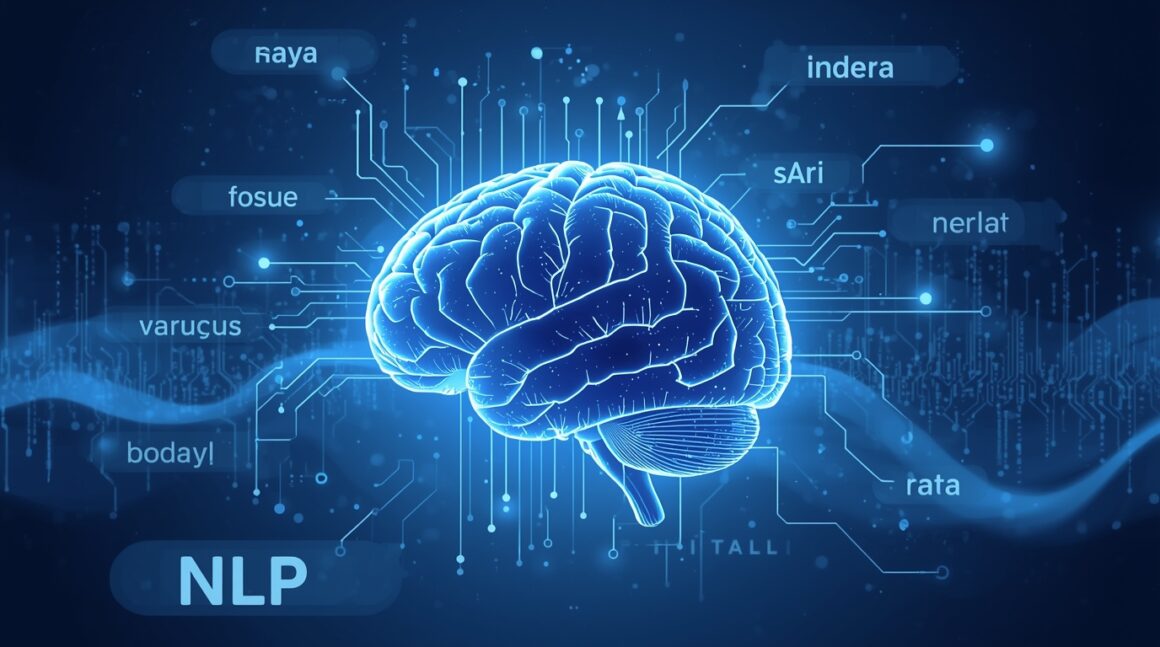
Natural Language Processing (NLP) is one of the most dynamic fields in artificial intelligence, driving breakthroughs in communication between humans and machines. This blog explores the Top 10 Research Areas in NLP for PhD scholars, covering Large Language Models (LLMs), Multimodal Learning, Explainable AI, Low-Resource Languages, Knowledge Graphs, Green NLP, and more. It outlines key challenges, open research questions, and potential PhD directions in each area, helping researchers identify topics with novelty, feasibility, and global impact.
Introduction
Natural Language Processing (NLP) has moved from a niche computer‐science sub-field to a central pillar in artificial intelligence, human-computer interaction, and data-driven research. With the explosion of unstructured text, voice, social media data, and multilingual content, the demand for solutions that understand, generate and reason over human language is stronger than ever. Yet, for PhD scholars and academic researchers, the question remains: Which research areas in NLP remain both fertile for novel contributions and aligned with current trends? Some may ask—“Has everything been solved now that large language models (LLMs) are ubiquitous?” The short answer: No. While LLMs bring breakthroughs, there are still deep, unresolved research questions. In this article, we’ll explore 10 high-impact research areas in NLP—each area defined, justified (why it matters now), examined for key challenges or open questions, and suggested with potential PhD research directions. This should serve as a roadmap for researchers planning their next major work.
Large Language Models (LLMs) & Foundation Models for NLP
Large language models—such as transformer-based architectures trained on massive corpora—are now considered foundation models for NLP. They underpin tasks like text generation, translation, summarization, reasoning, and more.
Why it matters now
- The commercial and academic impact of LLMs is soaring: with models accessible via APIs and open-weight variants, research into how they work, their limitations, and how to adapt or fine-tune them is urgent.
- Despite enormous progress, many core questions remain around reasoning, long-context handling, domain adaptation, cost/energy efficiency and interpretability.
- For PhD scholars, engaging with LLMs offers broad relevance, high publication potential, and real-world impact.
Key challenges & open research questions
- How do we make LLMs efficient and sustainable, especially for domains with limited compute resources?
- How to handle long-context/long-document reasoning (e.g., thousands of tokens) in LLMs without prohibitive compute cost?
- How to interpret, audit and control the behavior of LLMs (biases, hallucinations, safety)?
- What are the limits of LLMs—what they cannot yet solve well?
Potential PhD directions
- Design a novel adaptation of transformer/LLM architectures for very long documents (e.g., legal briefs, scientific articles) with efficient memory and attention mechanisms.
- Develop an interpretability framework for LLM outputs in specialised domains (e.g., medical, legal) that provides transparency to domain experts.
- Explore fine-tuning LLMs for low-resource languages or domain-specific corpora, comparing cost, performance and transfer-learning effectiveness.
Multimodal & Cross-modal NLP (Text + Vision + Audio)
Multimodal NLP deals with systems that combine language with other modalities—images, audio, video, sensor data—to understand, generate or reason across modes. Cross-modal refers to transferring knowledge across modalities.
Why it matters now
- Many real-world applications (e.g., video captioning, social media analytics, human-robot interaction, AR/VR) require bridging text with other modalities.
- Researchers are now exploring how language models can be extended or integrated into multimodal systems and how the interactions between modalities can improve performance and reasoning.
Key challenges & open research questions
- How to align representations across modalities such that textual understanding and vision/audio understanding can interface seamlessly?
- How to reason jointly across modalities (for example: reading a document and analysing a related chart/image and answering complex questions)?
- How to handle low-resource modalities or domains where annotated multimodal data is scarce?
Potential PhD directions
- Build a new benchmark dataset and method for multimodal reasoning in a domain such as healthcare (text + image + sensor-log) and propose models to perform joint inference.
- Investigate multimodal adaptation of LLMs—e.g., how a text-based LLM might be augmented with image embeddings and fine-tuned for cross-modal tasks with limited labels.
- Study transfer from high-resource modality to low-resource modality (e.g., data-rich language+vision → language+audio) and propose architectures that generalize.
Low-Resource Languages & Multilingual NLP
This area focuses on NLP methods for languages with limited annotated data, scarcity of resources (lexicons, corpora), and multilingual systems that span many languages rather than being monolingual English only.
Why it matters now
- Most global languages (and dialects) remain under-served by mainstream NLP systems; addressing this gap has both scientific and social justice implications.
- With globalization and cross-cultural communication, multilingual NLP systems are increasingly important. Multilingual foundation models are emerging.
Key challenges & open research questions
- How to build effective models with minimal annotated data or even zero-shot for low-resource languages?
- How to create language-agnostic or cross-lingual representations that transfer well across typologically different languages?
- How to ensure fairness and inclusivity in NLP research so that under-represented languages are not left behind?
Potential PhD directions
- Construct a multilingual benchmark covering several low-resource languages (especially from under-represented regions) and propose transfer-learning or self-supervised pre-training methods for them.
- Develop a method for unsupervised alignment of embeddings between a major language (English) and a low-resource language using minimal bilingual lexicons, and evaluate on downstream tasks like NER or summarization.
- Investigate ethical and sociolinguistic aspects of multilingual NLP: how socio‐cultural context impacts performance, bias, and usability of multilingual models.
Explainable, Interpretable & Responsible NLP
As NLP systems become pervasive (in healthcare, legal, hiring, media), the need for interpretability, transparency, fairness and accountability becomes critical. This area focuses on responsible design of NLP systems that can be audited, explained, controlled and made trustworthy.
Why it matters now
- Models are influencing high-stakes decisions (e.g., medical diagnosis, legal review, content moderation) → interpretability is no longer optional.
- Public scrutiny, regulatory interest (e.g., AI ethics, data protection), and deployment in sensitive domains demand responsible NLP.
- Research shows that even very powerful models leave many open questions around bias, adversarial vulnerability, and safety.
Key challenges & open research questions
- How to create explanations that are both accurate and meaningful to non-technical stakeholders (legal, medical professionals)?
- How to design evaluation metrics for interpretability, fairness and trustworthiness in NLP systems?
- How to balance model performance (e.g., accuracy) with responsibility constraints (e.g., fairness, transparency) in the optimisation loop?
Potential PhD directions
- Develop a framework for explainable NLP in a specific domain (e.g., clinical decision support) which integrates user-centric explanations and evaluates their impact on trust and decision-making.
- Propose and validate new fairness metrics for multilingual NLP models (ensuring that performance disparity across languages is minimised).
- Experimentally investigate model behaviour under adversarial attacks in NLP pipelines and propose mitigation strategies or robust training protocols.
Knowledge Extraction, Graphs & Structured Representation in NLP
This research area concerns extracting structured knowledge (entities, relations, events) from text, populating knowledge graphs, linking textual input to structured representations, and reasoning over that knowledge.
Why it matters now
- Richer NLP understanding goes beyond text classification or generation — it involves reasoning over structured knowledge.
- Knowledge graphs and structured representations enable downstream tasks (question answering, summarization, decision support) with higher fidelity.
Key challenges & open research questions
- How to reliably extract fine-grained relations, events and temporal sequences from raw text (especially in noisy, multilingual, or domain-specific data)?
- How to integrate pretrained language models with knowledge graphs for reasoning, inference, and dynamic update?
- How to ensure knowledge graphs remain up-to-date, handle contradictions, or integrate multi-source evidence and uncertainty?
Potential PhD directions
- Propose an approach that combines LLMs with knowledge-graph construction for a domain such as scientific literature: extract entities/events, build a graph, and evaluate reasoning performance.
- Empirical study of knowledge drift in text corpora (e.g., news articles over time), how graphs evolve, and propose dynamic graph update mechanisms.
- Design methodology for event-temporal modelling in text and integrate with NLP pipelines for predictive tasks (e.g., forecasting events from news).
Text Generation, Summarization & Conversational Systems
This area covers automatic text generation (creative or informative), summarisation of long texts, and the design of conversational agents/chatbots that interact in natural language.
Why it matters now
- With the success of LLMs, the possibilities for text generation, summarisation, and conversational NLP are huge, spanning industry (customer service, content creation) and academia.
- Yet, challenges remain in generating useful, accurate, contextual text. Summarisation still struggles with faithfulness and comprehensiveness; dialogue systems often face coherence, memory and alignment issues.
Key challenges & open research questions
- How to ensure factual accuracy, coherence, and relevance in text generation and summarisation (avoiding hallucinations)?
- How to build conversational agents with long-term memory, personalisation, context awareness, and multi-turn reasoning?
- How to evaluate quality in summarisation and generation beyond simple ROUGE or BLEU metrics—taking into account human relevance, readability, trust?
Potential PhD directions
- Create a summarisation system for domain-specific long documents (e.g., legal contracts, scientific reports) with metrics that include factual consistency, readability and user trust.
- Research multi-turn conversational system architecture that retains long-term context (across sessions) and personalises responses based on user behaviour and preference.
- Study generation of creative or mixed-modal text (e.g., textual story + image captions) and propose metrics/benchmarks for evaluation that align with human perception of quality.
Real-Time, Streaming & Resource-Constrained NLP
This area focuses on NLP in real-time, continuous, streaming contexts (e.g., live chat moderation, social media streams, sensor data) and/or resource-constrained environments (mobile, edge devices, IoT).
Why it matters now
- Many applications require instant responses, low latency, reduced compute/memory footprints (e.g., mobile assistants, edge NLP for sensors).
- Traditional models are heavy; bridging the gap between high performance and low resource is a vital research challenge.
Key challenges & open research questions
- How to build lightweight, efficient NLP models for deployment on edge devices (mobile, embedded) without compromising accuracy significantly?
- How to handle streaming text, incremental updates, concept drift, real-time adaptation in NLP pipelines?
- How to maintain privacy, security, and robustness when NLP is deployed in resource-constrained or distributed settings?
Potential PhD directions
- Develop a compact, on-device summarisation or classification model for conversational agents that runs on mobile hardware and adapts over time with user interactions.
- Research streaming sentiment analysis for social media: design pipelines that update models continuously, handle concept drift, and provide real-time insights with constrained resources.
- Investigate federated-learning frameworks for NLP on edge devices, exploring how to train models across distributed users while preserving privacy and achieving performant models.
Domain-Specific & Industry-Tailored NLP (Healthcare, Law, Finance)
This research area zeroes in on applying NLP to specific domains—healthcare, law, finance, education—each with its own terminologies, data types, challenges and regulatory constraints.
Why it matters now
- Domain-specific NLP systems are in high demand: healthcare narratives, legal documents, financial news all produce vast text data but require domain-aware solutions.
- Generic models often under-perform in domain contexts; domain adaptation, fine-tuning, specialised embeddings, regulatory compliance become important.
Key challenges & open research questions
- How to adapt models to domain-specific language (e.g., medical shorthand, legal jargon) quickly and reliably?
- How to evaluate domain-specific NLP systems in high-stakes contexts (e.g., medical diagnosis, legal decision support)?
- How to ensure compliance, privacy, ethical issues in domain NLP—especially in regulated industries?
Potential PhD directions
- Build a domain-aware NLP pipeline for medical summarisation of patient records, including interpretability, auditing and aligning with regulatory standards (e.g., HIPAA).
- Develop a legal‐document question-answering system trained on a specialised corpus of contracts and case law, with an integrated mechanism for assessing answer justification and citation.
- Research financial-news sentiment analysis that accounts for temporal drift, domain vocabulary changes and high-stakes decision-making in trading contexts.
Human-Centered NLP: User Experience, Social & Cognitive Aspects
Human-centred NLP investigates how humans interact with NLP systems, how cognitive, social, cultural, and usability factors influence the design and effectiveness of NLP solutions.
Why it matters now
- Many NLP applications interface directly with humans (chatbots, virtual assistants, writing aides). Understanding human factors (trust, usability, cognitive load) influences adoption and effectiveness.
- Social aspects (bias, fairness, equity across user groups/languages, cultural context) are increasingly in focus.
Key challenges & open research questions
- How to design NLP systems that adapt to human preferences, are inclusive, and consider cultural/linguistic diversity?
- How to measure user trust, usability, cognitive load in interaction with NLP systems?
- How to integrate human-in-the-loop approaches, allowing user correction, feedback and co-creation with NLP systems?
Potential PhD directions
- Conduct a mixed-methods study of user interaction with a multilingual chatbot: how cultural factors, language background, trust and usability affect outcomes and design guidelines.
- Design and evaluate a writing-assistant NLP tool that adapts to user cognitive load and writing style, measuring impact on productivity and user satisfaction.
- Investigate the role of social bias in automatic moderation systems: study how users from different demographic groups are affected and propose design changes to mitigate inequities.
Sustainability, Green NLP & Ethical Implications
This emerging area focuses on the environmental, ethical, and societal impact of NLP research and deployment: energy consumption, carbon footprint, resource usage, fairness, transparency, and social good orientation.
Why it matters now
- Training large NLP models consumes significant compute and energy; sustainability concerns are gaining traction.
- Ethical issues—bias, privacy, misuse of generation (deepfakes), algorithmic injustice—are increasingly important as NLP systems scale.
- Academia and industry alike are now asking: How do we build responsible, sustainable NLP?
Key challenges & open research questions
- How to quantify and reduce the environmental footprint of NLP model training and inference?
- How to embed ethical frameworks into NLP systems from design to deployment, especially for generative and high-stakes applications?
- How to measure societal impact of NLP systems (positive and negative) and create mechanisms for governance, accountability, and public transparency?
Potential PhD directions
- Develop a framework measuring the energy cost, carbon emissions, and compute-efficiency trade-offs of NLP models; propose methods to build models with sustainable constraints.
- Research algorithmic bias and fairness in generative text models: develop auditing tools and mitigation protocols for fairness across demographics and languages.
- Conduct case-studies on NLP for social good (e.g., disaster response, inclusive education, accessibility) and evaluate long-term impact, ethical implications and user benefit.
Trends & Future Directions Worth Watching
- The rise of multimodal foundation models that go beyond text into vision/audio/sensor is becoming mainstream.
- Shifting focus towards resource-efficient models, edge NLP, and streaming real-time processing for mobile/IoT.
- Increasing emphasis on ethics, sustainability and social good in NLP research — both modelling impacts and applications.
- Continual progress in low-resource and multilingual NLP, bringing more global languages into play and pushing beyond English-centric models.
- Growing interest in knowledge-centric NLP (knowledge graphs, reasoning, structured representation) as a complement to pure statistical/textual modelling.
- More human-in-the-loop and cognitive/user-centric research where NLP systems are evaluated in real human contexts, not only benchmark datasets.
For a PhD scholar in NLP, the research terrain today is simultaneously exciting and challenging. The breakthroughs of the recent past (especially LLMs) do not imply that the field is “done”—in fact, they reveal a new frontier of richer questions around scale, modalities, fairness, sustainability and real-world deployment.
Choosing one of the ten research areas above gives you a strong anchor. From there, by identifying a sharp research question, selecting an appropriate methodology, and being mindful of novelty and relevance, you can embark on a PhD journey that is not only publishable but meaningful.
To recap, the ten areas are:
- LLMs & Foundation Models for NLP
- Multimodal & Cross-modal NLP
- Low-Resource Languages & Multilingual NLP
- Explainable, Interpretable & Responsible NLP
- Knowledge Extraction, Graphs & Structured Representation
- Text Generation, Summarization & Conversational Systems
- Real-Time, Streaming & Resource-Constrained NLP
- Domain-Specific & Industry-Tailored NLP
- Human-Centered NLP: User Experience, Social & Cognitive Aspects
- Sustainability, Green NLP & Ethical Implications
Each area offers rich scope. The key is to pick one that aligns with your interests, has access to data/resources, and offers a clear route to novel contribution.
Conclusion
Natural Language Processing (NLP) continues to evolve at an extraordinary pace — transforming how humans and machines understand, generate, and communicate information. For PhD scholars and researchers, this field offers endless possibilities to explore, from the depths of Large Language Models (LLMs) and multimodal systems, to the challenges of low-resource languages, responsible AI, and green computing. The next decade of NLP research will not just be about improving accuracy or scaling models — it will be about responsibility, efficiency, inclusivity, and real-world impact. Scholars who can bridge linguistic theory, deep learning, and human-centered design will lead the next wave of innovation in AI communication systems. By choosing one of the ten research areas highlighted in this blog — and aligning your curiosity with societal needs — you can contribute to shaping the future of intelligent language technologies that are ethical, sustainable, and globally inclusive. So, whether your passion lies in interpretable AI, domain-specific NLP, cognitive linguistics, or multilingual systems, remember that every contribution matters in building a world where machines truly understand humanity’s words, culture, and intent.
Frequently Asking Questions
What are the most promising NLP research areas for PhD students in 2025?
The most trending areas include Large Language Models (LLMs), Multimodal NLP, Low-resource Language Processing, Responsible & Explainable NLP, and Green AI. These fields balance novelty, relevance, and real-world impact — offering strong publication and application potential.
How can I choose the right NLP research topic for my PhD?
Start by reviewing recent literature (2022–2025) in your area of interest, identify research gaps or underexplored problems, and align your topic with both academic novelty and societal relevance. Collaborating with mentors and checking top conferences like ACL, EMNLP, NAACL, and COLING can also guide your topic selection.
What programming tools or frameworks should NLP researchers master?
Key tools include Python, PyTorch, TensorFlow, Hugging Face Transformers, spaCy, NLTK, and LangChain. For multilingual and large-scale research, tools like OpenNMT, Fairseq, and FastText are also valuable. Familiarity with data annotation, model evaluation, and ethical audit frameworks is increasingly essential.
How important is explainability and ethics in NLP research today?
It’s crucial. With NLP systems influencing healthcare, law, hiring, and education, ensuring transparency, fairness, and accountability is now a major research focus. Explainable NLP helps build trust, reduces bias, and supports compliance with ethical AI regulations. Many top conferences now have dedicated tracks for Responsible NLP research.
What are the future directions of NLP beyond 2025?
The next wave of NLP research will focus on multimodal reasoning, real-time edge NLP, sustainable training methods, emotionally intelligent systems, and cross-lingual communication. Integrating cognitive science, linguistics, and social computing will also redefine how NLP understands human intent and empathy.