Introduction
The flexibility and decentralized nature of Mobile Ad Hoc Networks (MANETs) have drawn a lot of attention in the rapidly changing wireless communication landscape of today. These networks are perfect for situations like disaster recovery, military activities, and temporary network deployments since they are made up of mobile nodes that can connect without depending on a fixed infrastructure. Using effective routing to ensure dependable communication is one of the main problems in MANETs. Traditional routing methods are ineffective in wired networks because node mobility causes the network topology to change frequently. This is where MANET-specific routing protocols are useful. The Destination-Sequenced Distance Vector (DSDV) routing protocol is one of the oldest and most straightforward solutions among the several protocols created to deal with this problem. With significant improvements like sequence numbers, DSDV expands on the traditional distance-vector technique, which was first used to avoid routing loops and guarantee consistent path selection. The purpose of this blog post is to examine the fundamentals of the DSDV routing protocol, describe its operation, point out its benefits and drawbacks, and go over its uses in research and teaching. This book will provide you a strong foundation to comprehend DSDV and its significance in the world of mobile networks, regardless of your level of experience with network research or your level of interest in MANETs as a student.
What is DSDV?
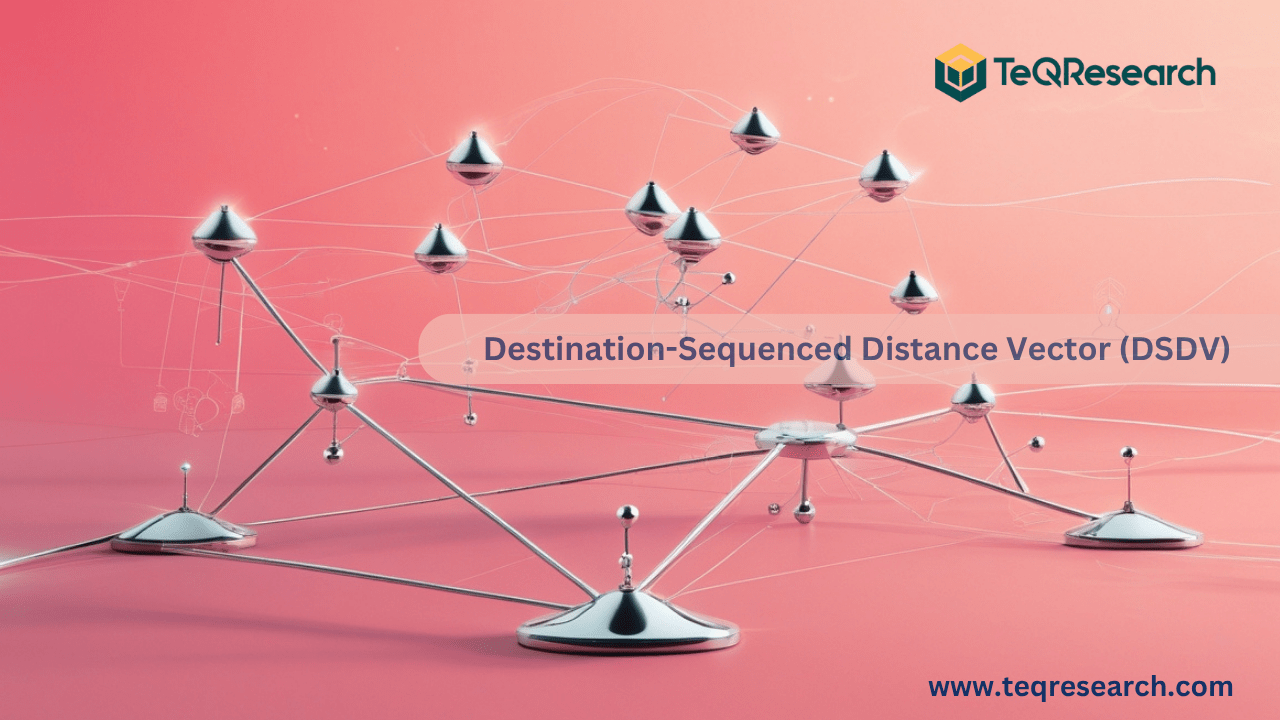
A proactive routing protocol created especially for Mobile Ad Hoc Networks (MANETs) is called Destination-Sequenced Distance Vector (DSDV). In order to overcome the drawbacks of conventional distance-vector routing algorithms, including the problem of routing loops and sluggish convergence in dynamic environments, C. Perkins and P. Bhagwat created it in 1994.
DSDV is fundamentally an improvement on the traditional Bellman-Ford distance-vector algorithm. In contrast to its predecessor, DSDV uses sequence numbers to monitor how current routing data is. Every network node has a routing table that contains a list of all potential destinations, the number of hops needed to get there, and the next hop. Sequence numbers are added to guarantee that nodes always select the most dependable and recent path. The routing table is updated in DSDV either on a regular basis or in response to a notable network change.
Even when nodes relocate or links fail, these updates assist nodes in keeping an accurate picture of the network structure. Because it consistently maintains routes to every destination, whether or not they are currently required, the protocol is seen as proactive. Reactive protocols like AODV or DSR, on the other hand, only find routes when necessary. DSDV offers a simple, table-driven method appropriate for small to moderately dynamic networks, loop-free routing using sequence numbers, and periodic table updates to adjust to topology changes. Despite its simplicity, DSDV laid the groundwork for many modern routing protocols and remains a valuable topic of study in MANET research.
How DSDV Works
The Destination-Sequenced Distance Vector (DSDV) protocol operates on a simple yet powerful idea: regularly updated routing tables enhanced with sequence numbers to ensure accurate and loop-free paths. Here’s a step-by-step breakdown of how DSDV works:
a) Routing Table Structure
Each node in a DSDV-based MANET maintains a routing table containing the following information for every known destination:
- Destination address
- Next hop address
- Number of hops to the destination
- Sequence number (generated by the destination)
- Install time (timestamp of the entry)
This table enables nodes to determine the best path to any other node in the network at any given time.
b) Sequence Numbers
A unique feature of DSDV is the use of destination sequence numbers. These numbers:
- Are even if the route is valid.
- Are odd if the destination is unreachable (used to invalidate routes).
- Always originate from the destination node, ensuring consistency and freshness of routing data.
When a node receives multiple routes to the same destination, it prefers:
- The route with the higher sequence number (i.e., the most recent).
- If sequence numbers are equal, the route with the fewer hops.
This prevents routing loops and ensures the network always uses the latest and most efficient paths.
c) Routing Updates
DSDV updates routing tables in two ways:
- Periodic Updates: Sent at regular intervals to broadcast the entire routing table.
- Triggered Updates: Sent immediately when a significant change is detected, such as a broken link or topology shift.
To reduce overhead, DSDV allows:
- Full dumps (entire routing table shared occasionally).
- Incremental updates (only changed entries shared more frequently).
This mechanism balances network bandwidth with topology accuracy.
d) Handling Topology Changes
When a node detects that a route is no longer valid (e.g., the next hop is unreachable), it:
- Increases the sequence number of that destination by 1 (making it odd).
- Broadcasts the updated routing entry to inform other nodes that the destination is unreachable.
e) Example Scenario
Suppose Node A wants to communicate with Node D. If A’s routing table shows:
- Destination D
- Next Hop: B
- Hops: 2
- Sequence Number: 56
This means Node A will forward data to Node B, which will then route it to Node D, using a path known to be valid and up-to-date.

DSDV works by continuously maintaining complete routing information, Using sequence numbers to prevent loops, and combining periodic and triggered updates to stay responsive and efficient. It’s a reliable protocol for relatively stable or moderately mobile MANETs but can become inefficient in highly dynamic environments due to its update overhead.
Key Features of DSDV
The Destination-Sequenced Distance Vector (DSDV) protocol introduces several features that make it suitable for routing in mobile ad hoc networks (MANETs). These features are designed to address the dynamic and decentralized nature of MANETs while maintaining efficient and loop-free communication.
1. Sequence Numbers to Prevent Routing Loops
DSDV uses destination-generated sequence numbers to track the freshness of routing information. These sequence numbers:
- Ensure that only the most recent route is used.
- Help avoid routing loops, a major drawback of traditional distance-vector protocols.
- Make route comparisons simple—higher sequence number means a newer and more reliable route.
2. Proactive (Table-Driven) Routing
DSDV maintains a complete list of routes to all reachable destinations at all times:
- Each node has a routing table that is updated regularly.
- This approach reduces latency because routes are available immediately when data needs to be sent.
3. Periodic and Triggered Updates
To keep routing tables current, DSDV uses:
- Periodic updates, which broadcast the full routing table at regular intervals.
- Triggered updates, sent only when significant changes (like a broken link) occur, helping minimize unnecessary traffic.
4. Full Dump and Incremental Updates
To reduce overhead:
- Full dumps share the entire routing table occasionally.
- Incremental updates share only the changed parts of the routing table more frequently.
This hybrid strategy balances accuracy and bandwidth efficiency.
5. Simple to Implement and Understand
DSDV builds on the familiar Bellman-Ford algorithm with minimal additions, making it:
- Straightforward to implement, especially in simulations.
- A great learning tool for students and researchers new to MANETs.
6. Consistent and Loop-Free Routing
By maintaining consistent routing tables with sequence numbers, DSDV ensures:
- Reliable data forwarding
- Minimal risk of loops or stale paths
- Quick route invalidation when network changes occur
DSDV’s key features—sequence numbers, proactive routing, and efficient update mechanisms—make it a foundational protocol in MANET research. While it may not scale well in large, highly dynamic networks, its design principles have influenced many modern routing protocols.
Advantages and Disadvantages of DSDV
While the DSDV (Destination-Sequenced Distance Vector) protocol offers a number of benefits for mobile ad hoc networks (MANETs), it also comes with trade-offs. Understanding both its strengths and limitations is essential for evaluating when and where to use it effectively.
Advantages
- Loop-Free Routing: The use of destination-sequenced numbers ensures that the routing paths are always loop-free. This prevents common issues in traditional distance-vector protocols, such as routing loops and the count-to-infinity problem.
- Immediate Route Availability: As a proactive protocol, DSDV maintains routes to all nodes at all times. This allows for low-latency communication, as no route discovery is needed before data transfer.
- Simplicity and Ease of Implementation: Based on the well-known Bellman-Ford algorithm with simple modifications. Easy to simulate and implement in academic environments and research tools like NS2 or NS3.
- Predictable Routing Behavior: The protocol’s deterministic approach makes it suitable for educational use and performance comparisons.
Disadvantages
- High Overhead: Frequent periodic updates and triggered broadcasts consume bandwidth and battery power. This becomes inefficient in large or highly mobile networks where topology changes frequently.
- Poor Scalability: The proactive nature of DSDV doesn’t scale well in networks with many nodes or rapid movement. Maintaining up-to-date routes to all destinations can overwhelm the network as it grows.
- Slow Reaction to Rapid Changes: Although triggered updates help, DSDV can still struggle to quickly adapt to frequent or unpredictable topology changes compared to reactive protocols like AODV.
- Redundant Information: Nodes may receive unnecessary routing information about destinations they never communicate with, adding to communication and processing costs.
| Advantages | Disadvantages |
| Loop-free routing | High control message overhead |
| Immediate route availability | Poor scalability in large networks |
| Simple and easy to understand | Inefficient in high-mobility environments |
| Suitable for small MANETs | Updates even for unused routes |
DSDV is most effective in small to moderately sized, less dynamic networks, where its simplicity and reliability can shine without overwhelming the system with control traffic.
Applications of DSDV
Although newer routing protocols have emerged, the Destination-Sequenced Distance Vector (DSDV) protocol remains important, especially in academic and controlled environments. Its simplicity, predictability, and loop-free operation make it valuable in several key areas.
- Academic and Educational Use: DSDV is widely used as a teaching tool in computer networking and wireless communication courses. It helps students understand the fundamental principles of distance-vector routing, the role of sequence numbers in avoiding routing loops, and the differences between proactive and reactive routing protocols. Its straightforward implementation makes it ideal for demonstration and experimentation in network simulation labs using tools like NS2, NS3, and OMNeT++.
- Research and Protocol Comparison: In research, DSDV is commonly used for performance comparison studies involving MANET routing protocols. It often serves as a baseline protocol to evaluate the behavior and efficiency of newer protocols such as AODV, DSR, or OLSR. Researchers assess various performance metrics including packet delivery ratio, routing overhead, end-to-end delay, and scalability, using DSDV as a reference point.
- Controlled or Small-Scale MANET Deployments: DSDV is suitable for small and relatively stable networks where node mobility is limited or predictable. In such environments, maintaining up-to-date routing information proactively does not lead to excessive overhead. It can be used effectively in temporary setups like classroom demonstration networks, or in low-mobility outdoor systems such as certain wireless sensor networks.
- Simulation-Based Research Projects: DSDV is frequently chosen for prototype testing and simulation-driven studies. It allows researchers to explore the impact of various parameters such as mobility models, node density, and movement patterns on network performance. Its simplicity also makes it a useful tool for evaluating optimization strategies, like tuning update frequency or improving control message efficiency.
- Foundation for Protocol Development: Many advanced routing protocols build upon ideas first introduced in DSDV. It serves as a solid starting point for protocol design, offering a model for managing routing tables, triggering updates based on network changes, and using sequence numbers to maintain route accuracy. These foundational elements have influenced the design of more scalable and adaptive MANET routing protocols.
While DSDV may not be suitable for large-scale or highly dynamic real-world MANET deployments, it remains highly relevant in educational, research, and small-scale environments. Its clear design and contribution to the evolution of mobile routing protocols make it a key topic for any scholar or practitioner in the field of wireless and mobile networking.
DSDV in Comparison with Other Protocols
While DSDV was one of the first proactive routing protocols designed for Mobile Ad Hoc Networks (MANETs), it’s important to understand how it stacks up against other well-known MANET routing protocols. Each protocol has its strengths and is best suited for specific network conditions. Below is a comparison between DSDV and two widely used protocols: AODV (Ad hoc On-Demand Distance Vector) and DSR (Dynamic Source Routing).
a) DSDV vs AODV
| Feature | DSDV | AODV |
| Routing Type | Proactive (table-driven) | Reactive (on-demand) |
| Route Availability | Always available | Discovered only when needed |
| Route Discovery Delay | Low (no delay) | High (due to on-demand discovery) |
| Overhead | High (due to periodic updates) | Lower (no periodic full-table broadcasts) |
| Sequence Numbers | Yes | Yes (used differently) |
| Scalability | Poor in large networks | Better scalability |
| Use Case | Small, stable networks | Larger, more dynamic networks |
DSDV offers lower latency but higher control overhead. AODV is more scalable and better suited for high-mobility environments.
b) DSDV vs DSR
| Feature | DSDV | DSR |
| Routing Type | Proactive | Reactive |
| Route Storage | Routing Table | Source Routing Cache |
| Packet Header Size | Small | Large (contains full route) |
| Route Maintenance | Regular updates | On-demand with route error handling |
| Scalability | Limited | Better for small to medium networks |
| Overhead Type | Control messages | Header size + control packets |
DSDV uses more bandwidth for updates but has lighter packet headers. DSR minimizes control traffic but can suffer from large packet sizes and stale route caches.
c) When to Use DSDV
- When low-latency routing is more important than bandwidth conservation.
- In smaller, relatively stable MANETs with limited node mobility.
- For educational and experimental purposes, especially to understand proactive routing behavior.
DSDV stands out for its simplicity, loop-free operation, and constant route availability, but it falls short in scalability and efficiency in highly dynamic or large-scale networks. Compared to AODV and DSR, DSDV is best seen as a foundational protocol useful for learning, benchmarking, and understanding the evolution of MANET routing strategies.
Conclusion
The Destination-Sequenced Distance Vector (DSDV) protocol is a foundational concept in the field of mobile ad hoc networks (MANETs). As one of the earliest proactive routing protocols, it introduced key innovations—most notably the use of sequence numbers—to solve critical problems such as routing loops and outdated paths. Though not widely used in large or highly dynamic real-world networks today, DSDV remains highly valuable in academic research, protocol development, and educational environments. It offers a clear, structured example of table-driven routing, making it ideal for those beginning their exploration of wireless network protocols.
Frequently Asking Questions
What is the main purpose of the DSDV routing protocol?
The primary goal of DSDV is to provide loop-free, proactive routing in mobile ad hoc networks (MANETs). It ensures each node has an up-to-date table of routes to every other node using sequence numbers to prevent outdated information and routing loops.
How does DSDV prevent routing loops?
DSDV assigns sequence numbers to routing updates, with each destination node generating its own. Routes with higher sequence numbers are considered fresher. This mechanism ensures that all nodes choose the most recent and reliable path, avoiding loops and the “count-to-infinity” problem.
What type of routing protocol is DSDV—proactive or reactive?
DSDV is a proactive (table-driven) routing protocol. It maintains complete routing tables at all times, regularly broadcasting updates regardless of whether data is being sent, which results in low latency but higher control overhead.
In which scenarios is DSDV most effective?
DSDV is most effective in small or moderately sized networks with limited mobility. It is ideal for use in academic settings, network simulations, and controlled environments where constant route availability is more important than minimizing bandwidth usage.
How does DSDV compare to other MANET protocols like AODV or DSR?
Compared to AODV and DSR, which are reactive protocols, DSDV has lower latency because routes are pre-established. However, it generates more overhead due to regular routing table broadcasts. While AODV and DSR scale better in large, dynamic networks, DSDV is simpler and easier to understand, making it useful for learning and benchmarking.