
Introduction
Over the past few decades, there has been a notable development in the mobile communication industry. Every iteration of cellular technology has had a significant impact on how people connect, from the heavy analog phones of the 1980s to the fast 5G smartphones of today. In this voyage, the launch of GSM (Global System for Mobile Communication), commonly referred to as the 2G cellular standard, was one of the most groundbreaking turning points. The first digital mobile communication standard to be widely adopted was GSM, which was introduced in the early 1990s. With its enhanced security, crisper voice communications, and the first-ever SMS capability, it superseded the previous 1G analog systems. In addition to improving the dependability and usability of mobile phones, GSM laid the groundwork for worldwide interoperability, which enables smooth phone use between nations. We’ll explore the basics of GSM in this blog, including its operation, salient characteristics, pros and cons, practical uses, and comparisons with other cellular protocols.
What is GSM?
The second generation (2G) digital mobile communication standard, known as GSM (Global System for Mobile Communication), was created to take the place of the previous 1G analog systems. After its initial introduction in Finland in 1991, it swiftly rose to the top of the global mobile standard adoption charts. In contrast to 1G, which used analog signals for voice transmission, GSM makes use of digital technology to increase security, lower noise levels, and improve call quality. Its foundation is TDMA (Time Division several Access) technology, which divides a frequency channel into time slots so that several users can share it. In most parts of the world, GSM primarily uses the 900 MHz and 1800 MHz frequency bands; in North America, it also uses the 850 MHz and 1900 MHz bands. The invention of the SIM card (Subscriber Identity Module), which allowed consumers to easily transfer between devices without modifying their subscription or mobile number, was one of its greatest successes.
To put it briefly, GSM was a global standard that brought mobile communication systems from different nations together, enabling international roaming for the first time. It was more than just a technological advancement.
How GSM Works in 2G Cellular Standard?
GSM provides voice, SMS, and limited data services using a structured network architecture and digital communication. GSM’s fundamental technology is TDMA (Time Division Multiple Access), in which each frequency channel is split up into several time slots, with a specific communication slot allotted to each user. As a result, multiple users can use the same channel without any problems. Step-by-Step Working of GSM:
- Mobile Station (MS):
- The user’s handset along with the SIM card.
- SIM stores subscriber details like IMSI (International Mobile Subscriber Identity) and authentication keys.
- Base Transceiver Station (BTS):
- The BTS is the cell tower that communicates directly with the mobile phone.
- It transmits and receives radio signals in a specific coverage area called a cell.
- Base Station Controller (BSC):
- Manages multiple BTS units.
- Handles frequency allocation, call handovers, and controls radio resources.
- Mobile Switching Center (MSC):
- Acts as the central hub of GSM.
- Responsible for call routing, switching, billing, and connecting to external networks (like the Public Switched Telephone Network – PSTN or the Internet).
- Databases for Subscriber Management:
- HLR (Home Location Register): Stores permanent subscriber data (SIM info, services subscribed).
- VLR (Visitor Location Register): Temporary data of roaming subscribers.
- AUC (Authentication Center): Provides authentication and encryption keys.
- EIR (Equipment Identity Register): Maintains a list of valid and stolen/blacklisted devices.
How a Call Works in GSM:
- When you dial a number, your phone sends a signal to the nearest BTS.
- The BSC assigns resources and manages the connection.
- The MSC checks the subscriber’s details in the HLR/VLR.
- The call is routed through the MSC to the recipient (within GSM or external network).
- Voice is digitized, encrypted, transmitted, and then reconstructed on the other side.
Example of Global System for Mobile Communication in 2G Cellular Standard
To better understand GSM, let’s look at some real-world examples of how the 2G standard was applied:
- Voice Calls: Digital voice communication was the most popular application of GSM. For example, compared to older 1G analog networks, users were able to make calls in the 1990s that were clearer and more secure.
- SMS (Short Message Service): One of the most widely used services globally, text messaging was first made available by GSM. For instance, in the late 1990s and early 2000s, sending “Happy New Year” SMS messages swiftly gained popularity throughout the world.
- Early GSM Phones: Well-known gadgets with GSM capabilities included the Motorola Startac (1996) and Nokia 3310 (2000). These phones have long-lasting batteries, international roaming capabilities, and voice and SMS call capabilities.
- Internationally GSM Networks: GSM is the first genuinely worldwide mobile standard, having been implemented in more than 200 countries. For instance, the main GSM network operators were Vodafone (UK), AT&T (USA), and Airtel (India).
- Data Services (GPRS/EDGE upgrades): Despite the extremely sluggish data speeds provided by GSM’s base standard, later improvements like GPRS (2.5G) and EDGE (2.75G) made it possible to access services such Simple WAP browsing Multimedia Messaging Service, or MMS Downloads of early mobile applications, such as wallpapers and ringtones
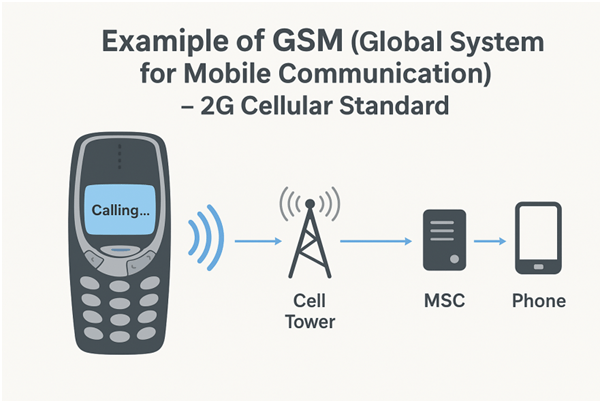
One of the most notable examples of GSM’s practical impact is the way it revolutionized everyday mobile usage in the 1990s and early 2000s. The Nokia 3310, which was introduced in 2000 and became a global symbol of GSM technology, allowed users to make digital voice calls with much higher clarity than the older 1G analog phones. GSM also introduced SMS (Short Message Service), which was rapidly embraced by people for sending brief text messages such as quick updates or holiday greetings, revolutionizing personal communication. GSM standards were used by mobile carriers like Airtel in India, Vodafone in the UK, and AT&T in the USA to build their networks. This allowed users to roam worldwide using the same phone and SIM card, which had never been feasible previously. The beginning of mobile data usage was also marked by the launch of basic mobile internet using GPRS and EDGE, which made it possible to use basic services like WAP surfing, ringtone downloads, and eventually MMS. This was a true breakthrough in mobile communication because it allowed a user with a GSM-enabled phone and SIM card to travel across nations while keeping connected, in addition to making calls and sending texts.
Key Features of GSM 2G Cellular Standard
GSM introduced a set of groundbreaking features that transformed mobile communication from a luxury into an everyday necessity. Below are the key features that defined the 2G GSM standard:
- Digital Voice Transmission: GSM transformed voice into digital signals, which improved call quality and reduced background noise, in contrast to 1G analog systems.
- SIM Card Technology: The Subscriber Identity Module (SIM card) was one of GSM’s most significant inventions. made it simple for customers to swap phones while maintaining their subscription and number.
- International Roaming: GSM established a worldwide standard that allows users to use their phones with little setup in other nations.
- Short Message Service (SMS): Made it possible to send and receive text messages with a character limit of 160. SMS swiftly rose to prominence as one of the most widely used mobile services globally.
- Data Services (GPRS/EDGE Support): GSM offered some basic data services, but with limitations. MMS, early apps, and mobile internet browsing were made possible by later updates that enabled GPRS (2.5G) and EDGE (2.75G).
- Time Division Multiple Access (TDMA): GSM effectively shared a frequency by dividing frequency channels into time slots using TDMA technology.
- Security and Encryption: Compared to analog systems, communication is now more secure thanks to authentication and basic encryption (A5/1 method) for calls and data.
- Broad Frequency Bands: Used in North America at 850 MHz and 1900 MHz and in Europe and Asia at 900 MHz and 1800 MHz. allowed for regionally variable deployment.
- Cost-Effective Deployment: Both developed and developing nations quickly adopted GSM networks because they were less expensive and simpler to set up..
Advantages and Disadvantages of GSM 2G Cellular Standard
Like every technology, GSM (2G) brought major improvements over its predecessor (1G), but it also had certain limitations. Let’s look at both sides:
Advantages of GSM
- Better Call Quality (Compared to 1G) : Digital voice transmission reduced noise and interference.
- SIM Card Flexibility: Allowed users to switch devices easily while keeping the same number and service.
- International Roaming: As a global standard, GSM enabled users to travel across countries with the same phone and SIM.
- Text Messaging (SMS): Introduced SMS, which quickly became a global communication trend.
- Security Improvements : Authentication and basic encryption (A5/1) offered more privacy than 1G analog systems.
- Widespread Adoption: GSM was deployed in 200+ countries, ensuring compatibility and affordability of devices.
- Cost-Effective for Operators: Standardized equipment and infrastructure reduced costs, encouraging global rollout.
Disadvantages of GSM
- Limited Data Speed : Base GSM supported data speeds of only 9.6–14.4 kbps. Even with GPRS/EDGE upgrades, speeds were far below modern standards.
- Security Weaknesses Encryption algorithms (like A5/1) were later found to be vulnerable, making GSM calls susceptible to hacking.
- Not Suitable for Multimedia/Internet : Could not support video calls, streaming, or high-speed internet
- Dependence on Signal Strength: Call drops and lower quality in weak coverage areas.
- Obsolete in Modern Networks: Being phased out in many countries in favor of 4G and 5G.
Applications of GSM in 2G Cellular Standard
GSM (2G) was more than just a technology for making calls — it became a foundation for mobile communication services that millions of people relied on daily. Below are the major applications of GSM:
- Voice Communication: The primary application of GSM was mobile voice calling. Digital transmission improved clarity and reliability compared to 1G analog systems.
- Short Message Service (SMS): GSM introduced text messaging (up to 160 characters). Became one of the most widely used communication methods worldwide in the 1990s and early 2000s.
- Mobile Data Services: Basic data connectivity was supported through GSM. Later upgrades like GPRS (2.5G) and EDGE (2.75G) enabled: Simple mobile web browsing (WAP), Multimedia Messaging Service (MMS) and Early mobile applications (like ringtones, wallpapers, and basic downloads)
- International Roaming: GSM’s global standardization enabled users to travel abroad and still use their phones with the same SIM card.
- Mobile Banking & Payments (via SMS/USSD): In many developing countries, GSM enabled mobile banking services like: Checking account balances,,Mobile money transfers (e.g., M-Pesa in Africa) and Bill payments through SMS/USSD codes
- Machine-to-Machine (M2M) and IoT Applications: Even today, GSM networks are still used in some regions for low-data IoT applications, such as: Smart meters, Vehicle tracking systems, Remote sensors and industrial monitoring
- Emergency Services: GSM supported emergency calling (e.g., 112/911), even without an active SIM card.
- GSM (Global System for Mobile Communication) – 2G Cellular Standard in Comparison with Other Protocols: GSM was not the only mobile standard, but it became the most widely adopted because of its simplicity, reliability, and global acceptance. To understand its impact better, let’s compare GSM (2G) with other major protocols:
Comparison Table: GSM vs Other Cellular Protocols
| Feature / Standard | 1G (Analog) | GSM (2G) | 3G (UMTS/WCDMA) | CDMA (IS-95/2G alternative) | 4G (LTE) |
| Technology Type | Analog | Digital (TDMA-based) | Digital (Packet-switched & Circuit-switched) | Digital (CDMA-based) | Fully Digital (All-IP) |
| Launch Period | 1980s | Early 1990s | Early 2000s | Mid-1990s | Late 2000s |
| Voice Quality | Poor, noisy | Clearer, less noise | High-quality | High-quality | HD Voice |
| Data Speed | None | 9.6–14.4 kbps (GPRS/EDGE: up to 384 kbps) | Up to 2 Mbps | ~14.4 kbps (later CDMA2000 improved to Mbps) | 100 Mbps+ |
| Services | Voice only | Voice, SMS, MMS, Basic Internet | Voice, Video Calling, Internet | Voice, SMS, Basic Data | Voice, HD Video, High-speed Internet |
| Security | Very weak (easy to tap) | Basic encryption (A5/1) | Stronger encryption | Better than GSM but proprietary | Strong encryption (AES) |
| Roaming | Limited | Excellent (global standard) | Widespread (but not as universal as GSM) | Limited (region-specific) | Global adoption increasing |
| Main Advantage | First mobile tech | Global standard, SMS, roaming | High-speed data, video services | Better spectrum efficiency | High-speed Internet, multimedia |
| Main Limitation | Poor quality, no data | Slow data, outdated now | Higher infrastructure cost | Lack of global standardization | Expensive infrastructure at launch |
Key Takeaways,
- GSM was the first true global standard, offering international roaming and digital voice.
- Compared to 1G, it was a huge leap (digital, secure, SMS).
- Compared to 3G and beyond, GSM falls short in data speeds and modern applications.
- GSM’s simplicity and worldwide adoption made it the foundation for later mobile generations.
Conclusion
An important turning point in the history of mobile communication was the introduction of the GSM (Global System for Mobile Communication)-2G cellular standard. Clearer voice calls, worldwide roaming, SIM card flexibility, and text messaging (SMS) were all made possible by GSM’s transition from analog to digital technology. These features helped to define how people communicated in the 1990s and 2000s. Despite its drawbacks, including sluggish data rates and fundamental security flaws, GSM set the stage for more sophisticated mobile technologies like 3G, 4G, and now 5G. In certain areas, GSM is still a dependable network for M2M (machine-to-machine) connectivity, inexpensive voice services, and Internet of Things devices. In conclusion, GSM was more than simply a technology; it was a worldwide standard that linked billions of people and, for the first time, made mobile communication genuinely universal. Its legacy endures in subsequent networks, demonstrating that the quick development of contemporary mobile communication would not have been feasible without GSM.
Frequently Asked Questions (FAQs)
When was GSM first introduced?
Radiolinja introduced GSM for the first time in Finland in 1991. It swiftly expanded throughout Europe before reaching the rest of the world.
What frequency bands does GSM use?
The main frequencies in which GSM operates are 900 MHz and 1800 MHz (Europe, Asia, and Africa). North America and Latin America (850 MHz and 1900 MHz)
What is the maximum data speed in GSM?
- The speed range of basic GSM is 9.6–14.4 kbps.
- GPRS (2.5G) rates were between 40 and 50 kbps.
- In optimal circumstances, EDGE (2.75G) rates could increase to 384 kbps.
Is GSM still used today?
Yes, but fewer people are using it. In order to make space for 4G and 5G, many nations are shutting down their 2G networks. Nonetheless, certain areas continue to utilize GSM, particularly for SMS, IoT/M2M devices, and basic voice.
What is the difference between GSM and CDMA?
- GSM (Global System for Mobile Communication):
- Uses TDMA (Time Division Multiple Access).
- Requires a SIM card for user identity.
- Offers excellent international roaming support.
- CDMA (Code Division Multiple Access):
- Uses spread-spectrum technology (users share the same frequency but are separated by unique codes).
- No physical SIM card (identity stored in the phone itself, though later CDMA phones adopted SIM for LTE).
- Limited roaming capabilities compared to GSM.