Introduction
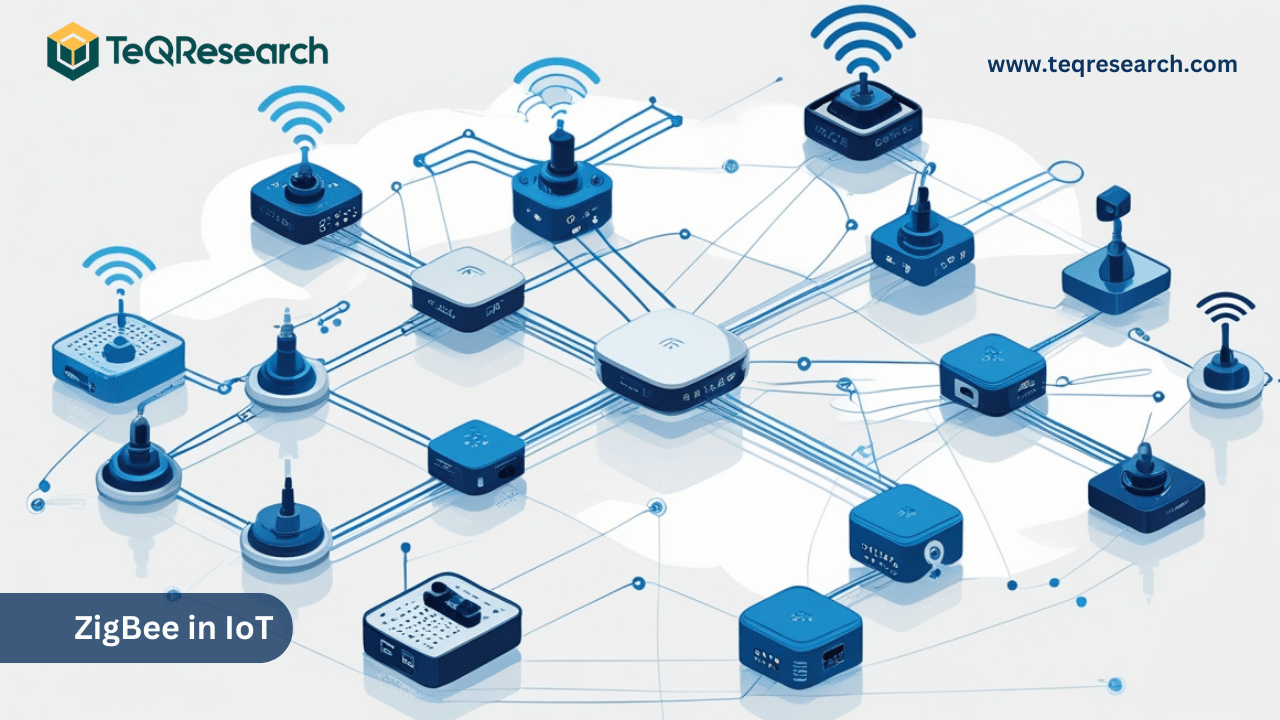
The way gadgets connect, communicate, and share data in homes, businesses, healthcare facilities, and even cities is being drastically changed by the Internet of Things (IoT). IoT networks are built on wireless communication protocols, which make it possible for everything from industrial sensors to smart lightbulbs to function without a hitch. Because of its low power consumption, dependability, and capacity to accommodate a large number of linked devices, Zigbee has become a popular choice among these protocols. Despite being widely known as a mesh networking technology, Zigbee’s full potential is found in its application to Internet of Things applications. In contrast to general-purpose mesh configurations, Zigbee in IoT is designed for energy-efficient, short-range communication between smart devices, which makes it the perfect choice in situations where Bluetooth or Wi-Fi might not be sufficient. What Zigbee means in the context of the Internet of Things, how it functions, its salient features, pros and cons, practical uses, and how it compares to other protocols will all be covered in this blog. You’ll know exactly when and why Zigbee is the best option for Internet of Things solutions by the end.
What is Zigbee?
A low-power wireless communication technology called Zigbee was created to link smart devices and facilitate effective communication between them. It is designed for low-data-rate, short-range applications and runs mostly in the 2.4 GHz frequency band according to the IEEE 802.15.4 standard. In a generic mesh setting, Zigbee is frequently discussed in terms of how devices create a multi-hop, self-healing network. However, the focus changes to Zigbee’s support for smart, connected devices that must consistently exchange small quantities of data while using very little power when it is used expressly for the Internet of Things. Some key aspects that define Zigbee in IoT usage include:
- Low energy consumption – allowing battery-powered sensors and devices to run for months or even years without replacement.
- Device-to-device communication – enabling IoT devices like smart bulbs, thermostats, or sensors to talk to each other and to a central hub.
- Scalability – supporting networks with hundreds (even thousands) of connected devices, which is critical for IoT ecosystems.
- Interoperability – ensuring devices from different manufacturers can work together under the same Zigbee network.
In essence, Zigbee (for IoT) is not just about creating a network; it’s about making everydaydevices “smart” and connected in a way that is cost-effective, energy-efficient, and reliable.
How Zigbee Works (when used for IoT, not general mesh)?
In an Internet of Things ecosystem, Zigbee serves as a low-power, short-range wireless communication protocol that links several smart devices. Zigbee is perfect for sensors, switches, and monitoring devices since it is made to efficiently convey little data packets rather than sending massive volumes of data like Wi-Fi does. Here’s how Zigbee functions in the IoT context:
- Network Architecture: The coordinator, which is frequently a hub or gateway, is the main component that initiates and controls the Zigbee network. Devices known as routers—which aren’t usually required in tiny IoT setups—help increase range by transmitting signals between nodes. End Devices: Data-transmitting, low-power Internet of Things devices such as door sensors, thermostats, and smart lightbulbs.
- Communication Flow: The coordinator (hub), which controls communication, receives connections from devices. In order to save power, end devices usually “wake up,” send and receive data (such as a temperature reading or an instruction to turn on or off a light), and then return to sleep mode. Zigbee’s low data rates (20–250 kbps) are enough for Internet of Things functions including switching, sensing, and command control.
- Frequency Bands: The 2.4 GHz ISM band is where Zigbee mostly functions, however it also supports 868 MHz in Europe and 915 MHz in North America. Global compatibility is offered by the 2.4 GHz option, although Wi-Fi interference may be present.
- Power Efficiency: By remaining idle for the most of the time and only sending when necessary, end devices use very little energy. For this reason, Zigbee works well with IoT devices that run on batteries.
In short, Zigbee in IoT works by creating a lightweight, low-energy network that connects everyday devices to a central hub or controller, enabling seamless communication without draining power or requiring complex infrastructure.
Example of Zigbee in IoT
To better understand how Zigbee is used in IoT, let’s look at some real-world examples where it powers smart, connected devices:
- Smart Home Lighting: Using a smartphone or voice assistant, Zigbee-enabled lightbulbs (such as Philips Hue) can be dimmed or turned on and off. The bulbs use little energy and respond quickly thanks to communication with a Zigbee hub. Home security: When a door is opened, Zigbee door and window sensors notify the hub. Zigbee is also used by motion sensors and smart locks for dependable, low-power communication. Smart Thermostats: To maximize heating or cooling, gadgets such as Zigbee thermostats may track temperature and humidity and transmit the information to a central hub.
- Industrial IoT: Zigbee sensors are used to track the tremor, temperature, and pressure of machinery. They save power and enable predictive maintenance by sending tiny quantities of data to a central controller.
- Healthcare IoT: Wearable technology with Zigbee support or patient monitoring sensors can measure body temperature, blood sugar, or heart rate and securely send the information to medical systems.
- Smart Agriculture: By automating irrigation systems and tracking water levels, zigbee soil moisture sensors help farmers save energy and increase agricultural harvests.
Example in Action: Imagine a Zigbee smart home setup where the lights automatically dim when the TV turns on, motion sensors activate outdoor lights when someone walks by, and a smart thermostat adjusts the temperature—all while consuming minimal energy and working together seamlessly.
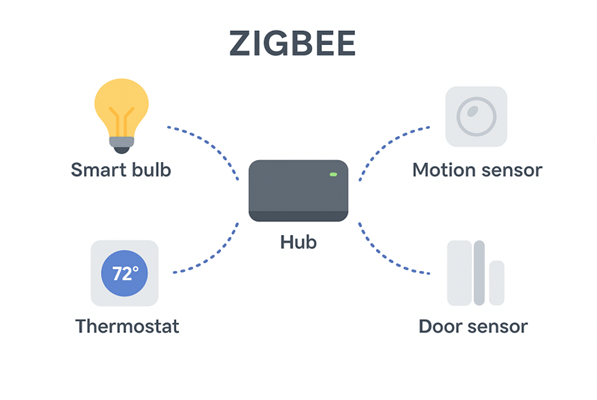
Smart homes are among the most prevalent and useful IoT applications for Zigbee. Take, for example, a house with Zigbee-enabled appliances like door sensors, motion sensors, thermostats, and smart lightbulbs. The motion sensor senses movement when a resident enters a room and communicates with the hub via Zigbee, which instantly activates the lights. Simultaneously, door sensors can notify the homeowner if a door is left open, and the thermostat linked to the Zigbee network can modify the room temperature according to preset preferences. The low-power, short-range wireless communication of Zigbee allows all of these devices to easily communicate with one another. This system’s advantage is that the gadgets may operate without continuous internet access. Local communication management via the Zigbee hub guarantees prompt replies and energy efficiency. Zigbee technology, for instance, is used by Philips Hue smart bulbs and IKEA TRÅDFRI lighting systems to enable homeowners to schedule automation, change colors, and dim lights using an app or voice assistant. This illustration demonstrates how Zigbee makes it possible for a dependable, low-power, and networked ecosystem that improves daily convenience, security, and energy efficiency.
Key Features of Zigbee (for IoT use)
Zigbee comes with a range of features that make it well-suited for Internet of Things (IoT) applications, especially where low power and reliable communication are essential. Some of the key features include:
- Low Power Consumption: Made for gadgets that run on batteries. Sensors and other end devices can operate for years on tiny batteries since they spend the majority of their time in sleep mode and only wake up when necessary.
- Scalability: Although actual implementations are smaller, this feature theoretically supports huge IoT networks with up to 65,000 devices. Perfect for big IoT ecosystems, industrial automation, and smart homes.
- Reliable yet Short-Distance Communication: Depending on the environment and interference, the typical indoor range is 10 to 100 meters. Ideal for IoT situations at home and at work.
- Security: AES-128 encryption is used to transmit data securely. crucial for delicate Internet of Things applications like smart security systems and healthcare.
- Interoperability: If devices from various manufacturers adhere to Zigbee standards, they can cooperate. encourages adaptability when creating IoT ecosystems.
- Low Data Rates: Functions at 20 kbps (868 MHz), 40 kbps (915 MHz), and 250 kbps (2.4 GHz) and is adequate for the Internet of Things. Enough to send automation commands, control signals, and sensor readings.
- Self-Healing Network (Optional in IoT): Zigbee routers may replay messages in mesh networking-enabled IoT systems, guaranteeing steady connectivity even in the event of a path failure. In larger-scale IoT systems, this improves reliability.
- Economical: Zigbee modules and chips are reasonably priced. makes it a sensible option for extensive IoT implementations.
In Zigbee’s key features—energy efficiency, scalability, security, and interoperability—make it a strong backbone for IoT applications ranging from smart homes to industrial automation.
Advantages and Disadvantages of Zigbee (when used for IoT)
Like any technology, Zigbee has its strengths and limitations. Understanding both helps in deciding whether it is the right fit for a specific IoT application.
Advantages of Zigbee in IoT
- Low Power Consumption: Perfect for Internet of Things devices that run on batteries, which can go months or years between charges or replacements.
- Scalability: Suitable for smart homes and industrial IoT, this network can link hundreds to thousands of devices.
- Cost-Effective: In comparison to Wi-Fi or cellular IoT solutions, Zigbee modules are very cheap.
- Secure Communication: Data privacy is ensured by built-in AES-128 encryption, which is essential for Internet of Things applications like security and healthcare.
- Interoperability: As long as devices from various brands adhere to Zigbee standards, they can communicate with one another.
- Dependable for Low-Data Applications: Ideal for sensors, switches, smart lights, and other gadgets that require minimal data transmission.
- Facilitates Mesh Networking (IoT Option): By enabling message forwarding, this feature increases dependability and range.
Disadvantages of Zigbee in IoT
- Limited Range: Usually between 10 and 100 meters indoors, this range would not be enough for big areas without routers or repeaters.
- Low Data Rate: Unsuitable for high-bandwidth applications (such streaming videos), with a maximum of 250 kbps.
- Interference Problems: Because it uses the 2.4 GHz band, which may overlap with Wi-Fi, it may interfere with signals.
- Requirement for a Hub/Coordinator: In order to connect to the internet or communicate with smart assistants, a lot of Zigbee devices need a specific hub.
- Not Suitable for Long-Distance or High-Speed IoT : More appropriate for low-power, local applications than for jobs involving a lot of data.
Zigbee is excellent for low-power, short-range IoT applications like smart homes, healthcare monitoring, and industrial sensors. However, for long-distance or high-bandwidth IoT requirements, alternatives like Wi-Fi, LoRa, or cellular IoT may be better.
Applications of Zigbee in IoT
Zigbee’s low power consumption, reliability, and scalability make it an ideal choice for many Internet of Things (IoT) applications. It is particularly effective in scenarios where devices need to exchange small packets of data while maintaining long battery life and operating seamlessly in large, connected networks. Below are the key application areas of Zigbee in IoT.
- Smart Homes: Zigbee is widely adopted in smart home ecosystems to enhance convenience, security, and energy efficiency. In lighting systems, Zigbee-enabled bulbs such as Philips Hue or IKEA TRÅDFRI can be remotely controlled through apps or voice assistants. Security devices like motion sensors, door/window sensors, and smart locks use Zigbee to deliver real-time alerts. Additionally, energy management solutions, such as smart plugs and thermostats, utilize Zigbee to monitor and optimize household energy consumption.
- Industrial IoT (IIoT): In industrial environments, Zigbee supports machine monitoring by tracking vibration, temperature, and pressure to predict and prevent equipment failures. It also facilitates asset tracking, where low-power Zigbee tags monitor the location of tools and machinery across factories. Moreover, Zigbee-based wireless automation systems control industrial lighting and HVAC, improving efficiency and reducing costs.
- Healthcare IoT: Zigbee plays an important role in healthcare by enabling secure and energy-efficient patient monitoring. Sensors powered by Zigbee can measure vital signs such as heart rate, body temperature, or glucose levels. Wearable devices further enhance patient care by continuously transmitting health data to healthcare providers while ensuring long battery life.
- Smart Agriculture: Zigbee contributes significantly to agricultural efficiency by powering soil and crop monitoring systems that optimize irrigation based on real-time moisture and nutrient data. Livestock tracking with Zigbee tags ensures continuous monitoring of animal health and movement. In greenhouses, Zigbee enables wireless automation of temperature, lighting, and ventilation systems, supporting sustainable farming practices.
- Smart Cities: Urban infrastructure also benefits from Zigbee technology. Smart metering solutions for electricity, gas, and water use Zigbee to automatically transmit consumption data to utility providers. Zigbee-based street lighting systems adjust brightness according to time of day or activity levels, saving energy. Additionally, Zigbee traffic monitoring sensors help optimize traffic flow and reduce congestion in cities.
- Retail and Commercial Spaces: In commercial settings, Zigbee enhances operational efficiency through smart shelves that detect product levels and send alerts when restocking is required. It also supports HVAC control, where smart thermostats and air-quality sensors powered by Zigbee improve energy efficiency and indoor comfort in large buildings.
In essence, Zigbee is best suited for IoT applications where devices need to transmit small amounts of data reliably, consume minimal power, and seamlessly connect within large-scale networks. Its wide adoption across smart homes, industries, healthcare, agriculture, cities, and commercial spaces highlights its importance in building sustainable and intelligent IoT ecosystems.
Zigbee in Compare Other Protocols (IoT context)
When choosing a communication protocol for IoT, Zigbee often gets compared with other popular technologies like Wi-Fi, Bluetooth Low Energy (BLE), and Z-Wave. Each protocol has its strengths and limitations depending on the use case.
1. Zigbee vs. Wi-Fi
- Zigbee: Low power, supports many devices, but has limited data rate (up to 250 kbps). Best for sensors, switches, and smart lights.
- Wi-Fi: High data rate (up to several Gbps), wide coverage, but consumes a lot of power. Better for bandwidth-heavy IoT applications like cameras or streaming devices.
Use Zigbee for low-power smart devices; use Wi-Fi for high-speed, always-on devices.
2. Zigbee vs. Bluetooth Low Energy (BLE)
- Zigbee: Can connect hundreds to thousands of devices in a network, operates on mesh, and suits large IoT setups.
- BLE: Very low power, simple connections, but limited number of devices in a network. Best for wearables and personal devices.
Zigbee scales better for smart homes/industrial IoT, while BLE is great for personal IoT gadgets.
3. Zigbee vs. Z-Wave
- Zigbee: Operates at 2.4 GHz globally, faster data rate (250 kbps), but more prone to Wi-Fi interference.
- Z-Wave: Operates in sub-GHz bands (868/915 MHz), lower data rate (100 kbps), but less interference and better range per hop.
- Both support mesh networking.
Zigbee offers speed and global availability; Z-Wave provides stability with less interference but is region-specific.
4. Zigbee vs. LoRaWAN (Long Range IoT)
- Zigbee: Short-range (10–100 m indoors), low data rate, designed for local IoT ecosystems.
- LoRaWAN: Long-range (kilometers), ultra-low power, designed for outdoor or city-wide IoT deployments like agriculture or smart cities.
Zigbee is ideal for indoor/home IoT, while LoRaWAN is better for outdoor/long-distance IoT.
| Protocol | Range | Power Usage | Data Rate | Devices Supported | Best Use Cases |
| Zigbee | 10–100 m | Very Low | Up to 250 kbps | 100s–1000s | Smart homes, sensors, automation |
| Wi-Fi | 50–100 m | High | Up to Gbps | 10s | Cameras, streaming devices, broadband IoT |
| BLE | 1–50 m | Very Low | 125 kbps–2 Mbps | Few (10s) | Wearables, beacons, health devices |
| Z-Wave | 30–100 m | Low | Up to 100 kbps | Up to 232 | Home automation, security systems |
| LoRaWAN | Several km | Very Low | < 50 kbps | 1000s | Agriculture, smart cities, utilities |
Conclusion
For Internet of Things applications, Zigbee has established itself as a dependable and energy-efficient communication technology. In contrast to talks of mesh networking in general, Zigbee’s genuine advantages—low power consumption, scalability, secure communication, and smooth device interoperability—become evident when we concentrate on it in the context of the Internet of Things. These characteristics make it particularly appropriate for applications where long battery life and tiny data transfers are essential, such as smart cities, healthcare, industrial automation, smart homes, and agriculture. Zigbee’s efficiency, affordability, and device support make it a strong contender in many IoT installations, despite its drawbacks, which include lower data rates and a shorter range when compared to Wi-Fi or LoRa. Zigbee is one of the most useful options for situations when devices must be permanently connected, reasonably priced, and long-lasting. Zigbee continues to play a crucial role in the quickly changing IoT ecosystem, frequently enhancing rather than replacing existing protocols. Businesses, developers, and consumers can construct strong and future-ready IoT ecosystems more intelligently by knowing where Zigbee shines and where it struggles.
Frequently Asked Questions (FAQs)
1. Is Zigbee better than Wi-Fi for IoT?
- The application determines this. Wi-Fi is better for high-bandwidth applications like streaming or cameras, whereas Zigbee is better for low-power, low-data IoT devices like sensors and smart lights.
2. How many devices can Zigbee support in an IoT network?
- Depending on the hub and network configuration, Zigbee can theoretically support up to 65,000 devices, but in practice, it typically supports hundreds of devices with reliability.
3. What is the range of Zigbee in real-world IoT usage?
- Usually indoors, between 10 and 100 meters (depending on equipment placement, walls, and interference). Zigbee routers that transmit signals between devices can increase the range.
4. Is Zigbee secure for IoT applications?
- Zigbee is appropriate for critical Internet of Things applications like smart locks and healthcare monitoring since it employs AES-128 encryption for secure transmission.
5. Do Zigbee devices need the internet to work?
- No, a hub or coordinator facilitates local communication between Zigbee devices. Only if you wish to remotely control devices—for example, from your phone while you’re away—do you require internet connection.
6. Can Zigbee work with voice assistants like Alexa or Google Home?
- It’s true that a lot of smart home hubs (like the Amazon Echo with Zigbee capability) let you operate Zigbee devices with Google Home, Apple HomeKit, or Alexa.
7. What are some real-life examples of Zigbee IoT devices?
- Typical Zigbee IoT products include motion sensors, smart locks, temperature sensors, energy-monitoring plugs, and smart lamps (Philips Hue, IKEA TRÅDFRI).
8. Does Zigbee interfere with Wi-Fi?
- Since both use the 2.4 GHz frequency, interference may occur. Zigbee, on the other hand, may avoid Wi-Fi’s widely used channels and uses tiny data packets.
9. Is Zigbee better than Bluetooth Low Energy (BLE)?
- BLE is better for point-to-point or individual IoT devices (like fitness trackers), whereas Zigbee is better for big networks with several devices (like a smart house).
10. What is the future of Zigbee in IoT?
- Matter, the new universal smart home standard, heavily relies on Zigbee, which is developing under the Connectivity Standards Alliance (CSA). This guarantees Zigbee’s continued relevance in upcoming IoT environments.