
What is Twofish Algorithm?
A symmetric key block cipher called Twofish was created to safely encode and decrypt data. It supports key sizes of 128, 192, or 256 bits and runs on 128-bit data blocks. For high security, Twofish employs a Feistel network structure with 16 encryption rounds, a Maximum Distance Separable (MDS) matrix, sophisticated key-dependent S-boxes, and whitening techniques (XOR-ing with key material before and after the rounds). It is known for being:
- Fast in both software and hardware implementations
- Flexible with multiple key lengths
- License-free and open-source (no patents)
Bruce Schneier and his colleagues created Twofish in 1998 as a contender for the Advanced Encryption Standard (AES) contest; nevertheless, AES finally decided to use the Rijndael algorithm. In spite of this, Twofish is still a widely used encryption standard today.
Introduction of Twofish Algorithm
A symmetric key block cypher for safe data encryption and decoding is the Twofish algorithm. Bruce Schneier and his group developed it in 1998 as a component of their entry for the Advanced Encryption Standard (AES) contest, which in the end chose the Rijndael algorithm. Despite not being chosen as the AES, Twofish has since become well-known for its excellent security, adaptability, and effectiveness, which has made it a preferred option for many encryption applications. Key features of Twofish include:
- Block size: Since it works with 128-bit blocks, the plaintext data is processed in 128-bit segments.
- Key sizes: Unlike some other algorithms, it offers a greater degree of security versatility by supporting key sizes of 128, 192, and 256 bits.
- Feistel network: The foundation of Twofish is the Feistel structure, a popular cypher architecture. It is a reversible structure that splits data in two parts and iteratively manipulates them.
- Key-dependent S-boxes: Twofish is immune to some cryptographic attacks, such as differential cryptanalysis, since it dynamically creates S-boxes (substitution tables) based on the encryption key.
- Whitening and mixing operations: To enhance diffusion and data mixing, the algorithm employs MDS matrix multiplications and whitening, which involves XORing data with subkeys both before and after rounds.
Twofish is well-suited for a variety of applications, including disk encryption, VPNs, and secure communication protocols. Its open-source nature, fast performance, and strong security guarantees have made it a preferred choice in many encryption systems.
Detailed Explanation of Twofish Algorithm
Overview:
- Block Size: 128 bits (data is processed in 128-bit blocks).
- Key Sizes: 128, 192, or 256 bits.
- Rounds: 16 rounds of encryption.
- Structure: Feistel network.
- Operations: Key-dependent S-boxes, whitening, MDS matrix multiplications, modular additions.
Step 1: Key Expansion (Key Scheduling)
The key expansion phase generates subkeys from the original encryption key. The key is processed through a series of transformations to produce a set of subkeys used in each round.
- Input: The initial key (128, 192, or 256 bits).
- Output: A series of subkeys for each round.
Key Expansion Process:
- There are several 32-bit words in the original key.
- A function that uses bit rotations, modular additions, and XOR operations then processes the key words.
- 40 32-bit subkeys are produced as a result of this key expansion procedure, and these are utilized during the 16 cycles.
Every cipher round uses a different, key-dependent subkey thanks to the key expansion.
Step 2: Whitening (Initial and Final)
Before and after the rounds, whitening is applied. Whitening involves XOR-ing the plaintext or ciphertext with a key-dependent value to provide an additional layer of security.
- Initial Whitening:
- The plaintext block P (128 bits) is XOR-ed with the first set of subkeys:
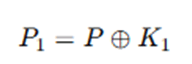
where K1 is the first subkey.
- Final Whitening:
- After the 16 rounds of encryption, the output D is XOR-ed with the final set of subkeys:
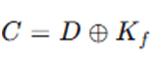
where Kf is the final subkey.
Whitening improves the cipher’s resistance to certain types of cryptanalytic attacks by introducing variability in the input and output.
Step 3: Feistel Network – 16 Rounds
Each round in the Twofish algorithm operates on the data in a Feistel network structure. The data is split into two halves: a left half (L) and a right half (R).
- Input: The data block is divided into two 64-bit halves: L0L_0L0 and R0R_0R0.
- Output: After 16 rounds, the data is recombined into a ciphertext block.
Round Structure:
For each round iii, the following steps are performed:
- Feistel Function F:
- The right half R of the data is processed by a complex function F(R,K) that combines the right half with a subkey K and applies substitution (through S-boxes), permutation, and mixing (via MDS matrix).
- The Feistel function is a combination of multiple operations:
- Substitution (using key-dependent S-boxes).
- Permutation and modular arithmetic (MDS matrix and modular additions).
- Feistel Round Update: The new left half and right half after the round are calculated as follows:
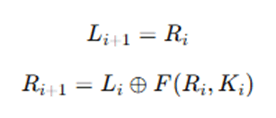
where F(Ri,Ki) is the Feistel function operating on the right half Ri using subkey Ki.
This process is repeated for 16 rounds. At the end of round 16, the final output L16 and R16 are concatenated to form the ciphertext.
Step 4: Final Whitening
After completing the 16 rounds, a final whitening operation is performed to further mix the output.
- Final Whitening:
- The resulting data from the last round (let’s call it D) is XOR-ed with a final set of subkeys:
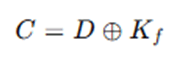
where C is the ciphertext and Kf is the final whitening key.
This ensures that even if the output looks similar to a plaintext block, the whitening provides another layer of security.
Step 5: Ciphertext Output
The final ciphertext C is the result of applying the whitening and all the rounds. It is a 128-bit block, the same size as the plaintext.
Summary of the Process:
- Key Expansion: Generate subkeys from the original encryption key.
- Whitening (Initial and Final): XOR the plaintext with a key-dependent value before and after rounds.
- Rounds (16 rounds): Split the data into two halves; apply the Feistel network in each round.
- Final Whitening: XOR the result of the final round with a final whitening key.
- Ciphertext: The result is the encrypted ciphertext.
F-function Example:
The F-function is the core operation inside each round. The formula can be simplified as:

- S(x): Apply substitution through S-boxes.
- ⊕: XOR operation.
- MDS: Apply the Maximum Distance Separable (MDS) matrix to increase diffusion.
Advantages and Disadvantages
Twofish is a symmetric-key block cipher that was one of the five finalists in the Advanced Encryption Standard (AES) competition. Though it was not ultimately selected as the AES standard, Twofish remains highly respected and widely used due to its strong security and efficient design. It offers a powerful combination of speed, flexibility, and robustness, but like any algorithm, it also comes with limitations depending on the context in which it is used.
Advantages
- High Security and Resistance to Cryptanalysis: Twofish provides strong resistance to a wide range of cryptographic attacks, including differential and linear cryptanalysis. It employs key-dependent S-boxes and pre- and post-whitening techniques, which make it extremely difficult for attackers to discover patterns in the encrypted data. Despite years of public analysis, no practical cryptographic vulnerabilities have been found, making Twofish a highly secure option for data protection.
- Flexible Key Lengths for Various Security Needs: Twofish supports three different key sizes: 128-bit, 192-bit, and 256-bit. This flexibility allows users to select a key size that best suits their performance and security requirements. Whether the need is high throughput or maximum protection, Twofish can be adapted to fit the purpose, making it highly versatile for both personal and enterprise applications.
- Efficient for Both Hardware and Software: The algorithm is designed for efficient implementation across multiple platforms, including both hardware and software environments. Twofish performs well even on low-powered embedded devices, and its structure supports parallelization, which can be exploited in multi-core systems to accelerate encryption and decryption processes. This balance of speed and security makes it suitable for real-time and high-performance applications.
- Open-Source and Royalty-Free: Twofish is open-source and unpatented, meaning it can be used freely without licensing fees or legal restrictions. This accessibility has led to its adoption in a range of security products, especially open-source tools like TrueCrypt and VeraCrypt. Its transparent design has been fully published and peer-reviewed, increasing trust and encouraging widespread implementation.
- Strong Diffusion and Consistent Data Handling: Twofish uses 128-bit block sizes, ensuring consistent encryption regardless of the size of the input data. It handles different plaintext lengths through standardized padding methods. Additionally, features like Maximum Distance Separable (MDS) matrices enhance diffusion, ensuring that even a small change in the input produces a vastly different ciphertext. This strengthens the algorithm’s ability to obscure any patterns that could be exploited by attackers.
- Protection Against Side-Channel Attacks: Unlike many algorithms that require additional safeguards, Twofish is designed to resist side-channel attacks such as timing analysis, power consumption monitoring, and cache-based attacks. These built-in protections make it a reliable choice for secure implementations, particularly in sensitive or constrained computing environments.
- Broad Use and Application Support: Though not chosen as the AES standard, Twofish is used in many encryption applications including VPN protocols, secure storage systems, and data protection software. Its adaptability, strong security model, and open-source nature continue to make it attractive to developers and security professionals across a variety of industries.
Disadvantages
- Larger Key Setup Time Compared to AES: One limitation of Twofish is that it has a relatively complex key schedule, which leads to slower key setup times compared to algorithms like AES. In applications where keys are changed frequently or where quick key initialization is required, this may become a performance bottleneck.
- Less Mainstream Adoption: Despite its technical merits, Twofish is less widely adopted than AES, particularly in enterprise and government systems where AES is a compliance requirement (e.g., FIPS standards). This means Twofish may not always be supported by default in modern operating systems, cryptographic libraries, or secure hardware modules.
- Increased Implementation Complexity: The use of key-dependent S-boxes and MDS matrices, while beneficial for security, also adds to the complexity of implementation. This can increase the likelihood of programming errors, especially in custom cryptographic software, unless the implementation is rigorously tested and validated.
- Larger Code Footprint: Compared to some lightweight ciphers, Twofish has a larger code and memory footprint, which may be a constraint for extremely resource-limited devices. Although it is efficient on most platforms, ultra-low-power environments like certain IoT devices might prefer simpler alternatives.
Twofish remains a highly secure, flexible, and open-source encryption algorithm with strong resistance to cryptanalytic and implementation-level attacks. Its ability to operate efficiently in both hardware and software, along with support for multiple key lengths, makes it a robust option for diverse security needs. However, factors like longer key setup time, lower mainstream adoption, and greater implementation complexity mean it may not be the ideal choice for every application. For developers and organizations seeking an alternative to AES with a strong theoretical foundation and public trust, Twofish continues to be a powerful and dependable encryption solution.
Applications of Twofish Algorithm
Twofish is a versatile and powerful symmetric encryption algorithm that finds application in a wide range of security-focused technologies. Due to its strong security features, flexibility in key sizes, and efficient performance, Twofish continues to be a preferred choice in various domains where confidentiality and integrity are paramount. Below are the major application areas where Twofish plays a critical role.
- Disk Encryption: One of the most prominent uses of Twofish is in full disk encryption systems, such as TrueCrypt and VeraCrypt. These programs leverage Twofish to protect the contents of hard drives, USB devices, and storage partitions. Even if a physical device is lost or stolen, Twofish ensures that the data remains inaccessible without proper authentication. Its speed and resistance to cryptographic attacks make it ideal for encrypting large volumes of data efficiently and securely.
- Virtual Private Networks (VPNs): In the realm of secure network communication, Twofish is used to encrypt data packets transmitted over VPNs. This helps maintain both the confidentiality and integrity of data shared between remote clients and servers across untrusted networks such as the internet. Twofish’s balance of high security, adjustable key sizes, and efficient performance makes it a trusted option for VPN providers seeking to establish secure tunnels without sacrificing speed.
- Secure File Storage and Cloud Encryption: With the rise of cloud computing, protecting files stored on remote servers has become critical. Twofish is employed to encrypt files before they are uploaded to cloud storage services. This ensures that only authorized users with the appropriate keys can access the content. Certain encrypted cloud storage providers even integrate Twofish at the file-level, using it as a core mechanism to prevent unauthorized access and enhance user privacy.
- Communication Channel Encryption: Twofish is also used to secure communication channels, including email systems and instant messaging applications. Its strong encryption capability, combined with relatively low computational overhead, allows it to function well in real-time communication environments. This enables users to enjoy secure conversations without noticeable latency, thus improving privacy and overall user experience.
- Backup Data Encryption: In backup systems, Twofish is used to encrypt sensitive data before it is stored as part of a backup set. This is particularly important for protecting sensitive files in case of a breach or physical theft of backup media. Backup software such as Acronis True Image incorporates Twofish to ensure that both individual users and enterprises can safeguard their archived information effectively.
- Smart Cards and Embedded Systems: Due to its lightweight design and small memory footprint, Twofish is a practical encryption solution for smart cards and embedded systems. These platforms often operate under strict resource constraints, yet require robust security for tasks such as digital transactions, authentication, and identity management. Twofish’s efficient operation enables secure performance in such limited environments without compromising encryption strength.
- Cryptographic Protocols and Hybrid Systems: Twofish is also integrated into custom cryptographic protocols where high-performance symmetric encryption is required. In hybrid encryption schemes, it is often paired with asymmetric algorithms (like RSA) to secure large datasets. The asymmetric component encrypts the Twofish key, while Twofish handles bulk encryption of the data, providing a secure and efficient end-to-end encryption framework.
- Digital Rights Management (DRM): Another important application of Twofish lies in the field of Digital Rights Management (DRM). It is used to protect digital content such as software, music, and videos by encrypting files in a way that only authorized devices or users can decrypt and access them. This helps prevent piracy and unauthorized distribution, which is crucial for digital content providers and streaming services seeking to enforce copyright protection.
In Twofish remains a trusted encryption algorithm across a diverse range of sectors due to its robustness, speed, and adaptability. From securing personal data on devices to enabling safe transmission of information in corporate environments, Twofish continues to offer reliable encryption wherever strong data protection is essential.
Conclusion
A symmetric key block cipher with exceptional security and efficiency, the Twofish algorithm is notable for its speed, versatility, and sturdy design. Twofish is still one of the most reliable encryption algorithms, providing robust defense against cryptographic attacks including differential and linear cryptanalysis, even though it was not chosen as the Advanced Encryption Standard (AES). It offers several key size options (128, 192, and 256 bits) to meet various security requirements while maintaining good security thanks to key-dependent S-boxes, whitening algorithms, and MDS matrix operations. Disk encryption, virtual private networks (VPNs), safe file storage, and backup systems are only a few of the many uses for the algorithm due to its performance and adaptability. Its open-source status and defense against side-channel attacks also add to its appeal in both open-source and commercial cryptography solutions. In conclusion, Twofish has demonstrated its strength and durability in the realm of cryptography by being a dependable option for protecting sensitive data in a variety of contemporary applications.
Frequently Asked Questions (FAQs)
1. What is the key size supported by Twofish?
- Answer: 128-, 192-, and 256-bit key widths are supported by Twofish. The encryption’s strength is determined by the key size selected; larger key sizes offer greater security but may also demand more processing power.
2. Is Twofish still secure for modern applications?
- Answer: Yes, Twofish is still safe for use in contemporary applications. It has been thoroughly cryptanalyzed and has not revealed any real-world flaws, even though it was not chosen as the AES algorithm. Robust security is ensured by its MDS matrix operations, whitening, and key-dependent S-boxes.
3. How does Twofish compare to AES?
- Answer: Both AES and Twofish are symmetric key block ciphers, but AES employs fixed key sizes of 128, 192, or 256 bits, while Twofish is renowned for its flexibility in key sizes (128, 192, and 256 bits). Although Twofish is thought to be a little slower than AES in terms of hardware, it is a wonderful choice for some use cases because it is open-source and provides good security.
4. What applications use Twofish encryption?
- Answer: Applications for Twofish include smart cards, VPNs, secure file storage, backup systems, and disk encryption (e.g., TrueCrypt, VeraCrypt). It is appropriate for protecting sensitive data on a variety of platforms because to its robust data protection capabilities and key size flexibility.
5. Is Twofish a patented encryption algorithm?
- Answer: No, there is no patent on Twofish. Since it is an open-source encryption algorithm, there are no licensing costs associated with using it. This is among the main factors contributing to Twofish’s popularity in both open-source and commercial cryptography solutions.