

What is Min-Min Scheduling Algorithm?
The Min-Min Scheduling Algorithm is a heuristic-based task scheduling technique commonly used in distributed computing environments such as cloud computing, grid computing, and parallel processing systems. Its primary goal is to minimize the overall completion time (also known as makespan) by assigning tasks to resources in an efficient manner. In simple terms, the algorithm selects the task with the minimum earliest completiontime and assigns it to the resource that can execute it fastest. This process is repeated until all tasks are scheduled. Min-Min works particularly well when there are many small tasks, as it prioritizes quick execution and aims to reduce idle time across available resources.
Introduction of Min-Min Scheduling Algorithm
Task scheduling is a critical component in modern computing environments where multiple tasks need to be executed across multiple machines or processors. Efficient scheduling ensures optimal resource utilization, reduced execution time, and improved system performance. The Min-Min algorithm emerged as a simple yet powerful heuristic for solving scheduling problems in heterogeneous environments—where different machines have different processing capabilities.
Unlike more complex optimization algorithms, Min-Min follows a greedy approach:
- It evaluates all possible task-resource combinations.
- It identifies the minimum completion time for each task.
- It selects the task with the smallest of these minimum values.
- It assigns that task to the corresponding resource.
This approach ensures that the system always processes the fastest-executing task first, which can significantly reduce the total execution time in many scenarios.
However, this also introduces certain limitations, especially when dealing with large tasks, which we will explore later.
Detailed Min-Min Scheduling Algorithm
Key Concepts
Before diving into the steps, let’s define some important terms:
- Task Set: T={T1,T2,T3,…,Tn}
- Resource Set: R={R1,R2,R3,…,Rm}
- Execution Time Matrix (ETC – Expected Time to Compute): ETC[i][j] represents the execution time of task Ti on resource Rj
- Completion Time (CT):

where:
- ReadyTime[j] is the time at which resource Rj becomes available
Step-by-Step Algorithm
Step 1: Initialize
- Define all tasks and resources.
- Initialize ReadyTime[j]=0 or all resources.
Step 2: Compute Completion Time Matrix
- For each task Ti and each resource Rj, compute:

Step 3: Find Minimum Completion Time for Each Task
- For each task Ti, find:

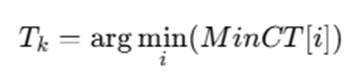
Step 4: Select Task with Global Minimum Completion Time
- Identify:
Step 5: Assign Task to Corresponding Resource
- Assign task Tk to resource Rj where CT[k][j] is minimum.
Step 6: Update Resource Ready Time
- Update:

Step 7: Remove Task from Task Set
- Remove Tk from the list of unscheduled tasks.
Step 8: Repeat
- Repeat steps 2–7 until all tasks are scheduled.
The Min-Min Scheduling Algorithm begins by initializing all available resources and setting their ready times to zero, meaning that all machines are initially idle. The algorithm then constructs a matrix that represents the expected execution time of each task on each resource. This matrix serves as the foundation for decision-making throughout the scheduling process. Next, the algorithm calculates the completion time for each task-resource pair by adding the execution time of the task on that resource to the current ready time of the resource. This step ensures that the algorithm considers both the processing capability of the resource and its current workload.
Once the completion times are computed, the algorithm identifies the minimum completion time for each task across all resources. This gives a list of the fastest possible execution options for each task. Among these, the algorithm selects the task with the smallest minimum completion time overall. This is the “Min-Min” decision—choosing the minimum among all minimum completion times.
After selecting the task, it is assigned to the resource that provides this minimum completion time. The ready time of that resource is then updated to reflect the new workload, ensuring that future scheduling decisions account for this assignment. The scheduled task is removed from the pool of pending tasks, and the algorithm repeats the entire process for the remaining tasks. This iterative approach continues until all tasks are assigned to resources. The strength of this approach lies in its simplicity and efficiency, as it always prioritizes the quickest tasks. However, this can lead to longer tasks being delayed, which may not always be ideal in balanced workloads.
Example of How Min-Min Scheduling Algorithm Works
Example Scenario
Assume we have:
- Tasks: T1, T2, T3
- Resources: R1, R2
ETC Matrix
| Task | R1 | R2 |
| T1 | 10 | 5 |
| T2 | 2 | 8 |
| T3 | 6 | 3 |
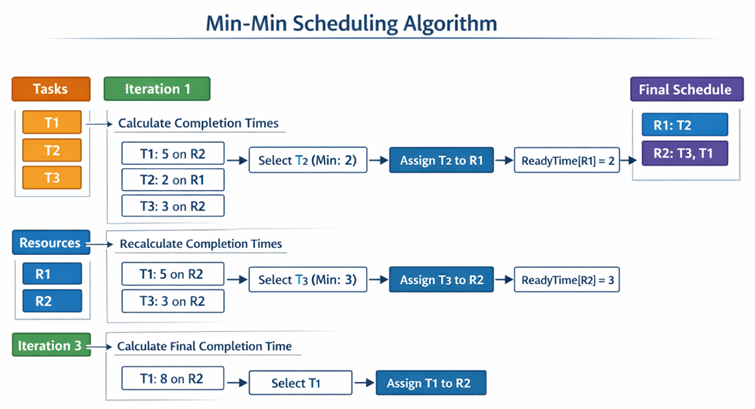
Iteration 1
- T1 → Min = 5 (R2)
- T2 → Min = 2 (R1)
- T3 → Min = 3 (R2)
בחר (Select) → T2 (minimum = 2)
Assign T2 → R1
Update ReadyTime[R1] = 2
Iteration 2
Recalculate:
| Task | R1 | R2 |
| T1 | 12 | 5 |
| T3 | 8 | 3 |
- T1 → Min = 5 (R2)
- T3 → Min = 3 (R2)
Select → T3
Assign T3 → R2
Update ReadyTime[R2] = 3
Iteration 3
| Task | R1 | R2 |
| T1 | 12 | 8 |
Select → T1
Assign T1 → R2
Final Schedule
- R1 → T2
- R2 → T3, T1
Advantages and Disadvantages of Min-Min Scheduling Algorithm
Advantages
- Simple and Easy to Implement : One of the strongest advantages of the Min-Min Scheduling Algorithm is its simplicity. The algorithm follows a clear and logical sequence: compute completion times, select the minimum, assign the task, and repeat. This straightforward structure makes it highly accessible for developers, researchers, and students. It does not require complex mathematical modeling or heavy computational overhead for implementation. Because of this, it is often used as a baseline algorithm in scheduling research and can be easily integrated into systems such as cloud schedulers or simulation environments.
- Efficient for Small Tasks: Min-Min is particularly effective when the workload consists of a large number of small-sized tasks. Since the algorithm always selects the task with the minimum completion time, smaller tasks tend to get executed first. This leads to rapid task turnover, allowing more tasks to be completed in a shorter period. In environments like web servers, microservices, or lightweight job processing systems, this behavior significantly improves responsiveness and throughput. It ensures that short tasks do not get stuck behind long-running processes.
- Improved Resource Utilization: The algorithm assigns each task to the resource that can complete it the fastest. This decision-making process ensures that resources are used efficiently based on their capabilities. Faster machines get more suitable tasks, while slower machines are not overloaded unnecessarily. As a result, idle time across resources is minimized, and the system operates closer to its optimal capacity. This is especially beneficial in heterogeneous environments where computing nodes have different performance levels.
- Reduced Makespan (in Many Cases): Makespan refers to the total time required to complete all tasks. Min-Min often achieves a lower makespan compared to basic scheduling strategies like First-Come-First-Serve (FCFS). By always choosing the task with the smallest completion time, the algorithm ensures that quick wins are achieved early, reducing the overall timeline. In many real-world scenarios, this leads to faster job completion and improved system efficiency, making it a popular choice in grid and cloud computing systems.
- Deterministic Behavior: Another advantage is that Min-Min produces consistent and predictable results. Given the same set of tasks and resources, the algorithm will always generate the same schedule. This determinism is useful for testing, benchmarking, and performance evaluation, as it allows easy comparison with other scheduling algorithms.
- Low Scheduling Overhead: Compared to more advanced algorithms like genetic algorithms or machine learning-based schedulers, Min-Min has relatively low computational overhead. The calculations involved (mainly minimum selection and matrix updates) are simple and efficient. This makes it suitable for systems where scheduling decisions need to be made quickly without consuming too many system resources.
Disadvantages
- Starvation of Large Tasks: One of the most significant drawbacks of Min-Min is task starvation. Since the algorithm always prioritizes tasks with the smallest completion time, larger tasks tend to be postponed repeatedly. If new small tasks keep arriving, large tasks may experience excessive delays or may not get scheduled promptly at all. This can be problematic in systems where all tasks are equally important or where deadlines must be met.
- Load Imbalance: Although Min-Min aims to minimize completion time, it does not explicitly consider load balancing across resources. As a result, some high-performance resources may become overloaded with tasks, while others remain underutilized. This uneven distribution of workload can lead to inefficiencies, increased waiting times for certain tasks, and reduced overall system performance in the long run.
- Not Suitable for All Workloads: Min-Min performs best in environments with a mix of small and medium-sized tasks. However, in workloads where tasks are of similar size or when fairness is a critical requirement, the algorithm may not perform well. For example, in real-time systems or environments with strict deadlines, prioritizing only short tasks can lead to missed deadlines for longer tasks. Therefore, its applicability is limited in such scenarios.
- Greedy Nature: Min-Min is a greedy algorithm, meaning it makes decisions based on the current best option without considering future consequences. While this approach works well in many cases, it can lead to suboptimal global performance. The algorithm does not evaluate how current assignments will affect future scheduling decisions, which may result in inefficient task distribution over time.
- Lack of Fairness: The algorithm does not ensure fairness among tasks. Tasks with longer execution times may consistently receive lower priority, leading to unequal treatment. In multi-user systems where fairness is important (e.g., shared cloud environments), this can result in dissatisfaction or performance issues for certain users.
- Scalability Issues in Large Systems: As the number of tasks and resources increases, the computation of the completion time matrix can become more intensive. Although still manageable, the algorithm may face scalability challenges in extremely large-scale distributed systems with thousands of tasks and nodes. Optimization techniques or hybrid approaches may be required to maintain performance.
Applications of Min-Min Scheduling Algorithm
The Min-Min Scheduling Algorithm is widely adopted across multiple computing domains due to its simplicity and effectiveness in reducing execution time. Below is a detailed explanation of how it is applied in different real-world environments:
- Cloud Computing: In cloud computing environments, thousands of user requests and computational jobs are processed simultaneously across virtual machines (VMs). The Min-Min algorithm plays a key role in task-to-VM allocation, ensuring that each task is assigned to the resource that can complete it in the shortest time. This approach helps cloud service providers optimize resource utilization, reduce response time, and improve user satisfaction. For example, in platforms like Amazon Web Services and Microsoft Azure, scheduling strategies inspired by Min-Min can be used to assign lightweight workloads quickly, ensuring faster service delivery. Additionally, Min-Min helps reduce operational costs by minimizing idle time and maximizing the efficiency of computing resources.
- Grid Computing: Grid computing involves a network of distributed and often geographically separated computers working together to perform large-scale tasks. These systems require efficient scheduling to distribute workloads across multiple nodes. Min-Min is particularly useful in this context because it evaluates all possible task-resource combinations and assigns tasks to the most suitable nodes. This ensures that computational tasks are executed efficiently across the grid.
- Distributed Systems: In distributed systems, multiple interconnected nodes collaborate to execute tasks. These systems often deal with dynamic workloads and varying resource capabilities. Min-Min helps in intelligent task distribution, ensuring that each node receives tasks it can process efficiently. By minimizing completion time, the algorithm enhances overall system performance and reduces latency. It is particularly useful in applications like distributed databases, microservices architectures, and network-based processing systems, where efficient task coordination is essential for maintaining performance and reliability.
- High-Performance Computing (HPC): High-Performance Computing environments, such as supercomputers and large-scale clusters, require advanced scheduling techniques to handle parallel tasks efficiently. Min-Min is used to assign computational jobs to processors in a way that minimizes execution time. In HPC systems, tasks often vary in size and complexity, and Min-Min ensures that smaller tasks are completed quickly, freeing up resources for more complex computations. Organizations like NASA and other research institutions use scheduling strategies similar to Min-Min in simulations, weather forecasting, and space research, where efficient resource utilization is critical.
- Workflow Scheduling: Workflow scheduling involves executing a sequence of dependent tasks, often seen in scientific and business processes. These workflows may include tasks with varying execution times and dependencies. Min-Min can be applied to schedule independent tasks within a workflow, especially in early stages where dependencies are minimal. It helps prioritize tasks that can be completed quickly, thereby accelerating the overall workflow execution. In scientific workflows—such as bioinformatics pipelines or data analytics processes—Min-Min improves efficiency by reducing idle time and ensuring faster completion of intermediate steps.
- Data Centers: Modern data centers handle massive volumes of computational jobs, ranging from user requests to backend processing tasks. Efficient scheduling is crucial to maintain performance and reduce energy consumption. Min-Min contributes to job scheduling optimization by assigning tasks to servers that can execute them quickly. This reduces processing delays and improves throughput.
- Internet of Things (IoT) Systems: In IoT environments, numerous devices generate tasks that need to be processed either locally or in the cloud. These tasks are often small and time-sensitive. Min-Min is well-suited for IoT systems because it prioritizes tasks with shorter execution times, ensuring quick processing of sensor data and real-time responses. This is particularly useful in applications like smart homes, healthcare monitoring, and industrial automation.
- Edge Computing: Edge computing involves processing data closer to the source (e.g., IoT devices) rather than relying entirely on centralized cloud systems. Min-Min can be used to schedule tasks across edge nodes, ensuring low latency and faster decision-making. By assigning tasks to the nearest or fastest available edge resource, the algorithm improves performance in time-critical applications such as autonomous vehicles and real-time analytics.
Conclusion
The Min-Min Scheduling Algorithm stands as one of the most fundamental and widely studied approaches in task scheduling for distributed and parallel computing systems. Its core principle—selecting the task with the minimum completion time—makes it both intuitive and highly effective in reducing overall execution time. One of the major strengths of Min-Min is its simplicity. It does not require complex computations or advanced optimization techniques, yet it delivers strong performance in many practical scenarios. This makes it an excellent starting point for understanding scheduling strategies and for building more advanced algorithms. In environments such as cloud computing, grid systems, and data centers, Min-Min has proven to be highly valuable in improving resource utilization and minimizing makespan. Its ability to quickly process smaller tasks ensures faster system responsiveness and better throughput.
However, the algorithm is not without its limitations. Its preference for shorter tasks can lead to starvation of longer tasks, and its greedy nature may result in suboptimal global decisions. These challenges highlight the importance of adapting the algorithm to specific use cases. To address these issues, researchers and practitioners often use hybrid approaches, combining Min-Min with algorithms like Max-Min or incorporating load balancing and fairness mechanisms. These enhancements help create more robust and adaptable scheduling solutions. In conclusion, the Min-Min Scheduling Algorithm remains a cornerstone in the field of task scheduling. It provides valuable insights into how tasks can be efficiently distributed across resources and continues to influence modern scheduling techniques in evolving computing environments.
Frequently Asked Questions (FAQs)
What is the main objective of the Min-Min Scheduling Algorithm?
The main objective is to minimize the overall execution time (makespan) by assigning each task to the resource that can complete it the fastest, ensuring efficient processing.
How is Min-Min different from Max-Min?
Min-Min selects tasks with the smallest completion time, whereas Max-Min prioritizes tasks with the largest completion time to improve balance and reduce starvation.
Where is Min-Min commonly used?
It is widely applied in cloud computing, grid computing, distributed systems, high-performance computing, and data centers for efficient task scheduling.
What is the biggest limitation of Min-Min?
The major drawback is task starvation, where larger tasks may be delayed due to continuous preference for smaller tasks.
Can Min-Min be improved?
Yes, it can be enhanced by combining it with Max-Min, applying load balancing techniques, and using hybrid or priority-based scheduling methods to achieve better performance and fairness.