Introduction
In today’s interconnected world, the Internet of Things (IoT) plays a crucial role in transforming how devices communicate and share information. From smart homes and cities to agriculture and industrial systems, billions of devices need to exchange small amounts of data efficiently and cost-effectively. However, not all IoT applications require high-speed internet or continuous connectivity — many simply need to send brief updates, such as temperature readings or location data, over long distances while consuming minimal power. This is where Sigfox comes into the picture. Sigfox is a Low-Power Wide-Area Network (LPWAN) technology specifically designed to provide long-range, low-cost, and energy-efficient communication for IoT devices. It enables sensors and devices to send tiny packets of data across vast areas without relying on traditional cellular or Wi-Fi networks. By focusing on simplicity, extended battery life, and wide coverage, Sigfox has become one of the leading connectivity solutions for IoT deployments worldwide. In this blog, we’ll explore what Sigfox is, how it works, its key features, advantages and disadvantages, real-world applications, and how it compares with other IoT communication protocols.
What is Sigfox?
Sigfox is a Low-Power Wide-Area Network (LPWAN) communication technology developed to connect IoT (Internet of Things) devices that need to send small amounts of data over long distances using minimal power and at low cost. Founded in 2010 by the French company Sigfox, it operates as a global network operator providing connectivity for IoT devices without relying on existing cellular infrastructure. Sigfox focuses on ultra-narrowband (UNB) communication — a technique that allows the transmission of small data packets using a very narrow frequency spectrum, reducing interference and extending range.
Unlike traditional networks such as Wi-Fi or cellular, Sigfox is optimized for low data throughput, meaning it’s not designed for applications requiring high bandwidth or real-time communication. Instead, it is perfect for devices that only need to send short, infrequent messages — such as smart meters, environmental sensors, or asset trackers. Sigfox operates within unlicensed ISM (Industrial, Scientific, and Medical) frequency bands, typically 868 MHz in Europe and 902 MHz in the U.S., making it accessible and cost-effective for global deployment. In summary, Sigfox provides a simple, low-power, and scalable communication solution that enables millions of IoT devices to connect seamlessly to the cloud — facilitating smarter cities, efficient logistics, and sustainable operations worldwide.
How Sigfox Works
Sigfox operates using a simple and efficient communication model tailored for IoT devices that transmit small data packets over long distances. Its design focuses on low power consumption, wide coverage, and cost-effective connectivity, making it ideal for applications such as smart metering, asset tracking, and environmental monitoring. Let’s break down how Sigfox functions step by step:
A. Sigfox Network Architecture
The Sigfox network architecture consists of four key components:
- IoT Device (Endpoint): These are sensors or devices equipped with a Sigfox module that collect and transmit data (e.g., temperature, motion, location).
- Base Station (Gateway): Sigfox base stations receive signals from multiple devices over the air using ultra-narrowband (UNB) radio technology. They can cover distances of up to 50 km in rural and 10 km in urban areas.
- Sigfox Cloud: Once data reaches the base station, it is securely forwarded to the Sigfox Cloud platform, where it is processed, filtered, and stored.
- Application Server / User Dashboard: The processed data is then sent to an application server or user interface (such as a dashboard or mobile app), where it can be visualized, analyzed, or used for decision-making.
B. Communication Process
- Uplink Communication (Device → Cloud): Devices send small data packets (up to 12 bytes) to the Sigfox base station. Each message is transmitted multiple times to ensure reliability.
- Downlink Communication (Cloud → Device): The Sigfox Cloud can send short responses back to devices (up to 8 bytes) for configuration or acknowledgment. However, this is limited to a few messages per day to save energy.
- Star Topology: All devices communicate directly with the base station in a star network configuration, eliminating the need for intermediate nodes like routers.
C. Example of Sigfox in Action
Let’s take an example of a Smart Water Meter using Sigfox:
- The smart meter measures water usage periodically.
- It sends the data as a small 12-byte message via Sigfox to the nearest base station.
- The base station forwards this data to the Sigfox Cloud.
- The utility company accesses the data through a secure web dashboard to monitor consumption and detect leaks.
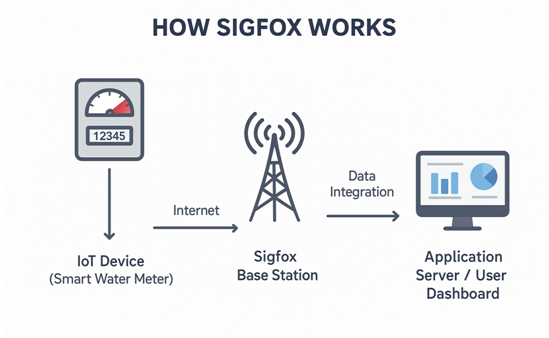
A practical example of how Sigfox works can be seen in smart water meters. These devices are installed in homes or commercial buildings to monitor water consumption in real time. The smart meter collects usage data periodically and sends it as a small data packet to the nearest Sigfox base station using ultra-narrowband (UNB) transmission. The base station then forwards the data to the Sigfox Cloud, where it is securely processed and stored. Utility companies can access this information through a web-based dashboard or mobile application, allowing them to track water usage, detect leaks, and generate accurate bills without sending personnel for manual readings. Because Sigfox is optimized for low-power, small-data communication, the smart meter can operate for several years on a single battery, making it a cost-effective and efficient solution for large-scale water monitoring systems. This example demonstrates Sigfox’s ability to connect IoT devices over long distances, provide real-time insights, and reduce operational costs while maintaining minimal power consumption.
Key Technical Highlights
- Data Rate: ~100 bps
- Message Size: 12 bytes uplink, 8 bytes downlink
- Battery Life: Up to 10 years
- Network Type: Star topology
- Frequency Bands: ISM (868 MHz EU, 902 MHz US)
In essence, Sigfox simplifies IoT connectivity by allowing devices to communicate efficiently with minimal energy usage, making it one of the most sustainable solutions for large-scale, low-data IoT applications.
Key Features of Sigfox
Sigfox is designed to meet the growing demand for simple, low-cost, and energy-efficient IoT connectivity. Its unique architecture and transmission method make it highly suitable for large-scale IoT deployments that require sending small data packets over long distances. Below are the key features that make Sigfox stand out among other LPWAN technologies.
- Low Power Consumption: One of Sigfox’s biggest strengths is its extremely low power usage. Devices connected to the Sigfox network can operate for 5–10 years on a single battery, depending on transmission frequency. This makes it perfect for remote sensors and devices where changing batteries frequently is impractical.
- Wide Coverage Area: Sigfox operates using sub-GHz frequency bands — typically 868 MHz in Europe and 902 MHz in the U.S. — along with ultra-narrowband (UNB) modulation to achieve long-range, low-power communication. This technology allows data transmission over distances of up to 50 km in rural areas and around 10 km in urban environments, enabling wide-area coverage with a minimal number of base stations.
- Low Data Rate and Small Message Size: Sigfox is designed for small and infrequent data transmissions, making it ideal for low-power IoT applications. Each uplink message can carry up to 12 bytes, while each downlink message is limited to 8 bytes. These restrictions significantly reduce power consumption and network interference, ensuring efficient and reliable communication for devices that only need to send essential information, such as temperature readings or status updates.
- Cost-Effective Connectivity: Since Sigfox operates in unlicensed ISM bands and uses a lightweight network structure, its deployment and operational costs are much lower than those of traditional cellular networks. It does not require SIM cards and offers simple subscription-based pricing for global connectivity. This affordability and simplicity make Sigfox especially appealing for industries such as smart metering, logistics, and agriculture.
- Scalability: Sigfox can handle millions of devices simultaneously due to its lightweight protocol and centralized cloud-based architecture. It’s suitable for massive IoT applications that require connecting thousands of devices with minimal maintenance.
- Robust Security: Each device in the Sigfox network has a unique identifier (ID) and uses message authentication and encryption to ensure data integrity and prevent tampering. The simplicity of the protocol also reduces potential attack surfaces.
- Cloud Integration: Sigfox offers seamless integration with various IoT cloud platforms such as: AWS IoT, Microsoft Azure IoT Hub, Google Cloud IoT Core. This allows data collected from devices to be easily transferred, visualized, and analyzed through APIs or dashboards.
- Global Roaming and Interoperability: Sigfox provides global network coverage across more than 70 countries through partnerships with local operators. Devices can move between countries without reconfiguration, supporting global IoT applications like supply chain tracking.
| Feature | Description |
| Power Efficiency | Operates for years on small batteries |
| Coverage | Up to 50 km in rural and 10 km in urban areas |
| Low Data Rate | 100 bps with small message sizes |
| Cost-Effective | Uses unlicensed spectrum and low-cost modules |
| Scalability | Supports millions of connected devices |
| Security | Encrypted and authenticated communication |
| Cloud Integration | Compatible with major IoT platforms |
| Global Roaming | Works seamlessly across multiple countries |
In short, Sigfox’s simplicity, scalability, and low-power design make it one of the most efficient connectivity options for IoT devices that need to transmit small amounts of data over long distances.
Advantages and Disadvantages of Sigfox
Sigfox has emerged as one of the leading Low-Power Wide-Area Network (LPWAN) technologies due to its simplicity, low cost, and energy efficiency. However, like any technology, it has both strengths and limitations that determine its suitability for specific IoT applications. Let’s explore the key advantages and disadvantages of Sigfox in detail.
Advantages of Sigfox
- Low Power Consumption: Sigfox devices can run for 5 to 10 years on a single battery because of the low data rate and infrequent transmissions. Ideal for remote and hard-to-reach locations where frequent maintenance or battery replacement is impractical.
- Wide Coverage: Sigfox base stations can cover up to 50 km in rural areas and 10 km in urban areas. Fewer gateways are needed, reducing infrastructure and deployment costs.
- Cost-Effective: Operates on unlicensed ISM bands, which eliminates the need for costly spectrum licenses. Uses simple hardware and low subscription costs, making it affordable for large-scale IoT projects.
- Easy Deployment and Integration: Devices connect automatically to the Sigfox network without requiring SIM cards or complex configurations. Supports cloud integration with major platforms like AWS, Azure, and Google Cloud through APIs.
- Reliable and Secure Transmission: Sigfox uses message repetition (each message is sent multiple times) to increase delivery reliability. Data is encrypted and authenticated, ensuring secure communication between devices and the cloud.
- Scalability: Supports millions of connected devices within a single network, making it ideal for massive IoT deployments like smart cities or logistics tracking.
Disadvantages of Sigfox
- Limited Data Capacity: Each uplink message is restricted to 12 bytes, and each downlink to 8 bytes. Not suitable for applications that require transmitting large amounts of data (like images, audio, or video).
- Low Data Rate: The data transfer speed is around 100 bits per second (bps), which is much slower than Wi-Fi or cellular networks. Suitable only for low-bandwidth applications such as sensor readings or alerts.
- Limited Downlink Communication: Devices can send more messages (uplink) than they can receive (downlink). This asymmetry limits two-way communication or real-time control operations.
- Network Dependency: Sigfox connectivity depends on the presence of Sigfox base stations in a region. Areas without Sigfox coverage require private network setup, which may be complex or unavailable in some countries.
- Lack of Local Network Ownership: The network is typically managed by the Sigfox operator, meaning users cannot build or fully control private Sigfox networks (unlike LoRaWAN).
- Message Delay and Reliability: Since messages are sent using UNB and repeated several times, there can be delays in transmission. No guaranteed message delivery, which may not suit critical, time-sensitive applications.
| Advantages | Disadvantages |
| Low energy consumption (5–10 years battery life) | Limited data payload (12 bytes uplink, 8 bytes downlink) |
| Wide coverage (up to 50 km rural) | Low data rate (~100 bps) |
| Cost-effective connectivity | Limited downlink communication |
| Easy setup and global scalability | Dependent on Sigfox network availability |
| Secure and reliable transmission | Cannot handle high-bandwidth or real-time data |
| Ideal for massive IoT deployments | Lack of private network flexibility |
In Sigfox excels in low-power, low-cost IoT applications where small data packets and long-range communication are essential. However, it is not suitable for high-speed or data-intensive use cases. Sigfox’s balance of simplicity, scalability, and affordability makes it a strong choice for smart cities, agriculture, logistics, and environmental monitoring, where the main goal is to connect many devices efficiently — not to transmit large volumes of data.
Applications of Sigfox
Sigfox plays a vital role across multiple industries by providing low-cost, low-power, and wide-range IoT connectivity. Here’s how different sectors benefit from it:
- Smart Cities: Sigfox helps cities become more efficient, sustainable, and citizen-friendly through IoT-based automation. For example, smart parking sensors detect available spots and share updates to reduce congestion, smart streetlights adjust brightness based on activity to save energy, and waste bins send alerts when full to optimize collection routes. This leads to reduced energy use, lower maintenance costs, and better urban planning.
- Smart Agriculture: In agriculture, Sigfox connects sensors over vast rural areas without needing continuous internet access. Soil moisture sensors optimize irrigation, weather monitors track conditions for yield forecasting, and livestock trackers monitor animal safety. These applications result in improved water management, higher productivity, and real-time farm monitoring.
- Smart Utilities: Utility providers use Sigfox to automate and remotely monitor energy, water, and gas systems. Smart meters report usage for accurate billing, pipeline sensors detect leaks, and electricity monitors record consumption. This leads to lower operational costs, less resource waste, and greater service efficiency.
- Industrial IoT (IIoT): In industrial settings, Sigfox enables asset tracking, predictive maintenance, and safety monitoring. Sensors can predict equipment failures, locate machinery, and detect hazardous conditions. The results include reduced downtime, enhanced safety, and better resource utilization.
- Logistics and Supply Chain: Sigfox enhances logistics with reliable, long-range tracking for goods and vehicles. It supports shipment tracking, temperature monitoring for perishable goods, and fleet management without depending on cellular networks. Benefits include accurate deliveries, reduced losses, and improved visibility across supply chains.
- Environmental Monitoring: Sigfox contributes to environmental protection by enabling low-cost, real-time monitoring. Devices measure air quality, water levels, and detect forest fires early. These applications help prevent disasters, protect resources, and promote sustainability.
- Healthcare and Wearables: In healthcare, Sigfox powers remote monitoring and connected medical devices. Applications include patient health tracking, fall detection for the elderly, and asset monitoring for hospital equipment. These solutions provide better patient safety, increased efficiency, and reduced hospital workload.
| Sector | Example Applications | Benefits |
| Smart Cities | Parking, lighting, waste bins | Efficient urban management |
| Agriculture | Soil sensors, livestock tracking | Better crop and resource control |
| Utilities | Smart metering, pipeline monitoring | Accurate billing, leak detection |
| Industrial IoT | Predictive maintenance, asset tracking | Reduced downtime, increased productivity |
| Logistics | Shipment and fleet tracking | Supply chain visibility |
| Environment | Air/water monitoring, fire detection | Sustainable ecosystem management |
| Healthcare | Wearables, patient monitoring | Improved care and safety |
Sigfox’s simplicity, affordability, and long-range capability make it a perfect fit for IoT applications that need periodic, small-scale data transmission. From smart cities and agriculture to healthcare and logistics, Sigfox enables smarter decision-making, reduces costs, and improves efficiency — powering a more connected and sustainable world.
Sigfox in Compare with Other Protocols
The Internet of Things (IoT) ecosystem relies on various communication technologies that differ in range, power efficiency, data rate, and cost. Among the most popular Low-Power Wide-Area Network (LPWAN) protocols are Sigfox, LoRaWAN, and NB-IoT. While all three aim to provide long-range and energy-efficient connectivity, each has unique technical characteristics, deployment models, and ideal use cases.
Sigfox operates as a public network managed by Sigfox operators, offering low-cost, small-data connectivity. LoRaWAN, on the other hand, supports both public and private networks, giving organizations more control and flexibility. NB-IoT uses licensed cellular networks operated by telecom providers, ensuring high reliability but at a higher cost.
In terms of range, Sigfox can reach up to 50 km in rural areas and about 10 km in urban environments, while LoRaWAN covers up to 15 km in rural and 5 km in urban areas. NB-IoT, leveraging cellular infrastructure, typically offers strong urban coverage up to 35 km.
When it comes to data rate and capacity, Sigfox supports approximately 100 bps — suitable for small data like sensor readings. LoRaWAN handles up to 50 kbps, while NB-IoT can reach 250 kbps, supporting more complex, real-time applications.
In terms of cost and power efficiency, Sigfox stands out as the most affordable option, requiring no SIM cards and consuming minimal power for up to 10 years of battery life. LoRaWAN is slightly costlier due to gateway installations, whereas NB-IoT has the highest operational costs because of SIM and subscription fees.
From a security and reliability standpoint, Sigfox provides encryption and message authentication but lacks guaranteed delivery. LoRaWAN uses AES-128 encryption, offering strong security for private deployments. NB-IoT, operating under cellular infrastructure, provides the highest level of security and reliability, making it ideal for industrial IoT.
In Sigfox is the best fit for simple, low-data, and cost-sensitive IoT applications like smart meters and environmental sensors. LoRaWAN is preferred when organizations need flexibility and control through private networks, while NB-IoT is ideal for industrial-grade and real-time applications requiring guaranteed connectivity. Ultimately, there is no single best protocol — each excels under different conditions. For large-scale, low-power, and globally connected IoT deployments, Sigfox remains a simple, efficient, and highly scalable connectivity solution.
Conclusion
Sigfox has emerged as one of the most influential technologies in the Low-Power Wide-Area Network (LPWAN) ecosystem, offering a simple, affordable, and energy-efficient way to connect millions of IoT devices across vast distances. Its design philosophy — focusing on small data packets, long range, and minimal power use — makes it ideal for applications that require periodic data transmission rather than continuous, high-speed communication. By enabling long battery life, cost-effective deployment, and global coverage, Sigfox has transformed industries such as smart cities, agriculture, logistics, and utilities. From smart meters to asset tracking, it allows organizations to gather valuable data without the need for complex infrastructure or high operational costs. However, it’s important to recognize that Sigfox is not a one-size-fits-all solution. Its limitations in data rate, message size, and two-way communication make it unsuitable for real-time or high-bandwidth applications. Instead, Sigfox shines when used for simple, low-data, large-scale IoT networks that require reliability, scalability, and sustainability. In essence, Sigfox represents a foundational technology in the IoT landscape — one that has paved the way for the growth of LPWANs and continues to play a crucial role in connecting the world’s “small data” devices efficiently. As IoT continues to evolve, Sigfox will likely coexist with other technologies like LoRaWAN and NB-IoT, forming a hybrid connectivity ecosystem where each protocol complements the others — driving the next wave of smart, connected, and data-driven innovations.
Frequently Asked Questions (FAQs)
What is Sigfox?
Sigfox is a Low-Power Wide-Area Network (LPWAN) technology designed for IoT devices. It enables small and infrequent data transmissions over long distances while consuming minimal power, making it ideal for remote and low-maintenance applications.
How does Sigfox differ from LoRaWAN and NB-IoT?
- Sigfox: Public network, very low data rate (~100 bps), long battery life, small message size (12 bytes uplink).
- LoRaWAN: Supports public and private networks, offers moderate data rate, and allows larger payloads.
- NB-IoT: Cellular-based, provides high reliability and higher data rate, suitable for industrial and real-time IoT applications.
How far can Sigfox transmit data?
Sigfox can transmit data up to 50 km in rural areas and about 10 km in urban areas, depending on terrain, obstacles, and network infrastructure.
How long do Sigfox devices last on battery?
With minimal and infrequent transmissions, Sigfox devices can function for 5 to 10 years on a single battery, making them perfect for long-term IoT deployments.
Is Sigfox secure?
Yes. Sigfox ensures data security through encrypted communication and message authentication, protecting information integrity and preventing unauthorized access.