Introduction
Energy efficiency is one of the most important issues facing wireless communication today, particularly in wireless sensor networks (WSNs) and mobile ad hoc networks (MANETs). These networks frequently use battery-operated equipment that needs to run continuously for extended periods of time. Therefore, preserving connectivity and prolonging network life require lowering power usage. Numerous protocols that concentrate on energy-aware routing and node management have been created in order to address this. Geographic Adaptive Fidelity, or GAF, is one such cutting-edge technique. By shutting off unused nodes, GAF saves energy without compromising routing performance as a whole. It automatically manages nodes by utilizing location data, enabling only a portion of them to be active at any given moment. The GAF protocol is thoroughly examined in this blog post, including its characteristics, benefits, and comparison to other energy-efficient protocols. Knowing GAF can help network engineers, researchers, and students alike develop intelligent energy management plans for wireless networks.
What is Geographic Adaptive Fidelity?
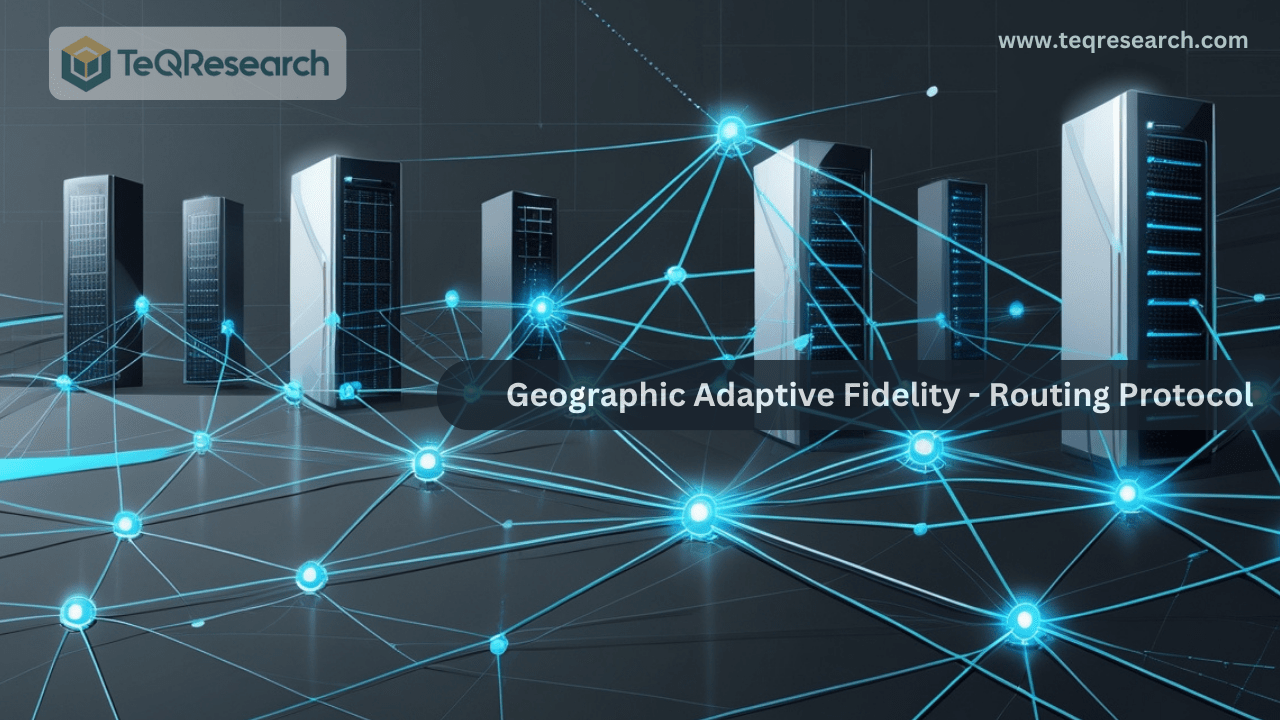
A location-based energy-saving protocol called Geographic Adaptive Fidelity (GAF) was created especially for wireless sensor networks (WSNs) and mobile ad hoc networks (MANETs). GAF’s main objective is to increase the network’s lifespan by cutting down on wasteful energy use without sacrificing communication quality. The way GAF operates is by creating a virtual grid out of the whole network region. A tiny geographic area is represented by each grid, and there may be several nodes within each grid. To save energy, the other nodes go into sleep mode, leaving only one node operational at a time to manage routing and data transfer duties.
GAF is based on the principle of node equivalence. Not every node in the same grid needs to remain awake if multiple nodes can carry out the same communication tasks (i.e., they are comparable in terms of routing). In this manner, GAF keeps the network connected even when there are fewer active nodes. Key points about GAF:
- It makes use of geographic data, usually from a location service or GPS.
- It ensures that the network stays connected and operational while reducing power consumption.
- GAF may be implemented with various network designs because it is not dependant on any particular routing protocol.
In GAF is a successful energy-aware protocol that optimizes energy utilization in dynamic, decentralized wireless networks by utilizing location awareness and clever node scheduling.
How Geographic Adaptive Fidelity Works?
Geographic Adaptive Fidelity, or GAF, makes sure that only a required portion of network nodes are ever inactive by cleverly controlling their activity statuses according to their physical locations. This is a detailed description of how the protocol works:
1. Grid Formation
- Virtual square grids are used to divide the entire network area.
- Each grid’s size is deliberately selected to allow for direct communication between any two nodes in nearby grids (within wireless transmission range).
- Every node in a grid is seen as having the same capacity to route data.
2. Node Equivalence and Role Assignment
- Within each grid, multiple nodes may exist.
- Since all of them can perform the same role (due to their close proximity), only one node needs to stay active for communication.
- Other nodes in the grid are considered redundant and can turn off their radios to save power.
3. Node States
Each node in GAF cycles through three states:
- Discovery: The node identifies its location and discovers other nodes within its grid.
- Active: The node is responsible for communication and routing within its grid.
- Sleeping: The node turns off most of its functionality to conserve energy.
Nodes in a grid take turns being active. This rotation helps in balancing energy usage among nodes, thus extending the overall network lifetime.
4. Role Switching
- A timer mechanism is used to switch the active role among nodes in a grid.
- When the timer of an active node expires, another sleeping node in the same grid wakes up and takes over the active role.
5. Use of Location Information
- GAF relies on GPS or other localization techniques to determine the physical position of each node.
- This location information helps the node to figure out which grid it belongs to and who its equivalent neighbors are.
Summary Workflow:
- Nodes get their location using GPS.
- Each node determines its grid based on its coordinates.
- Nodes in the same grid discover each other and negotiate who will be active.
- Only one node stays active while others sleep.
- The active role rotates periodically to distribute energy consumption.
Through this grid-based, location-aware mechanism, GAF efficiently reduces energy consumption, while ensuring continuous connectivity and reliable data routing in mobile and wireless networks.
Example of Geographic Adaptive Fidelity
To better understand how GAF – Geographic Adaptive Fidelity works in practice, let’s look at a simple example.
Scenario:
Imagine a wireless ad hoc network deployed over a 100m x 100m area. This network consists of mobile devices or sensors, each with a communication range of 20 meters. These devices are battery-powered, so saving energy is critical.
Step 1: Grid Formation
- The entire area is divided into equal square-shaped grids, each of size 20m x 20m.
- This grid size is chosen so that any node in one grid can still communicate with a node in an adjacent grid.
Step 2: Nodes within a Grid
- Suppose Grid A contains three nodes: Node A1, A2, and A3.
- All three nodes are located close enough to each other that they can perform the same routing and communication tasks.
Step 3: Role Assignment
- The nodes in Grid A exchange messages to identify each other and determine their roles.
- Node A1 is selected as the active node, while A2 and A3 enter sleep mode.
Step 4: Active Node Operation
- Node A1 remains active, handling any data forwarding, communication, or routing tasks assigned to Grid A.
- A1 continues this task for a fixed duration (say 10 minutes).
Step 5: Role Switching
- After 10 minutes, Node A1’s timer expires.
- Now, Node A2 wakes up and becomes the new active node, while A1 and A3 go to sleep.
- This rotational approach ensures that no single node’s battery is drained too quickly.
Benefits Seen in This Example:
- Instead of three nodes using power at the same time, only one is active at a time.
- The rotation balances energy usage, extending the life of all nodes.
- Communication within and across grids continues without interruption, since at least one node in each grid is always active.
This simple example shows how GAF helps in conserving energy by reducing redundant node activity, while still maintaining effective network coverage and communication.

The whole region is separated into tiny, virtual square grids according to node transmission range in a wireless ad hoc network that uses the GAF protocol. Take a 100 m × 100 m network region, for example, where each grid is 20 m x 20 m. This guarantees direct communication between nodes in neighboring grids. Assume that the same grid contains three nodes (A1, A2, and A3). Only one of them, let’s say A1, is chosen to remain active because they are all in close proximity to one another and can carry out the identical routing tasks. To conserve energy, the other two nodes, A2 and A3, go into a sleep state. All communication and data forwarding tasks both inside and outside the grid are now managed by A1. A1’s job is passed to A2 after a predetermined amount of time, and A1 sleeps while A3 stays on standby. As long as this rotation persists, all nodes will use energy fairly. In static or low-mobility contexts, such as sensor deployments or disaster response networks, GAF’s approach minimizes wasteful energy use while preserving uninterrupted network connectivity.
Key Features of Geographic Adaptive Fidelity
Geographic Adaptive Fidelity, or GAF, is renowned for its energy-efficient method of wireless sensor network and mobile ad hoc management. The following are the main characteristics that make GAF an effective and useful protocol:
- Grid-Based Topology: Virtual square grids make up the full network region. In terms of communication, nodes that are part of the same grid are regarded as functionally identical. Role assignment and node maintenance are made easier by this grid structure.
- Location-Aware Operation: GAF determines the grid in which a node lies by using geographic location data, frequently gleaned via GPS. This aids in figuring out node equivalency and efficiently planning energy-saving activities.
- Node Role Switching: Nodes in the same grid alternate between being active and sleeping. The longevity of every node is increased by this rotating mechanism, which also distributes energy usage equally.
- Model of Three-State Nodes: There are three energy states in which each node can function: Discovery: The node identifies its job and locates neighbors. Active: The node manages routing and communication duties. Sleeping: To conserve energy, the node turns off its radio, but it awakens when it’s ready to take over.
- Energy Conservation: By reducing the number of active nodes, GAF dramatically lowers overall energy consumption. Battery power is significantly reduced because each grid only has one active node at a time.
- Routing Independence: GAF is a framework for energy-efficient node management rather than a routing protocol in and of itself. It can be used in conjunction with other routing protocols to improve the energy efficiency and performance of networks.
- Scalability: GAF is very scalable and continues to function effectively as the network’s node count rises. Large network areas can be easily adapted to through the use of grid-based management.
- Robustness in Low-Mobility and Static Environments: GAF works best in situations with low-mobility or static node placements that don’t change frequently. It can continue to communicate reliably in such circumstances with little overhead.
Because of these characteristics, GAF is a good choice for applications like environmental monitoring, military networks, and disaster response systems where scalability, energy efficiency, and dependable communication are essential.
Advantages and Disadvantages of Geographic Adaptive Fidelity
Like any protocol, Geographic Adaptive Fidelity (GAF) has its strengths and limitations. Understanding both sides helps evaluate where and when GAF is most effective.
Advantages of GAF
- Energy Efficiency: By putting redundant nodes into sleep mode, GAF drastically lowers energy consumption. This increases the network’s total lifespan, which is important for devices that run on batteries.
- Load balancing: To prevent misuse of any one node, active responsibilities are rotated among equivalent nodes. By doing this, the network’s energy consumption is balanced.
- Preserves Network Connectivity: Because at least one node is constantly operational in every grid, GAF guarantees complete connectivity even with fewer active nodes.
- Scalability: GAF can effectively expand to big networks. Many nodes can be easily managed with the grid-based paradigm.
- Protocol Flexibility: GAF can be adjusted to many network types and routing strategies because it is not dependant on any particular routing protocol.
Disadvantages of GAF
- Reliance on GPS or position Services: In order to allocate nodes to grids, GAF needs precise position data. In situations where GPS is unreliable or unavailable, such as indoors or underwater, this can be difficult.
- Performance in High Mobility Situations: Static or low-mobility networks are where GAF performs best. Frequent grid modifications might result in higher overhead and decreased efficiency in high-mobility situations.
- Additional Complexity: Compared to simpler protocols, the grid layout and role-switching mechanism’s implementation adds complexity.
- Wake-Up Delays: Time-sensitive communication may be impacted by a delay in waking up when a sleeping node needs to become active.
| Aspect | Advantage | Disadvantage |
| Energy Efficiency | Conserves battery by using fewer active nodes | — |
| Scalability | Efficient for large networks | — |
| GPS Requirement | — | Needs location info (GPS or similar) |
| Mobility Handling | Good in static/slow-moving networks | Less effective in fast-moving networks |
| Load Balancing | Rotates node roles to extend lifetime | May introduce complexity and wake-up delays |
In GAF is a strong choice for energy-efficient communication in static or moderately mobile wireless networks, but it may not perform as well in highly dynamic environments or where precise location data is hard to obtain.
Applications of Geographic Adaptive Fidelity
Geographic Adaptive Fidelity (GAF) is especially useful in environments where energy efficiency, network longevity, and location awareness are critical. Here are some of the major applications where GAF plays an important role:
- Wireless Sensor Networks (WSNs): Used in environments like agriculture, smart homes, and industrial monitoring. GAF helps extend the battery life of sensor nodes by putting idle nodes to sleep. Example: Soil moisture sensors in a smart farm can remain in sleep mode when not actively needed.
- Mobile Ad Hoc Networks (MANETs): Perfect for disaster recovery, military communications, and search and rescue missions in areas without infrastructure. GAF saves energy and guarantees dependable communication. Even in the absence of central authority, nodes are capable of self-organization and effective operation.
- Military Surveillance Systems: GAF facilitates extended operations in remote or hazardous areas. Utilized in ground-based surveillance, when equipment needs to run continuously for extended periods of time without needing to be recharged.
- Environmental and Wildlife Monitoring: Beneficial for tracking weather, pollutants, and wildlife migrations in mountains, forests, and seas. The system can function without maintenance for months or even years because only the most important nodes are ever in use.
- Remote Health Monitoring: A GAF-based network made up of nearby or body-worn medical sensors can be used in remote or emergency healthcare settings. reduces energy consumption and extends the battery life of implanted or wearable technology.
- Space or Underwater Sensor Networks: In harsh or inaccessible locations where changing the battery is not an option. Sleep-wake scheduling by GAF contributes to the conservation of finite energy resources.
- Smart Cities and Infrastructure Monitoring: Used in smart city configurations for utility management, traffic control, and bridge safety monitoring. By lowering energy consumption, GAF facilitates long-term, low-maintenance deployments.
- Academic Research and Simulation Studies: Studies on energy-efficient routing frequently make use of GAF. GAF compares the energy performance of several protocols in simulated networks.
GAF is best suited for:
- Energy-constrained environments
- Large-scale wireless deployments
- Situations requiring self-organization and scalability
- Applications with mostly static or slowly moving nodes
By enabling nodes to sleep intelligently without compromising network performance, GAF becomes an essential tool in a wide range of real-world applications.
Geographic Adaptive Fidelity Compare with Other Protocols
To better understand the strengths and limitations of GAF – Geographic Adaptive Fidelity, it’s useful to compare it with other popular protocols used in wireless and mobile networks. Below is a comparison of GAF with some commonly used routing and energy-efficient protocols.
GAF vs LEACH (Low-Energy Adaptive Clustering Hierarchy)
| Aspect | GAF | LEACH |
| Type | Location-based, flat protocol | Cluster-based, hierarchical protocol |
| Energy Efficiency | Achieved by turning off redundant nodes | Achieved by rotating cluster heads |
| Scalability | Good for large networks with static/low-mobility nodes | Suitable for moderate-sized sensor networks |
| Mobility Support | Limited (better in static networks) | Very limited (designed for static networks) |
| GPS Requirement | Yes (or location info) | No |
Conclusion: GAF is better in location-aware networks; LEACH is useful where clustering helps manage data aggregation.
GAF vs GPSR (Greedy Perimeter Stateless Routing)
| Aspect | GAF | GPSR |
| Purpose | Energy conservation through node management | Efficient geographic routing |
| Routing Function | Does not perform routing; complements routing | Actively performs routing using greedy and perimeter mode |
| Energy Usage | Reduced by putting nodes to sleep | May use more energy as all nodes remain active |
| Mobility Support | Works best in static/low mobility | Performs well in dynamic mobile networks |
GAF saves energy and works well alongside GPSR, which handles the actual packet routing.
GAF vs CBRP (Cluster-Based Routing Protocol)
| Aspect | GAF | CBRP |
| Structure | Grid-based (geographical) | Cluster-based (logical hierarchy) |
| Energy Management | Sleep scheduling based on location | Limited energy optimization |
| Routing Focus | Not a routing protocol | Full routing protocol using cluster heads |
| Overhead | Low, mostly related to location discovery | Higher due to cluster maintenance |
GAF is focused on energy saving and complements routing protocols like CBRP, which organize nodes into logical clusters.
GAF vs ZRP (Zone Routing Protocol)
| Aspect | GAF | ZRP |
| Functionality | Energy-saving mechanism | Hybrid routing protocol (proactive + reactive) |
| Energy Saving | High due to sleep mode | Moderate, depends on routing activities |
| Mobility Handling | Low-mobility networks | Performs well in both low and moderate mobility |
GAF focuses on energy; ZRP focuses on efficient routing with less delay.
| Protocol | Primary Focus | Energy Saving | Mobility Support | Requires GPS | Routing Function |
| GAF | Energy conservation | High | Low | Yes | No (complements routing) |
| LEACH | Cluster-based data aggregation | Medium | Low | No | Yes |
| GPSR | Geographic routing | Low | High | Yes | Yes |
| CBRP | Cluster-based routing | Low | Medium | No | Yes |
| ZRP | Hybrid routing | Medium | Medium | No | Yes |
Conclusion
A clever and effective way to save energy in wireless networks, particularly in wireless sensor networks (WSNs) and mobile ad hoc networks (MANETs), is to use Geographic Adaptive Fidelity (GAF). GAF successfully lowers energy usage without compromising communication speed by partitioning the network space into virtual grids and permitting only one node per grid to stay active while others sleep. Longer network lifespans, balanced energy consumption, and scalable performance in big and static network environments are all facilitated by its location-based methodology, utilization of node equivalency, and rotation of active roles. GAF is still a useful protocol for energy-sensitive applications including environmental monitoring, military communication, and smart city infrastructure, despite certain drawbacks like its reliance on GPS and decreased performance in high-mobility situations. In conclusion, GAF is a complimentary framework that may be used in conjunction with other protocols to improve energy efficiency and maximize the use of network resources rather than functioning as a stand-alone routing system. GAF is a very useful and efficient solution for networks where communication continuity and battery life are critical concerns.
Frequently Asked Questions (FAQs)
What is the main goal of GAF?
GAF’s primary objective is to save wireless network energy by putting unused nodes to sleep while preserving full communication coverage through active nodes.
How does GAF determine which nodes should be active or sleeping?
The network is divided into virtual grids by GAF, and nodes that are part of the same grid are regarded as equal. Each grid has a single node that remains active while the others fall to sleep. To balance energy utilization, the active role alternates over time.
Does GAF work in mobile networks?
Low-mobility or static networks are ideal for GAF’s operation. Its efficacy may be diminished in high-mobility circumstances due to frequent grid changes and node migration.
Is GPS required for GAF to work?
Indeed, in order to determine which grid each node belongs to, GAF normally needs location data, which is frequently supplied by GPS or other positioning technologies.
Is GAF a routing protocol?
GAF isn’t a routing protocol, sorry. It is an energy-saving technique that maximizes node use and prolongs network life in conjunction with routing methods.
Can GAF be used with any routing protocol?
Indeed, GAF is agnostic of protocols and can be used in conjunction with other routing protocols, like AODV, GPSR, or ZRP, to increase network efficiency.
What are the three states of a node in GAF?
These three states are:
- Discovery: Locating additional grid nodes.
- Active: Carrying out communication and routing.
- Sleeping: To conserve energy, turn off the radio.
Where is GAF most commonly used?
GAF is extensively utilized in the following fields: emergency and military communication; wireless sensor networks (WSNs); mobile ad hoc networks (MANETs); environmental monitoring; and smart infrastructure.