
Introduction
Mobile Ad Hoc Networks (MANETs) have emerged as a key component in today’s rapidly changing wireless communication environment for situations in which conventional infrastructure-based networks are either unreliable or unfeasible. These include of mobile conferencing, disaster recovery, and military operations. Maintaining effective and dependable routing in the face of frequent topology changes brought on by node mobility is one of the fundamental problems in MANETs. The Temporally Ordered Routing Algorithm, or TORA, is one of the dynamic routing protocols that have been created to address this. TORA is notable for its distributed, adaptive, and loop-free architecture, which was developed especially for large-scale, highly dynamic mobile networks. In contrast to traditional routing protocols, TORA maintains and repairs routes using a special link reversal and time-based approach. This considerably improves scalability and efficiency by ensuring that only a small section of the network is engaged in the route reconfiguration process when changes occur in the network, such as link failures. We will examine TORA in-depth in this blog article, including its fundamentals, salient characteristics, advantages, drawbacks, practical uses, and contrasts with other well-known routing protocols. This book will provide you a comprehensive grasp of how TORA helps manage dynamic communication in mobile networks, regardless of your background—student, researcher, or networking enthusiast.
What is TORA?
The reactive (on-demand) routing system known as TORA (Temporally Ordered Routing Algorithm) was created especially for Mobile Ad Hoc Networks (MANETs). Its main objective was to provide highly scalable and adaptive routing in dynamic wireless environments, where node mobility might cause frequent and unpredictable changes in the network topology. The foundation of TORA is the idea of link reversal and temporally ordered updates. TORA creates a Directed Acyclic Graph (DAG) rooted at the destination, in contrast to conventional routing protocols that preserve a single path between source and destination. This DAG guarantees loop-free routing and aids in specifying the direction of data flow.
Every node in the network keeps track of a height value that indicates how far away it is from the destination in terms of time. The algorithm modifies these heights as necessary when the network changes, and they are used to direct packets “downhill” toward the destination. To guarantee the temporal ordering of control messages, TORA makes use of Lamport timestamps, a logical clock mechanism. Key characteristics that define TORA are:
- Reactive Protocol: Routes are created only when required, reducing unnecessary overhead.
- Localized Control: Only nodes affected by a topological change participate in the route maintenance process.
- Link Reversal Mechanism: When a link failure occurs, TORA reverses the direction of certain links to establish a new path, rather than initiating a complete route discovery.
- Multiple Route Support: TORA allows multiple valid routes to a destination, improving reliability.
Large, densely connected networks benefit greatly from TORA’s effectiveness, which is frequently paired with protocols like IMEP (Internet MANET Encapsulation Protocol) to effectively manage neighbor discovery and govern message distribution. In TORA is a reliable and flexible routing system that uses distributed computation and temporal ordering to sustain effective routing paths in extremely dynamic wireless environments.
How Temporally Ordered Routing Algorithm Works?
A Directed Acyclic Graph (DAG) anchored at the destination node is dynamically constructed and maintained by the Temporally Ordered Routing Algorithm (TORA). The basic concept is to use node “heights” to specify a flow direction from source to destination and modify them in response to changes in network structure. TORA operates in three main phases:
A. Route Creation (Route Establishment)
- Route Request (QRY):
- When a source node needs a route to a destination and no route exists, it broadcasts a Query (QRY) packet.
- This QRY packet propagates through the network until it reaches the destination or a node that has a valid route to the destination.
- Route Reply (UPD):
- The destination (or an intermediate node with route info) responds with an Update (UPD) packet.
- This UPD contains a reference level (a new logical height) that sets the foundation for the DAG.
- Nodes that receive this UPD adjust their height to be greater than that of their downstream neighbor, forming a downstream path toward the destination.
B. Route Maintenance (Link Reversal)
When a link failure is detected (e.g., due to node movement or energy depletion), the affected node:
- Increases its height by generating a new reference level (using a Lamport timestamp).
- Broadcasts an UPD to notify its neighbors.
- Neighbors compare heights:
- If they have a lower height, they remain downstream.
- If all neighbors are upstream (i.e., have higher heights), the node reverses the direction of its link.
- This localized link reversal continues until the DAG is re-established, restoring connectivity.
This mechanism ensures that only affected portions of the network participate in route repair, reducing overhead.
C. Route Erasure
If no valid route to the destination exists (e.g., due to network partition):
- The node detecting the disconnection initiates a Clear (CLR) message.
- The CLR propagates through the network, removing the invalid DAG and route entries.
- The process prevents routing loops and stale paths.
Concept of Node Height
Each node maintains a height tuple:
H = (τ, oid, r, δ, i)
Where:
- τ: logical time (timestamp of link failure or route creation)
- oid: originator ID of the reference level
- r: reflection indicator (used in route maintenance)
- δ: propagation ordering parameter
- i: unique node ID
Nodes always forward packets “downhill” – from higher height to lower height.
Control Packets in TORA
| Packet | Purpose |
| QRY (Query) | Route discovery |
| UPD (Update) | DAG formation or maintenance |
| CLR (Clear) | Route erasure on link failure |
- Data Forwarding: Always flows “downhill” through the DAG.
- Adaptation: Link failures are managed through height adjustments and link reversals.
- Efficiency: By localizing control messages, TORA reduces bandwidth usage and enhances scalability.
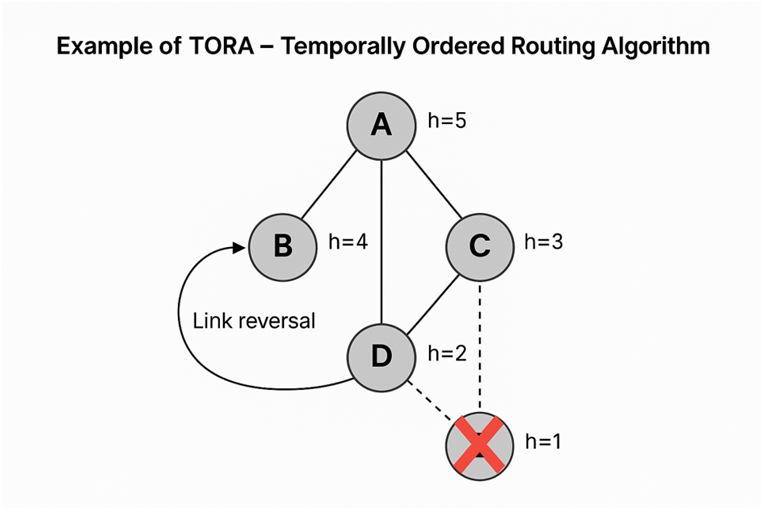
In a typical mobile ad hoc network scenario involving nodes A, B, C, D, and E, suppose node A wants to communicate with node E but initially has no route. To establish a path, node A broadcasts a Query (QRY) packet, which propagates through neighboring nodes until it reaches the destination node E. Upon receiving the QRY, node E responds by sending an Update (UPD) packet back through the network. This UPD contains a new reference level, establishing node E as the root of a Directed Acyclic Graph (DAG). Each node that receives the UPD assigns itself a height higher than the node from which it received the message, resulting in a downstream route from A to E through B, C, and D.
Once the route is established, data packets from node A begin flowing “downhill” through the DAG to node E. Each node uses the relative height values to determine the direction of forwarding. If a link failure occurs—such as the connection between nodes C and D breaking—TORA initiates a localized repair process. Node C, upon detecting the failure, assigns itself a new, higher reference level and broadcasts another UPD to reconfigure the DAG. If alternative paths exist (e.g., through another neighbor), the DAG is adjusted locally, and routing continues without global disruption. However, if no alternate path is available and the destination becomes unreachable, TORA sends a Clear (CLR) message to erase all invalid routes, preventing any loops or misrouted traffic. This example highlights TORA’s strengths: on-demand route creation, localized maintenance, and loop-free routing, making it ideal for dynamic and large-scale mobile networks.
Example of Temporally Ordered Routing Algorithm
Let’s have a look at a simplified example of TORA in action, using five nodes on a Mobile Ad Hoc Network (MANET): A, B, C, D, and E. Establishing a path from node A (source) to node E (destination) and monitoring TORA’s reaction to a connection failure are our objectives. Step-by-Step Example: Route Establishment and Maintenance
Step 1: Route Creation (Query and Update)
- Node A wants to send data to node E, but doesn’t have a route.
- It broadcasts a QRY (Query) packet to its neighbors.
- The query is forwarded: A → B → C → D → E.
- Upon receiving the QRY, node E (destination) replies with an UPD (Update) packet and assigns itself the lowest height (root of DAG).
- The UPD propagates back: E → D → C → B → A.
- Each node receiving the UPD adjusts its height to be greater than the sender, forming a DAG pointing toward node E.
Result: A → B → C → D → E (data flows downhill).
Step 2: Normal Data Forwarding
- Node A begins sending data to E through the DAG path.
- All nodes forward data downhill, based on their relative heights.
Step 3: Link Failure and Localized Repair
- Suppose the link between C and D breaks.
- Node C detects the link failure and increases its height using a new reference level (new timestamp).
- It sends an UPD to neighbors to adjust the DAG locally.
- If no downstream path is found, nodes reverse their link directions until a new DAG is established.
Step 4: Route Erasure (if needed)
- If the network becomes partitioned (e.g., E is unreachable), a CLR (Clear) message is sent to remove invalid routes.
Diagram: TORA Example Before and After Link Failure
Here is a simple illustration:
Before Link Failure (Established DAG)
[ A ] → [ B ] → [ C ] → [ D ] → [ E ]↑ ↑ ↑ ↑ ↑
h=5 h=4 h=3 h=2 h=1 (lowest)
- Heights decrease toward destination E.
- Data flows “downhill” from A to E.
After Link Failure (C–D link breaks)
[ A ] → [ B ] → [ C ] [ D ] → [ E ]↑ ↑ ↑
h=5 h=4 h=∞ (invalid)
- Node C has no valid downstream link.
- C increases its height and sends UPD to try alternative path.
- If an alternate route is found (e.g., C → F → E), a new DAG is formed.
- If no path is available, a CLR message is broadcast to erase route info.
Key Features of TORA
The Temporally Ordered Routing Algorithm (TORA) is uniquely designed to handle the dynamic nature of mobile ad hoc networks (MANETs). Below are its key features that distinguish it from other routing protocols:
- Highly Adaptive and Distributed: TORA is designed to operate efficiently in highly dynamic topologies. It uses distributed control, meaning that decisions are made locally by nodes based on information from their immediate neighbors.
- Loop-Free Routing: TORA guarantees loop-free paths using Directed Acyclic Graphs (DAGs). Data always flows “downhill” from nodes with higher heights to lower ones, preventing routing loops.
- Link Reversal Mechanism: When a link failure occurs, TORA doesn’t initiate a full network-wide route discovery. Instead, it uses a link reversal technique, where affected nodes adjust their link directions to restore the route. This minimizes control overhead and speeds up recovery.
- Temporal Ordering with Logical Time: TORA uses Lamport timestamps to maintain a consistent order of events across the network. This ensures that all nodes respond to topological changes in a coherent and conflict-free manner.
- Localized Reaction to Topology Changes: Only the nodes directly affected by a link failure participate in route maintenance. This localized control reduces bandwidth consumption and improves scalability.
- Multiple Route Support: TORA allows multiple valid paths from the source to the destination. This improves reliability and fault tolerance in case one route becomes unavailable.
- Scalable to Large Networks: Because of its localized nature and efficient control packet usage, TORA scales well with increasing network size. It performs especially well in dense and large-scale MANETs.
- On-Demand Routing (Reactive Protocol): TORA discovers routes only when needed, avoiding the continuous overhead seen in proactive protocols.
- Efficient Use of Bandwidth: Since control messages are only exchanged when changes occur (and only locally), TORA is bandwidth-efficient, making it suitable for resource-constrained environments.
These powerful features make TORA an ideal choice for complex, rapidly changing mobile network environments.
Advantages and Disadvantages of TORA
The Temporally Ordered Routing Algorithm (TORA) is designed to meet the demands of highly dynamic and mobile wireless networks. Like any routing protocol, it has its strengths and limitations. Below is a clear breakdown of its advantages and disadvantages.
Advantages of TORA
- Highly Adaptive to Topological Changes: TORA works effectively in network situations that are changing quickly. In reaction to link failures, it can swiftly reroute routes.
- Localized Route Maintenance: Only the impacted area of the network is involved in the recovery process when a connection breaks. This conserves bandwidth by reducing the spread of control messages.
- Loop-Free Routing: To guarantee loop-free routes even when doing route maintenance, TORA makes use of Directed Acyclic Graphs (DAGs) and logical heights.
- Multiple Route Support: Several legitimate routes to the destination are permitted by the algorithm. In routing, this offers fault tolerance and redundancy.
- Effective in Dense Networks: TORA works effectively in big, densely connected MANETs due to its reactive nature and localized control.
- On-Demand Operation: This minimizes needless control traffic by only creating routes when necessary.
Disadvantages of TORA
- High Complexity: The structure of the algorithm, such as preserving timestamps, logical heights, and DAGs, increases computational complexity. Simple or low-power gadgets might not be the best candidates.
- Reliance on Time Synchronization: Lamport timestamps, which TORA uses, necessitate network clocks that are not precisely synchronized. Inaccurate routing decisions may result from a lack of synchronization.
- Ineffective in Static or Small Networks: In comparison to more straightforward protocols, TORA’s techniques may add needless overhead to small or less dynamic networks.
- Control Overhead in the Event of Network Partition: The protocol creates CLR (Clear) messages that spread widely to remove invalid routes in the event that a destination becomes inaccessible (for example, due to a network partition), resulting in network-wide overhead.
- Requires Complementary Protocols: To monitor connection status and detect neighbors, TORA usually has to be used in conjunction with IMEP (Internet MANET Encapsulation Protocol), which complicates implementation.
TORA shines in large, mobile, and dynamic MANETs due to its fast and localized recovery features. However, its complexity and overhead make it less suitable for smaller or static networks, where simpler protocols may perform better.
Applications of TORA
When network topology changes often and traditional infrastructure-based routing is either unavailable or prohibitive, TORA’s highly adaptable and distributed architecture is perfect. TORA is very useful in the following important application areas:
- Military and Tactical Networks : In military operations, communication units are constantly on the move. TORA ensures reliable and robust routing between mobile command units, soldiers, and drones. Its localized repair and multiple path support offer strong fault tolerance in mission-critical scenarios.
- Disaster Recovery and Emergency Response: In natural disasters (earthquakes, floods, etc.), traditional network infrastructure is often damaged. TORA helps set up ad hoc communication networks quickly between first responders, medical teams, and command centers. Its reactive routing and fast route repair are vital in such time-sensitive operations.
- Vehicular Ad Hoc Networks (VANETs): Vehicles in smart cities or on highways can form dynamic networks to share data like traffic updates or accident alerts. TORA accommodates high mobility and frequent topology changes, ensuring continuous communication.
- Unmanned Aerial Vehicle (UAV) Networks: UAVs used in surveillance, delivery, or mapping tasks require real-time communication. TORA supports multi-hop routing and adapts to changing UAV positions without centralized control.
- Temporary Events and Remote Deployments: In situations like outdoor concerts, sports events, or research in remote areas, temporary networks are needed. TORA enables rapid deployment of temporary wireless networks without needing permanent infrastructure.
- IoT and Sensor Networks in Mobile Environments: In mobile IoT setups (e.g., wearable health monitors in field hospitals), nodes may enter and leave the network frequently. TORA’s on-demand routing and quick reconfiguration suit such environments well.
- Search and Rescue Operations: In inaccessible or mountainous regions, communication between mobile units (rescuers, dogs, UAVs) is vital. TORA ensures consistent connectivity through its self-healing routing mechanism.
TORA’s versatility makes it a powerful solution in environments that demand quick adaptation, decentralized control, and minimal downtime.
TORA –Comparison with Other Protocols
To fully understand the strengths and limitations of TORA, it’s essential to compare it with other popular routing protocols in Mobile Ad Hoc Networks (MANETs). Here, we compare TORA with AODV, DSR, and OLSR, based on several key aspects such as routing type, scalability, adaptability, control overhead, and loop handling.
Comparison Table: TORA vs Other MANET Routing Protocols
| Feature / Protocol | TORA | AODV (Ad hoc On-Demand Distance Vector) | DSR (Dynamic Source Routing) | OLSR (Optimized Link State Routing) |
| Routing Type | Reactive (On-Demand) | Reactive (On-Demand) | Reactive (On-Demand) | Proactive (Table-driven) |
| Route Maintenance | Link reversal with localized repair | Route discovery on demand | Route maintained via source cache | Periodic control messages |
| Multiple Path Support | Yes | No | Yes | Yes |
| Loop-Free | Yes (DAG-based) | Yes (Sequence numbers) | Yes (Source routing) | Yes (MPR-based link-state routing) |
| Control Overhead | Low in stable networks, moderate in failures | Moderate to high during route discovery | Moderate (Header size increases with hops) | High (Periodic message exchange) |
| Scalability | High (localized control updates) | Moderate | Low (due to route caching overhead) | Moderate to High |
| Reaction to Link Failure | Localized update (efficient) | Re-initiates route discovery | Removes broken route and re-discovers | Updates link state in next interval |
| Suitability | Highly dynamic and large networks | Moderate mobility and medium-size networks | Small networks with low mobility | Static or low mobility networks |
| Routing Information Stored | Height values, neighbors | Routing tables | Source route cache | Link-state tables |
Key Comparative Insights
TORA vs AODV
- Both are reactive, but TORA handles link failures more efficiently through localized updates, while AODV uses broader route discovery.
- TORA supports multiple paths, AODV usually maintains a single active path.
TORA vs DSR
- DSR uses source routing, storing the complete path in each packet, which increases overhead with path length.
- TORA is more scalable for larger networks due to its localized updates and lower routing overhead in high mobility scenarios.
TORA vs OLSR
- OLSR is proactive, maintaining full topology knowledge via periodic messages. It consumes more bandwidth in mobile environments.
- TORA, being on-demand and localized, is better suited for networks with frequent topology changes.
Use TORA when:
- The network is large, dense, and highly mobile.
- You need quick, localized route repairs.
- Bandwidth efficiency is critical in unstable conditions.
TORA offers a balanced approach to routing in MANETs by combining on-demand behavior, loop-free guarantees, and localized adaptability, making it a compelling alternative to more conventional protocols in dynamic environments.
Conclusion
Among the durable, effective, and scalable routing protocols designed to meet the demands of Mobile Ad Hoc Networks (MANETs) is the Temporally Ordered Routing Algorithm (TORA). Because of its unique methodology, which was developed with adaptability in mind and is based on temporal ordering, height-based routing, and link reversal mechanisms, TORA works particularly well in contexts that are highly mobile and dynamic. By limiting route maintenance to specific areas, conserving bandwidth, and reducing latency, TORA outperforms conventional routing algorithms that could necessitate worldwide network updates during failures. Its appropriateness for mission-critical applications such as military communication, disaster recovery, vehicle networks, and UAV operations is further enhanced by its capacity to accommodate numerous pathways, maintain loop-free routing, and react swiftly to topology changes. However, TORA is not without challenges. Its reliance on logical time synchronization and its relatively complex mechanism can be drawbacks in simpler or static network setups. Therefore, choosing TORA should be based on network scale, mobility, and application requirements. In summary, TORA is a powerful solution for environments where traditional routing protocols fall short. Its dynamic structure, intelligent route management, and localized responsiveness make it a valuable asset in the evolving landscape of wireless and mobile communication.
Frequently Asked Questions (FAQs)
What is the main advantage of TORA over other reactive protocols like AODV or DSR?
By employing a link reversal mechanism, TORA provides limited route maintenance, meaning that only nodes in close proximity to the failure react. In comparison to AODV or DSR, TORA is more scalable in large and dynamic networks since it lowers the overhead of network-wide control messages.
Does TORA support multiple routing paths between source and destination?
Yes, TORA’s DAG-based architecture allows it to keep several viable paths. This redundancy improves fault tolerance by guaranteeing communication even in the event of a route failure.
Is TORA suitable for small or static networks?
No, TORA’s complicated structure and control overhead may outweigh its advantages, making it unsuitable for small or low-mobility networks. In these situations, simpler protocols like AODV or DSR might be more effective.
How does TORA ensure loop-free routing?
Packets always travel “downhill” toward nodes with lower heights in TORA’s Directed Acyclic Graph (DAG), which is rooted at the destination. Routing loops are naturally avoided by this topology.
What happens when a destination node becomes unreachable in TORA?
To make sure nodes don’t hang onto outdated or unavailable paths, a node that detects that the destination is no longer reachable (for example, because of a network partition) sends out a Clear (CLR) message that spreads throughout the network to remove faulty routes.