What is Advanced Encryption Standard (AES) Algorithm?
Digital data is secured using the Advanced Encryption Standard (AES), a symmetric key encryption method. It replaced the earlier Data Encryption Standard (DES), which was susceptible to brute-force attacks, and was created, by the National Institute of Standards and Technology (NIST) in 2001. Key Characteristics of AES are:
- Symmetric Key Cipher: Encrypts and decrypts data using the same key.
- Block Cipher: Works with data blocks of a defined size (128-bit blocks).
- Multiple Key Lengths: Provides varying degrees of security by supporting 128-, 192-, and 256-bit key sizes.
- Several Rounds of Transformation: This method encrypts data by alternating, permuting, and combining it several times.
- Quick and Efficient: It is appropriate for both hardware and software implementations because it is made to be both computationally efficient and safe.
- Widespread Adoption: Cloud storage, financial institutions, government, wireless communication (Wi-Fi security), and other fields use it.
AES is a global standard for data encryption because of its great security, effectiveness, and resistance to the majority of known cryptographic attacks.
Introduction to AES Algorithm
An extensively used symmetric key encryption technique created to guarantee data security is called Advanced Encryption Standard (AES). It was created to take the place of the antiquated Data Encryption Standard (DES), which was rendered insecure by increases in processing power. Following a thorough examination procedure, the National Institute of Standards and Technology (NIST) chose AES in 2001.
History and Development
- To discover a substitute for DES, NIST launched a public competition in 1997.
- Because of its effectiveness, security, and adaptability, the Rijndael algorithm—created by Vincent Rijmen and Joan Daemen—was chosen as the winner in 2000.
- In 2001, AES was formally accepted as Federal Information Processing Standard 197, or FIPS PUB 197.
Why AES Replaced DES?
- DES’s security limitations: Because DES employs a 56-bit key, it is susceptible to brute-force assaults. In 1999, a distributed computing attack managed to crack DES in 22 hours.
- AES strength: AES is quite safe against brute-force assaults since it offers 128-, 192-, and 256-bit keys. Compared to DES, it is quicker and more effective, particularly for big datasets.
Key Features of AES:
- The Block Cipher encrypts data in 128-bit fixed-size blocks.
- Symmetric encryption: Encrypts and decrypts using the same key.
- Supports 128-, 192-, and 256-bit encryption; many key sizes are available.
- High Security: Impervious to well-known cryptographic attacks, such as brute force, linear, and differential cryptanalysis.
- Efficiency: It is appropriate for applications like cloud storage, safe communication, and financial transactions because it is optimized for both hardware and software implementation.
AES has emerged as the industry standard for encryption, safeguarding information in domains like banking, government, military, and online communications.
Detailed Explanation of AES Algorithm
The Advanced Encryption Standard (AES) is a symmetric block cipher that uses 128-, 192-, or 256-bit keys to encrypt and decrypt data in fixed-size blocks of 128 bits. The key size determines how many encryption rounds are used:
- AES-128 → 10 cycles
- AES-192 → 12 cycles
- AES-256 → 14 cycles
Because there are multiple transformation phases in each round, AES is safe and impervious to attacks.
Step-by-Step Process of AES Algorithm,
1. Key Expansion (Key Schedule)
Before encryption begins, AES generates a series of round keys from the initial key using the Rijndael Key Schedule.
Key Expansion Process:
- The original key (128, 192, or 256 bits) is used to derive round keys.
- A special function called the Rijndael key schedule is used, which includes:
- RotWord: Rotates bytes in a word left by one position.
- SubWord: Substitutes bytes using the AES S-Box (Substitution Box).
- XOR with Rcon: A round constant (Rcon) is XORed with the first word of the key schedule.

Where:
- W[i] is the expanded key word.
- Nk is the number of 32-bit words in the key (4 for AES-128, 6 for AES-192, 8 for AES-256).
- Rcon[i] is a round constant.
2. Initial Round
Before entering the main rounds, AES performs an initial AddRoundKey step, where the plaintext block is XORed with the first round key.

3. Main Rounds (Repeated for 10, 12, or 14 times)
Each round consists of four operations:
(i) SubBytes (Byte Substitution)
- Each byte in the 16-byte block is replaced using a fixed S-Box (Substitution Box).
- The S-Box is designed to provide non-linearity and confusion, making the cipher more resistant to attacks.
(ii) ShiftRows (Row Shifting)
- Bytes in each row of the 4×4 state matrix are cyclically shifted left by different offsets:
- Row 0: No shift
- Row 1: Shift left by 1 byte
- Row 2: Shift left by 2 bytes
- Row 3: Shift left by 3 bytes
This ensures diffusion in the encryption process.
(iii) MixColumns (Column Mixing)
- Each column of the 4×4 state matrix is multiplied by a fixed matrix in Galois Field GF(2⁸).
- This transformation spreads the influence of each plaintext byte over multiple ciphertext bytes.
MixColumns Transformation Formula:
For each column [S0, S1, S2, S3],
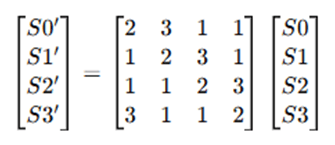
Where, multiplication is done in Galois Field GF(2⁸).
(iv) AddRoundKey (XOR with Round Key)
- The transformed state matrix is XORed with a round key derived from the original key.
- This step adds confusion to the encryption process.

4. Final Round (Same as Main Round but Without MixColumns)
- SubBytes
- ShiftRows
- AddRoundKey
5. Ciphertext Output
After completing the rounds, the final state matrix is converted back to a 128-bit ciphertext.
AES Decryption Process
Decryption follows the same process in reverse order, using:
- Inverse SubBytes (Inverse S-Box)
- Inverse ShiftRows (Shifting right instead of left)
- Inverse MixColumns
- AddRoundKey
The same round keys are used in reverse order to recover the original plaintext.
Summary of AES Steps:
- Key Expansion: Generates round keys from the main key.
- Initial AddRoundKey: XOR the plaintext with the first round key.
- Main Rounds:
- SubBytes (Byte substitution using S-Box)
- ShiftRows (Row-wise shifting of bytes)
- MixColumns (Column transformation using matrix multiplication)
- AddRoundKey (XOR with round key)
- Final Round: Same as main rounds without MixColumns.
- Ciphertext Output.
The Advanced Encryption Standard (AES) is a symmetric block cipher that encrypts data in fixed blocks of 128 bits using key sizes of 128, 192, or 256 bits. The algorithm operates through a series of transformations repeated over multiple rounds — 10 rounds for 128-bit keys, 12 for 192-bit, and 14 for 256-bit keys. Each round applies a sequence of operations to transform plaintext into ciphertext securely.
The process begins with the initial key expansion, where the original encryption key is used to generate a set of round keys using the Key Expansion algorithm. These keys are used in each round to ensure uniqueness and complexity in the encryption process. AES then performs an Initial Round, where the AddRoundKey operation is applied. In this step, the plaintext block is combined with the first round key using a bitwise XOR operation, effectively mixing the key with the input data.
Next, the algorithm enters the main rounds, each consisting of four steps: SubBytes, ShiftRows, MixColumns, and AddRoundKey. The SubBytes step is a non-linear substitution where each byte in the 4×4 state matrix is replaced using an S-box (Substitution Box), designed to provide confusion and resist linear and differential cryptanalysis. Following this, the ShiftRows step performs a cyclical shift on the rows of the state matrix. The first row remains unchanged, the second row is shifted one byte to the left, the third by two bytes, and the fourth by three bytes. This step helps distribute the byte values across columns.
The third transformation, MixColumns, works on each column of the state matrix independently. It performs a mathematical operation based on finite field (GF(2⁸)) arithmetic, multiplying each column by a fixed matrix to provide diffusion — spreading the influence of each byte over the output. This step ensures that changes in one byte affect the entire column, enhancing the encryption’s strength.
Finally, the AddRoundKey step is repeated, where the modified state matrix is again XORed with the current round key. This ensures that every round introduces a unique transformation tied directly to the encryption key. These four operations are repeated for all rounds except the final one. In the final round, the MixColumns step is omitted, and only SubBytes, ShiftRows, and AddRoundKey are applied to preserve the ciphertext’s structure.
Decryption in AES is essentially the reverse of encryption, using the Inverse SubBytes, Inverse ShiftRows, Inverse MixColumns, and AddRoundKey operations, applied in reverse order with the round keys derived in reverse from the Key Expansion. The mathematical structure and repeatable transformations in AES make it both highly secure and efficient, suitable for a wide range of modern cryptographic applications.
Advantages and Disadvantages of AES Algorithm
Advantages of AES Algorithm
- High Security: AES provides strong encryption with 128-bit, 192-bit, or 256-bit keys, making it resistant to brute-force and most known cryptographic attacks. Its design ensures excellent confusion and diffusion, crucial for secure encryption.
- Fast and Efficient: AES is optimized for both hardware and software. It performs faster than older algorithms like DES, especially when implemented in dedicated hardware (e.g., AES-NI in modern processors).
- Flexible Key Lengths: Users can choose between three key sizes depending on their security needs — AES-128 for speed, AES-256 for stronger protection.
- Standardized and Widely Adopted: AES is approved by NIST (FIPS PUB 197) and used worldwide across industries including banking, healthcare, defense, and cloud computing. It’s also a core component in standards like SSL/TLS, WPA2/WPA3, and IPsec.
- No Known Practical Weaknesses: To date, there are no effective practical attacks on the full AES algorithm, ensuring it remains one of the most reliable cryptographic standards.
Limitations of AES
- Key Management Challenges: AES is only as secure as the key management system. If encryption keys are not securely generated, stored, or exchanged, the algorithm’s strength is compromised.
- No Built-in Integrity or Authentication: AES only provides confidentiality. It doesn’t verify the authenticity or integrity of the data. To address this, it must be used with HMAC, GCM, or other authenticated encryption modes.
- Vulnerable to Side-Channel Attacks: Although the algorithm itself is secure, implementations may be vulnerable to timing, power analysis, or electromagneticattacks, especially on embedded devices.
- Computational Load for Low-Power Devices: In resource-constrained environments like IoT devices, AES (especially AES-256) can be computationally intensive, affecting performance and power efficiency.
- Quantum Computing Threat (Theoretical): While quantum computers are not yet a practical threat, future advancements could potentially weaken symmetric key encryption. AES-256 is still considered quantum-resistant, but AES-128 may be at risk in the long term.
AES remains one of the most secure, fast, and versatile encryption standards in use today. Despite a few implementation-related vulnerabilities and potential future challenges, proper use of AES with secure key management and modern protocols ensures robust data protection in virtually all digital environments.
Applications of AES Algorithm
AES’s robust security, effectiveness, and adaptability make it popular across a wide range of sectors and applications. Some of the main areas where AES is used are listed below:
- Secure Online Communication
- TLS/SSL Encryption: To protect online communications, AES is utilized in HTTPS, SSL/TLS protocols, and VPNs.
- Messaging Apps: AES is used for end-to-end encryption in applications such as Telegram, Signal, and WhatsApp to safeguard messages.
- Financial Transactions & Banking Security
- ATM Security: PINs and client transaction information are encrypted by banks using AES.
- Credit Card Encryption: Europay, MasterCard, and Visa (EMV) chip cards use AES.
- Online banking: Guards against cyberattacks on login information and online transactions.
- Cloud Data Encryption
- Cloud Storage Services: AES is used to encrypt customer data on platforms such as Dropbox, OneDrive, and Google Drive.
- Database Security: To safeguard stored data, Oracle Database and Microsoft SQL Server Transparent Data Encryption (TDE) both use AES.
- Wireless Network Security
- Wi-Fi Encryption: WPA2 (Wi-Fi Protected Access 2) and WPA3 use AES as their primary encryption technology to secure wireless networks.
- IoT Device Security: Used for safe data transfer in connected automobiles, smart home appliances, and industrial IoT.
- Military and Government Data Protection
- Top-secret government data encryption uses AES-256, which has been authorized by the National Security Agency (NSA) of the United States.
- Secure Military Networks & Communications: utilized in satellite and secure voice communications.
- Disk & File Encryption
- Full Disk Encryption (FDE): Entire hard drives are encrypted using AES by BitLocker (Windows) and FileVault (Mac).
- LUKS (Linux Unified Key Setup) offers disk encryption based on AES.
- Software for File Encryption: AES is used by programs like VeraCrypt, AxCrypt, and WinRAR encryption to secure files.
- Blockchain & Cryptocurrency Security
- Digital wallets containing private keys for cryptocurrencies like Ethereum and Bitcoin are secured by AES.
- Blockchain Networks: AES is used to encrypt transaction data in certain blockchain implementations.
- Healthcare Data Security
- Electronic Health Records (EHR): AES is used by hospitals and other healthcare facilities to encrypt patient data.
- HIPAA Compliance: In accordance with the Health Insurance Portability and Accountability Act, AES is necessary to secure sensitive healthcare data.
- Secure Email Communication
- AES is used in S/MIME and PGP (Pretty Good Privacy) encryption to safeguard email messages.
- AES-based technologies are used to encrypt private communications and secure business correspondence.
- Password Management
- Password managers such as LastPass, Dashlane, and Bitwarden use AES to safely store and encrypt user credentials.
Almost every industry where data security is essential uses AES, the industry standard for encryption. Its uses include cloud computing, messaging apps, blockchain security, banking, government, and healthcare.
Conclusion
For protecting digital data, one of the most popular and reliable encryption algorithms is the Advanced Encryption Standard (AES). It is a crucial part of many applications, such as internet communications, banking transactions, cloud storage, and government data protection, because of its high security, effectiveness, and adaptability. Due to its susceptibility to brute-force attacks, the antiquated Data Encryption Standard (DES) was superseded by AES, which provides enhanced security with key sizes of 128-, 192-, and 256-bit. AES is the recommended encryption technique for both software and hardware implementations due to its quick performance and defense against cryptographic attacks. AES offers strong defense against unwanted access, but in order to guard against potential weaknesses like side-channel attacks, it needs to be implemented securely and with appropriate key management. AES is still essential for protecting sensitive data in a variety of businesses as technology develops. AES-256 continues to be a very safe encryption standard, guaranteeing data privacy and secrecy for many years to come, even in the face of possible future threats from quantum computing.
Frequently Asked Questions (FAQs)
Q1. What makes AES more secure than DES?
Answer: Because AES employs bigger key sizes (128-, 192-, and 256-bit) than DES’s 56-bit key, which makes it more resilient to brute-force assaults, it is more secure than DES. Furthermore, to provide robust defense against a variety of assaults, AES uses sophisticated cryptographic algorithms including SubBytes, ShiftRows, MixColumns, and AddRoundKey.
Q2. How does AES encryption work?
Answer: AES uses a symmetric block cipher that works with 128-bit data blocks to encrypt data. Several encryption rounds are used, including SubBytes (substitution), ShiftRows (permutation), MixColumns (diffusion), and AddRoundKey (XOR with the key) (10, 12, or 14 depending on the key size). An encrypted ciphertext that can only be decrypted with the same key is the end result.
Q3. Where is AES encryption commonly used?
Answer: Cloud storage (Google Drive, OneDrive), wireless network security (WPA2, WPA3), disk encryption (BitLocker, FileVault), secure internet communications (HTTPS, VPNs, SSL/TLS), financial transactions (ATM PIN encryption, banking security), and military/government data protection all use AES.
Q4. Can AES encryption be broken?
Answer: Because of its huge key sizes, AES encryption is currently thought to be impenetrable by brute-force attacks. AES security can be jeopardized by side-channel attacks (such timing or power analysis attacks), weak passwords, and inadequate key management. Although AES-256 is now thought to be quantum-resistant, future quantum computers could be a concern.
Q5. What is the difference between AES-128, AES-192, and AES-256?
Answer: The length of the key and the number of encryption rounds are the main differences:
- AES-128: Encrypts data in 10 rounds using a 128-bit key.
- AES-192: Encrypts data in 12 rounds using a 192-bit key.
- AES-256: Encrypts data in 14 rounds using a 256-bit key.
Stronger security is offered by longer key sizes, but they may also demand more computing resources. For long-term security and extremely sensitive data, AES-256 is advised.