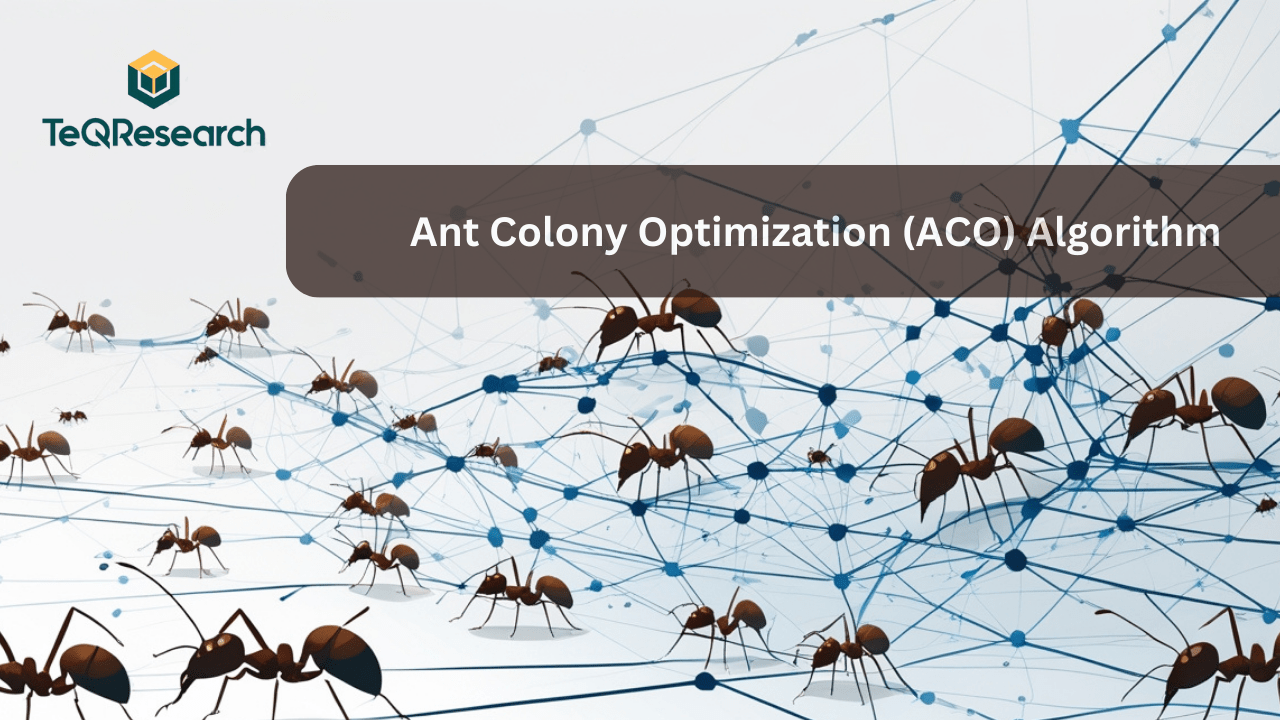
ACO Algorithm
Based on the feeding habits of actual ant colonies, Ant Colony Optimization (ACO) is a metaheuristic optimization technique inspired by nature. It was first presented by Marco Dorigo in the 1990s and is frequently used to solve combinatorial optimization issues, including network routing, job scheduling, and the Traveling Salesman Problem (TSP).
Ants use pheromone trails to determine the quickest route between their colony and a food source in the wild. Along the way, they leave behind chemical markers called pheromones. With time:
- Because they are traversed more frequently, shorter pathways acquire more pheromones.
- Evaporation causes longer routes to lose pheromones more quickly.
- Good solutions are reinforced when other ants follow the stronger pheromone trails.
Ants as agents investigating possible fixes. Paths as potential fixes for an issue. Pheromones serve as a reminder of effective remedies.
The solution space is explored by artificial ants. Pheromone trails are updated according to the quality of the solution. Ants are drawn to stronger trails, which gradually improves solutions. Premature convergence on a less-than-ideal path is avoided via pheromone evaporation. Effective for intricate optimization issues such as scheduling and shortest path routing. Adaptable and dynamic—able to change with the surroundings. able to manage broad search spaces when brute-force approaches fall short.
Introduction to ACO Algorithm
In the early 1990s, Marco Dorigo presented Ant Colony Optimization (ACO), a bio-inspired optimization algorithm modeled after the behavior of actual ants. It falls within the category of swarm intelligence algorithms, which use a collection of simple agents—such as ants—to solve complicated problems collectively. Ants’ ability to determine the quickest route between their nest and a food source served as the model for ACO. Ants use pheromone trails to communicate in the wild, which aids in their exploration and gradual reinforcement of the best routes. In order to tackle computational optimization challenges, this idea is mathematically formalized.
Artificial ants investigate potential fixes. They leave behind virtual pheromones along their travel routes. More ants are drawn to stronger pheromone trails, which reinforces sound solutions. Pheromone evaporation encourages exploration and inhibits early convergence. Through repeated iterations, the system converges to an optimal or near-optimal solution.
Effective for combinatorial issues such as network routing, scheduling, and TSP. Adaptive and self-organizing—able to deal with sudden changes in real time. It can be used to real-world issues because it doesn’t require a predetermined mathematical model.
Detailed Ant Colony Optimization (ACO) Algorithm
An iterative optimization system called Ant Colony Optimization (ACO) simulates how ants use pheromone trails to determine the quickest route to a food source. The ACO algorithm is broken down in great depth below, along with the mathematical formulas that are applied at each step.
Step-by-Step Explanation of ACO Algorithm
Step 1: Initialize Parameters
- Define the problem (e.g., a graph G=(N,E) where N are nodes and E are edges).
- Set algorithm parameters:
- m = Number of ants
- α = Influence of pheromone trails
- β = Influence of heuristic information
- ρ = Evaporation rate of pheromone
- Q= Constant for pheromone update
- Initialize pheromone levels τij on all paths to a small positive value.
- Define the heuristic information ηij (e.g., inverse of distance for shortest path problems):

where dij is the distance between nodes i and j.
Step 2: Construct Solutions (Ants Travel the Graph)
Each ant builds a solution by moving from node to node based on transition probability:

Where:
- Pij = Probability of ant moving from node iii to node j
- τij = Pheromone level on edge (i,j)(i, j)(i,j)
- ηij = Heuristic information (e.g., inverse of distance)
- α,β = Control the balance between pheromone influence and heuristic information
- J = Set of possible next nodes
Ants move until they complete a valid solution (e.g., visiting all cities in the Traveling Salesman Problem).
Step 3: Evaluate Solutions
- Compute the quality (fitness) of the solution found by each ant.
- Example: For the TSP problem, the cost function is the total path distance:

Where Lk is the total distance traveled by ant k.
- Keep track of the best solution found so far (global best solution).
Step 4: Update Pheromone Levels
Pheromone trails are updated in two parts:
- Pheromone Evaporation (to avoid excessive accumulation and encourage exploration):

where ρ is the evaporation rate (typically between 0.1 and 0.5).

where Δτijk is the pheromone contribution by ant k, calculated as:

- Q = Constant
- Lk = Total path length of ant k
Step 5: Repeat Until Stopping Criteria is Met
- Repeat Steps 2 to 4 for a fixed number of iterations or until convergence (no improvement over multiple iterations).
Algorithm Pseudocode
1. Initialize pheromone levels and algorithm parameters (α, β, ρ, Q)
2. While stopping condition not met:
a. For each ant:
i. Construct solution using probability rule
ii. Evaluate solution quality (fitness function)
b. Update pheromone trails (evaporation and deposition)
c. Keep track of the best solution found
3. Return the best solution
Example: ACO for Traveling Salesman Problem (TSP)
- Assume that ants begin in various cities and select the subsequent city according to distances and pheromone levels.
- Shorter paths gather more pheromones across multiple iterations, drawing in more ants.
- All of the ants eventually congregate at the shortest path.
ACO solves challenging optimization problems by simulating the foraging habits of actual ants. Ants are guided to the best solutions by pheromone levels, which strike a balance between exploration and exploitation. Important elements include evaporation, pheromone updating, and probabilistic path selection. Applied to robotics, AI, scheduling, and routing.
Advantages and Limitations of ACO Algorithm
The foraging habits of ants served as the inspiration for the potent optimization technique known as Ant Colony Optimization (ACO). Although it has been effectively used to solve numerous challenging optimization issues, it has benefits and drawbacks like any other method.
- The Ant Colony Optimization (ACO) method is a potent tool for resolving challenging optimization issues since it has a number of benefits. Its effectiveness in combinatorial optimization issues is one of its main advantages. ACO is especially well-suited for problems where conventional approaches frequently fall short of finding the best answers, such as the Traveling Salesman Problem (TSP), Vehicle Routing, and Job Scheduling. ACO’s ability to self-organize and adapt to changing conditions is another significant benefit. This makes it perfect for real-time and dynamic optimization issues like network routing.
- Stronger pheromone trails draw more ants, which over time improves convergence and yields better solutions. This is another way that ACO benefits from positive feedback reinforcement. Through pheromone evaporation, ACO prevents premature convergence, guaranteeing a wider search for optimal solutions than some optimization approaches like hill climbing, which can become trapped in limited optima.
- ACO’s capacity for distributed and parallel processing is another noteworthy benefit. ACO can be readily parallelized, increasing computational efficiency and scalability, because numerous ants independently explore the search space. Additionally, because ACO doesn’t require gradient information, it can be used to solve optimization problems that are non-differentiable, discontinuous, or extremely complex—issues that would be difficult for conventional gradient-based techniques to handle.
All things considered, ACO is a very successful metaheuristic algorithm for a variety of real-world applications due to its adaptive nature, positive reinforcement mechanism, and capacity to manage complex search spaces.
Limitations of ACO Algorithm
- Despite its advantages, the Ant Colony Optimization (ACO) algorithm has a number of drawbacks. The high computational cost is one of its main disadvantages. ACO can become computationally expensive, particularly for large-scale problems, because it necessitates numerous agents (ants) and numerous iterations to converge. In certain situations, ACO may also exhibit sluggish convergence. ACO may be less effective for time-sensitive applications since it may take longer to arrive at an ideal solution than other metaheuristic algorithms like Genetic Algorithm (GA) and Particle Swarm Optimization (PSO).
- The sensitivity of ACO’s parameters presents another difficulty. Proper adjustment of parameters like α (pheromone influence), β (heuristic influence), ρ (evaporation rate), and the number of ants is crucial for the algorithm’s performance. Incorrect optimization of these factors could result in less-than-ideal ACO solutions. Furthermore, ACO is less appropriate for continuous search spaces because it was initially created for discrete optimization situations. Modifications like Continuous ACO (CACO) have been developed to address this, however they need to be adjusted further in order to work well.
- Finally, there is a chance that ACO will see early convergence. The algorithm may become stuck in a less-than-ideal solution too soon if the pheromone evaporation rate is too slow. This would restrict exploration and lower the likelihood of discovering a better solution. Despite these drawbacks, when used properly with adjusted parameters and problem-specific adjustments, ACO is still a potent optimization technique.
An effective and flexible approach for resolving discrete optimization issues, particularly in scheduling, routing, and combinatorial searches, is Ant Colony Optimization (ACO). Its delayed convergence, computational complexity, and difficulties with parameter adjustment, however, call for careful evaluation.
Applications of ACO Algorithm
Because Ant Colony Optimization (ACO) is effective at tackling combinatorial optimization problems, it is employed extensively in many different industries. Here are a few significant real-world ACO applications from various fields.
- There are numerous uses for Ant Colony Optimization (ACO) in a variety of industries. ACO is especially useful for supply chain management, delivery route planning, and tour scheduling because it solves the Traveling Salesman Problem (TSP) in travel and logistics optimization by determining the shortest path that makes exactly one stop in each city. Similar to this, ACO helps businesses like FedEx, UPS, and Amazon increase delivery efficiency by optimizing the movement of delivery vehicles, taxis, and public transportation in the Vehicle Routing Problem (VRP). Additionally, it is essential to air traffic management, which serves to improve airspace efficiency by lowering congestion and optimizing aircraft schedules, landing procedures, and air traffic control.
- Internet routing protocols, wireless sensor networks (WSN), and mobile communication networks can all benefit from the usage of ACO in network routing optimization, which determines the most effective data transmission channel in computer networks. By effectively allocating computer resources, reducing latency, and enhancing system performance, it also helps with load balancing in cloud computing.
- ACO is widely used in robotics and artificial intelligence for path planning in autonomous robots, which aids in their efficient navigation of unfamiliar surroundings, avoidance of obstacles, and aim achievement. Robotic vacuum cleaners, self-driving automobiles, and warehouse automation are common examples of this application. ACO is also useful in swarm robotics, where several robots work together to effectively do challenging tasks.
- ACO helps with work scheduling optimization in manufacturing and scheduling by effectively assigning assignments to machines to cut costs and production time, which benefits sectors including software development, call centers, and factories. By identifying the best transportation routes, ACO also improves supply chain optimization, guaranteeing cost savings and increasing delivery efficiency.
- ACO also aids the bioinformatics and healthcare industries, especially in the areas of gene sequencing and protein folding. In these fields, the algorithm analyzes DNA sequences and finds patterns in protein structures, which helps with disease prediction and medicine discovery. Medical image processing is another crucial area where ACO is utilized to improve diagnostic accuracy through image segmentation in MRI, CT, and X-ray analysis.
- ACO is a key component of portfolio optimization in financial and economic applications, where it aids in choosing the optimal investment possibilities while balancing risk and return. It is also employed in stock market forecasting, helping to improve trading tactics and spot trends in the stock market to make better decisions.
- Lastly, ACO is used in artificial intelligence and gaming for AI pathfinding, which aids NPCs in effectively navigating open-world settings. Additionally, it is employed in gaming level creation, where it dynamically creates the best game maps, difficulty settings, and AI-powered tactics to improve user experiences.
Overall, ACO’s versatility and effectiveness make it an effective optimization technique for a variety of industries, providing robust answers to real-world challenges.
Ant Colony Optimization (ACO) is a powerful tool for routing, scheduling, AI, robotics, healthcare, finance, and cloud computing applications. Its adaptability to dynamic situations makes it an excellent candidate for real-time decision-making challenges.
Conclusion
An effective algorithm based on swarm intelligence, Ant Colony Optimization (ACO), finds the shortest paths by simulating the ants’ natural behavior. An efficient metaheuristic method for handling challenging combinatorial optimization problems, ACO was first introduced by Marco Dorigo in the 1990s.
Ant Colony Optimization (ACO) is very helpful for problems like the Traveling Salesman Problem (TSP), Vehicle Routing, and Job Scheduling because of its great efficiency for complicated optimization problems. It is perfect for real-time applications like network routing, cloud computing, and robotics path planning because of its self-organizing and adaptive nature, which enables it to dynamically adapt to changing circumstances. ACO’s positive feedback system, which uses pheromone reinforcement to guarantee that successful solutions are progressively improved over time, is one of its main advantages. Furthermore, unlike conventional optimization techniques, ACO provides global optimization capacity, successfully striking a balance between exploration and exploitation, which lessens the likelihood of being trapped in local optima.
The computational cost of Ant Colony Optimization (ACO) can be high, particularly when dealing with large-scale issues. Methods including deep learning integration, parallel ACO, and hybrid ACO have been investigated to increase efficiency. Since ACO’s effectiveness is largely dependent on the appropriate fine-tuning of parameters like pheromone impact (α), heuristic influence (β), and evaporation rate (ρ), its parameter sensitivity presents another difficulty. Furthermore, ACO’s use in continuous domains is restricted because it was primarily created for discrete optimization issues. To expand its capabilities to continuous search areas, Continuous ACO (CACO) versions are being developed.
ACO is still one of the most often used optimization strategies for resolving practical issues, despite several drawbacks. ACO will remain a vital tool in AI, engineering, and business applications due to developments in hybrid optimization, machine learning, and parallel computing.
Frequently Asked Questions (FAQs)
The following list of five frequently asked questions concerning the Ant Colony Optimization (ACO) Algorithm includes the responses:
Q1: How does Ant Colony Optimization (ACO) work?
A1: The foraging habits of actual ants served as the inspiration for the swarm intelligence algorithm known as ACO. Ants leave pheromones behind as they travel along several routes in search of food. Shorter routes gradually gather more pheromones, drawing more ants and strengthening the optimal solutions. To identify the best answers to scheduling, routing, and other optimization issues, the algorithm imitates this behavior.
Q2: What are the main applications of ACO?
A2: ACO is widely used in:
- Identifying the quickest route between cities is known as the Traveling Salesman Problem (TSP).
- Vehicle Routing: maximizing logistical delivery routes.
- Effective data transfer in communication networks is achieved by network routing.
- Assisting robots in navigating obstacles is known as robotics path planning.
- Job Scheduling: maximizing the distribution of tasks in manufacturing facilities.
Q3: What are the key parameters of ACO, and how do they affect performance?
A3: The main parameters are:
- α (Pheromone Influence): Higher values indicate preference for previously investigated routes.
- B (Heuristic Influence): Shorter routes are encouraged by higher values.
- Pheromone Evaporation Rate, or ρ, reduces pheromone intensity over time, preventing premature convergence.
- Ant Count (m): While more ants add computational expense, they also improve solution diversity.
In ACO, striking a balance between exploration and exploitation requires careful parameter tweaking.
Q4: What are the limitations of ACO?
A4: While ACO is powerful, it has some limitations:
- Costly to compute: Needs several iterations and agents (ants).
- Slow Convergence: In comparison to other algorithms, such as PSO, it could take longer to arrive at an ideal solution.
- Parameter Sensitivity: Ant population, heuristic influence, and pheromone evaporation rate fine tuning all affect performance.
- Limited for Continuous Problems: Standard ACO works best for discrete problems; continuous search spaces require changes (Continuous ACO).