
What is AOMDV Algorithm?
The Ad Hoc On-demand Multipath Distance Vector (AOMDV) Algorithm is an advanced routing protocol designed for Mobile Ad Hoc Networks (MANETs). It is an extension of the widely used Ad Hoc On-demand Distance Vector (AODV) routing protocol. The primary objective of AOMDV is to establish and maintain multiple loop-free and link-disjoint paths between a source node and a destination node. Unlike traditional routing protocols that maintain only a single route, AOMDV discovers multiple alternative routes during a single route discovery process. These backup routes can be immediately used if the primary route fails, reducing packet loss, minimizing route discovery overhead, and improving network reliability. AOMDV is particularly useful in highly dynamic wireless environments where nodes frequently move, causing network topology changes. By maintaining multiple paths, the protocol ensures continuous communication and better fault tolerance.
Introduction
Mobile Ad Hoc Networks (MANETs) consist of wireless mobile devices that communicate without relying on fixed infrastructure such as routers or access points. Since nodes move freely, network topology changes frequently, making routing a challenging task. Traditional routing protocols fall into two categories:
Proactive Routing Protocols
These protocols continuously maintain routing information for all nodes.
Examples:
- Destination-Sequenced Distance Vector (DSDV)
- Optimized Link State Routing (OLSR)
Reactive Routing Protocols
These protocols create routes only when needed.
Examples:
- AODV
- Dynamic Source Routing (DSR)
While AODV effectively discovers routes on demand, it maintains only a single route. If that route breaks, a new route discovery process must be initiated, increasing delay and control overhead. To overcome this limitation, researchers developed AOMDV, which extends AODV by maintaining multiple routes between source and destination nodes.
Key Objectives of AOMDV
- Discover multiple paths in a single route discovery.
- Reduce route discovery frequency.
- Improve packet delivery ratio.
- Minimize communication interruptions.
- Increase fault tolerance.
- Reduce routing overhead.
AOMDV is widely used in:
- Wireless sensor networks
- Military communication systems
- Disaster recovery networks
- Vehicular ad hoc networks
- Internet of Things (IoT)
Detailed Ad Hoc On-demand Multipath Distance Vector
The AOMDV algorithm consists of several stages:
- Route Discovery
- Multipath Route Formation
- Route Maintenance
- Route Failure Recovery
- Route Update Mechanism
The algorithm uses three primary control messages:
- Route Request (RREQ)
- Route Reply (RREP)
- Route Error (RERR)
Step 1: Route Discovery
When a source node wants to send data but does not have a route to the destination, it initiates route discovery.
The source broadcasts a Route Request (RREQ) packet.
The RREQ contains:
- Source Address
- Destination Address
- Source Sequence Number
- Destination Sequence Number
- Broadcast ID
- Hop Count
Route Request Formula
The route request can be represented as:

Where:
- S = Source Node
- D = Destination Node
- SeqS = Source Sequence Number
- SeqD = Destination Sequence Number
- BID = Broadcast ID
- HC = Hop Count
Each intermediate node records the reverse path to the source.
Step 2: Multipath Route Formation
Unlike AODV, duplicate RREQ packets are not discarded immediately. AOMDV allows multiple copies of RREQs to be processed if they arrive through different neighbors. This helps establish multiple routes.
Advertised Hop Count
AOMDV introduces a new concept called Advertised Hop Count. It represents the maximum hop count among all available paths.
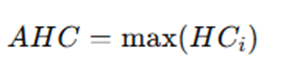
Where:
- AHC = Advertised Hop Count
- HCi = Hop Count of path i
This mechanism prevents routing loops.
Step 3: Route Reply Generation
When the destination receives RREQ packets through different routes, it sends Route Reply (RREP) messages.
Each RREP travels back along a distinct reverse path.
Route Reply Formula
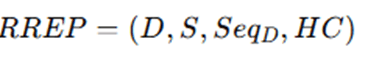
Where:
- D = Destination
- S = Source
- SeqD = Destination Sequence Number
- HC = Hop Count
The source receives multiple RREPs and stores multiple routes.
Step 4: Link-Disjoint Path Selection
AOMDV prefers link-disjoint paths.
Two paths are link-disjoint if they do not share any communication links.
Suppose:
Path 1:
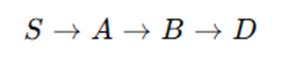
Path 2:
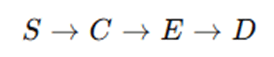
Since no common links exist, these paths are link-disjoint.
Number of Available Paths
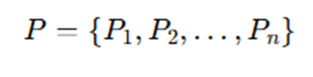
Where:
- P = Total path set
- n = Number of discovered routes
Step 5: Route Maintenance
Nodes periodically monitor active links.
If a link breaks, the node generates a Route Error (RERR) message.
Route Error Message

The source removes the failed path from the routing table.
Step 6: Route Failure Recovery
When the primary path fails:
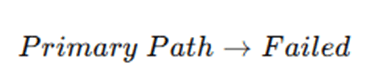
The source immediately switches to an alternate path.

This eliminates the need for a new route discovery process.
Step 7: Route Update
If all available paths fail:

A new route discovery process begins.

This ensures continuous connectivity.
The operation of AOMDV begins when a source node intends to communicate with a destination node but does not possess a valid route. Instead of maintaining routes continuously, the protocol performs route discovery only when needed. The source node broadcasts a Route Request packet throughout the network. Every neighboring node that receives the request records information about the reverse path and forwards the request further. As the Route Request propagates through the network, multiple copies may reach intermediate nodes and eventually the destination. Unlike traditional AODV, AOMDV does not discard all duplicate requests. Duplicate Route Requests arriving through different neighboring nodes are considered because they represent alternative paths. This capability enables the discovery of multiple routes during a single route discovery phase.
When the destination node receives Route Requests from different paths, it generates multiple Route Reply packets. Each Route Reply is transmitted back to the source through a different reverse path. As these replies travel through the network, intermediate nodes update their routing tables with multiple next-hop entries corresponding to distinct routes. To guarantee loop-free routing, AOMDV employs the concept of advertised hop count. This value represents the largest hop count among all known routes for a particular destination. By using sequence numbers and advertised hop counts, the protocol ensures routing consistency and avoids loops.
Once the source receives multiple Route Replies, it stores several routes to the destination. Usually, the route with the smallest hop count is selected as the primary route, while the remaining routes are maintained as backup routes. Data packets are transmitted through the primary route during normal operation. As nodes move, wireless links may break. Intermediate nodes continuously monitor link status. When a link failure occurs, the affected node generates a Route Error message and informs upstream nodes. The source node then removes the failed route from its routing table.
Instead of initiating an expensive route discovery process immediately, the source selects one of the previously discovered backup routes. Communication continues with minimal interruption. This fast recovery mechanism significantly improves packet delivery and reduces latency. Only when all available routes become invalid does the source initiate a new route discovery process. Consequently, AOMDV reduces routing overhead and increases network reliability compared to single-path routing protocols.
Example of How AOMDV Works
Consider the following MANET:
Nodes
- Source Node (S)
- Destination Node (D)
- Intermediate Nodes (A, B, C, E)
Initially, node S wants to send data to node D.
Route Discovery
The source broadcasts an RREQ.
Multiple routes are discovered:
Route 1
S→A→B→D
Route 2
S→C→E→D
Route 3
S→A→E→D
The destination sends RREP messages through all discovered routes.
The source stores:
| Route | Hop Count |
| S-A-B-D | 3 |
| S-C-E-D | 3 |
| S-A-E-D | 3 |
The source chooses one route as the primary route.
Failure Scenario
Suppose link:
A→B
fails.
Instead of starting route discovery again, the source immediately switches to:
S→C→E→D
Communication continues seamlessly.
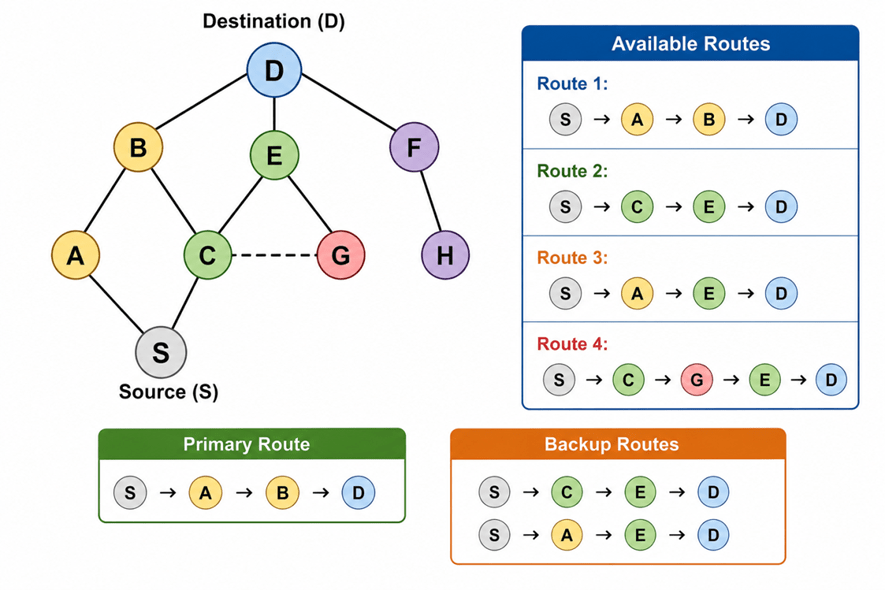
Route Selection Illustration
Before Failure
S —- A —- B —- D
|
|
C —- E —- D
Primary Path:
S-A-B-D
After Link Failure (A-B)
S A X B —- D
|
|
C —- E —- D
New Active Path:
S-C-E-D
Advantages and Disadvantages of AOMDV Algorithm
Advantages
- Multiple Route Availability: One of the most significant advantages of AOMDV is its ability to discover and maintain multiple routes between a source and destination node simultaneously. Unlike traditional routing protocols that maintain only a single path, AOMDV stores several alternative routes. If the primary route becomes unavailable due to node mobility or link failure, the protocol can immediately switch to a backup path. This feature significantly improves communication reliability and ensures uninterrupted data transmission. Multiple route availability is especially beneficial in highly dynamic wireless networks where route failures occur frequently.
- Reduced Route Discovery Frequency: In conventional single-path routing protocols, a new route discovery process must be initiated every time a route fails. This process consumes network bandwidth and increases communication delay. AOMDV reduces the need for frequent route discoveries by maintaining backup routes in advance. When the active route breaks, the source node simply switches to an alternative route without broadcasting new route request packets. As a result, the protocol reduces routing overhead, conserves network resources, and improves overall network efficiency.
- Improved Fault Tolerance: Fault tolerance refers to a network’s ability to continue operating even when failures occur. AOMDV achieves high fault tolerance by maintaining multiple link-disjoint or node-disjoint paths. If one path fails because of node movement, hardware failure, or wireless interference, another route can immediately take over. This redundancy minimizes communication interruptions and ensures continuous network connectivity. Such fault-tolerant behavior is particularly important in mission-critical applications such as military communications, disaster response operations, and emergency rescue systems.
- Lower Packet Loss: Packet loss occurs when data packets fail to reach their destination due to broken routes or network congestion. In single-path routing protocols, packets may be dropped while a new route is being discovered. AOMDV minimizes packet loss by providing alternative routes that can be used instantly when a route failure occurs. Since backup routes are already available, data transmission continues with minimal disruption. Consequently, the protocol improves packet delivery ratio and enhances the quality of service in wireless networks.
- Better Network Throughput: Network throughput represents the amount of successful data transmission over a network within a given period. Because AOMDV reduces route failures and minimizes communication interruptions, more packets successfully reach their destinations. The availability of multiple routes ensures continuous data flow even during topology changes. This capability leads to improved bandwidth utilization and higher overall throughput compared to traditional single-path routing protocols. Networks using AOMDV can therefore support more reliable and efficient communication.
- Reduced End-to-End Delay: End-to-end delay refers to the time required for a packet to travel from the source node to the destination node. In AOMDV, when a route failure occurs, the protocol does not need to initiate a new route discovery process immediately. Instead, it switches to one of the available backup routes. This rapid recovery mechanism significantly reduces communication delays. Lower end-to-end delay is particularly important for real-time applications such as video conferencing, voice communication, online gaming, and remote monitoring systems.Loop-Free Routing: Routing loops can cause packets to circulate endlessly within a network, leading to bandwidth wastage and increased delays. AOMDV prevents routing loops through the use of destination sequence numbers and the Advertised Hop Count mechanism. These techniques ensure that only valid and loop-free routes are maintained in the routing table. Loop-free routing enhances network stability, improves packet delivery performance, and prevents unnecessary resource consumption.
- Suitable for Dynamic Networks: Mobile Ad Hoc Networks are characterized by frequent topology changes due to node mobility. AOMDV is specifically designed to handle such dynamic environments effectively. The protocol adapts quickly to changing network conditions by maintaining multiple alternative routes. This adaptability makes AOMDV highly suitable for applications involving moving vehicles, mobile devices, drones, and wireless sensor nodes. Even in rapidly changing environments, the protocol can maintain stable communication and reliable routing performance.
Disadvantages
- Increased Routing Table Size: Since AOMDV maintains multiple routes for each destination rather than a single route, routing tables become larger. Each node must store information about several alternative paths, including hop counts, next-hop addresses, and sequence numbers. This additional routing information requires more memory and storage resources. In networks with limited hardware capabilities, such as wireless sensor networks, increased routing table size can become a significant challenge.
- Higher Initial Route Discovery Overhead: Although AOMDV reduces the frequency of future route discoveries, the initial route discovery process is more complex than that of AODV. The protocol allows multiple Route Request (RREQ) packets to propagate through the network to discover alternative paths. This process generates additional control traffic during route establishment. Consequently, the initial route discovery phase may consume more bandwidth and processing resources compared to single-path routing protocols.
- More Complex Implementation: AOMDV introduces several advanced mechanisms such as multipath discovery, route maintenance, advertised hop counts, and loop prevention techniques. These features increase the complexity of the protocol compared to AODV. Implementing and managing multiple routes requires more sophisticated algorithms and data structures. As a result, protocol development, testing, debugging, and deployment become more challenging for network designers and researchers.
- Increased Control Packet Processing: To establish multiple routes, AOMDV processes duplicate Route Request packets that arrive through different paths. Unlike AODV, which discards most duplicate requests, AOMDV must analyze and evaluate these packets to identify alternative routes. This additional processing increases computational overhead at intermediate nodes. In dense networks with many nodes, the number of control packets can become substantial, potentially affecting network performance.
- Energy Consumption: Wireless devices typically operate using limited battery power. The maintenance of multiple routes requires additional route monitoring, control packet transmission, and routing table updates. These activities consume energy and may reduce battery life. In energy-constrained environments such as wireless sensor networks and Internet of Things (IoT) deployments, the increased energy consumption associated with AOMDV can be a significant drawback.
- Scalability Challenges: AOMDV performs efficiently in small and medium-sized mobile ad hoc networks. However, as network size grows, maintaining multiple routes for numerous destinations becomes increasingly difficult. Larger networks generate more routing information, control packets, and route maintenance operations. This increased overhead can affect scalability and may lead to reduced performance in very large networks with thousands of nodes.
- Route Maintenance Complexity: Maintaining multiple routes requires continuous monitoring of route validity and link status. Whenever a link changes or fails, the protocol must update routing tables, remove invalid routes, and manage backup paths. Coordinating these operations across many nodes introduces additional computational complexity. Effective route maintenance becomes particularly challenging in highly mobile environments where network topology changes frequently. As a result, AOMDV requires more processing power than simpler routing protocols.
Applications of Ad Hoc On-demand Multipath Distance Vector Algorithm
- Military Communication Networks: Military operations often occur in infrastructure-less environments. AOMDV provides reliable communication through multiple backup routes.
- Disaster Recovery Systems: After earthquakes, floods, or hurricanes, communication infrastructure may be unavailable. AOMDV enables emergency teams to establish temporary wireless networks.
- Vehicular Ad Hoc Networks (VANETs): Vehicles communicate dynamically while moving. AOMDV maintains stable routes despite frequent topology changes.
- Wireless Sensor Networks: Sensor nodes deployed in remote environments can use AOMDV to ensure reliable data transmission.
- Internet of Things (IoT): IoT devices operating in decentralized environments benefit from multipath routing and fault tolerance.
- Drone and UAV Networks: Unmanned Aerial Vehicles require robust communication links. AOMDV provides alternative routes during movement.
- Smart City Infrastructure: Traffic monitoring, environmental sensing, and public safety systems can utilize AOMDV for resilient communication.
- Mobile Healthcare Systems: Medical monitoring devices in mobile environments can maintain reliable connectivity using multipath routing.
- Industrial Wireless Networks: Factories and industrial automation systems require uninterrupted communication, making AOMDV highly suitable.
- Campus and Temporary Event Networks: Conferences, exhibitions, and temporary campuses can deploy AOMDV-based MANETs without fixed infrastructure.
Conclusion
The Ad Hoc On-demand Multipath Distance Vector (AOMDV) Algorithm is a powerful enhancement of the AODV routing protocol that significantly improves routing reliability in Mobile Ad Hoc Networks. By discovering and maintaining multiple loop-free and link-disjoint routes between source and destination nodes, AOMDV minimizes communication disruptions caused by node mobility and link failures. Its ability to switch instantly to backup routes reduces packet loss, decreases end-to-end delay, and lowers route discovery overhead. Although maintaining multiple paths introduces additional storage and processing requirements, the benefits of enhanced fault tolerance, improved throughput, and greater network resilience make AOMDV an excellent choice for dynamic wireless environments such as military networks, disaster recovery operations, vehicular communication systems, IoT deployments, and wireless sensor networks. As mobile and decentralized networking technologies continue to evolve, AOMDV remains one of the most effective multipath routing solutions for ensuring reliable and efficient communication.
Frequently Asked Questions (FAQs)
Q 1: What is the main purpose of the AOMDV algorithm?
The primary purpose of AOMDV is to discover and maintain multiple loop-free routes between a source and destination, improving reliability and fault tolerance in Mobile Ad Hoc Networks.
Q 2: How is AOMDV different from AODV?
AODV maintains only one route to a destination, whereas AOMDV maintains multiple alternative routes. When a route fails, AOMDV can immediately switch to a backup route without initiating a new route discovery process.
Q 3: What are link-disjoint paths in AOMDV?
Link-disjoint paths are routes that do not share any common communication links. Using link-disjoint paths increases network robustness because the failure of one link does not affect other routes.
Q 4: Why does AOMDV reduce end-to-end delay?
AOMDV reduces delay because backup routes are already available. When the primary route fails, the protocol switches to an alternate route instead of performing a time-consuming route discovery process.
Q 5: Where is the AOMDV algorithm commonly used?
AOMDV is commonly used in Mobile Ad Hoc Networks, Wireless Sensor Networks, Vehicular Ad Hoc Networks, military communication systems, disaster recovery operations, drone networks, IoT environments, and smart city applications.