
What is the Artificial Bee Colony Algorithm?
The Artificial Bee Colony (ABC) Algorithm is a nature-inspired optimization algorithm based on the intelligent foraging behavior of honey bee swarms. It belongs to the family of swarm intelligence and evolutionary computation techniques, which solve optimization problems by simulating collective behavior observed in natural systems. In the Artificial Bee Colony algorithm, the process of searching for optimal solutions is modeled as the search for food sources by artificial bees. Each food source represents a candidate solution, and the nectar amount corresponds to the fitness value of that solution. Through cooperation, communication, and adaptation, the swarm iteratively improves solution quality. ABC is especially valued for its simplicity, robustness, and ability to escape local optima, making it suitable for nonlinear, multimodal, and high-dimensional optimization problems.
Introduction to the Artificial Bee Colony Algorithm
Optimization problems appear across engineering, data science, machine learning, operations research, and bioinformatics. Traditional deterministic optimization methods often struggle with complex, nonconvex, or noisy search spaces. This limitation led researchers to explore bio-inspired metaheuristic algorithms. The Artificial Bee Colony algorithm was introduced to model how real honey bees efficiently locate and exploit food sources using limited individual intelligence but strong collective coordination. The algorithm divides artificial bees into three functional groups:
- Employed Bees – exploit known food sources.
- Onlooker Bees – select food sources based on shared information.
- Scout Bees – explore new regions randomly.
This division allows the algorithm to balance exploration (searching new regions) and exploitation (refining good solutions), which is a core challenge in optimization.
Detailed Artificial Bee Colony Algorithm
3.1 Problem Representation
Let an optimization problem be defined as:

where:
- D is the dimensionality of the problem,
- x is a candidate solution,
- f(x) is the objective (fitness) function.
Each food source corresponds to a solution vector xi
3.2 Initialization Phase
A population of SN food sources is initialized randomly within the search space:

where:
- i=1,2,….,SN
- j=1,2,….,D
- xjmax-xjmin are lower and upper bounds.
Each food source is assigned an employed bee.
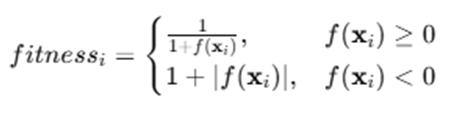
3.3 Fitness Calculation
Fitness is computed differently depending on whether the problem is minimization or maximization. For minimization:
3.4 Employed Bee Phase
Each employed bee generates a new candidate solution vij by modifying the current one:

where:
- k≠i is a randomly selected solution,
- ϕij∈[−1,1] is a random number.
If the new solution yields better fitness, it replaces the old one (greedy selection).
3.5 Onlooker Bee Phase
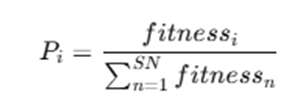
Onlooker bees select food sources based on probability proportional to fitness:
Selected solutions are further modified using the same neighbor-generation equation as in the employed bee phase.
3.6 Scout Bee Phase
If a food source is not improved for a predefined number of cycles (limit), it is abandoned. The corresponding employed bee becomes a scout and generates a new random solution:

3.7 Termination Condition
The algorithm stops when:
- Maximum number of iterations is reached, or
- Acceptable solution quality is achieved.
Step-by-Step Explanation of the Artificial Bee Colony Algorithm,
The Artificial Bee Colony (ABC) algorithm operates through a sequence of biologically inspired phases that collectively enable efficient optimization. Each phase corresponds to a specific role observed in natural honey bee foraging behavior. The algorithm iteratively improves candidate solutions by balancing exploration and exploitation until an optimal or near-optimal solution is obtained.
Initialization of Food Sources (Candidate Solutions)
The algorithm begins with the initialization phase, where a predefined number of candidate solutions, known as food sources, are randomly generated within the feasible search space. Each food source represents a potential solution to the optimization problem, encoded as a vector of decision variables. The randomness in initialization ensures diversity in the population, allowing the algorithm to cover a wide range of the search space from the outset.
At this stage, each food source is assigned exactly one employed bee, establishing a one-to-one correspondence between employed bees and solutions. The quality of each food source is evaluated using the objective function, and an initial fitness value is computed. This fitness value reflects the amount of “nectar” available at the food source and serves as a measure of solution quality.
Employed Bee Phase: Local Exploitation of Solutions
In the employed bee phase, each employed bee explores the neighborhood of its assigned food source to find a potentially better solution. This is achieved by generating a new candidate solution through a small perturbation of the current one, guided by the difference between the current solution and a randomly selected neighboring solution.
This local search mechanism enables exploitation, as it focuses on refining existing solutions rather than exploring entirely new regions. After generating the new solution, its fitness is evaluated and compared with the fitness of the current solution. If the new solution yields an improvement, it replaces the old one according to a greedy selection strategy. Otherwise, the original solution is retained. This process allows gradual improvement while preventing deterioration in solution quality.
Information Sharing Through the Waggle Dance Mechanism
Once employed bees complete their neighborhood search, they share information about the quality of their food sources with the rest of the colony. This communication process is inspired by the waggle dance observed in real honey bees, which conveys information about food source quality. In the algorithmic context, the shared information consists of the fitness values of food sources. This information is made available to onlooker bees, enabling them to make informed decisions about which food sources to exploit further. The sharing of fitness-based information ensures that promising solutions receive more attention in subsequent phases.
Onlooker Bee Phase: Probabilistic Selection and Intensified Exploitation
During the onlooker bee phase, onlooker bees select food sources based on a probability distribution proportional to fitness values. Food sources with higher fitness have a greater chance of being selected, while poorer solutions are less likely to attract onlookers. This probabilistic selection mechanism introduces a balance between determinism and randomness, preventing premature convergence.
After selecting a food source, an onlooker bee generates a new solution in the neighborhood of the chosen food source using the same perturbation strategy employed by employed bees. The newly generated solution is evaluated, and a greedy selection process determines whether it replaces the existing one. This phase intensifies exploitation around high-quality regions of the search space, accelerating convergence toward optimal solutions.
Abandonment Criterion and Scout Bee Phase
As the algorithm progresses, some food sources may fail to improve over a predefined number of iterations, known as the limit parameter. Such food sources are considered exhausted, analogous to depleted nectar sources in nature. When this condition is met, the employed bee associated with that food source abandons it.The abandoned employed bee then becomes a scout bee, whose role is to explore new regions of the search space by generating a completely new food source at random. This random exploration mechanism is crucial for maintaining population diversity and preventing stagnation. By introducing new candidate solutions, scout bees help the algorithm escape local optima and enhance its global search capability.
Memorization of the Best Solution
Throughout the optimization process, the algorithm continuously tracks and memorizes the best solution found so far. This solution represents the food source with the highest fitness (or lowest objective value in minimization problems). Memorization ensures that the best-known solution is preserved even if population dynamics fluctuate during subsequent iterations. This mechanism contributes to the stability and reliability of the algorithm, guaranteeing that the final output reflects the best solution discovered during the entire search process.
Iterative Cycle and Termination Condition
The employed bee phase, onlooker bee phase, and scout bee phase together form a single iteration cycle of the Artificial Bee Colony algorithm. These cycles are repeated iteratively, allowing continuous refinement of candidate solutions. With each iteration, poor solutions are discarded, promising solutions are enhanced, and new areas of the search space are explored. The algorithm terminates when a predefined stopping criterion is satisfied. Common termination conditions include reaching a maximum number of iterations, achieving a target fitness value, or observing no significant improvement over successive iterations. Upon termination, the memorized best solution is returned as the final output.
Example: How the Artificial Bee Colony Algorithm Works
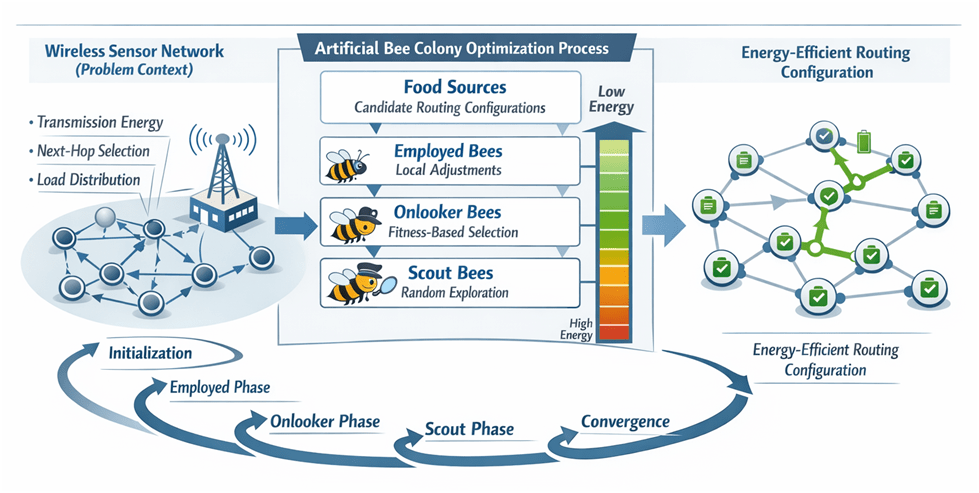
To clearly understand the working mechanism of the Artificial Bee Colony (ABC) algorithm, consider an example optimization problem in the domain of wireless sensor networks (WSNs). The objective of this problem is to minimize overall energy consumption while maintaining reliable data transmission between sensor nodes and a base station. Since sensor nodes are energy-constrained, efficient routing is critical to prolong network lifetime. In this context, the ABC algorithm treats each food source as a candidate routing configuration, and the nectar amount represents how energy-efficient that routing configuration is.
Problem Representation in the Context of Wireless Sensor Networks
In the given example, each food source encodes a set of routing parameters such as:
- Next-hop node selection
- Transmission power levels
- Path selection priorities
- Load distribution among nodes
The objective function evaluates total energy consumption, which may include transmission energy, reception energy, and idle listening energy. Lower energy consumption corresponds to higher fitness values, making such solutions more attractive to artificial bees.
Initialization Phase: Generation of Random Routing Configurations
The algorithm begins by randomly generating multiple routing configurations within feasible constraints of the wireless sensor network. These initial solutions are distributed across the search space to ensure diversity. Each configuration is assigned to an employed bee, and its energy consumption is computed using the objective function. At this stage, some routing configurations may be inefficient, while others may already exhibit relatively low energy usage. This diversity provides a strong foundation for effective optimization.
Employed Bee Phase: Local Adjustment of Routing Parameters
During the employed bee phase, each employed bee attempts to improve its assigned routing configuration by making small modifications. These modifications may include changing the next-hop node for a particular sensor, adjusting transmission power, or redistributing traffic loads. After modifying the routing parameters, the employed bee evaluates the new configuration by recalculating energy consumption. If the new configuration consumes less energy than the previous one, it replaces the old configuration. This greedy selection mechanism ensures that routing performance improves or remains stable over time. Through this process, local exploitation of promising routing paths takes place.
Onlooker Bee Phase: Fitness-Based Selection of Efficient Routes
Once employed bees complete their local searches, they share information about the quality of their routing configurations with onlooker bees. Onlooker bees analyze this information and probabilistically select routing configurations with lower energy consumption. Configurations that demonstrate higher energy efficiency attract more onlooker bees, resulting in increased search activity around these solutions. Onlooker bees further refine these routing paths by applying small parameter changes and reevaluating energy usage. This phase intensifies exploitation around energy-efficient routes, accelerating convergence toward optimal or near-optimal solutions.
Scout Bee Phase: Discovery of New Routing Paths
Some routing configurations may fail to improve after several iterations, indicating that they are suboptimal or trapped in local minima. When this occurs, the corresponding food sources are abandoned. The associated employed bees become scout bees and generate entirely new routing configurations randomly. These new configurations may explore unexplored regions of the solution space, such as alternative routing paths or node combinations. This phase introduces exploration into the optimization process and prevents the algorithm from stagnating around suboptimal routing strategies.
Iterative Optimization and Convergence Behavior
The employed bee, onlooker bee, and scout bee phases together form one iteration cycle. With each cycle, inefficient routing configurations are discarded, efficient ones are refined, and new routing possibilities are explored. Over time, the population of solutions gradually shifts toward configurations that minimize energy consumption. As iterations progress, changes in energy consumption become smaller, indicating convergence. Eventually, the algorithm identifies a routing configuration that provides an optimal balance between energy efficiency and network performance.
The final outcome of the Artificial Bee Colony algorithm in this example is an energy-efficient routing configuration that significantly reduces total energy consumption in the wireless sensor network. This optimized routing strategy extends the operational lifetime of sensor nodes, improves data delivery reliability, and enhances overall network sustainability.
Advantages and Disadvantages of the Artificial Bee Colony Algorithm
The Artificial Bee Colony (ABC) algorithm has gained significant attention in the field of optimization due to its simplicity and effectiveness. However, like all metaheuristic algorithms, it exhibits both strengths and limitations. Understanding these advantages and disadvantages is essential for selecting ABC for appropriate problem domains and for designing hybrid or improved variants.
Advantages of the Artificial Bee Colony Algorithm
- Simplicity and Ease of Implementation: One of the most prominent advantages of the Artificial Bee Colony algorithm is its conceptual simplicity. The algorithm is based on intuitive biological behavior and involves straightforward operations such as random initialization, neighbor generation, fitness evaluation, and greedy selection. As a result, it can be implemented easily without complex mathematical operators, making it accessible to researchers and practitioners alike.
- Minimal Number of Control Parameters: ABC requires only a few control parameters, typically the population size, limit value, and maximum number of iterations. This simplicity reduces the effort needed for parameter tuning compared to many other metaheuristic algorithms. Fewer parameters also enhance algorithm robustness and reduce the risk of improper configuration.
- Strong Global Search Capability: The presence of scout bees enables the Artificial Bee Colony algorithm to explore new regions of the search space effectively. By randomly generating new solutions when existing ones stagnate, the algorithm avoids premature convergence and maintains diversity. This strong global search ability makes ABC particularly effective for complex optimization landscapes.
- Effectiveness for Nonlinear and Multimodal Problems: The Artificial Bee Colony algorithm performs well on nonlinear, nonconvex, and multimodal optimization problems, where multiple local optima exist. Its probabilistic selection mechanism and exploration–exploitation balance allow it to navigate rugged search spaces and locate near-global optima efficiently.
- Balanced Exploration and Exploitation Mechanism: ABC naturally balances exploration and exploitation through the coordinated roles of employed, onlooker, and scout bees. Employed and onlooker bees focus on refining promising solutions, while scout bees introduce randomness to explore new areas. This balance improves convergence reliability and solution quality across diverse problem types.
Disadvantages
- Slow Convergence Speed: Despite its strong global search capability, the Artificial Bee Colony algorithm may exhibit slow convergence, especially during later stages of optimization. The random nature of solution updates can limit fine-grained exploitation, causing the algorithm to require more iterations to reach high-precision solutions.
- Sensitivity to Parameter Settings: Although ABC uses fewer parameters than many algorithms, its performance can still be sensitive to parameter selection, particularly the limit value and population size. Poorly chosen parameters may lead to excessive exploration or insufficient exploitation, affecting convergence behavior and solution quality.
- Limited Efficiency for Very High-Dimensional Problems: The standard Artificial Bee Colony algorithm may struggle with very high-dimensional optimization problems due to increased search space complexity. As dimensionality grows, the probability of generating effective neighbor solutions decreases, often requiring algorithm modifications or hybridization to maintain performance.
- High Number of Function Evaluations: ABC often requires a large number of objective function evaluations, especially for complex or computationally expensive problems. This can increase computational cost and runtime, making the algorithm less suitable for real-time or resource-constrained applications unless optimization or parallelization techniques are applied.
Applications of the Artificial Bee Colony Algorithm
The Artificial Bee Colony (ABC) algorithm has been successfully applied across a wide range of scientific, engineering, and computational domains. Its adaptability, robustness, and ability to handle complex search spaces make it particularly suitable for solving nonlinear, multimodal, and constrained optimization problems. This section highlights the major application areas where the ABC algorithm has demonstrated significant effectiveness.
- Numerical Function Optimization: One of the earliest and most common applications of the Artificial Bee Colony algorithm is numerical function optimization. ABC is widely used to solve benchmark optimization problems involving continuous, nonlinear, and multimodal objective functions. Its global search capability allows it to locate near-optimal solutions even in highly complex search landscapes, making it a popular choice for evaluating optimization performance.
- Machine Learning Model Tuning: In machine learning, the Artificial Bee Colony algorithm is extensively used for hyperparameter optimization. ABC can automatically tune parameters such as learning rates, regularization factors, kernel parameters, and network architectures. By efficiently exploring the parameter space, the algorithm enhances model accuracy, generalization performance, and training efficiency across various learning models.
- Feature Selection: Feature selection is a critical preprocessing step in data mining and machine learning. ABC has been effectively employed to identify optimal or near-optimal feature subsets by minimizing redundancy while maximizing classification accuracy. The algorithm treats each food source as a feature subset and evaluates its fitness based on performance metrics, thereby improving computational efficiency and predictive accuracy.
- Clustering and Classification: The Artificial Bee Colony algorithm is widely applied in clustering and classification tasks. In clustering, ABC optimizes cluster centers to minimize intra-cluster distance and maximize inter-cluster separation. For classification problems, ABC is used to optimize decision boundaries, classifier parameters, and rule sets, resulting in improved classification performance.
- Image Processing and Segmentation: In the field of image processing, ABC has been applied to tasks such as image segmentation, thresholding, edge detection, and image enhancement. By optimizing objective functions related to image quality or segmentation accuracy, ABC helps in identifying meaningful patterns and structures within images, particularly in medical and remote sensing applications.
- Power System Optimization: The Artificial Bee Colony algorithm plays a significant role in power system optimization, including economic load dispatch, optimal power flow, voltage control, and network reconfiguration. Its ability to handle nonlinear constraints and multi-objective functions makes it suitable for optimizing power generation costs while maintaining system stability and reliability.
- Wireless Sensor Network Routing: In wireless sensor networks (WSNs), ABC is widely used for energy-efficient routing and topology optimization. By minimizing energy consumption and balancing network load, the algorithm helps extend network lifetime and improve data transmission reliability. ABC-based routing strategies are particularly valuable in large-scale and energy-constrained sensor deployments.
- Scheduling and Resource Allocation: The Artificial Bee Colony algorithm has been successfully applied to scheduling and resource allocation problems, such as job scheduling, task assignment, and cloud resource management. By optimizing resource utilization and minimizing completion time or operational cost, ABC supports efficient decision-making in dynamic and complex environments.
- Control System Design: In control engineering, ABC is used for controller parameter tuning, including PID controller optimization and adaptive control systems. By automatically adjusting control parameters, the algorithm enhances system stability, response time, and robustness under varying operating conditions.
- Bioinformatics and Computational Biology: ABC has found increasing applications in bioinformatics and computational biology, such as gene selection, protein structure prediction, sequence alignment, and biological network optimization. Its capability to search large, complex solution spaces makes it well-suited for handling high-dimensional biological data.
Conclusion
The Artificial Bee Colony (ABC) algorithm represents a robust and intuitive approach to solving complex optimization problems by mimicking the collective foraging behavior of honey bees. By modeling optimization as a cooperative search process involving employed, onlooker, and scout bees, the algorithm effectively balances exploration of new solution spaces with exploitation of promising solutions. This balance enables ABC to perform well on nonlinear, nonconvex, and multimodal problems where classical optimization techniques often fail. One of the key strengths of the Artificial Bee Colony algorithm lies in its simplicity and flexibility. The algorithm requires only a small number of control parameters and employs straightforward mathematical operations, making it easy to implement and adapt across diverse application domains. Additionally, the scout bee mechanism provides an inherent ability to escape local optima, enhancing the reliability of the search process. Despite these strengths, ABC is not without limitations. Issues such as slower convergence speed and sensitivity to parameter settings can affect performance, particularly in high-dimensional or computationally expensive problems. However, ongoing research has shown that these challenges can be mitigated through parameter tuning, adaptive strategies, and hybridization with other optimization techniques.
Frequently Asked Questions (FAQs)
Is the Artificial Bee Colony Algorithm Suitable for Machine Learning?
Yes, the Artificial Bee Colony algorithm is widely used in machine learning applications. It is particularly effective for hyperparameter tuning, feature selection, and neural network weight optimization. By efficiently searching high-dimensional parameter spaces, ABC helps improve model accuracy and generalization performance.
How Does the Artificial Bee Colony Algorithm Differ from Genetic Algorithms?
The Artificial Bee Colony algorithm and Genetic Algorithms (GAs) differ in their underlying inspiration and operators. ABC is based on cooperative foraging behavior and uses probabilistic selection and neighborhood-based solution updates. In contrast, Genetic Algorithms rely on biological evolution principles, employing crossover and mutation operators to generate new solutions. ABC typically uses fewer parameters and simpler operations than GAs.
Can the Artificial Bee Colony Algorithm Escape Local Optima?
Yes, ABC has an inherent mechanism to escape local optima through the scout bee phase. When a solution fails to improve over a predefined number of iterations, it is abandoned and replaced by a randomly generated solution. This random exploration allows the algorithm to move away from local optima and explore new regions of the search space.
What Parameters Control the Performance of the Artificial Bee Colony Algorithm?
The performance of the Artificial Bee Colony algorithm is primarily influenced by a few key parameters, including population size, limit value (which determines when a food source is abandoned), and maximum number of iterations. Proper selection and tuning of these parameters are crucial for achieving optimal performance across different problem domains.
Is the Artificial Bee Colony Algorithm Computationally Expensive?
The Artificial Bee Colony algorithm can be computationally expensive, especially for problems with complex or costly objective function evaluations. Since the algorithm relies on repeated fitness evaluations across multiple iterations, computational cost may increase significantly. However, this issue can be alleviated through parallel processing, efficient fitness evaluation strategies, or hybrid optimization approaches.